24 African Symbols and Their Meanings: A Region-by-Region Guide
By Essence of the Road Art · Published October 2026
This article contains affiliate links. If you buy through them, we may earn a small commission at no extra cost to you. We only feature pieces we would live with ourselves.
Why we wrote this
Search for African symbols and you get the same grid every time: forty small black icons, each with one English word underneath. Strength. Love. Wisdom. Unity. No people, no place, no date.
Most of them come from one tradition — Adinkra, from the Asante of Ghana — presented as if they spoke for a continent of fifty-four countries and well over a thousand languages.
That grid is not wrong so much as it is small. It leaves out a Nigerian sign system that was carved and dyed long before anyone in Europe wrote it down, a Kongo diagram of the whole of a human life, an Ethiopian cross that still leads processions, a Zulu necklace that works as a love letter, and the oldest known drawing made by a human being, which was found in a cave in South Africa.
So this guide does it differently. Twenty-four symbols from five regions, and every one of them tied to something you can check: a named object in a museum collection, with its date and catalogue number, or a monument listed by UNESCO. For each symbol you get what it looks like, what it meant to the people who made it, the museum record, and one honest way to live with it.
Where we have already written a full guide to a country, this article links to it. Think of this page as the map, and those guides as the towns.
We are not a museum, and most of what follows belongs to other people. Every claim below points to a source, and all of them are listed at the end so you can read the evidence yourself.
📌 Quick Answer
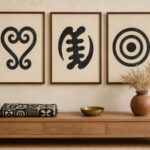
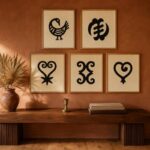
African symbols and their meanings are regional, not continental — each belongs to a particular people, place and period. In West Africa they carry proverbs: Asante adinkra stamps, Akan brass gold weights, nsibidi signs, the royal leopard of Benin, the Yoruba sea deity Olokun, the Bamana Chiwara antelope, mud-dyed bògòlanfini and the 21-string kora. In North Africa and the Nile Valley they protect and order: the Amazigh Yaz, the khamsa hand, the eight-pointed star and the ankh. In Central Africa they map the cosmos and keep records: the Kongo dikenga, the nkisi nkondi, Kuba raffia patterns and the Luba lukasa. In the East and the Horn: the Ethiopian processional cross, the Aksum stela, the kanga and the Makonde mapiko mask. In Southern Africa: Ndebele wall painting, the Zulu ucu, the eland of San rock art and the Zimbabwe bird. Most can be lived with as art made in the spirit of the tradition; a few — Benin brass, the nkisi nkondi, old mapiko masks — are objects where an “antique” for sale should make you ask how it left Africa. For a symbol-led wall of your own, our Adinkra Symbol Wall Art Set (5) is the printable set we make for exactly this.
Table of Contents
- How to read an African symbol
- How we checked: the museum record
- West Africa — symbols that carry proverbs
- North Africa and the Nile Valley — protection and order
- Central Africa — the cosmos, the oath and the record
- East Africa and the Horn — faith, stone and cloth
- Southern Africa — walls, beads, rock and stone
- Four symbols that cross every border
- How to live with African symbols at home
- What to look for when buying — and what to avoid
- FAQ
- Sources and further reading
How to read an African symbol
Three things hold true across almost everything in this guide, and they change how you use any of it.
A symbol belongs to a people, not to a continent. “African symbol” is a search term, not a category anyone in Africa uses. The Asante, the Edo, the Bamana and the Zulu each built their own visual language, and they are as different from each other as Celtic knotwork is from Byzantine icons. The respectful version of any piece names its people and its place. That is also, conveniently, the version that looks more considered on a wall.
Many African symbols are spoken before they are drawn. An adinkra stamp stands for a proverb. A brass gold weight calls one up. A kanga prints a sentence on itself, and a griot’s kora carries history in song. The picture is often shorthand for words — which means a symbol without its sentence is only half there.
Some objects were never decoration. A Kongo nail figure, a Makonde dance mask and a Benin altar leopard were working objects with jobs to do, and many of the examples now in Western museums left Africa through conquest. The museum record proves that a symbol is old and real. It does not always prove the object was acquired fairly — and we say so where it matters.
If the difference between a symbol and a motif is new to you, our guide to symbols versus motifs is the five-minute version.
How we checked: the museum record
Every entry below ends with a museum record line. It names an institution — the British Museum, the Metropolitan Museum of Art, the Brooklyn Museum, the Detroit Institute of Arts, the Toledo Museum of Art, the Smithsonian, the musée du quai Branly — and, where one exists, the object’s catalogue or accession number. Type that number into the museum’s online collection search and you will see the object itself.
Where the evidence is a building or a site rather than an object, we cite its UNESCO World Heritage listing. Where the evidence is an exhibition, we give its title and dates. Nothing in this article rests on “it is said that”.
West Africa — symbols that carry proverbs
1. Adinkra — the stamped proverb
What it looks like: black motifs stamped in rows on cotton — stars, drums, spirals, combs, ram’s horns — usually inside a hand-drawn grid.
What it means: each stamp stands for a proverb or a saying, and the cloth as a whole is about leave-taking. The name is connected to di nkra, “taking leave of someone”, and adinkra cloth is worn mainly at funerals. The stamps are carved from calabash or cassava and printed with badie, a dense black dye made by boiling the bark of the badie tree with iron slag. Adinkra was once restricted to the Asante king; today anyone may wear it. One of its most widely used signs, Gye Nyame, means “except God”. Another, Dwennimmen — ram’s horns — is explained by the U.S. National Park Service at the African Burial Ground National Monument in New York as a reminder that “even the strong have to also be humble”. Adinkra travelled the Atlantic in memory, not only in cloth.
The museum record: the oldest surviving adinkra cloth is in London. British Museum Af1818,1114.23 was collected by Thomas Edward Bowdich at the Asante court in Kumase in 1817 and given to the museum the following year. It is 276 by 202 centimetres, sewn from narrow woven strips, and stamped with nsroma stars and double dono drums in a grid of thirty-five squares. One detail matters more than the rest: a popular origin story dates adinkra to 1818, when the Asante defeated King Adinkra of Gyaman. This cloth was already in Bowdich’s luggage a year earlier.
How to live with it: one symbol, printed large, with its proverb written on the back of the frame. Our Adinkra Symbols guide covers the individual signs, the Ghana guide puts them beside kente and the Golden Stool, and Sankofa has its own page.

2. Abrammuo — the Akan gold weights
What it looks like: brass miniatures small enough to sit in a palm — geometric blocks first, and later birds, elephants, people and buildings.
What it means: Akan merchants and rulers in what is now Ghana and Côte d’Ivoire used these weights, called abrammuo, to set standard units for weighing gold dust and to regulate the gold trade. They were made over roughly five centuries, from about 1400 to 1900, each one carved in wax and cast in brass. The geometric weights are the oldest; figurative weights appear from around 1600, and every figurative weight called up a proverb. An elephant recalls “one who follows the track of the elephant never gets wet from the dew on the bushes” — the safest place is under a chief’s protection. A bird’s foot recalls “the fowl’s foot steps on the chicken but does not kill it”: authority should correct without crushing.
The museum record: Metropolitan Museum of Art 1994.312.17, a bird gold weight, brass, 18th–19th century, just 3.5 centimetres tall. The Met’s catalogue entry records the proverbs above.
How to live with it: these are the most collectable small symbols on this list. Group three to five on a tray or in a shallow shadow box and tell the proverbs when someone asks. Buy contemporary castings, and ask for provenance on anything sold as old.
3. Nsibidi — a script that belongs to a society
What it looks like: hundreds of abstract and pictographic signs — circles, crossing lines, linked loops — dyed into cloth, carved, drawn, and even performed as gestures.
What it means: nsibidi is a graphic communication system from the old Cross River region of south-eastern Nigeria and south-western Cameroon, associated with the Ejagham, Efik, Igbo and Ibibio peoples. It was used above all by the Ekpe and Mgbe leopard societies, multi-ethnic, all-male associations. Some signs were public; many were known only to members. European writers began describing it in detail in 1909 and 1910, but excavated terracottas from Calabar, dated roughly between the 5th and 15th centuries, carry imagery readily comparable to nsibidi — evidence that the system is far older than its first description.
The museum record: the Hood Museum of Art at Dartmouth College published Ukara: Ritual Cloth of the Ekpe Secret Society (Ugochukwu-Smooth Nzewi, 2015), devoted to the indigo cloth of the Ekpe society. As the museum explains, plain cotton becomes a ritual object once nsibidi is dyed into it; members wear it at initiations and public events. Ukara is woven in Abakaliki and designed by male artists in Abiriba, Arochukwu and Ohafia, and its rows of triangles stand for the leopard’s claws — the society’s power.
How to live with it: with restraint. Copying ukara is like framing someone else’s membership card. Look instead for contemporary Nigerian artists who work with nsibidi as their own inheritance. Our Adire guide and Nigeria colour palette cover the parts of Nigerian design that are made to be shared.
4. The leopard of Benin — the king’s counterpart
What it looks like: a brass leopard, its spots punched as rings, often cast as a pair or as a water vessel for washing hands.
What it means: in the Kingdom of Benin, in what is now southern Nigeria, the leopard is among the most emblematic symbols of the oba, the king — his royal counterpart in the wild. Obas kept semi-domesticated leopards at the palace to show their mastery over an opposing realm, and when an oba died it was said that “the leopard has returned to his lair.” The brass was cast by the royal guild of brass casters, the Igun Eronmwon.
The museum record: Metropolitan Museum of Art 1991.17.59, a leopard aquamanile, brass, 16th–19th century. A pair of brass leopards belonging to Nigeria’s National Commission for Museums and Monuments (52.13.1–2) was lent to the Art Institute of Chicago’s Benin exhibition, whose exhibition text explains the leopard’s meaning. Here the provenance line matters: in 1897 a British force sacked Benin City and plundered the palace, and that is how most Benin brass reached Europe. On 13 October 2022 the Smithsonian’s National Museum of African Art returned twenty-nine Benin bronzes to Nigeria’s National Commission for Museums and Monuments.
How to live with it: the leopard as a motif is open to everyone — prints, textiles, a pair of figures on a console. An old Benin brass for sale is a different matter: the first question is how it left Benin City.
5. Olokun — the sea in indigo
What it looks like: a deep indigo cloth with pale motifs laid out in a grid, painted on with a starch resist before dyeing.
What it means: Olokun is the Yoruba deity of the sea and of wealth, and Olokun is the name of one of the most celebrated designs in adire eleko, the starch-resist indigo cloth of south-western Nigeria. Each square of the grid carries its own small motif, and the cloth is read as a whole.
The museum record: British Museum Af1971,35.17, an Olokun adire cloth bought at Oje market in Ibadan in 1971 as part of the Jane Barbour collection. The register counts twenty-two designs, notes that the maker signed the hem, and observes that the designs are repeated upside down, so that a wire pattern in one half becomes a tortoise in the other. A second example, Harn Museum of Art 2007.30.1 (c. 1973), has a stool at its centre.
How to live with it: adire is a living textile, still made today, so this is one of the easiest traditions here to support directly. Use a full cloth as a throw, or frame a section where two motifs meet. All twelve classic patterns are in our Adire guide.
6. Chiwara — the antelope who taught farming
What it looks like: a carved wooden antelope crest with tall upright horns and an openwork body, worn on top of a dancer’s head.
What it means: among the Bamana of Mali, the men’s Ci Wara society is named for the mythical inventor of agriculture, and its ceremonies teach young men and women to farm cooperatively. The headdresses dance in pairs: the male antelope stands for the life-giving sun, the female for the earth. The masquerade belongs to the agricultural year — fertility, sowing and the work that feeds a village.
The museum record: Toledo Museum of Art 2006.69, a male Chiwara headdress, whose label sets out the sun-and-earth pairing. In 2006 the musée du quai Branly in Paris gave the form a full exhibition, Ciwara, chimères africaines (23 June – 17 December 2006).
How to live with it: the pair is the point. A single antelope on a shelf is half a sentence; two, facing each other, is the whole idea.
7. Bògòlanfini — cloth that marks a passage
What it looks like: cream motifs on a black-brown ground — dots, zigzags, crosses — on heavy hand-woven cotton.
What it means: in Bamana tradition men weave narrow cotton strips and women decorate the finished cloth, painting it with plant extracts and mud. The motifs can carry proverbs, songs, messages or historical events. A woman’s wrapper was worn at moments of transition — before a marriage was consummated, or after childbirth — and a dot motif called tigafaranin evokes a beaded belt linked to seduction and fertility.
The museum record: Metropolitan Museum of Art 1979.206.190, a bògòlanfini wrapper, first half of the 20th century.
How to live with it: real mudcloth reads as texture first and pattern second, so give it a plain wall or a linen sofa. How to tell real cloth from printed imitations is in our mudcloth guide.
8. The kora — history with 21 strings
What it looks like: a tall harp-lute with a large calabash body covered in skin and twenty-one strings rising to a long hardwood neck.
What it means: the kora is the instrument of the Mandinka jali — the hereditary musicians, storytellers and singers of Senegambia and the wider Mande world, often called griots in English. The jeliw sang heroic epics to the kora and the ngoni, and the Met counts them among the ways African history has been recorded. The symbol is not the instrument’s shape. It is memory performed out loud.
The museum record: Metropolitan Museum of Art 1975.59, a Mandinka kora from Senegal, about 1960, made of gourd, goat skin, antelope hide and ebony, with twenty-one strings.
How to live with it: an instrument on a wall is honest decor when it is a real, playable piece bought from a maker. The kora sits among Senegal’s other symbols — the baobab, the calabash, the lion — in our Senegal guide.
North Africa and the Nile Valley — protection and order
9. The Yaz — a letter that became a flag
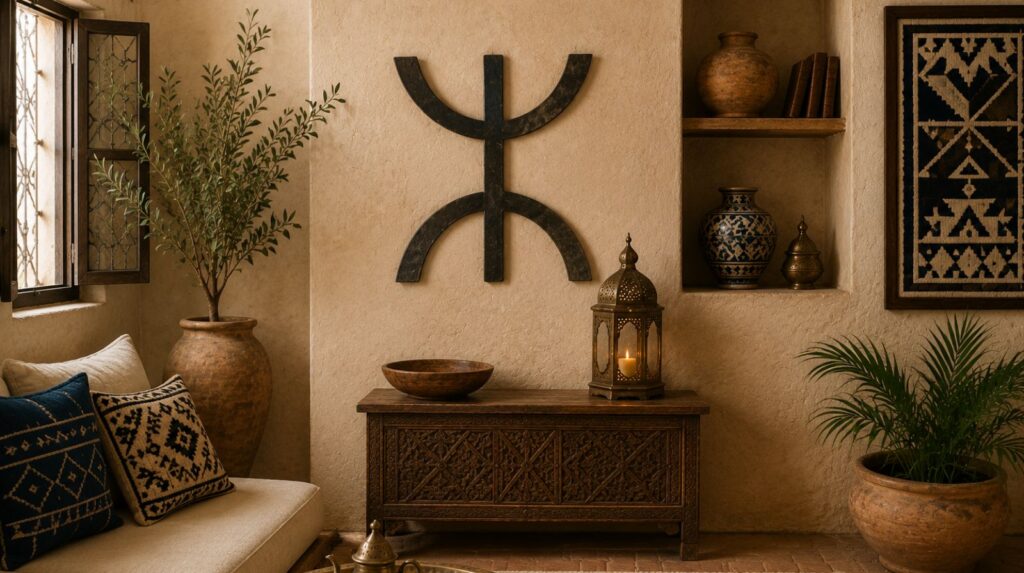
What it looks like: ⵣ — a single letter of the Tifinagh alphabet that resembles a figure with raised arms.
What it means: the Yaz represents the word Amazigh, the name the Indigenous peoples of North Africa — often called Berbers — use for themselves. It sits in red at the centre of the Amazigh flag, between bands of blue for the sea, green for the mountains and yellow for the desert; the red stands for resistance. The flag was designed in 1970 by Mohand Arav Bessaoud of the Berber Academy and made official by the World Amazigh Congress at Tafira in the Canary Islands in 1997.
The museum record: the Musée Pierre Bergé des Arts Berbères at the Jardin Majorelle in Marrakech, inaugurated on 13 December 2011, is devoted entirely to Amazigh material culture — jewellery, textiles, carpets and everyday objects, which its guide describes as carrying “a mystical language of symbols”. The museum notes that Tifinagh, an alphabet thousands of years old, was adopted by Morocco in 2003 and recognised as an international standard in 2004.
How to live with it: the Yaz is an identity sign for living people, not a pattern, so use it the way you would use any people’s flag — knowingly. For decor, the Amazigh rug vocabulary of diamonds, zigzags and crosses is the more natural route; all twelve are in our Moroccan symbols guide.
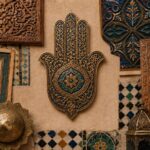
10. The khamsa — five fingers at the door
What it looks like: an open hand, fingers together, usually in silver.
What it means: khamsa means “five” in Arabic, and the hand is a protective amulet against the eye of envy. It is one of the few symbols in this guide shared across faiths: Muslim, Jewish and Christian families in North Africa and the Middle East have all worn it and hung it on walls and doorways. It is also called the Hand of Fatima.
The museum record: British Museum 2014,6009.1, a khamsa pendant from Morocco, made in the 1890s in silver with enamel and glass. Haverford College’s exhibition Khamsa: Amulets of North Africa drew on more than thirty Moroccan khamsas from the 19th and 20th centuries.
How to live with it: where it has always gone — by the door. One small silver hand in an entrance hall does more than any amount of wall art in that spot.
11. The eight-pointed star — geometry as order
What it looks like: two squares overlaid at forty-five degrees, repeated and interlocked until a whole wall becomes a field of stars.
What it means: in the Islamic architecture of Morocco, geometry does much of the work that figurative images do elsewhere, and the eight-pointed star is one of its most common building blocks. It appears in zellige — mosaics of hand-cut glazed tile — in carved cedar and plaster, and in pierced brass lamps.
The museum record: the Bou Inania Madrasa in Fez, begun in 1350 for the Marinid sultan Abu Inan Faris and finished in 1355. Its lower walls are covered in zellige forming complex geometric patterns, and the main pattern of its carved minbar is built around eight-pointed stars. The Medina of Fez, founded in the 9th century and at its height under the Marinids, has been a UNESCO World Heritage Site since 1981.
How to live with it: one star-pattern element — a tiled tray, a pierced lantern, a single zellige-inspired print — rather than a whole wall. Ten patterns, and how to read them, are in our Moroccan geometric patterns guide.
12. The ankh — the hieroglyph for life
What it looks like: a cross whose upper arm is a loop.
What it means: in ancient Egypt the ankh was the hieroglyph for “live”, “alive” and “life”, and it became a widely used symbol of life in general — held by gods, given to kings, cast in metal and faience. It is the oldest symbol in this guide still in everyday use, and today it is also widely worn as a sign of African heritage across the diaspora.
The museum record: Metropolitan Museum of Art 30.8.30, a ceremonial implement in the shape of an ankh, faience, Dynasty 18, about 1396–1386 BCE. Its central ankh carries the name ring of King Thutmose IV, and it was found in his tomb in the Valley of the Kings during excavations in 1903.
How to live with it: the ankh is simple enough to work at any size, from a small brass object on a desk to a large print above a bed. We have not yet written our Egypt guide; when we do, it will be linked here.
Central Africa — the cosmos, the oath and the record
13. The dikenga — a life drawn as a circle
What it looks like: a cross inside a circle, sometimes with a small disc at the end of each arm.
What it means: the dikenga, or Kongo cosmogram, is a diagram of existence. Its horizontal line, the Kalunga, is the threshold between the world of the living and the world of the dead. The four points of the circle are the four moments of the sun — musoni, kala, tukula and luvemba — read as conception, birth, maturity and death, with the sun’s journey standing for a human life. Historical sources place the symbol before European contact in 1482, and enslaved Bakongo people carried it across the Atlantic: archaeologists in the United States have found it engraved on pottery and drawn in church basements.
The museum record: the National Gallery of Art in Washington built a landmark exhibition around this idea — The Four Moments of the Sun: Kongo Art in Two Worlds (30 August 1981 – 31 May 1982), organised by Robert Farris Thompson of Yale and Joseph Cornet. Three decades later the Metropolitan Museum of Art gathered 146 works for Kongo: Power and Majesty (18 September 2015 – 3 January 2016).
How to live with it: a cross in a circle is one of the cleanest graphic forms in African art and works beautifully in ochre and charcoal. The full Kongo system, including the Kalunga line and the four suns, is in our Kongo guide.
14. Nkisi nkondi — the figure that held an oath
What it looks like: a carved wooden figure bristling with iron nails, blades and screws, sometimes with a sealed pack of materials at the belly.
What it means: a nkisi is a container for a spiritual force, and nkondi figures were used to ratify agreements and contracts. With each ritual, a nail was driven into the figure — so the number of nails is a record of how many times it was called on.
The museum record: Detroit Institute of Arts 76.79, a Kongo nail figure made between 1875 and 1900, in wood with screws, nails, blades and a cowrie shell. The Met’s 2015 Kongo exhibition featured mangaaka figures of this type from the Yombe region.
How to live with it: you don’t. This is the clearest museum-only object in the guide: it was made to work, not to be looked at, and an old one on the market raises every provenance question at once. See one in a museum instead — Detroit’s is on our sources list.
15. Kuba raffia — the pattern that refuses to repeat
What it looks like: square panels of raffia palm fibre covered in interlocking geometric designs in tan and black, deliberately irregular.
What it means: in the Kuba kingdom, in what is now the Democratic Republic of the Congo, men wove the raffia and women stitched, dyed and decorated it. The finished panels were displayed rather than worn and served as currency and as a measure of prestige. The Met records hundreds of named designs, often called after people or things — smoke, crocodile scales — and composed so that a pattern shifts, breaks and restarts across a single panel. Variation was the sign of skill.
The museum record: Metropolitan Museum of Art 1999.522.15, a double prestige panel, raffia palm fibre and vegetable dye, late 19th to mid-20th century.
How to live with it: take the lesson, not just the look. A gallery wall that breaks its own grid once — one frame out of line, one size different — reads as designed rather than assembled. Shoowa velvet and Kuba royal patterns are in our Kongo guide.
16. The lukasa — a history you hold in your hand
What it looks like: a small hand-held wooden board, roughly the size of a hardback book, covered in pins and coloured beads.
What it means: among the Luba of the Democratic Republic of the Congo, the lukasa was read by members of the mbudye association who had reached its highest level. Each bead and pin is a prompt: the board holds genealogies of rulers and titleholders, medicinal knowledge and the landmarks of a kingdom. To an outsider it is a decorated board. To a reader it is an archive.
The museum record: Brooklyn Museum 76.20.4, a lukasa, wood, metal and beads, late 19th or early 20th century. The definitive exhibition was Memory: Luba Art and the Making of History at the Museum for African Art in New York (2 February – 8 September 1996), curated by Mary Nooter Roberts and Allen F. Roberts.
How to live with it: the idea translates perfectly to a home: a memory shelf where every object stands for a person or a place, and the arrangement itself is the story.
East Africa and the Horn — faith, stone and cloth
17. The Ethiopian processional cross
What it looks like: a flat cross of cast brass, bronze or silver, its arms opening into stepped terminals and pierced crosses, mounted on a wooden staff.
What it means: in the Ethiopian Orthodox Church, processional crosses are carried and held aloft during services and processions. Coloured cloths tied to their loops symbolise the veil of Mary. The stepped design may go back to the architecture of the Aksumite period, and may refer to the cross as the Tree of Life.
The museum record: Metropolitan Museum of Art 1998.37, a processional cross from the Lasta region, brass, 14th–15th century. The Met notes that crosses made before the 17th century are rare because so many were destroyed in the conflicts of the 16th century, and that similar motifs appear at Lalibela, whose eleven rock-hewn churches, cut around 1181–1221 under King Lalibela, became a UNESCO World Heritage Site in 1978.
How to live with it: the cross is a living religious object, so treat it as one — a modern hand-cast piece, hung at eye level on its own, never as a wall accessory among many. Eleven more Ethiopian symbols are in our Ethiopia guide.
18. The Aksum stela — the obelisk that came home
What it looks like: a towering granite monolith carved to look like a multi-storey building, with false doors and windows.
What it means: the stelae of Aksum, capital of one of the great kingdoms of the ancient world, are funerary monuments — doors carved for the dead. The Met suggests that the stepped forms on Ethiopian crosses may echo this Aksumite architecture.
The museum record: the proof here is a homecoming. Aksum’s Stele 2 — about 1,700 years old, roughly 24 metres tall and 150 tonnes — was removed to Rome by Mussolini’s troops in 1937. Italy returned it in April 2005, and the last of its three blocks was set back on its original site on 31 July 2008, in a reinstallation project run with UNESCO.
How to live with it: the stela’s lesson is proportion. Tall, narrow formats — a vertical print, a column of three small frames — bring the same upward pull to a low room.
19. The kanga — a cloth that speaks
What it looks like: a rectangle of printed cotton with a bold border, a central motif and a band of Swahili text.
What it means: the kanga of the Swahili coast carries a message — a proverb, a riddle, a greeting — printed into the cloth, so the wearer can say something without saying it aloud. Kangas are given as gifts, which makes the sentence matter as much as the pattern.
The museum record: British Museum 2017,2024.1, a kanga printed between 1946 and 1954 for the Zanzibar market — in Manchester, England, by Dehns (Africa) Ltd. It has a sharp-toothed fish at its centre and a Swahili inscription in Arabic script. The curator’s note adds a detail no decor blog will tell you: translations were made because some inscriptions turned out to have rude meanings.
How to live with it: read it before you frame it. The structure of the kanga and its jina is in our Kenya guide.
20. The mapiko mask — a spirit on the dancer’s head
What it looks like: a carved wooden helmet mask with a human face, real hair set into wax, and raised scarification patterns.
What it means: among the Makonde of the plateau divided by the Rovuma River between Mozambique and Tanzania, the mask is worn in the mapiko dance that marks initiation. Each dancer represents the spirit of a dead person, and only initiated men knew that a living member was inside. The masks were carved by a men’s society whose members also danced in them.
The museum record: British Museum Af1957,03.70, a Makonde helmet mask from Mozambique in wood, beeswax and human hair, its scarification applied in strips of black beeswax — markings, the curator notes, used by Makonde and Matambwe women. The Ditsong Museums of South Africa document the mapiko dance itself.
How to live with it: the face and its scarification patterns can inspire; an old danced mask belongs to its community’s history. The Makonde helmet form is in our Tanzania guide.
Southern Africa — walls, beads, rock and stone
21. Ndebele wall painting — the house as a canvas
What it looks like: bold geometric patterns in saturated colour, every shape held inside a heavy black outline, painted across the outside walls of a homestead.
What it means: among the South African Ndebele, mural painting is women’s work, learned from mothers and grandmothers. Each pattern carried meaning, much of which has been lost — but the discipline of the outline and the confidence of the colour have not.
The museum record: the tradition reached the world’s museums through one artist. Esther Mahlangu, born in 1935 near Middelburg, was invited to Magiciens de la Terre at the Centre Pompidou in Paris in 1989, and in 1991 she painted a BMW 525i — the twelfth car in the BMW Art Car Collection and the first by a woman.
How to live with it: borrow the black outline. A single bold Ndebele-inspired piece in a quiet room carries more than a dozen small patterned objects. All twelve South African symbols are in our South Africa guide.
22. The ucu — a necklace that is a love letter
What it looks like: strands and small panels of glass beads in white, red, green and black.
What it means: Zulu beadwork is a written language of colour. Young women made beaded “love letters” for suitors working far from home. A girl’s first necklace, an ucu of twisted white beads with a single white ring, announced that she was a maiden; a man who received one hung a white handkerchief to show he was in love. A green ring said a proposal had been accepted. A second letter heavy with red beads said I miss you, and the white handkerchief was swapped for a red one in reply.
The museum record: the Phansi Museum in Durban documents this beadwork tradition and its colour code in its story Incwadi Yothando: The Secret Love Language of Beads.
How to live with it: framed beadwork is one of the most personal pieces a room can hold — buy contemporary work from South African bead artists, and ask what the colours say before you hang it.
23. The eland — the animal of power in San rock art
What it looks like: a large antelope painted in red-brown and white on a sandstone wall, often shown dying, with human figures beside it.
What it means: for the San, the eland was the animal most charged with spiritual power. In the Kalahari, San dancers harness a supernatural energy, n/om, from a freshly killed eland, and they describe trance as “the death that kills us all”. In the famous panel at Game Pass Shelter in the Drakensberg, a dying eland stumbles while a figure holds its tail — a figure whose legs end not in feet but in hooves, halfway between person and animal.
The museum record: the Metropolitan Museum of Art publishes Geoffrey Blundell’s essay on Game Pass in its Heilbrunn Timeline of Art History. And the deepest root of all is at the other end of the country: at Blombos Cave, about 300 kilometres east of Cape Town, archaeologists led by Christopher Henshilwood found a cross-hatched pattern drawn in red ochre on a stone flake about 73,000 years ago — published in Nature in 2018 as the oldest known drawing made by a human.
How to live with it: rock art does not need copying to be honoured — a print in the red-brown and bone of the sandstone does the work. The eland and the human-animal figure are entries 11 and 12 of our South Africa guide.
24. The Zimbabwe bird — a nation’s emblem returned
What it looks like: a stylised bird of green-grey soapstone, perched on top of a tall carved column.
What it means: the birds come from Great Zimbabwe, the stone city built by the Shona between about 1100 and 1450. Six soapstone posts topped with birds were found in the eastern enclosure of the Hill Ruins, possibly for ritual use. The bird is now Zimbabwe’s national emblem, on its flag and its banknotes.
The museum record: Great Zimbabwe National Monument has been a UNESCO World Heritage Site since 1986. The birds themselves are a restitution story: of the eight original carvings, six were taken by European colonialists more than a century ago. South Africa returned five in 1981, a year after Zimbabwe’s independence, and Germany returned the pedestal of another in 2003. One remains in South Africa, in Cecil Rhodes’s former house.
How to live with it: the form is a bird on a column, which makes it the one symbol here that wants a pedestal. A single sculptural bird on a slim plinth gives a corner the vertical accent most rooms are missing. We have not yet written our Zimbabwe guide.
Four symbols that cross every border
The cowrie. The money cowrie, Monetaria moneta, was gathered in the Maldives and shipped across the Indian Ocean and around Africa in astonishing numbers: at least thirty billion shells reached the Bight of Benin between 1500 and 1875, where they bought cloth, food and, terribly, human beings. They were still accepted for taxes in parts of British West Africa in the early 20th century, and Ghana named its currency, the cedi, after them in 1965. Its full meaning in decor is in our cowrie shell guide.
The baobab. Senegal put the baobab on its coat of arms in 1965, beside a lion, above a wavy green line for the Senegal River. It appears again in the Tanzania guide as rooted endurance. Our Baobab Tree of Life print is the piece we made for it.
The tree of life. From the Ethiopian cross to the Yoruba Igi Iye pattern in adire, the tree that joins earth to sky turns up in tradition after tradition. Our tree of life guide follows it across the continent.
Sankofa. The Akan bird looking back over its shoulder — “go back and get it” — has become one of the most quoted African symbols in the diaspora. It has its own page, so we will leave it there.
How to live with African symbols at home
Name the people, not the continent. A small label on the back of a frame — Asante, Ghana or Bamana, Mali — turns a decorative piece into one with a story. When guests ask about it, you will have the answer.
One region per wall. A gallery wall that mixes adinkra, a khamsa, a Kongo cosmogram and Ndebele colour reads as a souvenir shop. Pick one region and let the palette follow it: indigo and cream for Yoruba adire, black-brown and bone for bògòlanfini, ochre and charcoal for Kongo, saturated primaries held by black for Ndebele.
Keep the sentence with the symbol. Most of these symbols stand for words. Write the proverb on the back of the frame, or keep the guide link on your phone. A symbol with its sentence is a conversation; without it, it is a shape.
Buy living traditions, admire sacred ones. Adire, bògòlanfini, kanga, kente, Ndebele-inspired painting and Kuba-inspired pattern are made to be sold and worn today, and buying them supports the people who make them. Nail figures, danced masks and royal brass are better visited than owned.
Mind the scale. A single large symbol carries a room; twenty small ones clutter it. For sizes, framing and hanging heights, our print, frame, hang and light guide covers the practical side.
What to look for when buying — and what to avoid
Ask how it left Africa. For anything sold as antique — Benin brass above all, but also nail figures, danced masks and stone sculpture — the right question is not “is it real?” but “where has it been since it was made?” A seller who cannot answer that has answered it.
Prefer “inspired by” that says so. Art made in the spirit of a tradition is honest when it tells you which tradition and does not pretend to be from it. That is how we describe our own work in the Essence of the Road Art shop.
Check the cloth. Real bògòlanfini is painted onto hand-woven strips you can feel; real adire shows slight unevenness where starch was applied by hand; a real kanga carries a sentence. Printed imitations of all three are everywhere.
Read any text before you hang it. Kanga inscriptions are real sentences, and as the British Museum’s own records show, not all of them are polite.
If you design your own pieces, Creative Fabrica is where we source pattern and texture bundles — and the same rule applies: name the tradition you are drawing on.
FAQ
What are the most common African symbols and their meanings?
The best-known worldwide are Adinkra symbols from the Asante of Ghana — Gye Nyame (“except God”), Sankofa (“go back and get it”) and Dwennimmen (ram’s horns, strength with humility). Beyond Adinkra, the most widely recognised are the ankh of ancient Egypt (life), the Kongo cosmogram (the cycle of a human life), the khamsa of North Africa (protection), the Amazigh Yaz (the name of a people), the Ethiopian cross (faith), and the Zimbabwe bird (a nation). Each belongs to a specific people and place.
Is there an African symbol for strength, love or family?
There is no single African symbol for any of them, because there is no single African visual language. In Adinkra, Dwennimmen — the ram’s horns — stands for strength joined to humility. In Zulu beadwork, colour itself spells out love: white beads for a first love letter, red for longing. In Benin, the leopard stands for royal power. In Bamana tradition, a pair of Chiwara antelopes stands for learning to farm together. The more useful question is which people’s symbol you want, and why.
Are African symbols the same as Adinkra symbols?
No. Adinkra is one system, from the Asante of Ghana, and it is the one most often shown online. Africa has many others: nsibidi in Nigeria and Cameroon, Tifinagh and Amazigh rug motifs in North Africa, the Kongo cosmogram in Central Africa, Ge’ez script and processional crosses in Ethiopia, and colour-coded beadwork among the Zulu, to name a few.
What is the oldest African symbol?
The oldest known drawing made by any human being is African: a cross-hatched pattern in red ochre on a stone flake from Blombos Cave in South Africa, about 73,000 years old, published in Nature in 2018. Among symbols with a known meaning still in use, the ankh is the oldest in this guide — the object we cite is around 3,400 years old.
Is it respectful to decorate with African symbols?
Yes, when you do three things: name the people the symbol comes from, buy from living traditions or from artists who say plainly what inspires them, and leave sacred and looted objects where they belong. Respect is mostly a matter of knowing what you are hanging — which is the reason this guide exists.
Why are so many African symbols in European and American museums?
Some objects were bought, traded or commissioned. Many were taken by force — Benin City in 1897, the Aksum obelisk in 1937, the Great Zimbabwe birds in the colonial era. Several have now come home: the Aksum obelisk was returned by Italy in 2005, five Zimbabwe birds were returned by South Africa in 1981, and the Smithsonian returned twenty-nine Benin bronzes to Nigeria in 2022.
Sources and further reading
Every museum record and date in this article comes from the sources below.
West Africa
- British Museum — Adinkra cloth, Af1818,1114.23
- Adrian Anagnost, “Adinkra from Kumase to the British Museum”, British Art Studies 28 (2025) — article
- Smarthistory, Kristen Laciste — Adinkra cloth
- Adinkra symbols — the oldest surviving cloth and the Gyaman tradition
- U.S. National Park Service, African Burial Ground National Monument — Dwennimmen: Humility and Strength
- Metropolitan Museum of Art — Bird gold weight, 1994.312.17
- Akan goldweights — overview and dating
- Hood Museum of Art, Dartmouth — Ukara: Ritual Cloth of the Ekpe Secret Society
- Nsibidi — overview, early documentation and Calabar terracottas
- Metropolitan Museum of Art — Leopard aquamanile, 1991.17.59
- Art Institute of Chicago, Benin exhibition — Pair of Leopards, NCMM 52.13.1–2
- Smithsonian — Benin bronzes returned to Nigeria, 13 October 2022
- British Museum — Olokun adire cloth, Af1971,35.17
- Harn Museum of Art — Cloth with Olokun motif, 2007.30.1
- Toledo Museum of Art — Chiwara male antelope headdress, 2006.69
- musée du quai Branly — Ciwara, chimères africaines (2006)
- Metropolitan Museum of Art — Bògòlanfini wrapper, 1979.206.190
- Metropolitan Museum of Art — Kora, 1975.59
- Alexander Ives Bortolot, “Ways of Recording African History”, Metropolitan Museum of Art (2003) — essay
North Africa and the Nile Valley
- Berber flag — design and adoption
- Musée Pierre Bergé des Arts Berbères, Jardin Majorelle — visitor guide (PDF)
- British Museum — Khamsa pendant, 2014,6009.1
- Haverford College — Khamsa: Amulets of North Africa
- Archnet — Madrasa al-Bu’inaniya, Fez
- Bou Inania Madrasa — construction and decoration
- UNESCO World Heritage — Medina of Fez
- Metropolitan Museum of Art — Ceremonial implement in the shape of an ankh, 30.8.30
Central Africa
- National Gallery of Art — The Four Moments of the Sun: Kongo Art in Two Worlds (1981–82)
- Metropolitan Museum of Art — Kongo: Power and Majesty (2015–16)
- Kongo cosmogram — overview
- Detroit Institute of Arts — Nail figure (nkisi nkonde), 76.79
- Metropolitan Museum of Art — Double prestige panel, Kuba, 1999.522.15
- Brooklyn Museum — Lukasa (memory board), 76.20.4
- musée du quai Branly library — Memory: Luba Art and the Making of History (1996)
East Africa and the Horn
- Metropolitan Museum of Art — Processional cross, 1998.37
- World Heritage Site — Rock-Hewn Churches, Lalibela
- UNESCO — Aksum obelisk reinstallation
- British Museum — Kanga, 2017,2024.1
- British Museum — Makonde helmet mask, Af1957,03.70
- Ditsong Museums of South Africa — The mapiko masks
Southern Africa
- BMW Art Car Collection — Esther Mahlangu, Art Car 12 (1991)
- AWARE: Archives of Women Artists — Esther Mahlangu
- Phansi Museum on Google Arts & Culture — Incwadi Yothando: The Secret Love Language of Beads
- Geoffrey Blundell, “African Rock Art: Game Pass”, Metropolitan Museum of Art — essay
- Cosmos — Is this the world’s oldest drawing? (Blombos Cave)
- UNESCO World Heritage — Great Zimbabwe National Monument
- Al Jazeera — Zimbabwe gets back iconic bird statues stolen during colonialism
Across the continent
- Shell money — the cowrie trade
- Coat of arms of Senegal — lion and baobab
- Gye Nyame — meaning
Related reading
- 12 Ghanaian Symbols and Their Meanings: A Decor Lover’s Guide
- 12 Senegalese Symbols & Their Meanings
- 12 Moroccan Symbols & Their Meanings
- 12 Kongo Symbols and Their Meanings
- 12 Ethiopian Symbols and Their Meanings
- 12 Kenyan Symbols and Their Meanings
- 12 Tanzanian Symbols & Their Meanings
- 12 South African Symbols and Their Meanings
- African Motifs Explained: Adinkra, Kente, Mudcloth
- Understanding African Textiles Meaning for Home Decor
A closing note
Go back to the British Museum’s adinkra cloth for a moment. A young Englishman carried it out of Kumase in 1817, and for two hundred years it has sat in London, fragile and mostly unseen, while the internet reduced its language to one-word captions. And yet the cloth still says what its maker meant it to say. The stars are still stars. The drums are still drums. The proverbs are still there for anyone who learns to read them.
That is the case for every symbol in this guide. They were not made to be decoration, and they were not made for us — but most of them were made to be understood, and understanding is something anyone can offer.
So choose one. Learn its people, its place and its sentence. Put it where it will be seen and asked about, and give the answer when someone does. A symbol you can explain is the only kind worth hanging. If you would like to start with the tradition we know best, our Adinkra Symbol Wall Art Set (5) is five proverbs in one frame set.
Shop the Essence of the Road Art collection
Every piece below is our own work — digital downloads you print at home, made in the spirit of the traditions in this guide and labelled as such.
- Essence of the Road Art on Etsy — the full collection
- Adinkra Symbol Wall Art Set (5) — five African symbols, the set we make for a symbol-led wall
- Baobab Tree of Life Print — Senegal’s emblem tree, in earth tones
- Elephant Wall Art Printable, Afrocentric Symbolism Poster — the elephant of the Akan gold-weight proverb
- Africa Map Textured Collage Print — the continent this guide maps, in mixed-media texture
- Afrocentric Wall Art Set (3), Earth Tone Terracotta and Africa Map — a three-piece wall in the ochre-and-charcoal palette
Tags: #african symbols and their meanings · #african symbols · #adinkra symbols · #nsibidi · #benin bronze · #chiwara · #mudcloth · #amazigh · #khamsa · #ankh · #kongo cosmogram · #ethiopian cross · #kanga · #ndebele · #zulu beadwork · #zimbabwe bird · #african art history · #african wall art