Sankofa Symbol Meaning: The Akan Proverb Behind the Bird
By Essence of the Road Art · Published July 2026
This article contains affiliate links. If you buy through them, we may earn a small commission at no extra cost to you. We only feature pieces we would live with ourselves.
Sankofa is the most quoted African symbol in the world and one of the most consistently softened. It gets printed under graduation photographs and on tote bags with a caption about honouring your roots — which is not wrong, exactly, but it is about a third of what the proverb actually says.
The full version is more demanding and considerably more interesting. It is not a symbol about remembering. It is a symbol about going back to get something you left behind, which is an errand, not a feeling.
Quick answer. The Sankofa symbol meaning comes straight from its Twi name: san (return), ko (go), fa (fetch) — “go back and get it.” The full Akan proverb is “Se wo were fi na wosan kofa a, yenkyiri”: it is not taboo to go back and fetch what you forgot. It is one of more than a hundred adinkra symbols of the Akan people of Ghana and Côte d’Ivoire, and it exists in two accepted forms — a bird whose body faces forward while its head turns back to lift an egg, and an abstract spiral-heart. Its emphasis is retrieval, not nostalgia: the past is treated as a place you can walk back to and take something from. If you would like to live with it, we give the print away free — the Sankofa printable is yours, and the full Adinkra Symbol Wall Art Set of 5 picks up where it leaves off.
Table of Contents
What the word actually says
Sankofa is a compound built from three Twi elements, and taking it apart is the fastest route to the real meaning:
- san — to return
- ko — to go
- fa — to take, to fetch
Not “look back.” Not “remember.” Go back and fetch. The construction is active and it has a destination and an object. You are going somewhere, and you are coming back holding something.
The proverb behind it makes the instruction explicit: “Se wo were fi na wosan kofa a, yenkyiri” — “it is not taboo to go back and fetch what you forgot.”
Notice what that sentence is doing. It is not praising the past. It is granting permission. Somebody, somewhere, needed to be told that returning was allowed — that there is no shame in having forgotten, and no shame in going back for it. That is a very different message from “honour your heritage,” and it is why the symbol lands as hard as it does with people whose line was broken.
Two forms, and an argument about which came first
Sankofa is drawn two ways, and both are accepted:
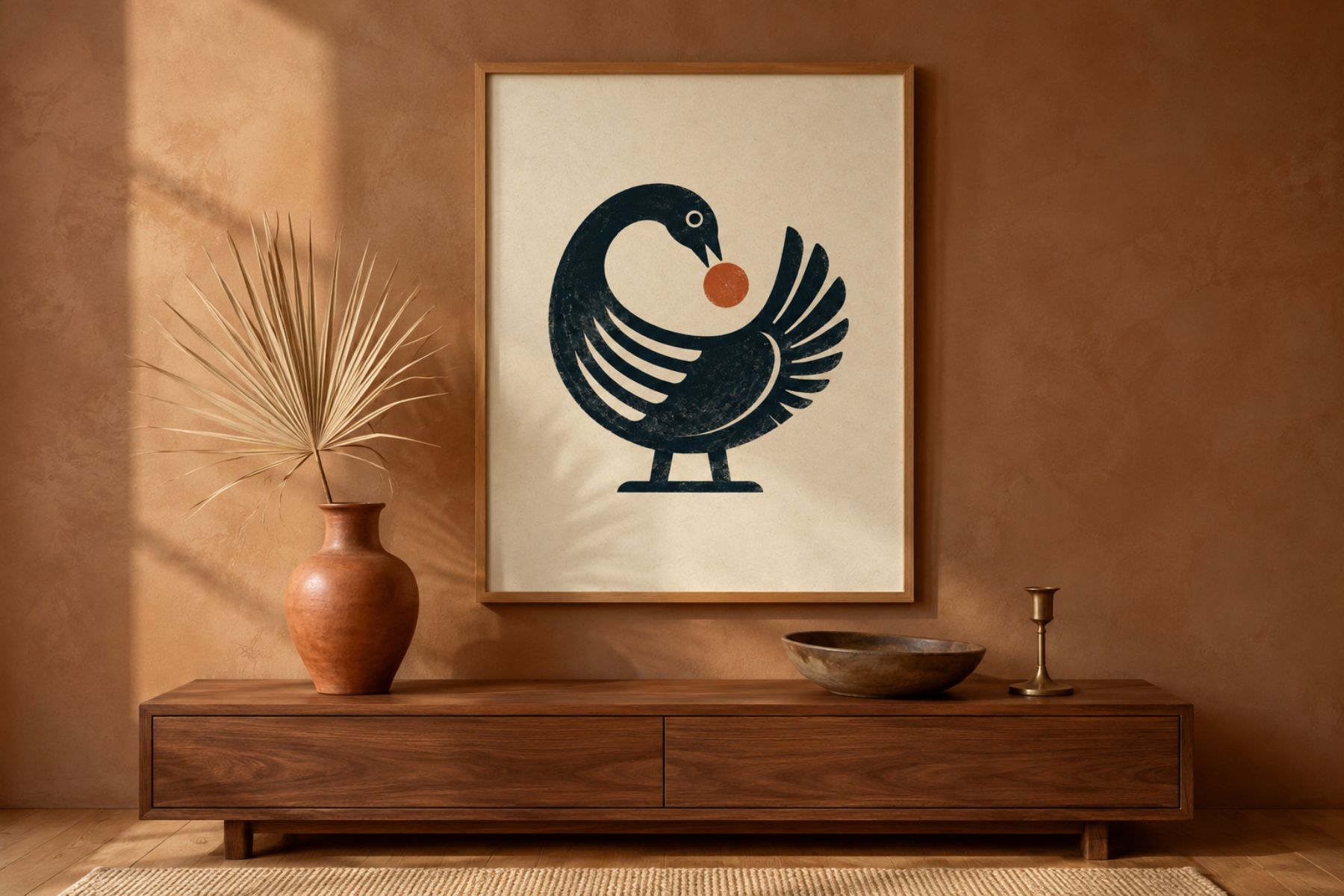
The bird. A stylised bird with its feet planted forward and its head turned completely backward, often lifting an egg from its own back into its beak. Forward-facing body: the present and the future. Backward-turning head: the deliberate act of looking. The egg: knowledge, or the generations to come.
The spiral-heart. An abstract heart-like form built from two symmetrical spirals, top and bottom. Simpler, more geometric, easier to stamp — and in practice the more common form on actual adinkra cloth.
Now the honest part. Sources disagree about which form is older, and they disagree confidently. Some argue the bird is the traditional form rooted in the proverb, with the spiral a later stylisation. Others hold that the spiral-heart is the original stamped glyph and the narrative bird is the popularised version that travelled. You will find pages stating either position as settled fact. They cannot both be right, and the honest answer is that this is contested.
We flag it because it is a small, clean example of the larger problem with published symbol meanings — covered properly in our guide to the difference between a symbol and a motif. Confidence is cheap. Sourcing is not.
Where Sankofa comes from
Sankofa is an adinkra symbol — one of a system of more than a hundred (sources count between 122 and 129) belonging to the Akan people of Ghana and Côte d’Ivoire.
Adinkra are stamped, never woven. The stamps are cut from calabash, five to eight centimetres square, slightly curved so they roll on with a rocking motion. The dye, adinkra aduru, is boiled down from the inner bark of the badié tree until it thickens to near-black. The centre of production is Ntonso, about twenty kilometres northwest of Kumasi. Tradition credits the system to Nana Kwadwo Agyeman Adinkra of the Gyaman kingdom; after Gyaman’s defeat by the Asante in the early nineteenth century, the craft moved into Asante hands.
And the context that most people skip: adinkra cloth was funerary. It was worn at burial rites — to bid the dead farewell, and to keep the proverbs they had lived by in front of the living. The word itself is usually glossed as “farewell.”
That matters for Sankofa specifically. A symbol about retrieving what was left behind, stamped on the cloth you wear to bury someone, is not a gentle motivational message. It is being said at a graveside.
Our full Adinkra guide covers twenty-four of the symbols, and the wider Ghanaian symbols guide puts adinkra alongside kente, the Golden Stool and the rest of the visual language.
The famous carving that probably is not a Sankofa
This is the section that will change how you read every symbol claim you meet afterwards.
In lower Manhattan, during 1990s construction, archaeologists uncovered a colonial-era burial ground holding the remains of hundreds of free and enslaved Africans. Among them, Burial 101: a man aged roughly 26 to 35 who died sometime after 1760, in a coffin whose lid carried a heart-shaped pattern picked out in 51 iron tacks, about eighteen inches across.
The pattern was identified as a Sankofa. It was widely invoked when 419 sets of remains were reinterred at the site in 2003, and it was chiselled into the black granite memorial unveiled in 2007. It became one of the most powerful pieces of evidence in American public history for African cultural survival under slavery — a man buried by people who marked his coffin in his own visual language.
And then peer-reviewed scholarship complicated it. The historian Erik Seeman has argued that the tack pattern is very likely not a Sankofa at all — that on close inspection it corresponds to well-documented Anglo-American coffin-decoration practice of the period, and that Sankofa may not yet have existed as a symbol in West Africa when that coffin was made.
We are not telling you which reading is right; that is a live scholarly question and we are a decor journal, not an archaeology department. What we are pointing at is the shape of what happened. A meaning was proposed, it was emotionally true and desperately needed, it was adopted by a community, it was carved into granite — and the correction arrived years later and travelled a fraction as far. The National Park Service still maintains a Sankofa page for the site.
That is not a scandal. It is just how symbol meanings actually move, and it is why the four-question test matters: which people, what name in their language, what object, what source.
What Sankofa asks that the greeting-card version does not
Three things get lost in the softened translation, and they are the three most useful parts.
It assumes you forgot. The proverb is addressed to someone who has already lost the thing. There is no version of Sankofa for people who kept everything. Its whole premise is a gap.
It requires you to go. San ko fa — return, go, fetch. Three verbs of motion, none of them contemplative. Sankofa is not satisfied by feeling warmly about the past. You have to walk back to it and do the retrieval, which in practice means archives, elders, languages, records, uncomfortable conversations. It is labour.
It is forward-facing. The bird’s feet never turn. The body stays pointed at where it is going, and only the head turns. The retrieval is for the journey ahead — you are collecting supplies, not moving back in. Sankofa gives no permission at all to live in the past. It gives permission to raid it.
That is the version worth putting on a wall.
Why it carries so much weight in the diaspora
For anyone whose ancestry was interrupted — by the transatlantic slave trade, by colonial record-keeping, by migration, by silence in a family — Sankofa functions less like a proverb and more like a licence.
The dominant message such a person absorbs is usually the opposite: that what was lost is gone, that asking is impolite, that you should be looking forward. Sankofa says, in the plainest terms available, that going back is not taboo. That there is no disgrace in the gap and no disgrace in closing it.
It is why the symbol travelled as far as it did. Haile Gerima’s 1993 film Sankofa took the name for a story about a modern woman thrown back into the memory of a plantation. Ghana’s 2019 “Year of Return” — the state invitation to the diaspora to come back on the four-hundredth anniversary of the first recorded enslaved Africans arriving in Virginia — is a national-scale Sankofa. The symbol keeps getting used because the errand it describes keeps needing doing.
How Sankofa gets drawn wrong
The shape carries the meaning, so a distorted Sankofa is a distorted proverb. Four errors we see constantly, especially in AI-generated art:
- The hybrid. A bird and a spiral-heart merged into one glyph. These are two separate forms of the same symbol. They do not combine.
- The mirror flip. The bird reversed, so the head turns the “wrong” way relative to convention. Easy to do when a designer flips an image to fit a layout.
- The egg in the beak with no journey. The egg lifted from the bird’s own back is the whole gesture — the past is on you and you reach for it. An egg simply held in the beak of a forward-facing bird is a different picture entirely.
- Bird-shaped decoration. A generic pretty bird with a turned head, invented rather than reproduced. It looks right at thumbnail size and means nothing.
The rule we use: use AI for the room, never for the glyph. Generate the mockup, the background, the framing, the styling — but take the symbol itself from a verified reference and overlay it. Our Adinkra guide has the full verification checklist.
Where Sankofa belongs in a home
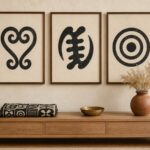
Put it where memory is kept, not where guests are impressed. Above a desk. Beside the shelf with the photographs. In the hallway you pass every morning rather than the wall over the sofa. It is an instruction to yourself, not a statement to visitors.
Give it isolation. Sankofa alone on a wall stays readable. Sankofa as one of twelve stamped symbols across a print becomes a texture. Both are fine objects, but only one is still speaking.
Keep it warm. Adinkra were stamped in near-black bark dye on unbleached cloth. Cream, charcoal, walnut, terracotta and ochre hold them; cool grey and stark white flatten them. The Ghana colour palette has the exact tones.
Keep the words with it. If the print does not carry the proverb, write it on the back of the frame. In six months you will be glad it is there, and so will whoever inherits it.
Frequently asked questions
What is the Sankofa symbol meaning in simple terms?
The Sankofa symbol meaning is “go back and get it,” from the Twi san (return), ko (go), fa (fetch). The full Akan proverb is “it is not taboo to go back and fetch what you forgot.” It is an adinkra symbol of the Akan people of Ghana and Côte d’Ivoire, and its emphasis is on active retrieval — going back to recover something specific and carrying it forward — rather than on nostalgia or simply remembering.
Is Sankofa a bird or a heart?
Both forms are accepted. The bird shows a body facing forward with the head turned back, usually lifting an egg from its own back. The spiral-heart is an abstract form built from two symmetrical spirals and is the more common shape on stamped adinkra cloth. Sources disagree about which came first, and you will find each position asserted as fact. What is not in dispute is that they are two forms of one symbol — they should never be merged into a single hybrid glyph.
What does the egg in the Sankofa bird’s mouth mean?
The egg is generally read as knowledge, wisdom, or the future generations who will inherit it. The key detail is that the bird lifts the egg from its own back — the past is already carried, and the act is reaching for it deliberately rather than receiving it. That reach is the whole symbol; a bird simply holding an egg while facing forward is not doing what Sankofa does.
Is Sankofa a religious symbol?
Not in the sense of belonging to a specific faith. It is a philosophical symbol from Akan proverb tradition rather than a devotional one. That said, it carries funerary weight: adinkra cloth was originally worn at burial rites, so Sankofa was among the proverbs put in front of mourners. It is not a light symbol, and it sits comfortably in a home where memory and loss are acknowledged.
Can I use the Sankofa symbol if I am not Ghanaian?
Adinkra are widely shared, and the line is drawn at understanding rather than ancestry — if you can say what the symbol means and why it speaks to you, you are honouring it. Two practical cautions. First, get the form right; a distorted glyph is a distorted proverb. Second, if you intend to sell products using it, be aware that Ghana’s Copyright Act 2005 names adinkra as protected folklore and requires National Folklore Board authorisation for commercial use — a contested and rarely-enforced provision, but a real one.
Related reading
- Adinkra Symbols and Their Meanings: The Ultimate Guide
- 12 Ghanaian Symbols and Their Meanings: A Decor Lover’s Guide
- The Difference Between a Symbol and a Motif
- Adinkra 5-Piece Gallery Wall: How to Build One at Home
- Kente Cloth Patterns and Meanings
Closing
The softened Sankofa asks you to appreciate the past. The real one asks you to go and get something out of it, and it assumes the thing is already lost. That is a harder message and a much better one to have on a wall, because it is the only version that actually tells you to do anything.
If you want it on yours, the Sankofa print is free — 300 DPI, warm cream, sized to frame at 9×12 through 18×24, with the proverb printed on the file so the words stay attached to the shape. And if you decide you want the wall it belongs on, our Adinkra Symbol Wall Art Set of 5 gives you four more symbols at matching scale, each one named.
Shop the Essence of the Road Art collection
- Free Sankofa printable — 300 DPI, proverb included, yours to keep
- Adinkra Symbol Wall Art Set (5) — one symbol per sheet, built for isolation
- Essence of the Road Art on Etsy — the full printable collection
- Baobab Tree of Life Print — warm earth-tone symbolism for a living room