12 Kongo Symbols and Their Meanings: A Decor Lover’s Guide
By Essence of the Road Art -Published July 2026
This article contains affiliate links. If you buy through them, we may earn a small commission at no extra cost to you. We only feature pieces we would live with ourselves.
Why we wrote this
There is a shape you have almost certainly seen without knowing its name.
A cross inside a circle. Sometimes four small discs at the ends of the arms, sometimes a diamond, sometimes just two lines meeting. It appears on Afro-boho prints, on album covers, on tattoos, on gallery walls in Atlanta and Brooklyn and London. It is one of the most widely reproduced symbols to come out of Central Africa, and it is almost always sold with no explanation at all.
It is called the dikenga — the Kongo cosmogram — and it is not a decorative cross. It is a diagram of the universe.
That gap, between how often the shape is used and how rarely it is explained, is the reason we wrote this piece.
There is a second reason, and it is a correction we want to make out loud. “Congo” is not one culture. The region covers the Democratic Republic of the Congo, the Republic of the Congo, and northern Angola — an area larger than Western Europe, home to hundreds of distinct peoples. Three of those traditions dominate what you will see sold as “Congolese art”: the Kongo (BaKongo) of the Atlantic coast, the Kuba of the Kasai river region, and the Luba of the southeast. They are different peoples, with different kingdoms, different languages, and different visual languages. A Kuba raffia panel and a Kongo cosmogram have roughly as much to do with each other as a Welsh quilt and a Greek icon.
Most decor writing flattens all of it into “tribal patterns from the Congo.” We are going to take them one at a time.
We are not Congolese. We make Afrocentric wall art, and most of what follows belongs to other people. We are writing it the way we would want someone writing about our own visual language to write — with care, with sources, and without flattening anything into a single image. Where a meaning is contested or layered, we have tried to say so. Where a piece carries weight that should slow you down before buying, we have tried to say that too.
This is the fourth piece in our Symbols & Meaning series. If you have not yet read the Tanzania guide, it sits alongside this one.

📌 Quick Answer
The twelve most significant Kongo-region symbols come from three distinct visual traditions. From Kongo (BaKongo) cosmology on the Atlantic coast: the dikenga cosmogram, the four moments of the sun, the Kalunga line, the nkisi nkondi power figure, the mintadi stone guardian, and the nzimbu shell — meanings of cosmic structure, the four stages of life, the threshold between living and dead, sworn oaths, watchful mourning, and wealth drawn from the sea. From Kuba textiles of the Kasai region: shoowa cut-pile raffia cloth, the never-repeating interlace, and the reserved royal pattern — meanings of prestige and stored wealth, improvisation as mastery, and design as social rank. From the wider Congo Basin: Mbuti bark cloth, the Luba lukasa memory board, and the spiral — meanings of freehand forest rhythm, history held in an object, and time that turns rather than runs. Of these, Kuba cloth, bark cloth, basketry and the spiral are the ones we recommend living with; the nkisi figure was never made to be decoration.
Table of Contents

A note on cultures, names, and care
Three streams sit underneath this article, and they did not arrive at the same time or from the same place.
The Kongo Kingdom was one of the largest and most organised states in Central Africa, established on the Atlantic coast well before Portuguese ships arrived in 1483. Its territory covered parts of what is now Angola, the Republic of the Congo, and the western DRC. Its visual language is unusually philosophical: much of what survives is an attempt to draw, in the simplest possible marks, how the world is structured. That is why a single cross inside a circle can carry an entire cosmology.
The Kuba Kingdom sits far inland, along the Kasai river, and developed one of the most sophisticated geometric design traditions anywhere. Where Kongo art asks how is the universe arranged, Kuba art asks how far can pattern be pushed before it breaks. It is a court tradition, tied to kingship, rank, and the display of wealth — and it is, of the three, the most naturally at home on a modern wall.
The peoples of the wider basin — Mbuti communities in the Ituri rainforest, the Luba of the southeast, and many more — are grouped with the others only by modern borders. The Mbuti tradition of painted bark cloth and the Luba tradition of the beaded memory board have nothing to do with either the Kongo cosmogram or Kuba court textiles. They are here because they are frequently sold as “Congolese,” and because both are genuinely worth knowing.
We mention all of this because lumping these traditions together as “Congo art” flattens differences that matter — and because the differences are the most interesting part.
A second note. Kongo cosmological symbolism is better documented than most African symbol systems, partly because the diaspora carried it across the Atlantic and scholars followed it there. But documentation is not the same as consensus. Readings of the dikenga vary between regions, between ritual specialists, and between the historical Kongo Kingdom and its later diaspora forms. We have given the most widely-cited meanings below, with notes where the meaning is layered.
The Kongo cosmology — a universe you can draw
1. The dikenga — the cross inside the circle
What it looks like: a cross inside a circle. In its fuller form, small discs or diamonds sit at the four ends of the arms.
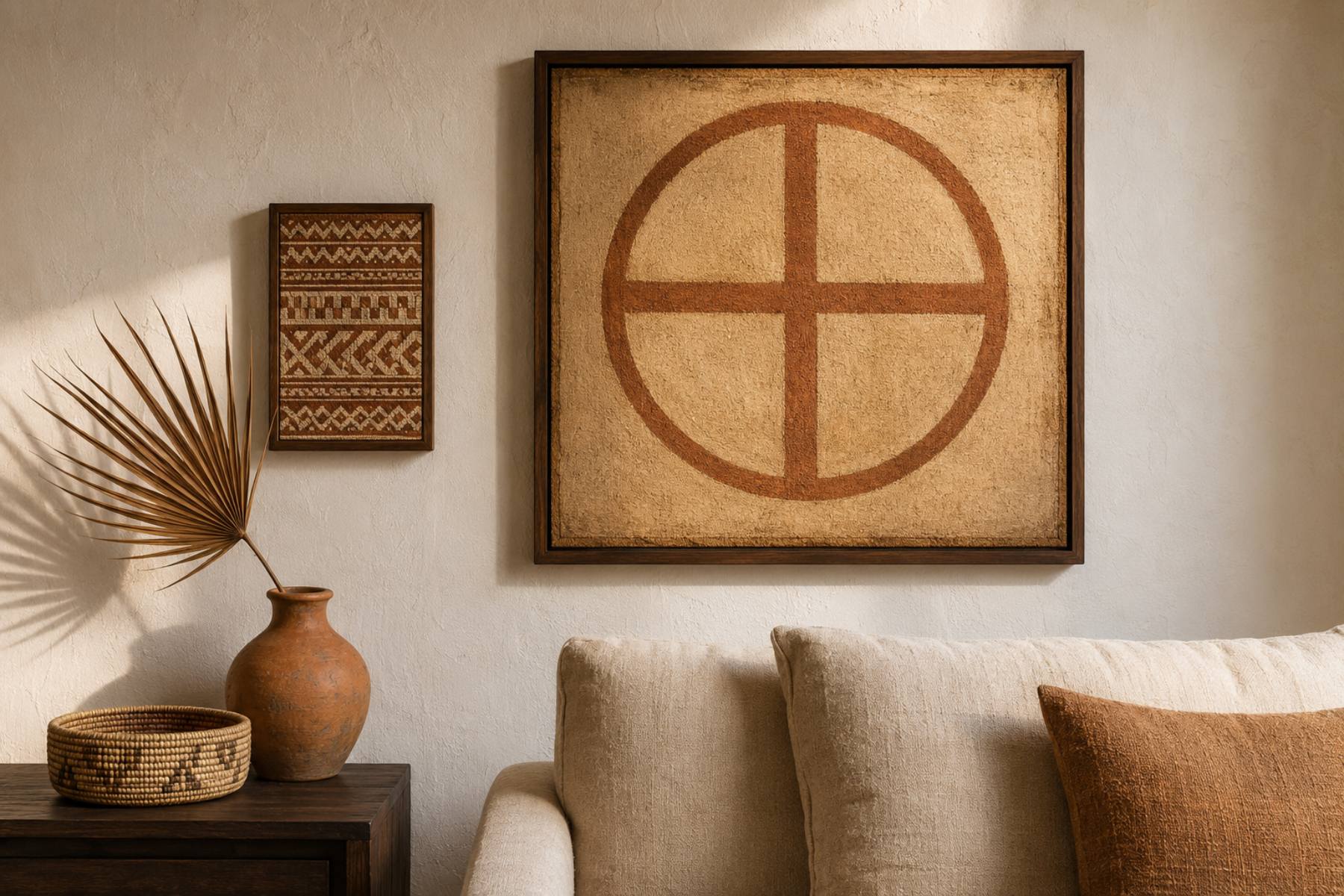
What it means: the dikenga is a map of existence. The horizontal line divides the world of the living, above, from the world of the dead, below. The vertical line connects them — the axis along which a person can move between states. The circle is the sun’s path around both worlds. The word itself relates to turning: this is a cosmos in motion, not a static diagram.
The most powerful point on the whole figure is the centre, where the two lines cross. That is where a person stands.
Where you’ll see it: on printed wall art, on textiles, and — significantly — marked on the floors of ritual spaces in Cuba, Haiti and the American South, carried there by BaKongo people during the transatlantic slave trade.
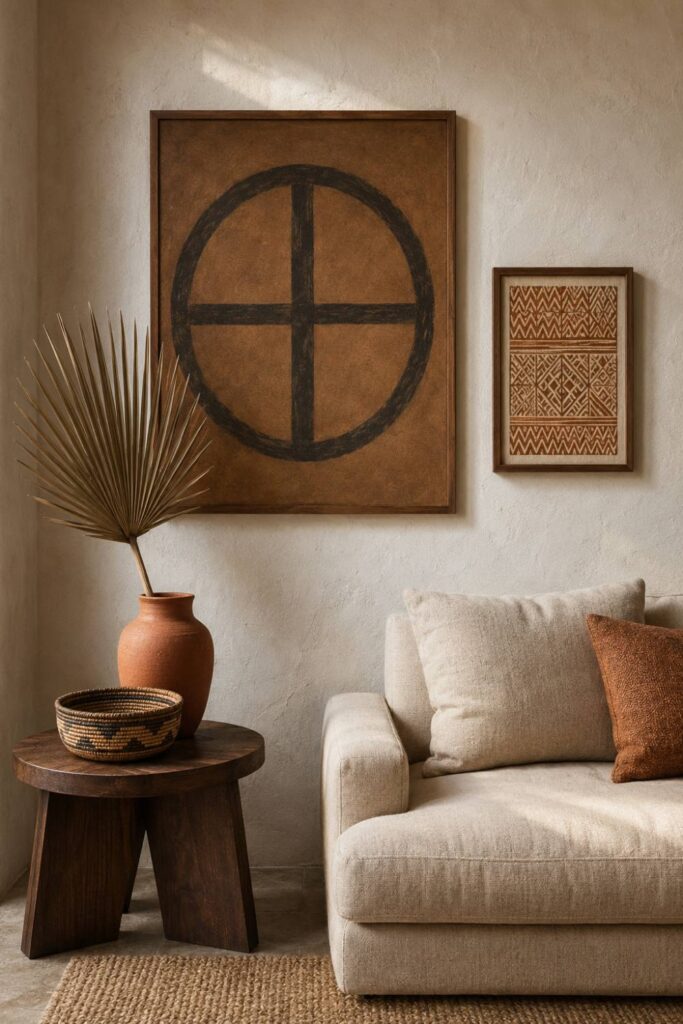
How to live with it: this is the single most meaningful Kongo motif you can bring into a home, and the one most often used carelessly. Give it space. A dikenga print works best alone on a wall, at a reasonable scale, not crowded into a gallery grid with six unrelated pieces. If you hang it, know what it says.

2. The four moments of the sun — a life in four positions
What it looks like: four marked points around the dikenga circle, sometimes shown as discs, sometimes as small suns.
What it means: the four moments correspond to the sun’s positions — dawn, noon, sunset, and midnight, when the sun is understood to be shining in the world of the dead. Mapped onto a human life, they are conception, birth, maturity, and death. Mapped onto anything else — a plant, a society, an idea — they are the same four stages. Everything transitions through them.
There is something quietly consoling in this. Death, in the Kongo reading, is not the end of the diagram. It is the fourth position on a circle, and the circle keeps going. The dead are understood to gain wisdom and, in some readings, to return.
How to live with it: the four-moment cycle suits a bedroom, a reading corner, or anywhere you sit still long enough to think. We would avoid using it as a purely graphic element in a hallway where nobody looks twice.
3. The Kalunga line — the water between worlds
What it looks like: the horizontal bar of the cross. Sometimes drawn explicitly as water, sometimes as a mirrored line.
What it means: Kalunga is the threshold — a body of water separating the living from the ancestors, and in some readings the ocean itself. It is a boundary, but a permeable one; the whole point of the cosmogram is that the two worlds communicate.
For BaKongo people taken across the Atlantic, that layer of meaning became unbearably literal. The ocean was Kalunga. The cosmogram travelled with them, and versions of it survive in Afro-Cuban, Haitian and African-American ritual practice to this day.
How to live with it: this is context worth knowing rather than a motif to hunt for on its own. It is also the reason the dikenga carries such particular weight in African-American design traditions — it is not a borrowed African symbol there, it is an inherited one.

4. Nkisi nkondi — the figure that held an oath
What it looks like: a carved wooden figure, often standing with one arm raised, driven through with iron nails, blades and screws. Frequently there is a cavity in the belly, sealed with resin, cloth, or a mirror.
What it means: an nkisi is not a statue and not an idol. It is a container. A ritual specialist — a nganga — packed the cavity with medicines and materials that gave the object its power, then activated it. The nails are neither decoration nor violence: each one records an oath sworn, an agreement sealed, a dispute brought before the figure. An nkisi nkondi functioned as a legal and spiritual instrument. The figure witnessed, and it enforced.
Its power came from what was inside it and from the knowledge of the person who activated it — not from how it looked. This is the opposite of how we usually think about sculpture.
How to live with it: honestly, we would not. This is the clearest example in the whole series of an object that was never made to be decor, and the market for them is tangled up with colonial looting; enormous numbers were removed from the region under Belgian rule and have never gone home. A credited museum photograph is a different matter. A replica nailed figure sold as “tribal decor” is one to walk past.
5. Mintadi — the stone guardians who think
What it looks like: a seated soapstone figure, chin resting on a hand, elbow on a knee, often wearing a cap of rank.
What it means: mintadi (singular ntadi) were carved as funerary and commemorative figures, placed at the graves of chiefs and notable people. The posture — head supported, eyes lowered, body still — reads across cultures as thought, grief, or watchfulness. They are among the calmest objects in Kongo art, and among the most immediately legible to an outside viewer.
How to live with it: the posture itself is the usable idea. A print or a contemporary sculpture that echoes that seated, thinking form carries the mood without appropriating a grave marker. It is a good motif for a study or a quiet corner.
6. Nzimbu shells — wealth that came from the sea
What it looks like: small marine shells, used in quantity — in strings, in bowls, sewn onto cloth.
What it means: nzimbu shells, harvested off the island of Luanda, functioned as the Kongo Kingdom’s currency. Wealth, in a very literal sense, came out of the sea — which sits interestingly beside Kalunga, the water threshold between worlds.
There is a hard history attached. When Portuguese traders began importing shells from elsewhere in bulk, they devalued the currency. It is one of the earliest recorded instances of an outside power deliberately breaking an African economy, and it played a part in the kingdom’s decline.
How to live with it: shell-and-raffia texture is one of the easiest Central African references to bring home without overstepping. A bowl of shells, a shell-trimmed mirror, a coiled basket. Quiet, material, and it carries a real story if anyone asks.
Kuba textiles — pattern as intelligence
7. Shoowa cloth — raffia that reads as velvet
What it looks like: a roughly square panel of woven raffia, densely embroidered so the surface has the depth and nap of velvet, in cream, rust, black and brown.
What it means: Kuba textiles were prestige goods, not everyday cloth. They stored wealth, marked rank, and were used as bride price, tribute, and funerary display. The labour involved is extraordinary: men wove the raffia base cloth, women embroidered the cut-pile surface, and a single panel could take months to finish.
How to live with it: this is the Congo-region motif we recommend most freely, and the one that suits an Afro-boho room best. Framed as a textile panel it is genuinely spectacular — earth-toned, graphic, tactile, and completely at ease beside linen, clay and wood. Buy from sellers who can name the region, and ideally the maker. A printed imitation of Kuba cloth is a very different object from a woven one, and it looks it.
8. The never-repeating interlace — variation as skill
What it looks like: interlocking geometric bands — chevrons, key patterns, hatched blocks — that establish a rhythm and then deliberately break it.
What it means: this is the detail that makes Kuba design remarkable. The patterns are not machine-regular. A weaver will run a motif, shift it, interrupt it, and resolve it somewhere unexpected. The variation is not error; it is the demonstration of mastery. Twentieth-century mathematicians studying Kuba cloth found a formal richness in it comparable to tiling traditions they already had names for — having arrived, as usual, several centuries late.
How to live with it: if you take one styling idea from this entire article, take this one. A pattern that varies reads as human; a pattern that repeats perfectly reads as wallpaper. It is the strongest argument there is for handmade texture in a room, and it applies whether or not anything in your house is African.
9. Royal patterns — design that carried rank
What it looks like: specific named designs, some of which were historically restricted to the king and titled office-holders.
What it means: certain Kuba patterns were not available to everyone. Design carried rank, and a cloth could communicate the wearer’s status, age, and marital position at a glance. Individual weavers also developed signature patterns that were recognised as theirs. This is pattern functioning as social information — the same job Zulu beadwork colour does further south.
How to live with it: worth knowing mainly so that you can describe what you own accurately. “A Kuba-style raffia panel” is honest. “An authentic royal Kuba cloth” usually is not, and the distinction matters more than it costs.
The wider Congo Basin — three more traditions
10. Mbuti bark cloth — painted by hand in the Ituri forest
What it looks like: irregular painted marks — dots, lattices, branching lines, hatching — on a soft, beaten bark ground.
What it means: made by Mbuti communities in the Ituri rainforest, the cloth is beaten from inner bark until it is pliable, then painted freehand by women, often with pigment applied with a finger, a twig, or a chewed stick. The compositions are loose, rhythmic and improvisational, following the logic of forest sound and pattern rather than geometry.
They are frequently compared to twentieth-century modernist abstraction. The comparison flatters the wrong party; this tradition long predates the modernists, several of whom encountered Central African work in European collections before their own styles changed.
How to live with it: framed bark cloth is one of the most beautiful and least-copied things you can hang. It is quiet, textural, unmistakably handmade, and it looks like nothing else on a Pinterest board.
11. The Luba lukasa — a board that holds history
What it looks like: a small hand-held wooden board, studded with beads and shells in clusters that look irregular but are not.
What it means: a lukasa is a memory device. Court historians of the Luba kingdom used the arrangement of beads to recall genealogies, migrations, sacred sites, and the structure of political power — an object built to hold history in a society that transmitted it orally. Crucially, different trained readers could draw different narratives from the same board. It is a prompt, not a text.
How to live with it: not a decor object, but a genuinely useful idea to borrow. A wall arranged as memory rather than symmetry — objects placed for what they hold rather than where they balance — is a Luba-influenced way to think about a gallery wall, and it produces far better rooms than a grid does.
12. The spiral — time that turns rather than runs
What it looks like: a spiral, a coil, a shell form.
What it means: across several Congo Basin traditions the spiral carries the idea the dikenga states outright — that time turns rather than travelling in a straight line, and that return is built into the structure of things. It is the gentlest entry into this cosmology and the least likely to be misused.
How to live with it: a spiral print, a coiled basket, a shell. If you want the philosophy without taking on a specific sacred diagram, this is the motif to choose. It is also the easiest to repeat quietly around a room.

How to live with Kongo symbols at home
Let the cosmogram be the loudest thing in the room. If you hang a dikenga, it should be the piece a visitor asks about. Scale it generously, hang it alone, and keep the wall around it plain. A cosmogram squeezed between two botanical prints reads as a graphic squiggle, which is exactly what it is not.
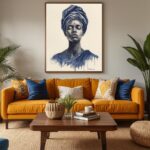
Use Kuba cloth as the workhorse. Where the dikenga needs reverence, Kuba cloth just needs a good frame. It is the most flexible piece in this article: it sits happily above a sofa, in a hallway, over a bed, or leaning on a shelf. Two panels in the same palette, framed identically, make an excellent pair.
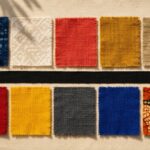
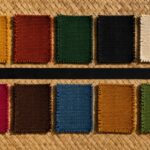
Build the palette from the materials, not from a swatch card. Everything in this article is raffia, bark, clay, soapstone, shell and iron. That gives you cream, rust, ochre, deep brown, charcoal, and the dull warm grey of stone. Choose your paint and textiles from that list and the room assembles itself.
Repeat texture instead of pattern. The Congo Basin traditions are all about surface — cut pile, beaten bark, coiled fibre. Two or three textural echoes across a room (a basket, a nubby cushion, an unglazed pot) do more than another patterned print will.
Give the quiet pieces the close positions. Bark cloth and beadwork-scale objects reward proximity; put them where someone stands rather than where someone glances. Save the big graphic statements for the far wall.
Light everything warm. These are pigment-and-fibre traditions and cool white bulbs kill them. A warm bulb in a lamp, rather than an overhead, brings the rust and ochre back.
If you are printing digital art at home to build a wall like this, size and paper weight matter more than most people expect — we walk through both in our print, frame, hang and light guide.
What to look for when buying — and what to avoid
Buy the textile; think twice about the figure. Kuba cloth, raffia, bark cloth and basketry were made as goods and prestige objects — trade was always part of their life, and buying one continues a legitimate history. Nkisi power figures and mintadi grave markers were not made for that, and the market in them is entangled with colonial removal.
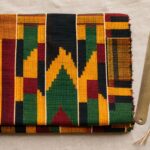
Check whether it was woven or printed. A genuine shoowa panel has visible pile, an uneven edge, and a back that looks like the work of a hand. A digital print of Kuba pattern on cotton is a decorative textile, which is fine — but it should be priced and described as one.
Be suspicious of the word “authentic” without a place attached. “Authentic African mask” tells you nothing. “Carved in the Kasai region, purchased from the maker’s cooperative” tells you everything.
Avoid the nailed-figure replica. It is the single most common Kongo-derived object sold as decor, and the one whose meaning is most completely lost in translation.
Prefer makers and cooperatives over marketplaces where you can. Congolese and diaspora artists working in these traditions are not hard to find, and buying from them puts money where the visual language came from.
If you are buying printable art instead — including ours — the same rule applies to the description as to the object. Art inspired by a tradition should say so. We try to hold ourselves to that in our Etsy shop, and you should hold us to it too.
FAQ
What is the Kongo cosmogram?
A cross inside a circle representing the structure of the universe: the world of the living above, the world of the dead below, the water threshold (Kalunga) between them, and the sun’s turning path around both. Its four points mark dawn, noon, sunset and midnight — and, mapped onto a human life, conception, birth, maturity and death. The centre, where the lines cross, is where a person stands.
Is it disrespectful to use the dikenga in decor?
It is not forbidden, and the symbol carries deep, inherited significance in African-American design traditions specifically — it crossed the Atlantic with the people who held it. The disrespect lies in using it as a graphic squiggle with no idea what it says. Know the meaning, give it room, and credit where it comes from.
Is Kuba cloth the same as mudcloth?
No. Kuba cloth is cut-pile embroidered raffia from the Kasai region of the DRC. Mudcloth (bogolanfini) is hand-painted cotton from Mali, roughly 2,000 miles away, made by an entirely different process. We compare them directly in our African motifs guide.
Are Kongo, Kuba and Luba the same people?
No. They are distinct peoples with separate kingdoms, languages, and artistic traditions, grouped together mainly by the modern borders of the Congo. Treating their art as one style is the most common error in decor writing about the region.
What is an nkisi figure, and can I buy one?
An nkisi is a carved container packed with ritual materials by a specialist and activated for a specific purpose — healing, protection, or the sealing of an oath. The nails record agreements, not decoration. We do not recommend buying replicas as decor: the objects were never made for that, and the antique market is bound up with colonial looting.
What colours work best with Congo-region decor pieces?
Take the palette from the materials: raffia cream, rust, ochre, deep brown, charcoal, and warm stone grey. One deep accent — indigo or forest green — grounds the scheme without fighting it. This is very close to the palette in our Afro-boho colour guide.
A closing note
The dikenga is a diagram drawn by people who wanted to say something enormous with two lines and a circle: that the living and the dead share a structure, that the sun does not stop when it leaves your sky, and that the point where everything crosses is where you happen to be standing.
That is a remarkable thing to be able to draw. It is also, if you let it, a remarkable thing to hang on a wall — not because it is decorative, though it is, but because it is a claim about how the world is put together, made by people who were thinking hard about it long before anyone asked them to.
If you take one thing from this piece, let it be that the Congo is not a single aesthetic. It is at least three, layered onto a country whose borders were drawn in a European conference room, by peoples who were making meaning out of raffia, bark, stone and iron for centuries before that. When you bring a piece of this region into your home, you are joining a specific conversation — the Kongo conversation, or the Kuba conversation, or the Mbuti conversation. Not all of them at once.
The right response is attention. Look at what you have chosen. Know which conversation it belongs to. Place it where its quiet work can be done.
That, as best as we can tell, is the difference between styling a room and making a home.
“The four moments of the sun equate with the four stages of life: conception, birth, maturity, and death. For the Bakongo, everything transitions through these stages — planets, plants, animals, people, societies, and even ideas.” — on the meaning of the dikenga cosmogram
We would add: which is exactly why a dikenga on a bedroom wall reads differently from a geometric print. The geometric print decorates the room. The cosmogram makes a claim about the person standing in it.
Also read:
- 12 Senegalese Symbols & Their Meanings
- 12 Tanzanian Symbols & Their Meanings: A Decor Lover’s Guide
- 12 Moroccan Symbols & Their Meanings: A Decor Lover’s Guide
- Adinkra Symbols and Their Meanings: The Ultimate Guide
- African Motifs Explained: Adinkra, Kente and Mudcloth
- A Respectful Guide to African Textiles and What They Mean
- How to Mix Global Motifs at Home Without Losing Yourself
Shop the Essence of the Road Art collection
Every piece below is our own work — digital downloads you print at home, in the raffia-and-clay palette this article describes.
- Essence of the Road Art on Etsy — the full collection
- Adinkra Symbol Wall Art Set (5) — five African symbols, the closest set we make to a symbol-led gallery wall
- Africa Map Textured Collage Print — mixed-media texture, the nearest thing in the shop to the surface quality of woven cloth
- Afrocentric Wall Art Set (3), Earth Tone Terracotta and Africa Map — a three-piece wall in exactly this palette
- Baobab Tree of Life Print — earth-tone botanical, good beside a cosmogram print