Cowrie Shell Meaning in African Decor: Symbolism & Use
By Essence of the Road Art · Published July 2026
Cowrie shells are one of the most weighted small objects in African material culture. They served as currency from at least the 14th century across vast trade networks — Mali, Songhai, the Hausa kingdoms, the Yoruba city-states. They were cast in Ifa divination by Yoruba priests, sewn onto ceremonial garments to signal wealth, blessed onto altars for protection, and carried in pouches close to the body. A handful of small shells, and somehow money, prayer, beauty and memory all fit inside them.
Today cowries appear in afrocentric decor as accent pieces — mirrors, garlands, basket trims, altar objects — and the meaning survives the move into the living room on one condition: restraint. This guide covers the full story — the currency centuries, the spiritual traditions, the feminine symbolism — and then the practical part: five ways to style cowries at home, what to pair them with, where to buy real ones, and the mistakes that turn a meaningful object into beach-bar theming.
Quick answer: Cowrie shells carry deep meaning in African decor: they served as currency across West Africa for centuries, were used in divination and ritual, and continue to symbolise wealth, fertility, protection and ancestral connection. In contemporary homes they are styled in small clusters — a hand-thrown bowl of shells, a cowrie-framed mirror, a garland over open shelving — always in modest numbers so the meaning is not diluted into mass decoration. Pair them with earth-tone afrocentric wall art, ceramics and textiles, never with generic coastal theming.
Table of Contents
Cowries as currency: the long history
From roughly the 14th century into the early 20th, cowrie shells were the dominant currency across much of West Africa. The shells themselves came from astonishingly far away — harvested in the Maldives in the Indian Ocean, shipped through Arab and later European trade routes, carried across the Sahara by caravan — and that distance was precisely what made them work as money. They could not be counterfeited, could not be locally harvested in quantity, did not decay, and could be counted, strung and bagged in standard units. A market woman in Timbuktu and a trader in the Yoruba city of Oyo could price goods in the same shell.
The volumes were staggering: by the peak of the trade, cowries were imported by the ton, and everyday prices — a basket of yams, a length of cloth — had standard shell values. The association with wealth and abundance that cowries carry in decor today is not a vague “symbol of prosperity”; it is the residue of six centuries in which the shell literally was prosperity. The memory survives in language: Ghana’s modern currency, the cedi, takes its name from the Akan word for cowrie.
There is also a heavier chapter that honest decor writing should not skip: during the transatlantic slave trade, cowries were among the currencies in which human beings were priced. That history does not make the shell unfit for the home — West African cultures themselves never abandoned it — but it is part of why the cowrie deserves to be displayed with knowledge and dignity rather than scattered as filler.
Spiritual and ritual meaning
In Yoruba tradition, cowries speak. In the divination system called merindinlogun, a diviner casts sixteen cowrie shells and reads the pattern of mouths facing up or down — a channel through which the orishas answer. The shells’ slit-like opening is often described as a mouth for exactly this reason: the cowrie is an object that tells.
Across the wider region, cowries have long been worn and sewn as protection — stitched into clothing, woven into hair, studded onto ceremonial masks and headdresses, tied above doorways. The logic is consistent: an object of concentrated value stands between the wearer and misfortune.
The traditions crossed the Atlantic intact. In Santería and Lukumí in the Caribbean, in Candomblé in Brazil, in Vodou in Haiti, cowrie divination and cowrie-adorned ritual objects remain central — one of the clearest examples of African spiritual technology surviving the Middle Passage. For diaspora households, this is often what a bowl of cowries on a shelf quietly holds: not decoration, but continuity.
One respectful boundary for decor purposes: displaying cowries as meaningful objects is open to everyone; staging them as a mock altar or divination set when the practice is not yours is where homage tips into costume. Style the shells for what they are in your home — objects of memory, value and beauty — and the meaning holds.
The fertility and feminine connection
The cowrie’s shape — smooth, oval, with that lipped opening on the underside — has been read as feminine across many African cultures for as long as the shell has been in human hands. It is one of the oldest fertility symbols on the continent, worn in waist beads, bridal jewelry and maternity blessings.
In decor, that association makes cowries especially at home in bedrooms, on vanity tables, and in spaces marking a threshold — a marriage, a pregnancy, a new home. A small dish of cowries on a nightstand or dresser is a traditional and quietly beautiful way to hold that meaning without announcing it to every guest.
Five ways to style cowries at home
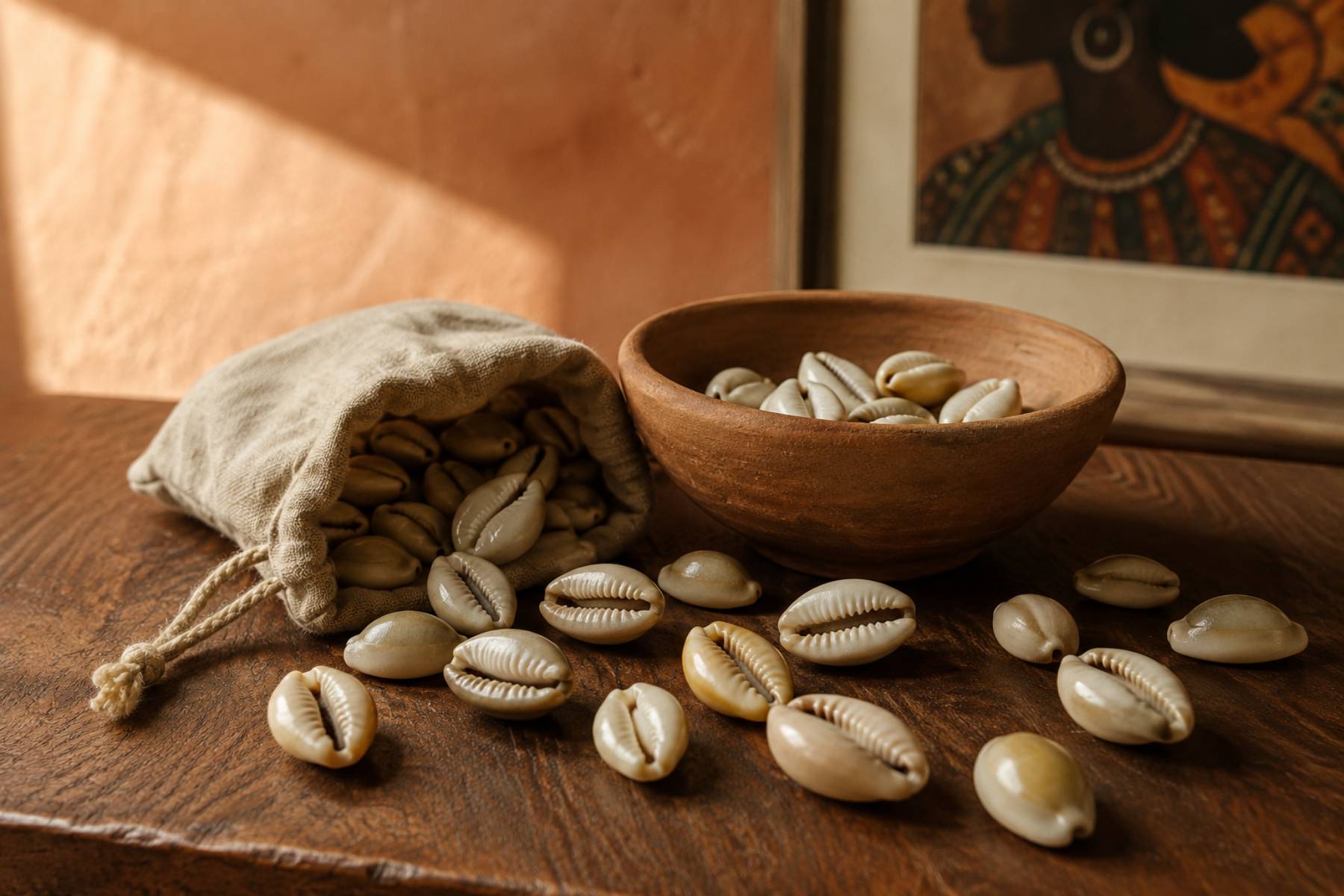
1. The bowl cluster. The simplest and most respectful display: a loose handful of shells in a hand-thrown clay or wooden bowl, placed on a console, shelf or coffee table. The craft object and the shells reinforce each other — machine-perfect glass bowls kill the effect. Ten to twenty shells; the restraint is the styling.
2. The cowrie mirror. The most iconic cowrie decor piece — a small round mirror framed in rings of shells. Traditionally hung near windows or entry doors, where it bounces daylight and stands watch at the threshold. One cowrie shell wall mirror carries an entire wall corner on its own; it needs no companion pieces.
3. The garland. Shells strung on natural fibre, draped along open shelving, across a headboard edge, or down the side of a styled bookcase. Choose garlands where the cord is jute, cotton or leather — plastic line undoes the material honesty that makes the piece work.
4. Woven-in details. Cowries sewn onto basket rims, pillow edges, lampshade trims or wall-hanging fringes — the shell as one voice inside a textile rather than a soloist. This is the easiest entry point in rooms that already lean layered afro-boho.
5. The framed arrangement. A shadow-box frame with a small, deliberate grid or arc of shells on linen backing — the museum treatment, and a strong choice beside framed prints because it matches their formality. It also puts fragile heirloom shells behind glass.
Pairing cowries with wall art
Cowries are small, matte, cream-to-sand colored objects — which makes them natural companions to warm, earth-toned art and terrible companions to neon and chrome. The pairing rule: let the wall carry the color and the story, let the shells echo it at hand level.
A minimalist Black woman print set above a console with a bowl of cowries beneath is the classic build — portrait above, memory below. The Modern Africa map collage works the geographic angle: continent on the wall, trade-route currency on the shelf. And because cowries share West African ground with the Adinkra system, the Adinkra Symbol Set of 5 surrounds them with the same symbolic language — our Adinkra symbols guide covers what each one means.
For the wider context of how meaning-bearing objects and textiles work together in a room, our African textiles meaning guide and the Senegalese symbols guide — where the cowrie appears among Senegal’s twelve — are the natural next reads. And if you are deciding what your overall style even is, two minutes with our Afrocentric home style quiz will tell you whether your cowries belong in a minimalist vignette or a layered afro-boho wall.
Where to source authentic cowrie shells
Etsy is the strongest source for ethically framed cowrie pieces — search “natural cowrie shells” or “cowrie shell garland” and favor shops that name the shell species and origin. Typical prices: $5–20 for a small bag of loose shells, $15–40 for garlands, $30–90 for mirrors.
Amazon stocks bulk natural cowrie shells in the $10–25 range — quality varies, so buy from listings with clear sourcing language and real-photo reviews.
How to spot plastic fakes: real cowries are cool to the touch and warm slowly in the hand, have faint natural weight variation between shells, and show no seam line along the sides. Uniform weight, a visible mold seam, or a suspiciously identical gloss across fifty shells means plastic. Avoid any bulk lot labeled just “shells” with no species name.
If you only do one thing from this section: buy fewer, better shells. Twelve real cowries in a hand-thrown bowl outweigh three hundred plastic ones in every sense that matters.
From adornment to interior: what jewelry teaches about styling
Long before cowries reached consoles and shelves, they lived on bodies — waist beads strung for girls at coming-of-age, bridal necklaces layered for weddings, shells braided into hair, belts of cowries marking dancers and priests. Personal adornment was the shell’s first home, and every rule of good cowrie decor is borrowed from it.
Jewelry never uses a thousand shells; it uses seven, or twelve, placed where they catch movement and light. It always sets the shell against warm, living materials — skin, leather, cotton, brass — never against plastic. And it treats each shell as countable, the way currency is countable. Bring those three habits indoors and you cannot really go wrong: modest numbers, natural neighbors, deliberate placement.
The 1990s cowrie revival — chokers, anklets, the shells suddenly everywhere from Dakar to Brooklyn — is also worth remembering, because it shows what happens when the object outruns its meaning: for a while, cowries read as a trend instead of an inheritance. Interiors are simply the current chapter of the same story, and the homes that get it right are the ones treating the shell as the oldest thing in the room, not the newest.
The mistakes that flatten the meaning
1. Volume. A hundred shells glued to a lamp base is theming; twelve in a clay bowl is meaning. When in doubt, remove half.
2. Coastal context. Cowries beside driftwood signs and anchor pillows read as beach decor, and the African story disappears entirely. Keep them in earth tones, ceramics and textiles.
3. Plastic. Fake shells are cold in every sense. If the budget only covers a small bag of real ones, that is the better purchase.
4. Glue. Once shells are glued into permanent craft arrangements they can never be restrung, re-styled or passed on. Bowls, strings and shadow boxes keep them alive; hot glue retires them.
5. Explaining nothing. The quiet superpower of meaningful decor is being able to answer “what are those?” with a real story. If a guest asks and the answer is “they came with the mirror,” the object deserved better — which is, honestly, why this article exists.
What cowrie decor costs (and where the money goes)
A realistic starter budget: $12–18 for a small bag of genuine shells (roughly 25–40 pieces, more than two bowls’ worth), $8–20 for a secondhand hand-thrown bowl or a new artisan one, and nothing at all for placement. The complete first vignette lands under $35 and outlasts every trend cycle in the room.
Step-ups from there: a genuine cowrie mirror at $30–90 (the widest quality range — check that shells are stitched or wired to the frame, not hot-glued), garlands at $15–40, and shadow-box arrangements at whatever your frame habit costs. The rule of thumb that keeps quality up: pay per shell, not per pound. Sellers who count their cowries tend to have handled them; sellers who weigh them tend to have imported a sack.
Frequently asked questions
Is it culturally appropriate to use cowrie shells in my home if I’m not African?
Generally yes, with respect and context. Cowries have been traded across Africa, Asia, Europe and the Americas for centuries — they are among the most cross-cultural objects on earth. What matters is sourcing ethically, displaying them in cultural context (with afrocentric decor, not as generic beach theming), and knowing what they mean so you can speak to them if asked.
Where should I place cowrie shell decor?
Traditional placements: entryways (the cowrie mirror near the front door as light-bouncer and threshold guard), bedrooms and vanities (the fertility and feminine connection), and intentional vignettes or altars. Avoid bathrooms and kitchens — steam, grease and the contexts themselves work against the symbolism.
What do cowrie shells go best with?
Hand-thrown ceramics, brass, wood, mudcloth and other African textiles, and framed earth-tone afrocentric art. The shells need meaningful neighbors to keep their meaning; pair them with mass-produced coastal decor and they lose context immediately.
How do I clean and care for cowrie shells?
Dust with a soft cloth or brush. For deeper cleaning, mild soap, water and air-drying. No harsh cleaners, no polish — the natural matte surface is the point. Real cowries last generations with no care at all, which is rather fitting for the object.
Are cowries still used as money anywhere?
Not as official currency — colonial administrations phased them out for coinage in the early 20th century. But they never stopped being treated as valuable: bride-wealth traditions, ceremonial gifts and divination sets across West Africa still count and exchange cowries, and the name of Ghana’s cedi keeps the ledger open in language.
Related reading
- 12 Adinkra Symbols & Their Meanings: The Symbolism in African Art — Ghana
- 12 Symbols & Their Meanings: The Symbolism in African Art — Senegal
- Tree of Life Symbolism in African Art: Meaning & Decor Use
- Understanding African Textiles Meaning for Home Decor
- African Motifs Explained: Adinkra, Kente, and Mudcloth
Closing
Cowrie shells are one of the few small objects that hold their meaning across six centuries and four continents. Use them sparingly, source them honestly, and give them neighbors — clay, cloth, wood, and art — that speak the same language. A bowl of twelve real shells beneath a well-chosen print says more than a wall of theming ever could — and it will still be saying it when the trend cycle has moved on twice.