How to Mix Global Motifs at Home Without Losing Yourself
By Essence of the Road Art · Published April 2026
This article contains affiliate links. If you buy through our links, we may earn a small commission at no extra cost to you. We only recommend pieces we’d style in our own homes. As an Amazon Associate I earn from qualifying purchases.
The question no one says out loud: How to mix global motifs
There is a moment that happens to almost everyone who loves beautiful things. You are standing in your living room, holding a Moroccan pouf you found online, and next to it is the mudcloth pillow you bought last month, and behind both is a small Japanese ceramic your friend brought back from Kyoto — and you freeze.
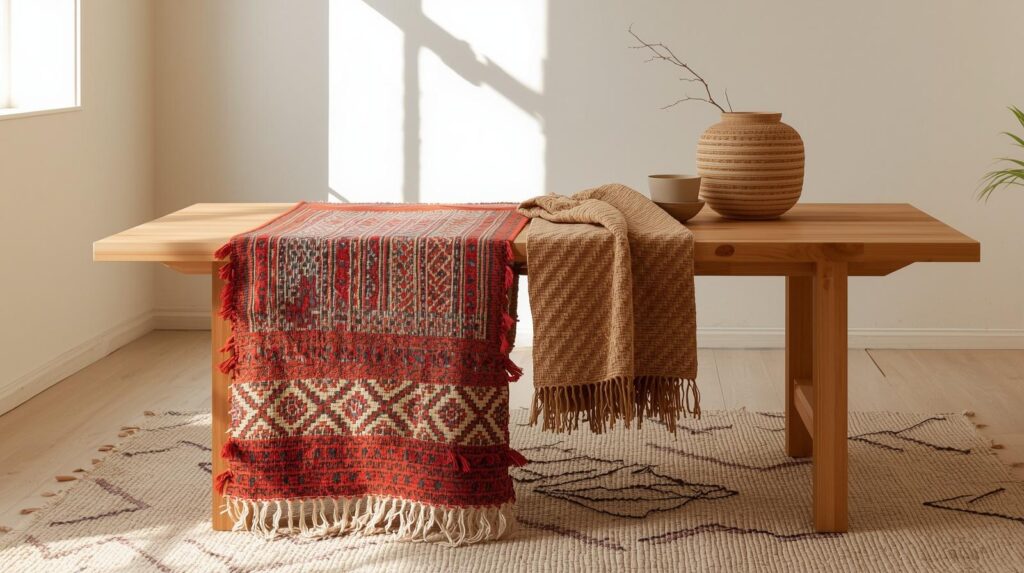
Can all of this live in one room?
Is it too much?
Is it disrespectful?
Will it look like I am trying too hard?
We wrote this post because nobody answers that question honestly. Decor magazines show you perfectly styled “globally inspired” rooms without telling you how the styling works — or why it so often goes wrong. And the internet is full of “around the world in 12 patterns” listicles that leave you with more objects and no more confidence.
Learning how to mix global motifs can elevate your home decor while showcasing diverse cultures.
So this is not that. This is the slower, quieter conversation about what it actually means to bring motifs home from many places — Moroccan, Indian, Japanese, West African, South American — and have the room still feel like yours.
📌 Quick Answer
To mix global motifs at home without it feeling scattered, choose one culture to anchor the room, let others accent rather than compete, and unify everything with a single earthy color story (think ochre, indigo, terracotta, or cream). Name each piece by its real origin, buy from makers where possible, and edit ruthlessly — depth comes from fewer, more meaningful objects, not more of them.
Table of Contents
Why “global” decor usually fails
The failure almost always looks the same: a room that is trying to reference everywhere ends up feeling like nowhere. A Moroccan lamp on a Japanese console next to an Indian block-print throw under a framed mudcloth square — and somehow the whole arrangement feels like a hotel lobby instead of a home.
The reason is quiet but important. Each of those objects carries its own gravity. A Moroccan zellige tile lamp holds the weight of centuries of Maghrebi craftsmanship. A Japanese tea bowl carries wabi-sabi — the philosophy of imperfect, transient beauty. A mudcloth pillow is a piece of Malian women’s visual storytelling. When you line all four up on the same console, none of them can breathe. They cancel each other out.
Depth is not the same as density. A room with one Moroccan lamp, given space, says something. A room with twelve objects from twelve countries says nothing.
The one story rule — and how to pick the anchor
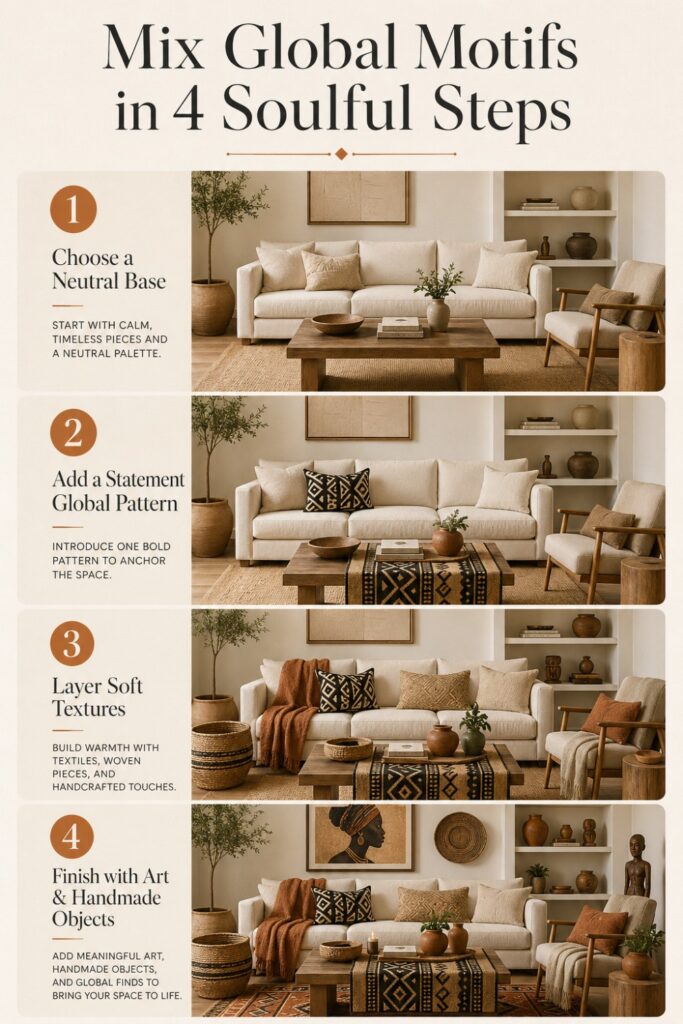
Here is the rule we follow. Before anything else in the room, choose one culture as the anchor. Everything else accents it. Not equals it. Accents it.
The anchor is usually determined by one of three things:
- The piece you love most. The rug you bought with your first real paycheck. The framed textile your mother gave you. The ceramic from a trip you will never forget. That piece tells you which culture the room is built around.
- The material you gravitate toward. If every beautiful thing you save on Pinterest has warm wood and natural fiber, you are probably building toward a Japanese-leaning room. If it is indigo and handwoven everything, West African. If it is carved detail and saturated color, Moroccan or Indian.
- The feeling you want to walk into. Calm and spare? Japanese anchor. Warm and layered? Moroccan or West African. Rich and jewel-toned? Indian.
Once the anchor is chosen, every other piece has a job: to support the story, not to start a new one. A Japanese-anchored room can hold one African textile pillow beautifully. But that pillow is a guest in the room, not a co-host.
The earthy color bridge that ties everything together
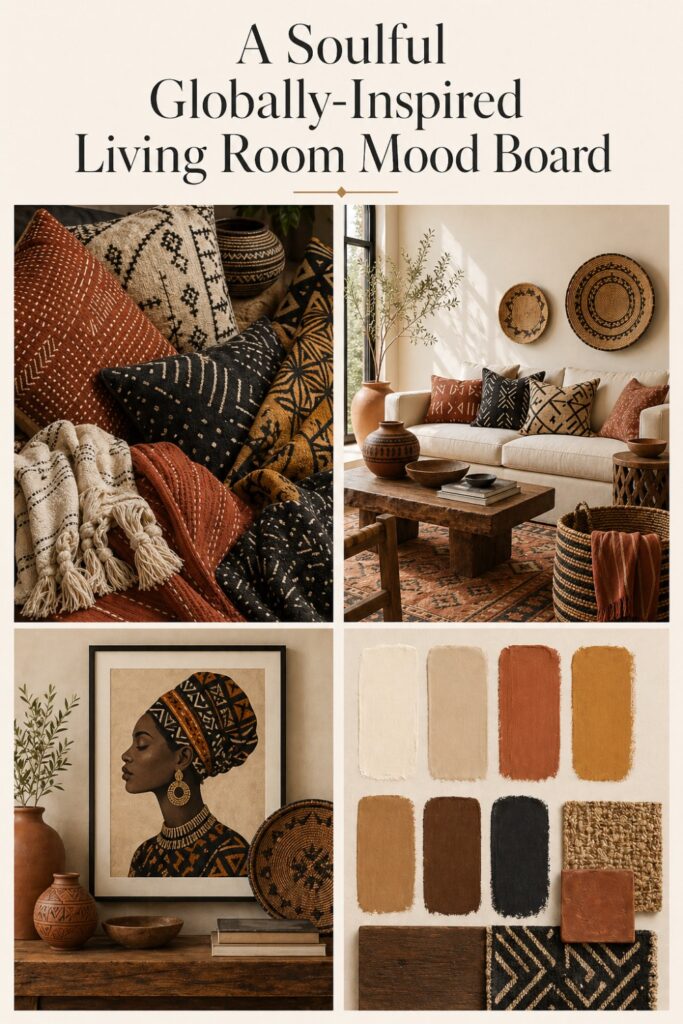
There is a reason Afro-Boho, Japandi, Mediterranean, and Moroccan-inspired interiors so often share the same palette — ochre, terracotta, indigo, cream, clay, warm black, and deep green. These colors have shown up in traditional textiles and ceramics across continents for centuries, because most of them come from the same sources: iron-rich earth, indigo plants, tea-leaf dyes, charcoal, lime.
This is your bridge. If every motif in your room shares at least one of these tones, the room will read as intentional even when the origins are wildly different. A Moroccan pouf in ochre, a mudcloth pillow in cream and black, a Japanese raku bowl in earth-brown, and an Indian block-print throw in indigo all live peacefully together — because the palette is saying this is one room, even when the objects come from four continents.
The opposite: a candy-pink Moroccan pouf next to a royal-blue Japanese bowl next to a neon Ankara print. Technically all “global,” aesthetically an argument.
Moroccan, Japanese, Indian, West African — what each brings
Rather than flatten these traditions into one “global” category, it helps to know what each actually brings to a room. When you know the emotional register of each, you can mix them more thoughtfully.
Moroccan decor brings warmth, ornament, and intimacy — carved wood, pierced brass lanterns, deep-pile Beni Ourain rugs, zellige tile, low seating. The feeling is of a room that invites you to stay.
Japanese decor brings restraint, patience, and natural material — raw wood, linen, ceramic with texture, a single branch, ikebana logic. The feeling is of a room that asks you to slow down.
Indian decor brings color, craft, and storytelling — block-printed textiles, embroidered cushions, brass detailing, saturated jewel tones. The feeling is of a room that celebrates.
West African textiles (mudcloth from Mali, Kente from Ghana, Adire from Nigeria, Kuba cloth from Congo) bring symbolism, graphic strength, and human hand — each pattern carrying specific cultural meaning. The feeling is of a room with lineage. (If you want to go deeper on these, our companion [guide to African textiles and what they mean] covers each in detail.)
South American and Andean textiles bring geometric rhythm and natural dye — Peruvian woolens, Chilean baskets, Mexican serape stripe. The feeling is of a room with altitude and air.
Notice: each one has a different emotional register. That is why mixing them requires care. A Moroccan-warm room with a Japanese-calm bowl is a beautiful tension. A Moroccan-warm room with an Indian-celebratory throw and a Japanese-calm bowl and a West African-symbolic textile is chaos dressed as worldliness.
How to tell appreciation from appropriation in your own home
This is the question women write to us about more than any other. And the honest answer is that there is no one perfect rule — but there are some checks we use ourselves, and they are quieter and kinder than the internet version of this conversation.
Here is how we think about it:
- Can you name what you own? If you can say “this is a Beni Ourain rug from the Atlas Mountains” instead of “this is a cute tribal rug,” you are already doing the work. Naming is the first act of respect.
- Did a maker get paid? The difference between appreciation and extraction often lives in the supply chain. A handwoven basket bought from an artisan co-op or a Black-owned or woman-owned importer is a very different object from a $12 Amazon lookalike labeled “boho tribal.”
- Are you using it the way it was meant to be used — or at least not disrespectfully? Sacred objects on the floor is a problem. A ceremonial textile thrown carelessly over a bathroom hamper is a problem. A beautiful functional rug serving as a rug? That is exactly what it was made for.
- Can you tell the story when someone asks? If you can say “this is Adire from Nigeria, and it was made using an indigo resist-dye technique passed down through Yoruba women,” you are not appropriating — you are carrying.
None of this means you need a PhD in every culture before buying a pillow. It means you are choosing to be the kind of person who finds out. That is the whole difference.
Where to actually find pieces that are not mass-produced
This is the section where most blogs hand you a list of Amazon links and call it a day. We will give you some affordable options too — but we want to be honest about what you are getting.
For truly artisan-made pieces:
Look for fair-trade importers, small woman-owned shops, or direct-from-maker platforms. Prices are higher, but you are paying for real hands and a real chain of custody. These pieces become family objects. They are not what you buy when you want a quick Saturday refresh — they are what you save for over a season.
For affordable accents that do not pretend to be something they are not:
Big marketplaces are fine for the supporting layer of a room — as long as you call the pieces what they are. “Moroccan-inspired” tile tray is not a Moroccan tile tray, and that is okay when you know the difference.
| Piece | What it actually is | Approx. price |
|---|---|---|
| Moroccan-style pouf in natural leather | Factory-made version of a traditional form | ~$60–90 |
| Indian block-print cotton throw | Often genuinely hand-printed, check the listing | ~$25–45 |
| Japanese raku-style ceramic bowl | Machine-assisted with hand finishing | ~$20–40 |
| Handwoven seagrass basket set | Usually genuinely handwoven — natural material | ~$35–55 |
| Turkish-style kilim runner | Factory-woven lookalike, good for layering | ~$50–80 |
For the true anchor piece — the one your room is built around — we would always recommend saving and sourcing from an artisan-led seller rather than a marketplace.
And if the anchor you are building toward is West African / Afrocentric, our own Indigo Archives collection was designed exactly for that quiet, editorial role — printable wall art in indigo, cream, and charcoal, sized for gallery-scale impact. Use ARCHIVE15 as a collector’s code.

A room you can build this month for under $300
Let’s make this real. Here is a living room built the way we actually recommend — one anchor, earthy palette, global accents, under $300 total.
The anchor: A Beni Ourain-inspired rug in cream and charcoal (~$150). This sets the room’s cultural register as warm-Moroccan-adjacent.
The primary accent (African): One mudcloth-inspired pillow cover in cream and black (~$18). Sits on the sofa. Picks up the charcoal in the rug.
The secondary accent (Indian): An Indian block-print cotton throw in indigo (~$30). Folded loosely over one arm of the sofa.
The quiet note (Japanese): A single raku-style ceramic vessel (~$25) on the coffee table with one dried branch.
The grounding layer: A handwoven seagrass basket (~$40) beside the sofa for throws or magazines.
Printable wall art: One large indigo textile-inspired print, digital download (~$12, no frame).
Total: around $298.
One anchor. Three cultures accented. One earthy palette. Every piece has a job. Nothing is shouting over anything else. And the room will still feel right in three years, because nothing in it is trying to be anything other than what it is.

FAQ
Can I mix Moroccan, Indian, and African decor in the same room?
Yes — this is one of the most beautiful directions in modern decor. The key is to let one culture anchor the room and the others accent it, unify everything with a shared earthy palette (ochre, indigo, terracotta, cream), and give each piece enough visual space to breathe. Three cultures done with care looks collected. Seven cultures done without editing looks confused.
How do I know if my globally inspired room is appropriation or appreciation?
Four honest checks: can you name the origin of each piece, did the maker get paid, are you using the object respectfully, and can you tell its story when asked. If the answer to those is yes, you are appreciating. Appropriation usually shows up as vague labels, cheap mass-market sourcing, and objects treated as generic aesthetic rather than as cultural specificity.
What is the easiest global motif to start with?
Moroccan and Indian textiles are the gentlest entry points because they are widely available, affordable, and visually forgiving — both traditions layer well with almost any existing neutral furniture. Japanese restraint is the hardest to do well on the first try because it demands editing skill.
Where should I buy authentic global decor without overspending?
Look for fair-trade co-ops, small woman-owned and BIPOC-owned importers, and artisan-direct Etsy shops for the anchor pieces of a room. Use marketplace sources for supporting accents — and always call “inspired-by” pieces what they actually are, rather than implying authenticity that is not there.
A closing thought
The best global rooms we have ever walked into were not the most traveled ones. They were the most felt ones.
A Moroccan rug that someone saved for a year to buy. A Japanese bowl that holds a friendship. A West African textile that carries a grandmother’s memory. A single Indian print, framed and loved.
These rooms are not “global” because they collect cultures. They are global because the person who lives there has let specific places, and specific hands, and specific stories, live with her.
That is the quieter version of this aesthetic. The one we are trying to make room for.
“The real voyage of discovery consists not in seeking new landscapes, but in having new eyes.” — Marcel Proust
We would add: and in letting those new eyes shape the home you come back to.
What next? Discover 15 Afrocentric Wall Art Ideas for a Modern Living Room.