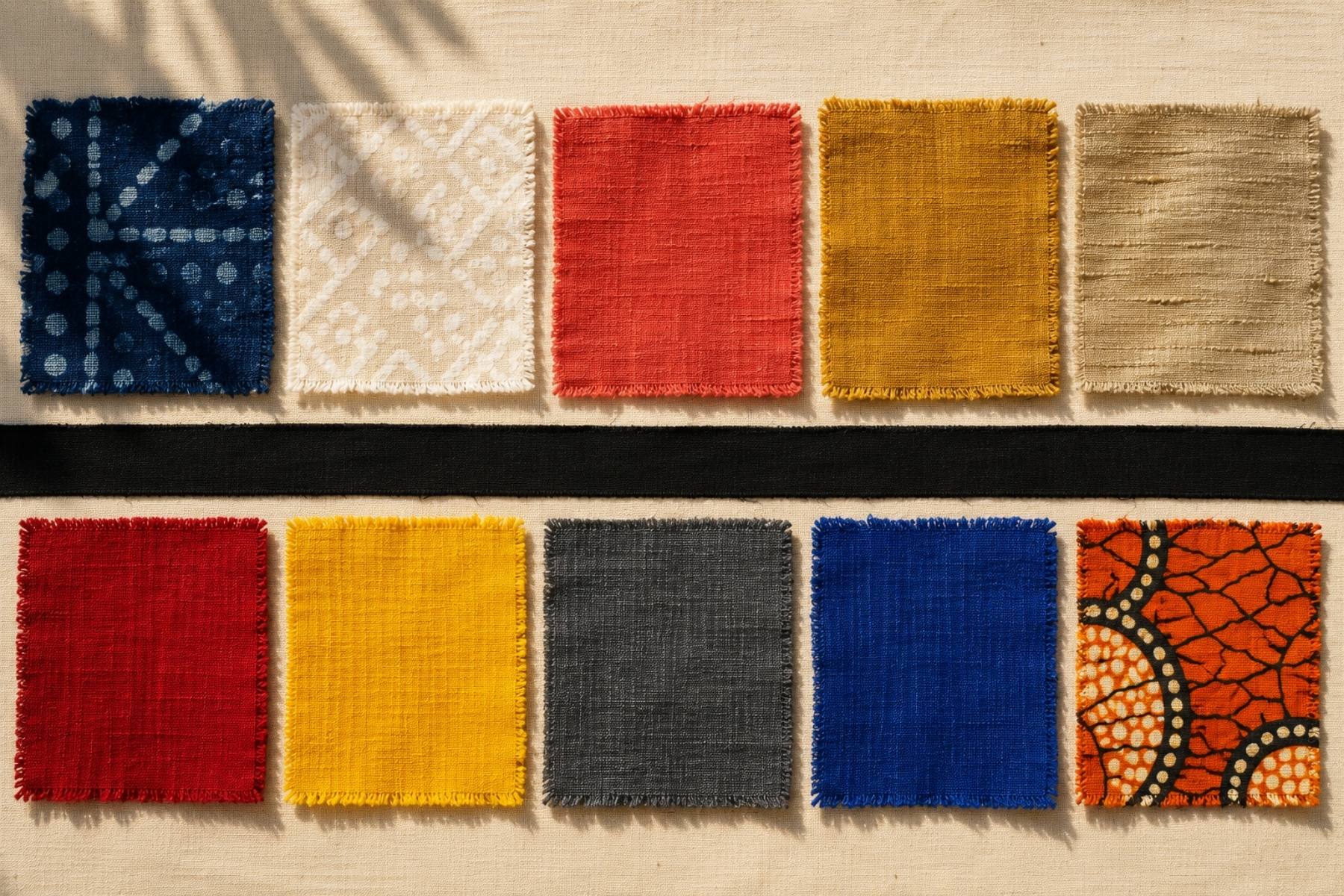
Nigeria Color Palette: Adire Indigo, Benin Coral and Lagos Yellow
By Essence of the Road Art · Published July 2026
This article contains affiliate links. If you buy through them, we may earn a small commission at no extra cost to you. We only feature pieces we would live with ourselves.
Nigeria does not have a color palette so much as a color industry. This is a country where cloth carries names, ranks and occasions: where indigo patterns are painted on in cassava starch before the dye vat ever sees the fabric, where a strip-woven textile comes in three named colorways that signal what event you are dressed for, and where the reigning Oba of Benin is crowned in coral. Then Lagos adds twenty million people, a fleet of yellow buses and the loudest wax prints on the continent.
That density is why Nigeria earns its own guide in our series after Morocco, Ghana, Senegal and Tanzania. Below are five schemes with real hex codes — from the quietest adire blue to full ankara volume — plus the craft story inside each one, the room it serves best, and the art and objects that carry it home.
Quick answer: The classic nigeria color palette starts with Yoruba adire — deep indigo against cassava-resist white — grounded by charcoal and warmed with one jewel of Benin coral or brass gold, in a 60-30-10 rhythm of white, indigo and coral. It reads crisp and ceremonial at once. The one-step version is our Indigo & Black Abstract Set of 3, which hangs the adire register in three frames.
Table of Contents
What makes Nigerian color different
Two habits set Nigeria apart from every other palette in this series. The first is that color here is written before it is worn. Adire patterns are painted or stitched as resist before the dye bath; each motif has a name and often a proverb. Aso-oke, the Yoruba ceremonial strip-weave, comes in three canonical colorways so established they function like a dress code: sanyan, the quiet beige of wild silk; etu, an indigo so deep it reads as blue-black; and alaari, woven crimson. Tell a Yoruba tailor the occasion and the cloth names itself.
The second habit is volume control. Nigeria runs the full dial — from etu’s near-black restraint to ankara’s maximum chroma — and never apologizes at either end. That makes it the most flexible country in this whole series: there is a Nigerian scheme for a monastery-quiet study and one for the loudest family room on the street, and they share the same heritage.
1. Yoruba Adire — the signature scheme
Adire indigo #26355B · Resist white #EDE7D6 · Faded mid-blue #54689B · Soft charcoal #2A2622 · Brass hint #B8893C
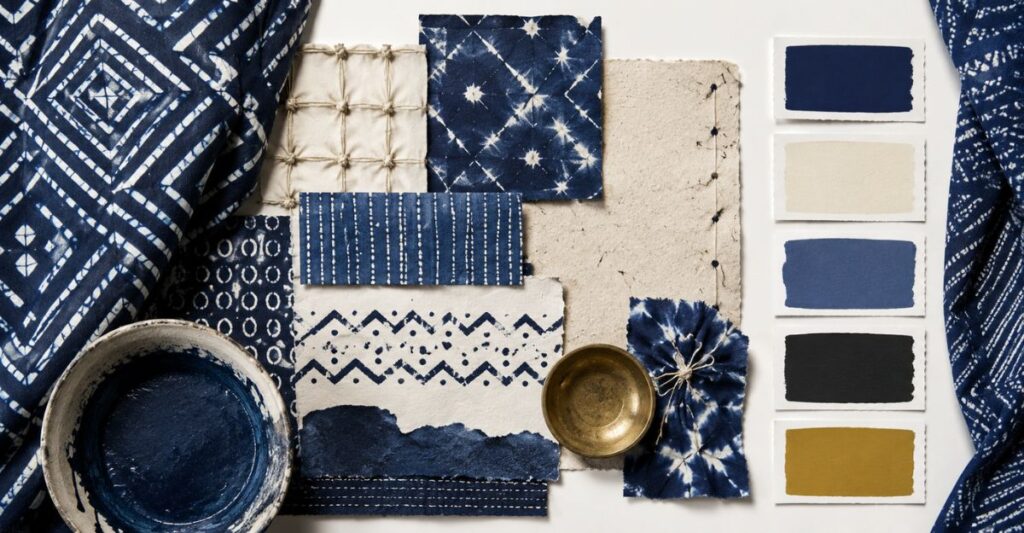
Where the color comes from. Adire means “tied and dyed,” and the Yoruba dyeing towns of Abeokuta and Ibadan have made it an art form with sub-genres: adire eleko, where women paint patterns in cassava-starch paste with feathers and knife-edges; adire oniko, tied with raffia; adire alabere, stitched. Wherever the resist holds, the cloth stays cream; everywhere else, repeated dips build indigo depth. The result is blue-and-white with a handwriting no printer can fake.
What it means and how it feels. Adire motifs carry names and meanings — proverbs, birds, husbands’ jealousy, all catalogued in pattern. As a room, the scheme is crisp and literate: white breathing room, indigo depth, charcoal punctuation, one glint of brass. It is graphic without being loud — the Nigerian cousin of Senegal’s softer indigo mood, with more contrast and more pattern confidence.
Hang it: the Indigo & Black Abstract Set of 3 is the register in three frames; the Indigo Africa Map poster extends it. Layer it: an indigo block-print duvet or throw. For how indigo behaves as quiet luxury, our Indigo decor guide continues the thread.
2. Aso-Oke Heritage — the three named cloths
Sanyan beige #C9B490 · Etu blue-black #232B3F · Alaari crimson #8E2F3C · Raw cotton #F0E9D8 · Thread gold #C79A3A
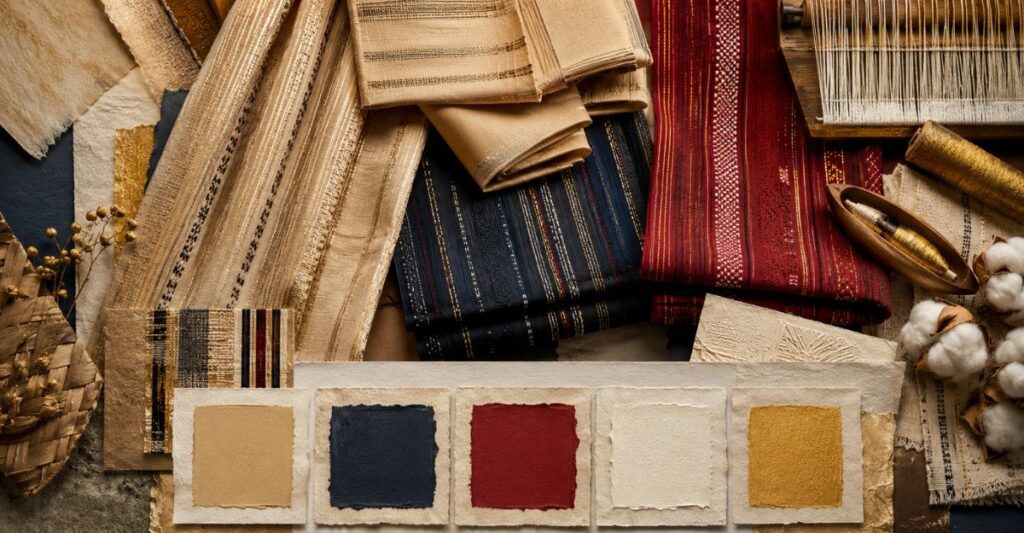
Where the color comes from. Aso-oke — “top cloth” — is the Yoruba ceremonial strip-weave, produced on narrow looms and sewn into wide wraps, agbada robes and gele headwraps. Its three classic colorways are so codified they have personal names: sanyan, woven from the beige silk of the anaphe moth, the most prestigious and the quietest; etu, “guinea fowl,” an indigo dyed so deep it shimmers blue-black; and alaari, crimson silk, historically dyed with camwood. A fourth voice, metallic thread, arrived later and never left.
What it means and how it feels. Aso-oke is occasion made visible — weddings, chieftaincies, funerals each call their cloth. As an interior scheme it is the most sophisticated neutral system in this series: beige with actual lineage, a black that is secretly blue, one ceremonial red. Use sanyan as the room’s ground, etu in the largest dark pieces, alaari once. The impression is formal warmth — a room dressed for something.
Hang it: the Abstract Golden Black Woman print carries the sanyan-and-gold mood; the Geometric Africa Map in gold on dark supplies the etu depth. Layer it: a cream and black woven cotton throw with one crimson cushion.
3. Benin Coral & Brass — the royal scheme
Benin coral #B5473A · Brass gold #B8893C · Ivory #EFE8D8 · Ebony #221D18 · Deep leaf #3F5C46
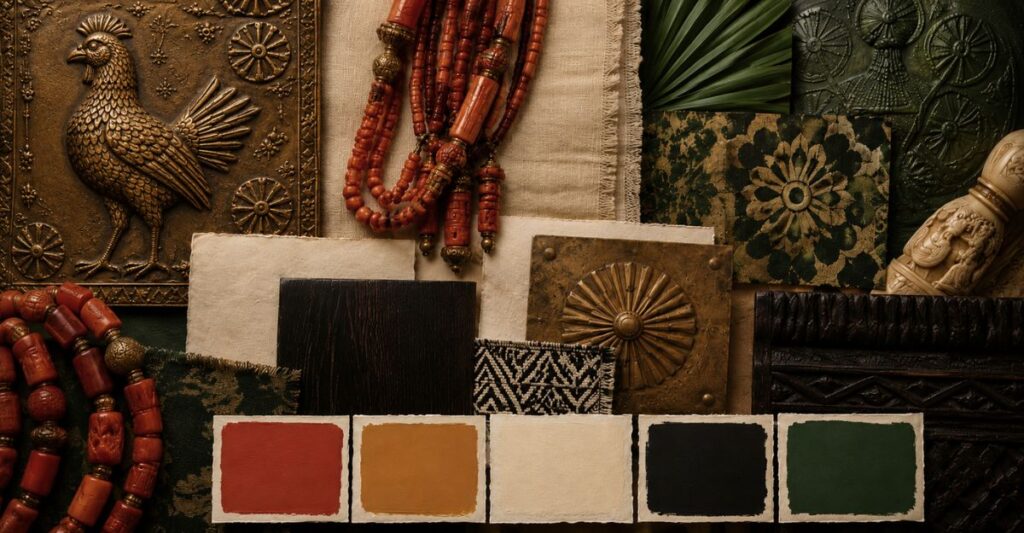
Where the color comes from. The Kingdom of Benin, in today’s Edo State, built one of the great court art traditions of the world: the famous brass plaques and heads cast by the lost-wax method for the royal palace, and coral — red coral beads traded across centuries — as the exclusive regalia of the Oba and his chiefs. At coronation the Oba wears coral from crown to slippers; the color is not decoration but office.
What it means and how it feels. Coral speaks rank and continuity; brass is memory cast in metal — the plaques were literally the kingdom’s archive. As a room, the scheme is warm, dense and stately: ivory ground, coral lead, brass catching the light, ebony and leaf-green holding the edges. Libraries, dining rooms and any space that hosts occasions wear it naturally.
Hang it: the Black Woman, Tribal Mask & Africa Map Set of 3 carries the court-art gravity; the Geometric gold-on-dark map doubles the brass. Layer it: a coral red velvet cushion cover and one real brass object with weight.
4. Lagos Yellow — the city energy scheme
Danfo yellow #E8B32A · Asphalt gray #57544E · Rust #9C5A34 · Concrete cream #E7E2D5 · Palm green #4E7A4E
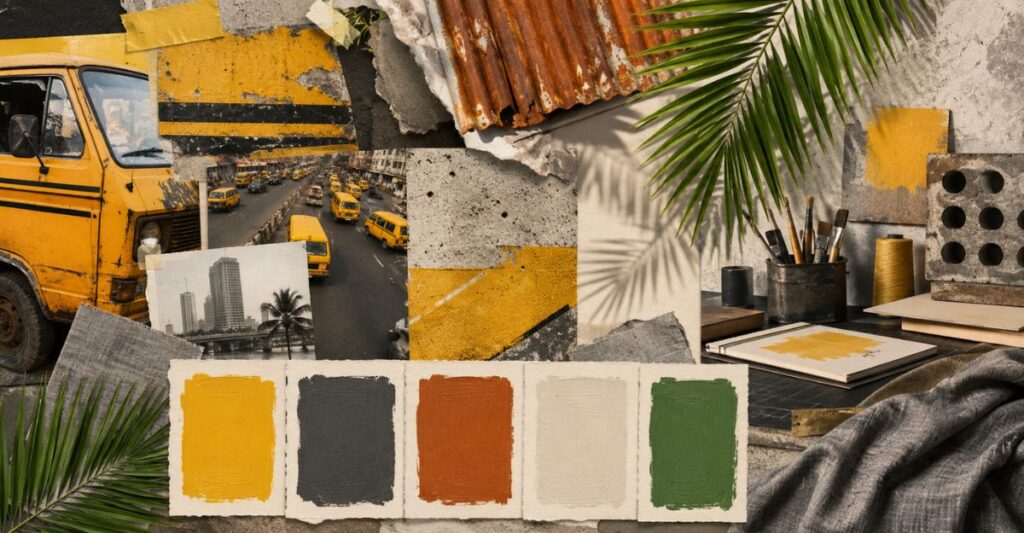
Where the color comes from. Lagos runs on yellow: the danfo minibuses and kekes that move the city are painted a taxi-bright gold, so the streetscape reads as motion in one color. Around it: sun-baked asphalt, rusting roofs, raw concrete, and the palms that survive everything. No committee designed this palette; twenty million people in a hurry did.
What it means and how it feels. This is hustle as a color scheme — optimism with exhaust fumes. Domesticated, it works like Ghana’s Makola scheme from our Ghana guide but with fewer colors and more attitude: concrete-cream ground, one committed yellow, gray and rust doing the grown-up work. Home offices, creative studios and kitchens take it best; it is the scheme for rooms where things get made.
Hang it: the Colorful Afrocentric Africa Map poster brings the street energy, and the Afrocentric Music vinyl collage print adds the city’s soundtrack — Lagos is, after all, the capital of Afrobeats. Layer it: a mustard yellow cotton throw against gray linen.
5. Ankara Celebration — the full-volume scheme
Wax orange #E07B28 · Cobalt #2749A8 · Fuchsia #B93A7C · Leaf green #3E8E4E · Pattern white #F3EFE4
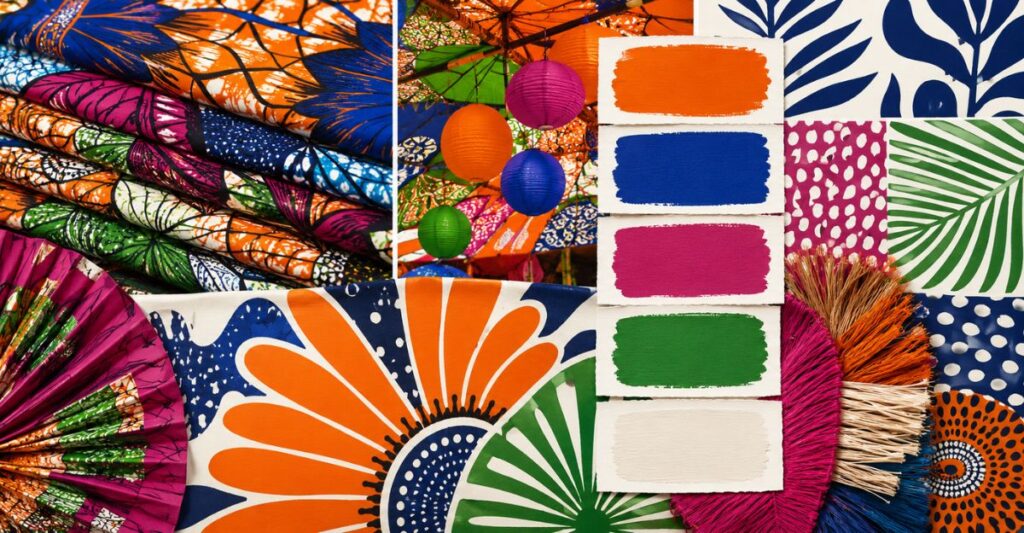
Where the color comes from. Ankara — African wax print — arrived via Dutch trade routes and was adopted, renamed and reinvented so thoroughly that West Africa is now its home and Nigeria its loudest runway. The cloth is printed with resin on both sides, colors at maximum saturation, patterns that carry nicknames and messages traded between market women. An owambe — a Lagos party — is ankara’s natural habitat: whole families in matching aso-ebi prints, color coordinated at celebration scale.
What it means and how it feels. Ankara is joy with a dress code — belonging, occasion and wit printed at full volume. At home, use it the way an owambe does: committed, but coordinated. One upholstered statement piece or one wall of framed prints in a shared colorway, everything else in pattern white. Diluted ankara reads as clutter; committed ankara reads as a party with a guest list.
Hang it: the colorful editorial Black Woman prints hold this energy at gallery quality — pair two in a shared palette. Layer it: ankara wax print cushion covers on a neutral sofa.
A note on sources, briefly
Nigerian color is authored: adire patterns are painted proverbs, aso-oke colorways carry personal names, coral is a literal office, and even Lagos yellow was voted into existence by a city’s worth of daily decisions. Keep the names attached when you borrow the schemes — sanyan, etu, alaari, adire eleko — because the vocabulary is half the value, and it is exactly what a paint-deck version of these colors loses.
How to choose between the five
The nigeria color palette runs on a volume dial, so choose by loudness. Silence to full blast: Aso-Oke Heritage is the quietest (a neutral system with lineage), then Yoruba Adire (graphic but composed), Benin Coral & Brass (warm and stately), Lagos Yellow (awake), Ankara Celebration (party). Match the room’s job to the volume: bedrooms and studies at the quiet end, dining and hosting rooms in the middle, kitchens, studios and family rooms at the loud end.
Then apply the one rule every scheme above shares with our continental guide: a 60 percent ground the eye can rest on, one lead color at 30, one deliberate surprise at 10. Nigeria supplies the confidence; the arithmetic keeps it wearable.
The 10-minute version: hang the palette
Printable art auditions a country before you commit fabric or paint. Download a set above, print at home or at a local shop (our printing guide covers sizes and paper), frame it, and live with the scheme for two weeks. Black frames sharpen adire and aso-oke; oak warms Benin and Lagos. A set of 11×14 frames covers a trio wall, and Vecteezy’s mockup library previews the wall before you print a page.
Frequently asked questions
What colors represent Nigeria?
Green and white officially — the flag’s agriculture and peace — but the cultural palette is far richer: adire indigo and resist white from Yoruba dye towns, the sanyan-etu-alaari triad of aso-oke, Benin’s royal coral and brass, Lagos’s taxi yellow and the full-spectrum brights of ankara wax print.
What is adire and how is it made?
Adire is Yoruba indigo resist-dyed cloth, centered historically in Abeokuta and Ibadan. Patterns are created by painting cassava-starch paste (adire eleko), tying with raffia (adire oniko) or stitching (adire alabere) before repeated dips in the indigo vat; wherever the resist holds, the cloth stays pale, and the pattern emerges as the indigo deepens around it.
What are the traditional aso-oke colors?
Three named classics: sanyan, a quiet beige woven from wild silk and considered the most prestigious; etu, an indigo dyed so deep it reads blue-black; and alaari, crimson. Modern aso-oke adds metallic threads and contemporary colorways, but the three names still function as a ceremonial dress code.
Why is coral so important in Benin?
Coral beads have been royal regalia in the Kingdom of Benin for centuries — the Oba and his chiefs wear coral as a mark of office, and at coronation the king is robed in it. In a room, coral red therefore carries a specific meaning of rank and continuity, which is why we use it as a single deliberate jewel rather than a wall color.
Which nigeria color palette works in a small apartment?
Yoruba Adire: blue recedes, the white keeps things open, and the scheme’s pattern-confidence gives a small room character without crowding it. Run indigo through art and textiles, keep walls resist-white, and let one brass object supply the light.
How do I use ankara in decor without it looking chaotic?
Commit and coordinate, the way a Lagos owambe does: pick one wax-print colorway, give it one statement moment — an upholstered chair, a set of framed textile panels, a row of cushions — and hold everything else at pattern white. Scattered small doses of many prints read as clutter; one committed dose reads as intent.
Related reading
- African Color Palette Guide 2026: From Marrakech Clay to Himba Ochre
- Ghana Color Palette: Kente Gold, Red Clay and the Colors of Accra
- Senegal Color Palette: Indigo, Teranga Sand and the Pink Lake
- Indigo Decor: A Quiet Luxury Guide
- 2026 Color Trends With African Roots
Closing
Five schemes, one dial: Nigeria colors a home from blue-black whisper to wax-print celebration, and every stop on the dial has a name, a cloth and a story. Start quiet with adire or aso-oke, warm up with Benin coral, and save ankara for the room that hosts your own owambe. The single set we recommend first is the Indigo & Black Abstract Set of 3 — the adire register, three frames, one afternoon.