Tree of Life Symbolism in African Art: Meaning & Decor Use
By Essence of the Road Art · Published July 2026
This article contains affiliate links. If you buy through them, we may earn a small commission at no extra cost to you. We only feature pieces we would live with ourselves.
The tree of life is one of the few symbols that appears across nearly every African cultural tradition — from the Bambara of Mali to the Akan of Ghana to the Zulu of southern Africa. The specific tree varies (baobab in many traditions, acacia or ebony in others), but the meaning is remarkably consistent: the tree stands where the ancestors, the living and the not-yet-born meet — roots, trunk and branches of one continuous thing.
That consistency is what makes it such strong wall art. A tree of life piece is not a seasonal motif; it is a thesis about family and time, which is why it tends to become the print people keep when they move and pass down when they don’t. This guide walks through the three great African traditions behind the motif — the baobab, the Akan Nyame Dua, and the ancestral family tree — and then the practical part: choosing the right version for your room, styling it, and sourcing it well.
Quick answer: Tree of life symbolism in African art draws from three main traditions: the baobab as the literal “tree of life” across West, Central and Southern Africa; the Adinkra symbol Nyame Dua (“God’s tree”), representing divine presence and protection in the home; and the ancestral family-tree tradition connecting past, present and future generations. In decor, the motif works best as a single large anchor piece — framed above a sofa, console or bed — surrounded by restrained, earth-toned styling.
Table of Contents
The baobab: the tree that earned the name
Across West and Southern Africa the baobab is called the tree of life without any poetry intended — the title is a job description. A mature baobab stores tens of thousands of gallons of water in its swollen trunk, which is why it survives — and why villages survive near it — through droughts that kill everything else. Its fruit (superfood-famous today as “baobab powder”) and young leaves are eaten; its bark fibre becomes rope and cloth; its vast hollow trunks have served as granaries, shelters, and meeting chambers. Individual trees live over a thousand years — some far longer — so the baobab your great-grandmother traded under is, in many villages, the same baobab standing today.
The metaphor writes itself, and African cultures wrote it early: the baobab is the ancestor made visible. It appears in creation stories (the “upside-down tree” that the gods replanted roots-to-sky), in village life as the palaver tree — the shaded floor where disputes are settled and stories told — and in Senegal, where it is the national emblem, it shades sacred burial traditions of griots, the keepers of memory.
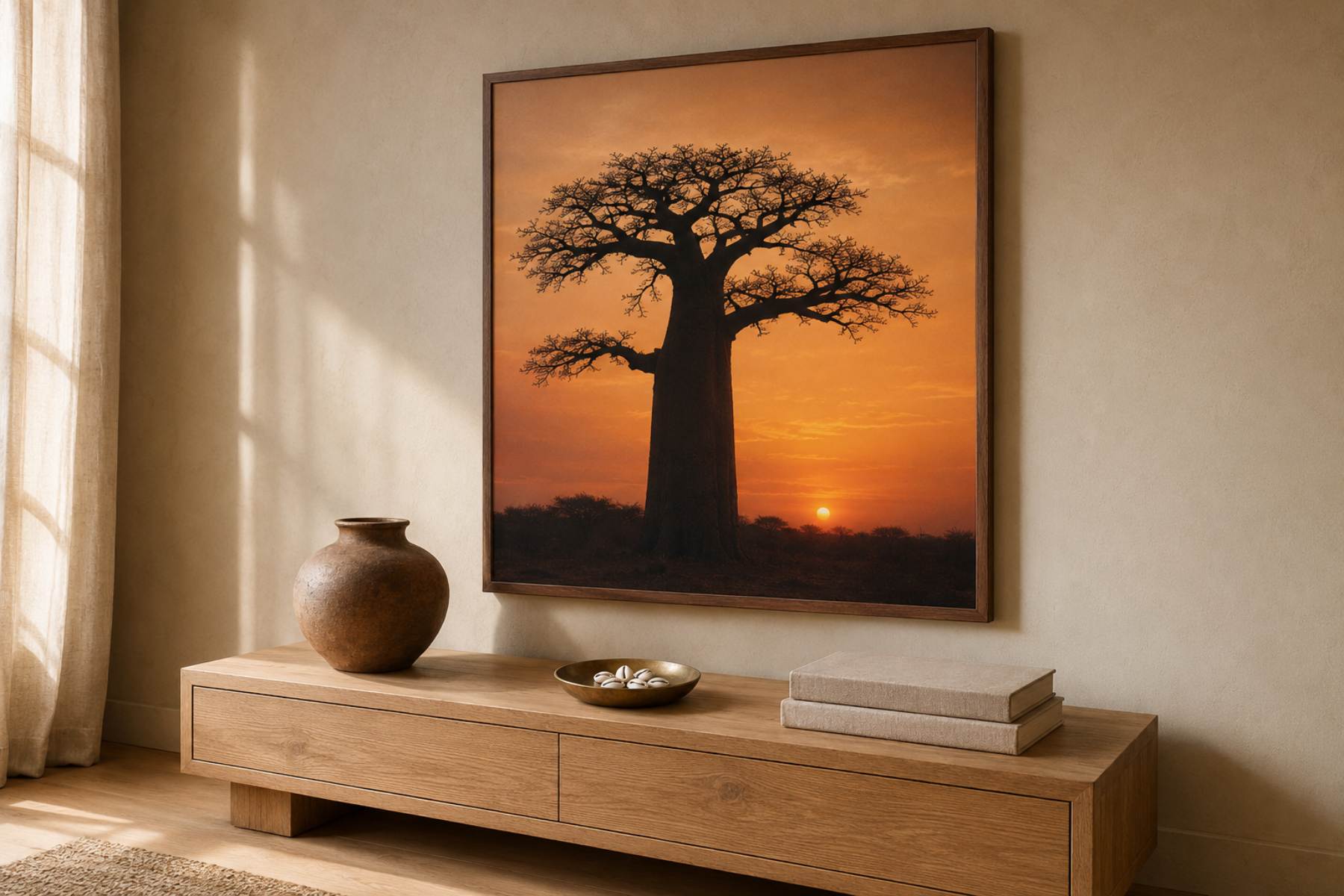
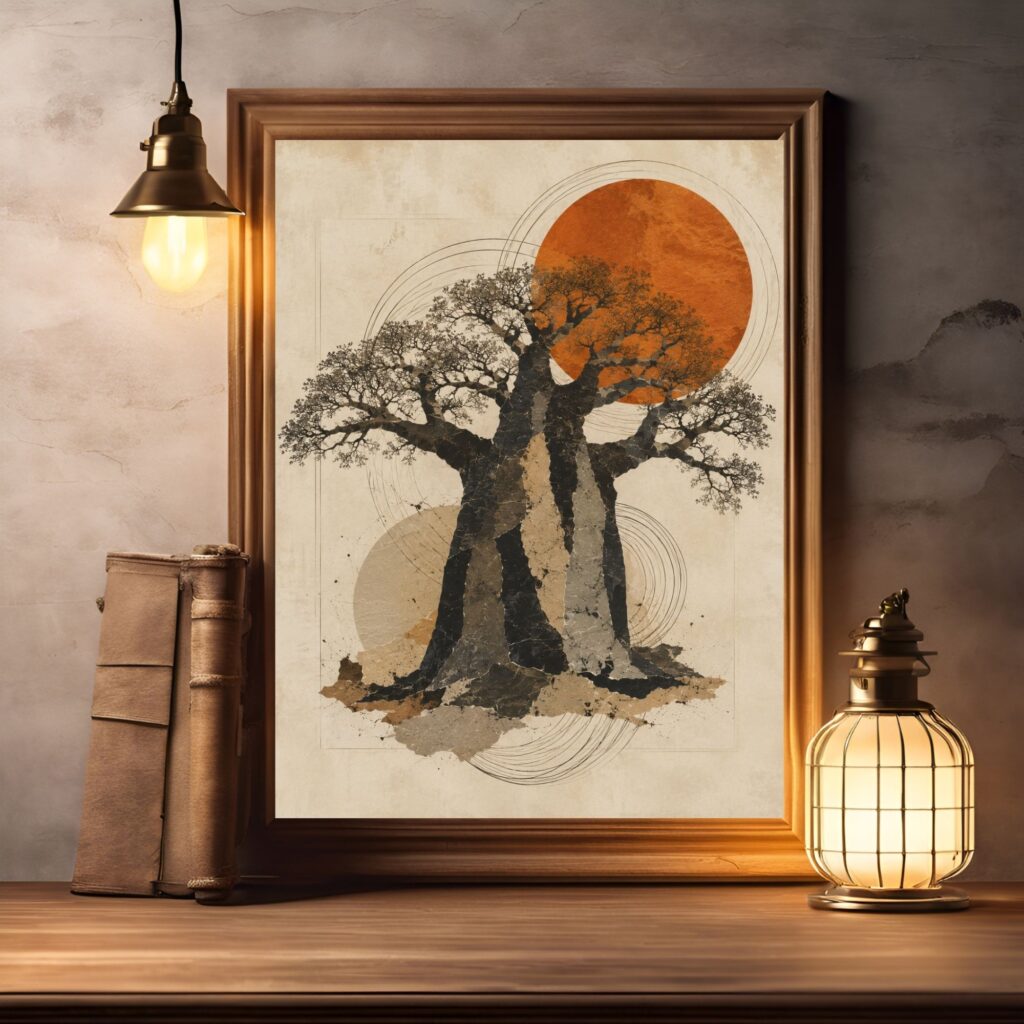
In contemporary afrocentric wall art, the baobab most often appears silhouetted against warm sunset gradients or as stylised illustration with the trunk’s mass emphasized. Both versions carry the meaning; what matters is scale — a baobab print wants to be the largest thing on its wall, for reasons the tree itself would consider obvious.
Nyame Dua: the Akan tree of God
Among the Akan of Ghana, the Adinkra symbol Nyame Dua means “tree of God.” The original was not an artwork but an altar: a forked branch — usually cut from a specific tree with three or more prongs — set upright in the yard before a house, holding a vessel of water and offerings. It marked the household’s standing relationship with the divine: protection asked for, protection acknowledged.
As a drawn symbol in the Adinkra system, Nyame Dua is among the most spiritually weighted of them all — the compact form of “God is present in this house.” Where Sankofa speaks to memory and Gye Nyame to God’s supremacy, Nyame Dua speaks to shelter.
That meaning suggests its placement. In contemporary homes, a framed Nyame Dua works best at thresholds and in quiet corners: the entryway, where the original altars stood; a reading corner; above a small table that functions, whether you name it so or not, as the house’s intentional space. It sits naturally alongside its sibling symbols — our 12 Adinkra symbols guide covers the full family, and the Adinkra Symbol Set of 5 hangs five of them, Nyame Dua’s kin, as one coordinated wall.
The ancestral family tree
Beyond the baobab and Nyame Dua stands the broadest version: the tree as family. Roots as the ancestors — named or lost; trunk as the living generation; branches and leaves as children born and coming. Many African cultures use exactly this visual grammar in textiles, carvings and painting, and it is the version that resonates hardest across the diaspora, where the roots half of the image carries the weight of interrupted genealogy.
This is why an African tree of life print in a diaspora home is rarely “just decor.” It stands in for family records that the Middle Passage erased; it says the line continues in a single image. Commissioned versions make the statement literal — custom family-tree pieces with actual names lettered onto branches — and they have quietly become one of the most meaningful gift categories in afrocentric art: weddings, first babies, grandparents’ anniversaries.
Choosing the right tree for your room
The three traditions style differently, and choosing between them is really a question about what you want the wall to say.
Choose the baobab when the room needs warmth and presence — living rooms, dining rooms, any gathering space. Sunset-palette baobabs bring terracotta, ochre and rust, which lock into the warm earth palettes we map in the African color palette guide.
Choose Nyame Dua when the space is quiet and the meaning should be too — entryways, studies, bedrooms, meditation corners. Black-on-cream, thin frame, modest size; it works as punctuation, not headline.
Choose the ancestral tree when the story is explicitly family — above the sideboard where holiday dinners happen, the stairwell of family photos, the nursery. This is the version to commission rather than buy off the shelf if budget allows.
Unsure which speaks to your overall style? Our two-minute Afrocentric home style quiz sorts that out before you spend anything.
How to style tree of life art
As the anchor. One large piece — 18×24 or bigger — above the sofa, bed or console, hung with its center 57–60 inches from the floor. The tree does the cultural work; the styling around it should be almost embarrassingly restrained: one clay vessel, one brass object, one textile. Our gallery wall and hanging guide covers the mechanics.
At the threshold. A smaller framed Nyame Dua or baobab by the front door greets the household and its guests — the modern echo of the yard altar and the palaver shade.
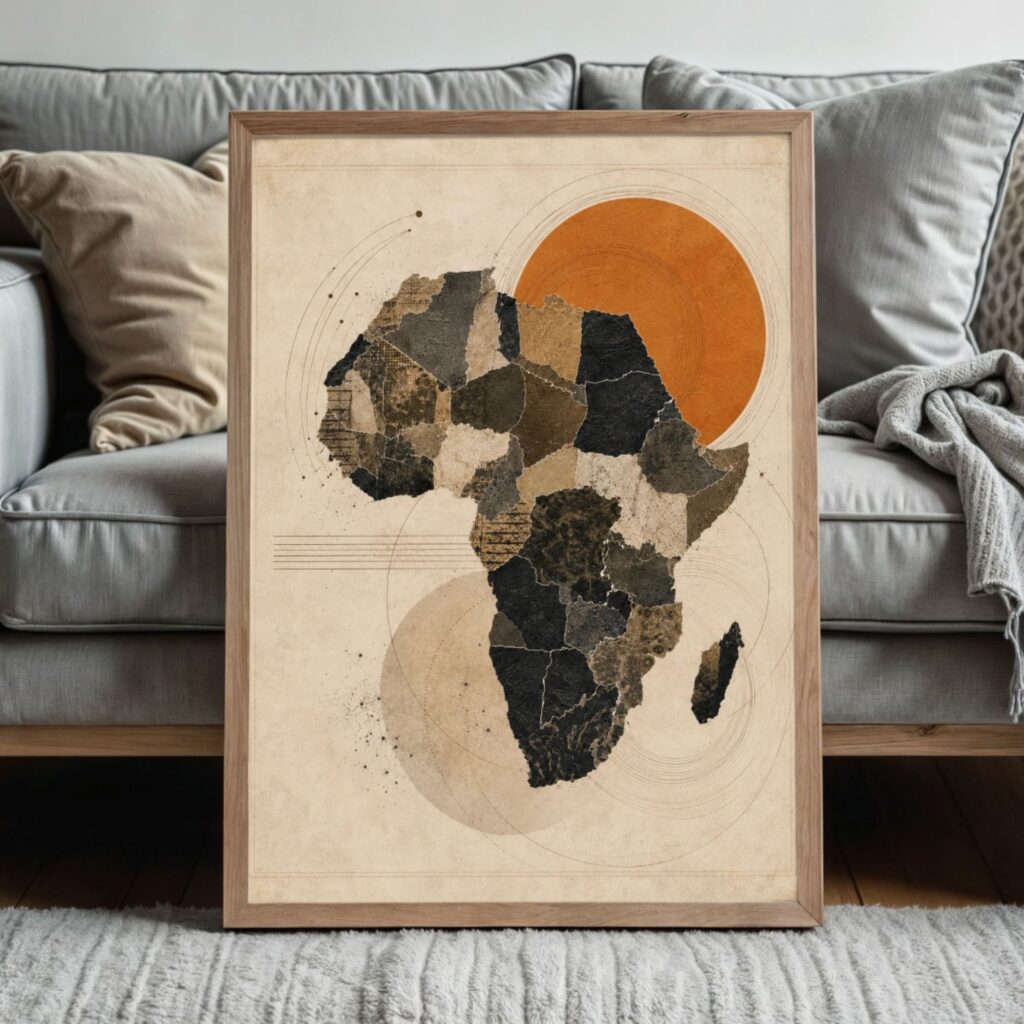
In conversation with the continent. The strongest two-piece wall we know in this theme: a tree of life beside an abstract Africa map — the place and the lineage, geography and genealogy, in the same palette.
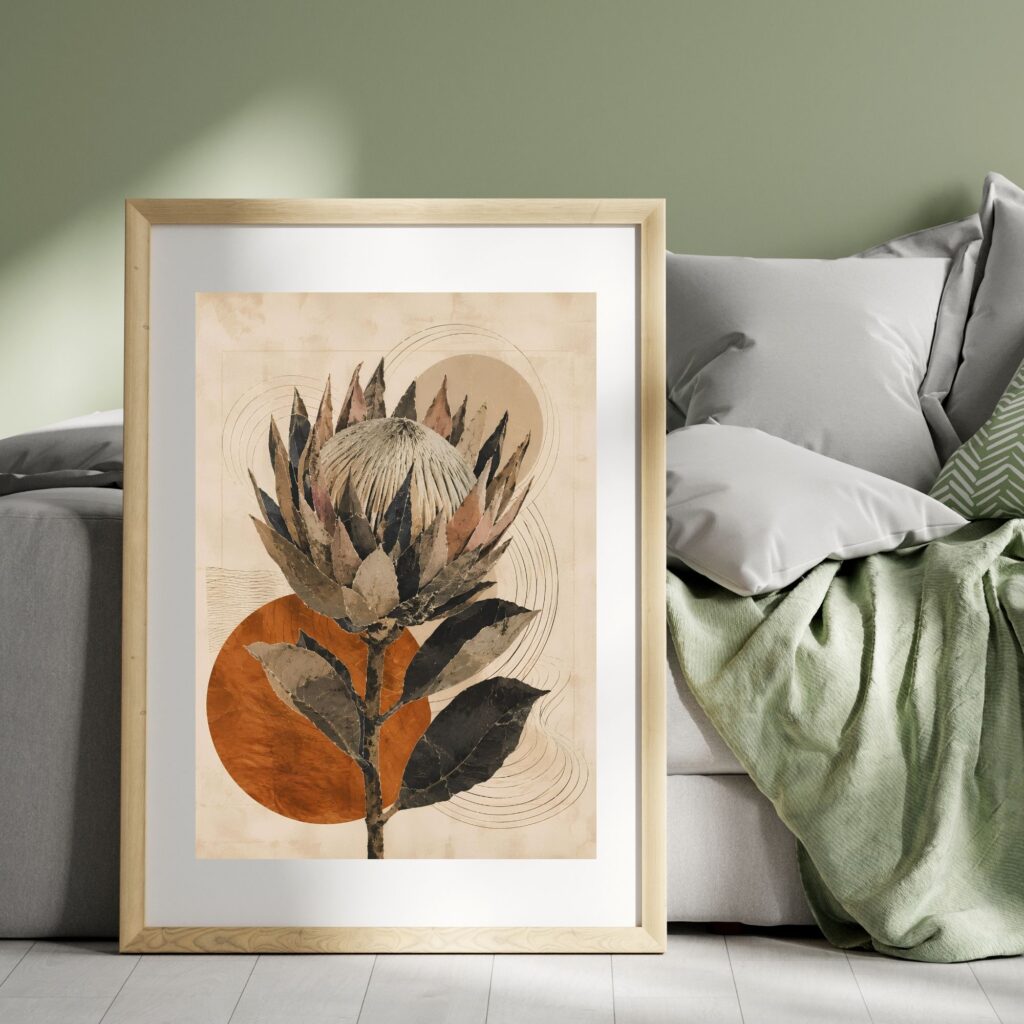
A Kilimanjaro landscape print or a Protea flower print extends the same natural-monument language where a third piece is wanted.
With living echoes. A tall plant near tree of life art is almost too on-the-nose, and works anyway — a dracaena or fiddle-leaf fig repeats the vertical line and keeps the wall from feeling like a museum label. A small bowl of cowrie shells on the console below adds the ancestral-object layer; our cowrie shell meaning guide explains why those two belong together.
What to avoid. Mass-market “tree silhouette” decals and generic swirl-trees with no cultural specificity. The tree of life matters because of its traditions; strip those and what remains is a shape. If a listing cannot tell you which tree and whose tradition, keep scrolling.
Where to source meaningful tree of life art
Independent artists on Etsy. Search “baobab wall art,” “African tree of life” or “Nyame Dua print” and favor shops that name the maker and the tradition. Prints run $15–80; originals higher. From our own shop, the Modern Africa Wall Art collage carries the geographic-ancestral theme that pairs most naturally with tree pieces while our baobab and Nyame Dua collection is in the works.
Amazon. Several African tree of life prints with credible cultural framing sit in the $25–60 range — read the description for the actual tradition, not just the keyword.
Creative Fabrica. For printables you can size to your exact wall — and patterns to coordinate pillows or table linens around the art — Creative Fabrica’s afrocentric bundles run $5–15 with generous licenses; it is the same catalog we use for pattern work in our own production.
Custom commissions. For the ancestral version with real names, Etsy’s custom family-tree designers charge $80–300 depending on branches and detail. Allow 2–4 weeks, and have your names and dates ready — gathering them from relatives is, fittingly, half the gift.
Three tree-of-life walls that work
The living room anchor. A 24×36 sunset baobab in a walnut frame above a cream sofa; below and to the side, one tall dracaena in a woven basket planter. Terracotta and ochre pillows repeat the print’s palette; nothing else on the wall. This is the highest-impact version and the easiest — one purchase, one nail, done. The print’s warmth carries the room through winter, which is precisely the baobab’s résumé.
The entry threshold. A 12×16 black-on-cream Nyame Dua in a thin oak frame beside the door, at eye level where keys are grabbed and coats go on. A small shelf beneath holds a clay dish and one candle. Guests rarely comment on it; households report noticing it every single day — which is the difference between decor for visitors and decor for the people who live there.
The stairwell lineage. An ancestral family tree print — commissioned, names on branches — hung at the stair landing among framed family photographs. The tree gives the photo wall its thesis; the photos give the tree its proof. Of the three builds, this one takes longest to assemble and is the only one that makes relatives cry at holidays, which is how you know it is working.
Print, frame and light it right
Large tree-of-life pieces reward a little printing discipline. At 18×24 and above, use a print shop rather than a home printer and ask for matte or lustre stock — sunset gradients band visibly on cheap gloss. Frame warm: walnut and oak for baobabs and ancestral trees, thin matte black or oak for Nyame Dua; brushed brass works if the room already carries brass. Skip reflective glass on sunset prints or hang them opposite a blank wall, because a window reflected in a 24×36 glass front erases the artwork daily at exactly golden hour, with no sense of irony.
Light it warm — a 2700K picture light or a nearby lamp — and the ochres deepen; light it cool and the same print goes muddy. And as with the free print projects covered in our DIY printable guide, always print a letter-size test strip of the darkest area before committing to the full sheet.
The tree of life as a gift
If one theme in this article deserves a practical postscript, it is gifting. A tree of life print is the rare present that fits every family milestone on the calendar: a wedding (two lines joining one trunk), a birth (a new branch), a new home (roots going down), an anniversary or a grandparent’s birthday (the whole tree, finally visible). The commissioned ancestral version with real names is the heirloom tier, but even a well-chosen baobab print, framed in walnut and given with its story written on a card, lands with a weight that gift cards never will.
For housewarmings specifically, it pairs naturally with the ideas in our Afrocentric housewarming gift guide — and because printables travel as files, the same purchase can be printed once for the recipient and once, quietly, for yourself, which is entirely legal within personal-use licensing when both homes are yours to decorate. For gifting beyond your household, a second license is the honest route; it costs less than the frame.
Frequently asked questions
Is the tree of life only an African symbol?
No — the Norse Yggdrasil, the Celtic Crann Bethadh and the Jewish Etz Chaim all use the tree the same way. What makes the African versions distinct is the specific tree (usually the baobab), the specific traditions (Nyame Dua above all), and the ancestral weight the motif carries across the continent and diaspora.
Where should I hang a tree of life print?
Entryways (the threshold tradition), family and dining rooms (the gathering tradition), and bedrooms or quiet corners (the Nyame Dua register). Anywhere works if the piece gets enough wall to breathe — the tree of life crowded between shelves loses its authority.
Can I get a custom ancestral family tree designed?
Yes — independent designers on Etsy specialise in afrocentric family trees at $80–300. Provide names, relationships and any dates; ask for a printable file in addition to any framed option so future branches can be added and reprinted.
What size should tree of life art be?
Larger than instinct says. 18×24 minimum above furniture; 24×36 above a sofa on a generous wall. The motif’s whole argument is rootedness and presence — a timid 8×10 tree of life argues against itself.
What pairs well with the tree of life?
Sankofa, for the shared go-back-and-fetch ancestry theme — the free Sankofa print is the zero-cost way to test the pairing. Gye Nyame beside Nyame Dua for the divine register. Cowrie shells and hand-thrown ceramics at surface level. And warm, living materials everywhere: wood, jute, linen, clay.
Related reading
- 12 Adinkra Symbols & Their Meanings: The Symbolism in African Art — Ghana
- Cowrie Shell Meaning in African Decor: Symbolism & Use
- African Motifs Explained: Adinkra, Kente, and Mudcloth
- Africa Map Wall Art: A Cultural Decor Guide for Soulful Homes
- How to Set Up a Gallery Wall — Print, Frame, Hang & Light
Closing
The tree of life is one of the few wall art motifs that carries real generational weight. Hung well — the right tradition for the room, at a scale that respects the subject, sourced from someone who can name the tree — it becomes the piece your children or grandchildren remember. Not decoration; inheritance — the only decor category where the compliment you are aiming for arrives a generation late, and is worth the wait.