12 Adire Patterns and Their Meanings: A Decor Lover’s Guide
By Essence of the Road Art · Published September 2026
This article contains affiliate links. If you buy through them, we may earn a small commission at no extra cost to you. We only feature pieces we would live with ourselves.
Why we wrote this
In its 2026 trend report, Pinterest named Afrohemian decor one of the looks of the year, with searches for “afrobohemian home decor” up 220%. A little further down the same list sat a more specific number: “adire fabric”, up 130%.
That second figure is the one that caught us. People are no longer saving “African textiles” in general; they are asking for one cloth by name. Yet search for what that cloth actually says and the answers are thin: a tie-dye tutorial, a few shop listings, an encyclopedia entry. Nothing for someone holding a length of indigo, wondering what the little pictures mean.
So here is that guide: twelve adire patterns, the three techniques that make them, and an honest note on which belong on a wall. After the Moroccan, Kongo and Ethiopian guides, it is also the first textile in our Symbols & Meaning series.
We are not Yoruba. We make Afrocentric wall art, and adire is the textile that most directly shaped our own indigo work. Every pattern name and meaning below has been checked against at least two sources, from Yoruba scholars and writers to museum collection records, because meaning is the one thing a decor blog should never improvise.
📌 Quick Answer
Adire patterns and meanings come from the hand-dyed indigo cloth of Yoruba women in southwestern Nigeria, and they work at two scales. Whole cloths carry names: Olokun (the deity of the sea; wealth and depth), Ibadandun (“Ibadan is sweet”) and Sun Bebe (“lift up the beads”). Inside them sit motifs: cowries for wealth, the tree of life for growth, spirals for the cycle of life, guinea corn for provision, the wall gecko for a stable home, pillars for support, the crossroads for decisions, the chameleon for adaptability and nested squares for long life. Almost all can live on a wall; Olokun needs context, and the Ifá divination tray is the one motif we leave out. For the indigo mood in print, our Black Woman Reading Wall Art in indigo and ochre is the closest piece we make.
Table of Contents
A note on names, makers and care
Adire is women’s work. Among the Yoruba the craft passed from mother to daughter, each family keeping its own sequence of designs. Men arrived only in the 1930s, when sewing machines and cut-metal stencils entered a trade done entirely by hand.
Abeokuta, the Egba capital in Ogun State, is its heart. Histories credit Chief Jojolola Soetan, the second Iyalode (head of women) of Egbaland, with building the trade in the Kemta and Itoku quarters in the early twentieth century, and the Kemta adire market still involves well over a thousand women. Ibadan became known for its hand-painted cloths, and Osogbo for the workshops that kept the craft alive after its mid-century decline.
Three things follow. Spellings vary: the same cloth appears as Ibadandun, Ibadadun or Ibadan dun. Meanings were handed down by word of mouth, so written sources sometimes disagree; where they do, we say so. And not every indigo cloth is adire. Shibori, batik and factory “tie-dye” all get sold as African indigo, and even meaningful West African cloths are read differently: kente is woven strip by strip, adire is dyed. Adire is Yoruba, resist-dyed and made by hand.
Three ways to make adire
Every adire pattern starts with one idea: stop the indigo reaching part of the cloth. What changes is how, and the method draws the pattern before any motif does.
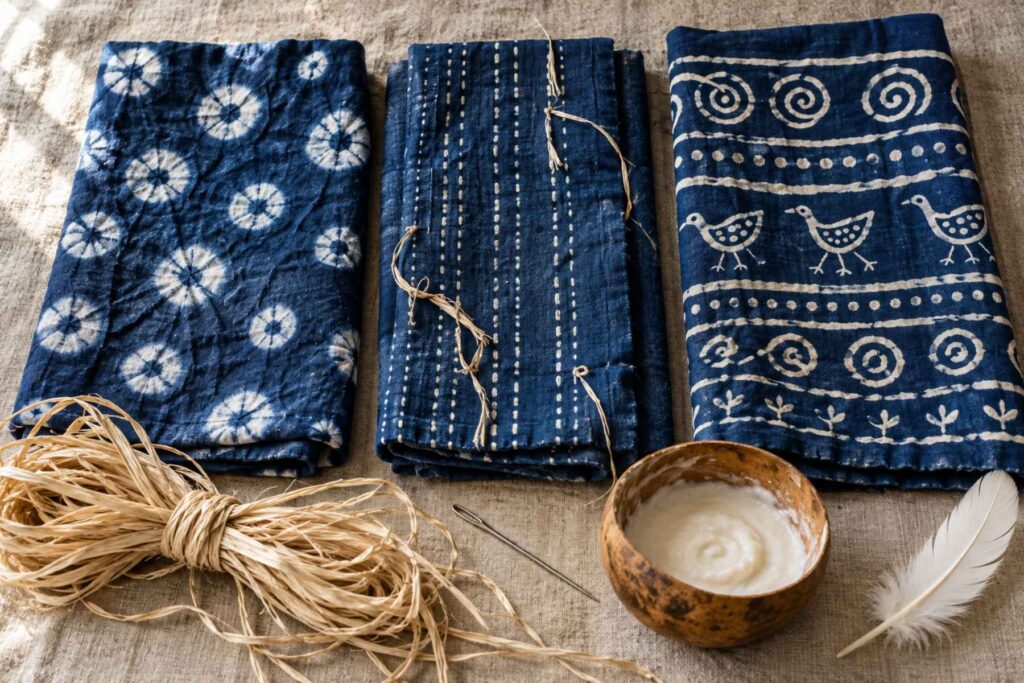
Oniko: tied. Raffia is bound tightly around seeds, pebbles or pinches of cloth. Each bound point stays pale, so oniko reads as constellations of small white circles, or as stripes where the cloth was folded and tied.
Alabere: stitched. The name comes from the needle. Raffia or thread is sewn through the cloth and pulled tight, and when the stitches come out, fine broken lines remain. Some makers leave the raffia in.
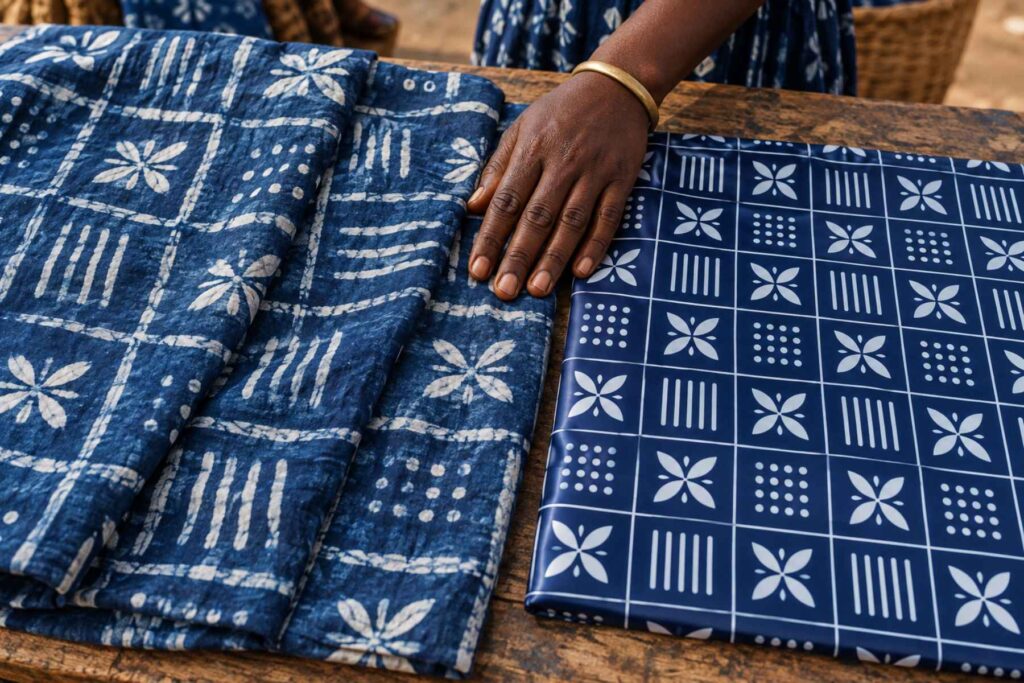
Eleko: starch resist. The youngest and most admired technique, dating from around 1910. Cassava paste is painted on freehand with chicken feathers, a palm-leaf midrib or a matchstick for dots. The cloth goes into the indigo vat again and again, darkening with each dip, before the starch is washed out and the drawing appears white on blue. From the 1930s men cut stencils from the tin lining imported tea chests, and stencilled eleko became the faster cousin of the painted cloth.
The shorthand: dots mean tying, broken lines mean stitching, drawn pictures mean starch.
The 12 patterns, one by one
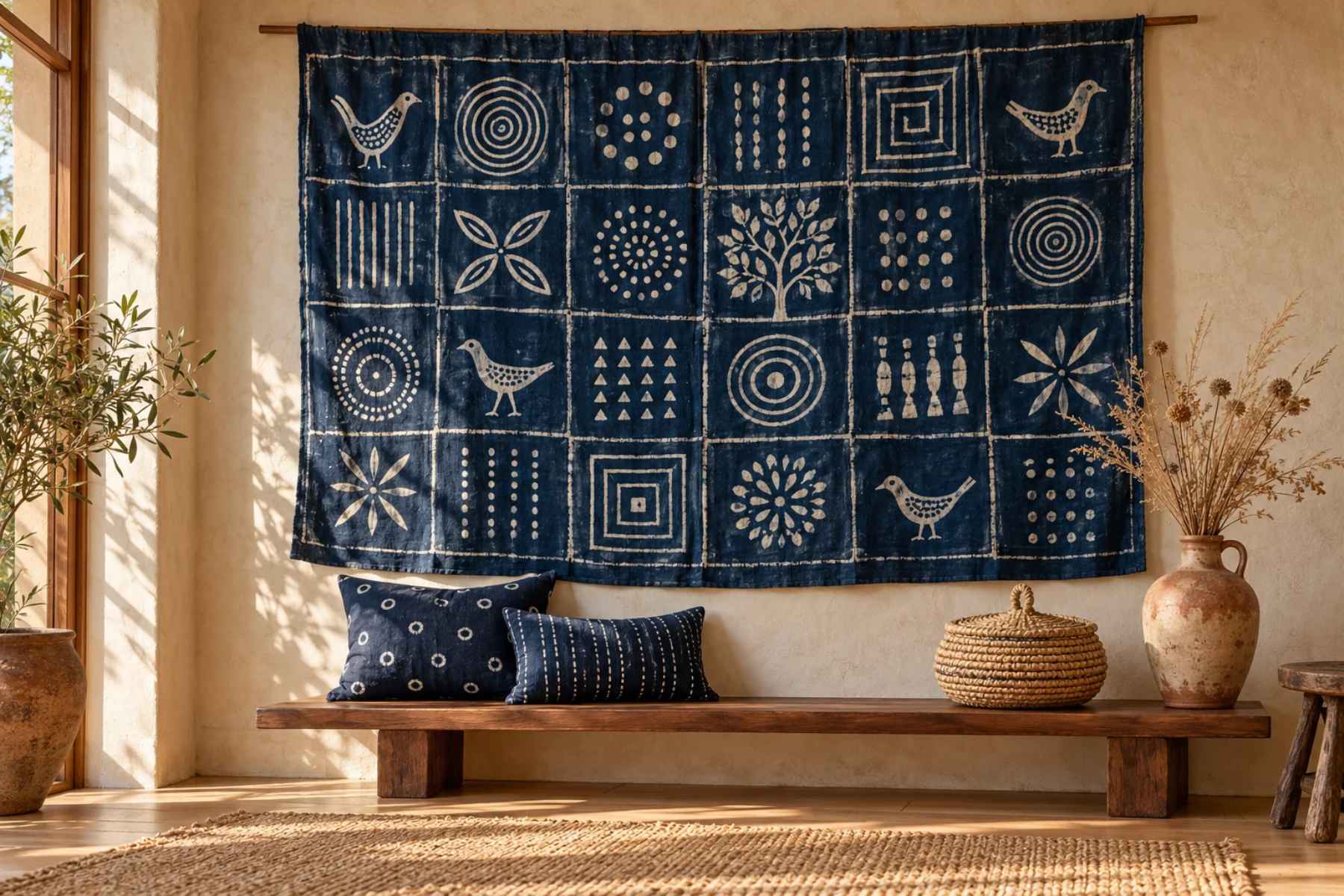
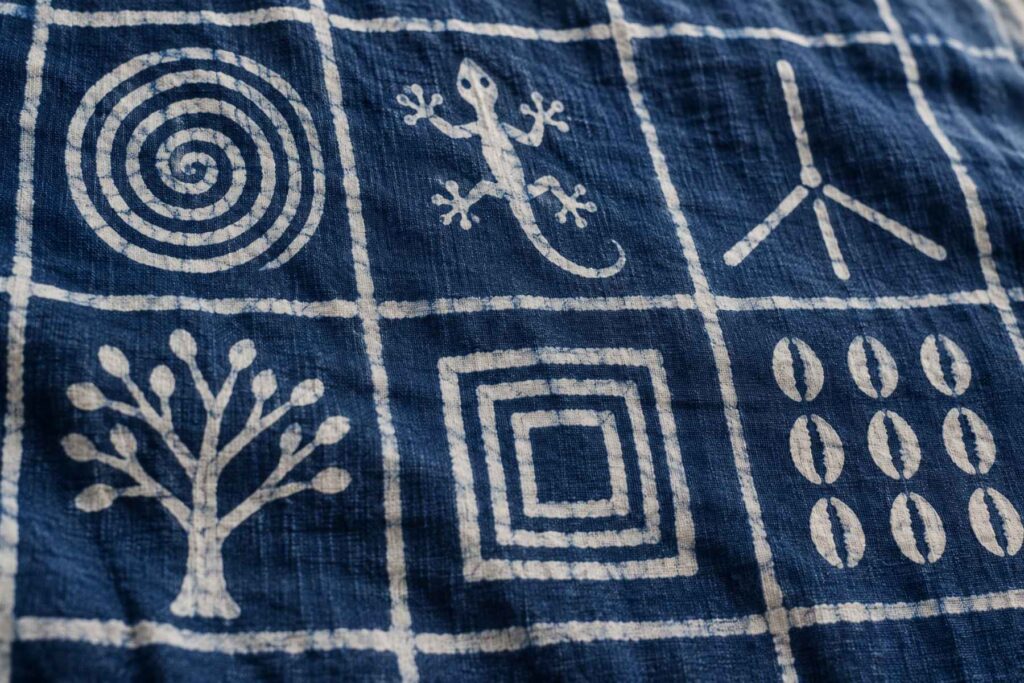
The first three are whole cloths, compositions a buyer would ask for by name. The other nine are motifs that live inside them, one square at a time.
1. Olokun: the deity of the sea
What it looks like: large squares crowded with birds, lizards and crocodiles, often with a four-legged stool among them.
What it means: named for Olokun, the Yoruba deity of the sea, the cloth is read as wealth and the mystery of deep water. Treat it as a sacred name, not a colourway.
2. Ibadandun: “Ibadan is sweet”
What it looks like: a grid four squares deep and seven across, every square different. The signature square shows the pillars of Ibadan’s hilltop Mapo Hall alternating with spoons.
What it means: civic pride, drawn by hand. The spoons were read as a mark of quality, and five was the best. Of the named cloths it is the easiest to live with: it praises a city, not a deity.
3. Sun Bebe: “lift up the beads”
What it looks like: abstract shapes floating on a ground of tiny circles.
What it means: the name is agreed; the reading is not. Yoruba scholars Margaret Areo and Rom Kalilu read it as the sensuous raising of women’s waist beads, while a Nigerian textile guide sees royal crown beads in the dotted ground. Its quiet, all-over rhythm suits cushions best.
4. Owo ẹyọ: cowrie shells
What it looks like: small ovals with a slit down the middle, alone or in rows.
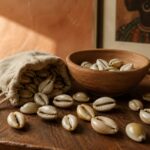
What it means: wealth and prosperity. Cowries were money across Yorubaland, and owó is still the Yoruba word for money. We follow the shell across the continent in our cowrie shell meaning guide.
5. Igi Iye: the tree of life
What it looks like: a single branching tree filling its square.
What it means: growth and strength. Its cousin is Igi Odan, the market tree, and both sit happily beside the tree of life in wider African art.
6. Olókòtó: concentric spirals
What it looks like: a spiral winding out from a centre, or rings inside rings.
What it means: the cycle of life: we start small and grow bigger. A close relative, Òkòtó, adds a sharper edge: every stage of life is short. Echo it at home with a coiled basket or a round mirror.
7. Ọka bàbà: guinea corn
What it looks like: heads of grain, often with birds pecking at the seeds.
What it means: provision that arrives without strain; the saying runs, the hand that feeds you will never lack. Made for a kitchen or dining wall.
8. Ọmọnile: the wall gecko
What it looks like: a small lizard, splayed flat as if clinging to a wall.
What it means: its name translates as “child of the owner of the house”, the heir. It was drawn for mothers who had lost children, as a wish that the next would stay and grow old. Today it reads as a peaceful, stable home.
9. Òpó ilé: the pillar
What it looks like: upright columns, the same pillars that anchor Ibadandun.
What it means: strength and support, the posts that hold a house up. The saying beside it: what you struggle to get lasts longer.
10. Orita mẹta: the three-way crossroads
What it looks like: three lines meeting at a point, or lines crossing inside a square.
What it means: a decision, and the reassurance that a hard road still arrives. Areo and Kalilu add that crossroads mark the meeting of the physical and spiritual worlds, which makes it a natural motif for an entryway.
11. Agẹmọ: the chameleon
What it looks like: a chameleon, recognisable by its curled tail; it is also called Ọ̀ga.
What it means: adaptability, and the knack of slipping out of danger. Areo and Kalilu read it as the creature that neutralises the schemes of one’s enemies.
12. Ogbó: concentric squares
What it looks like: squares nested inside squares, a pattern also called Atọ.
What it means: long life and prosperity. Ogbó is the Yoruba word for old age, so the pattern works like a blessing drawn in lines, and it is the most modern-looking motif in adire.
Which of the twelve belong on a wall
Most of them. Adire was made for the market: in the 1920s Senegalese merchants were buying up to two thousand wrappers a day in Abeokuta. Ibadandun, Sun Bebe, cowries, guinea corn, pillars, the gecko, spirals and nested squares were made to be worn in public and sold, and living with them is what they were for.
Olokun needs context. It carries the name of an orisha who is still worshipped. Olokun cloths were sold and worn too, so it is not off-limits, but hang it as what it is: a whole cloth with a wall of its own, never cut into cushions, its name known if someone asks. Dyeing itself was placed under the protection of Iya Mapo, the orisha who guards women’s crafts.
One motif we leave out entirely: Opon Ifá, the tray on which Ifá divination is performed. It does appear on adire, but it belongs to a working religious practice, and it is the one line we do not cross in a decor guide.
How to live with adire at home
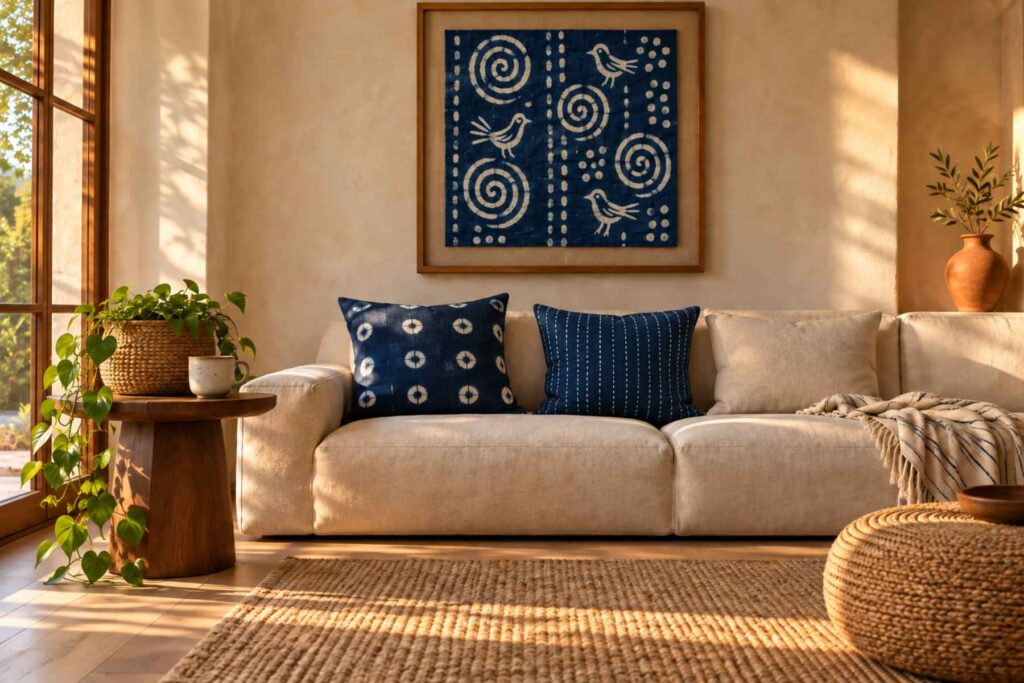
Start with three companions: indigo, warm wood and natural fibre. Indigo is cool and deep; oak, walnut, raffia, jute and cane warm it. We go deeper into the blue in our indigo decor guide.
Hang a whole cloth, or frame a square. A wrapper hung loose from a wooden tapestry hanger lets every square be read. A single square from a cloth that is already worn looks beautiful in a deep shadow box frame.
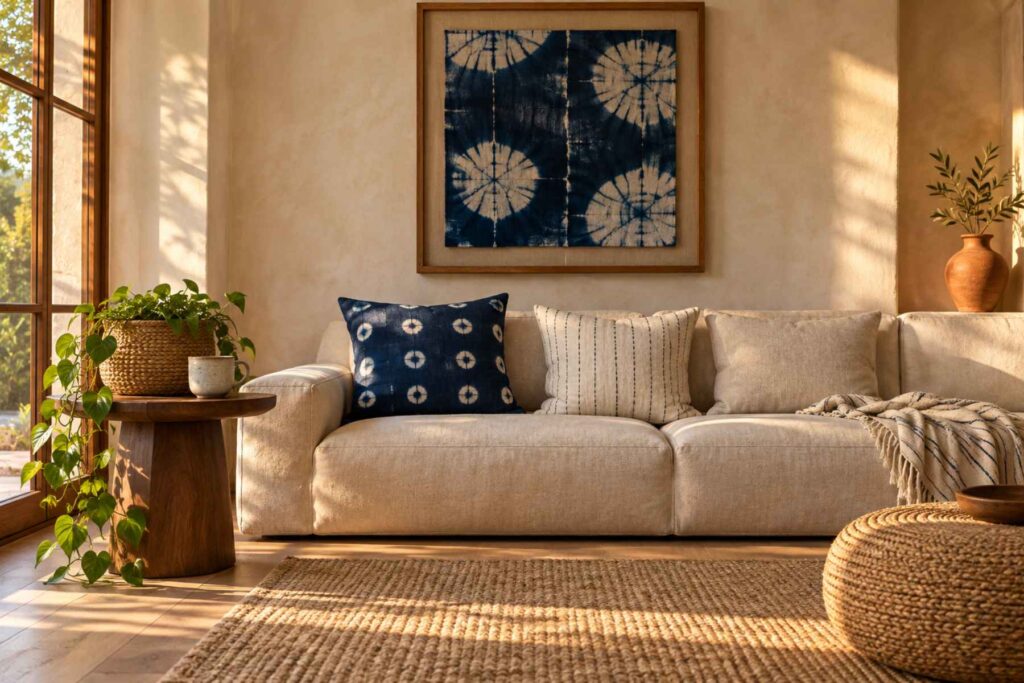
Mix techniques, not motifs. One eleko cushion, one oniko cushion, one plain linen. Different methods in one indigo look collected; three copies of one motif look like a shop display.
Build the palette in five colours: indigo, chalk white, warm oak, raffia cream and a single note of terracotta or rust. A coiled seagrass basket covers two at once, and our Nigeria colour palette takes the scheme further.
Use adire-inspired art where cloth would not survive. Kitchens, bathrooms and sunny walls are hard on real textile, so let prints carry the mood: our Black Woman Reading Wall Art in indigo and ochre, whose polka-dot dress nods to oniko dots, pairs well with our Indigo Africa Map print. They are inspired by adire, not adire. Printing at home? Our print, frame, hang and light guide covers paper and sizing.
What to look for when buying
Look for difference, not perfection. Hand-painted eleko is drawn square by square: a classic Ibadandun repeats no motif, and one museum Olokun repeats only five of its twenty blocks. A factory print repeats perfectly, and imported prints copying adire now crowd Nigerian markets, to the protest of Abeokuta’s producers.
Read the surface. Tied and stitched cloths keep puckers and crease lines from the binding, some alabere pieces still carry their raffia, and natural indigo varies in depth across the cloth.
Ask the technique. A maker will answer oniko, alabere or eleko without hesitating. “Adire print” is a print.
Buy from the source. In Abeokuta, the adire market in Itoku is where women dyers sell their own cloth. Online, buy from Nigerian makers and diaspora designers. If you design adire-inspired pieces yourself, Creative Fabrica is where we source indigo pattern and brush bundles.
FAQ
What does the word adire mean?
“Tied and dyed”, from the Yoruba adi (to tie) and re (to dye). It names the process rather than the product, and around 1900 it came to mean indigo cloth patterned by resisting the dye.
Is adire the same as batik?
No. Classic adire eleko resists the dye with cassava starch; batik uses wax. Nigerian makers took up wax from the 1960s for a cheaper, multicoloured cloth called kampala, so some modern cloth sold as adire is technically batik.
What is the difference between adire and mudcloth?
Adire is Yoruba cloth from Nigeria, patterned by blocking indigo. Mudcloth, or bogolanfini, is made by Bamana women in Mali, who paint fermented, iron-rich mud onto cloth first dyed in a leaf bath. Our mudcloth patterns and meanings guide covers bogolan, and African motifs explained sets both beside adinkra and kente.
Can I decorate with adire if I’m not Yoruba?
Yes. Adire was made to be sold, and it travelled far beyond Yorubaland. Respect lies in the how: buy from makers, learn the names, give Olokun its context and leave Opon Ifá alone. Our respectful guide to African textiles sets out the wider approach.
What colours are traditional in adire?
Indigo and white: undyed cotton against blue that runs from sky to near-black, depending on how many times the cloth was dipped. Multicoloured adire arrived much later, with kampala.
Where is adire made today?
Abeokuta remains the centre, with its markets in Kemta and Itoku. Osogbo is home to the art centres of Nike Davies-Okundaye, who has trained thousands of young women in the craft, and a new generation of Nigerian designers has carried adire into international fashion.
A closing note
There is a detail in Ibadandun we keep coming back to. A cloth that announces “Ibadan is sweet” also grades itself, quietly, by the number of spoons beside its pillars. Five was the best.
That is a textile that expects to be read closely. Every square is different, every motif has a name, and a woman drew each one with a feather, knowing someone would stand in front of it and look. So hang it where someone will, and let it be read one square at a time.
Also read:
- Kente Cloth Patterns and Meanings: How to Read Ghana’s Royal Weave — the woven counterpart
- Mudcloth Patterns and Meanings — Mali’s painted cloth
- A Respectful Guide to African Textiles and What They Mean
- African Motifs Explained: Adinkra, Kente and Mudcloth
- 12 Ethiopian Symbols and Their Meanings: A Decor Lover’s Guide — the previous guide in this series
- Nigeria Colour Palette — the palette behind adire
- Indigo Decor and Afrocentric Wall Art
- Cowrie Shell Meaning in African Decor
A small invitation
If you are building a home around meaning rather than trend, you may like our free Afrocentric Gallery Wall Guide: a short curatorial reference for walls that mix textiles, symbols and prints, with three layout patterns, framing notes and the spacing rules we use at home. It arrives in one quiet email, just the PDF and a note from us.
Shop the Essence of the Road Art collection
Every piece below is our own work: digital downloads you print at home, in the indigo, cream and earth palette this article describes.
- Essence of the Road Art on Etsy — the full collection
- Black Woman Reading Wall Art, Afrocentric Print in Indigo and Ochre — the closest piece we make to adire’s indigo and white
- Indigo Africa Map Printable Wall Art — a single indigo accent for a textile wall
- Africa Map Wall Art Set (3), Terracotta Textile Print — textile-patterned maps in the warm half of the palette
- Africa Map Textured Collage Print — a mixed-media surface that reads like cloth
- Adinkra Symbol Wall Art Set (5) — five West African symbols for a symbol-led wall