12 Kenyan Symbols and Their Meanings: A Decor Lover’s Guide
By Essence of the Road Art · Published October 2026
This article contains affiliate links. If you buy through them, we may earn a small commission at no extra cost to you. We only feature pieces we would live with ourselves.
Why we wrote this
Search for Kenyan decor and you get one thing: red. Maasai red, over and over, on cushions, lampshades and prints, as though a country of forty-plus peoples had a single colour.
The Maasai are about two percent of Kenya’s population.
The other ninety-eight percent is the more useful part for anyone decorating a room. Kenya has a coast that built an architecture around displaying objects beautifully, a cloth that prints a proverb on itself, a basket with a famous theft story that turns out not to be true, a stool that is also a pillow, and a pink stone carved by hand in one small town in the west.
None of that is in the gift-shop version. So this guide skips the postcard: twelve Kenyan symbols in three groups — the Swahili coast, the highlands, and the Rift and the north — with what each means, one thing you can do with it, and a straight answer on which should never be bought.
We are not Kenyan. We make Afrocentric wall art, and most of what follows belongs to other people. We have written it with sources, with care, and with the differences left in.
This is the third East African guide in our Symbols & Meaning series, after Tanzania and Ethiopia.
📌 Quick Answer
The twelve most significant Kenyan symbols fall into three families. From the Swahili coast: the kanga and its printed jina proverb, the carved Lamu door, the zidaka display niche and the woven kikoi — cloth that speaks, a doorway that announces a household, wealth shown through what it displays, and the Indian Ocean in a stripe. From the highlands: the mugumo fig, Kirinyaga, the kiondo and Kisii soapstone — sacred ground you do not plant, the mountain of brightness, a communal craft nobody owns, and pink stone cut by hand. From the Rift and the north: the Turkana ekicholong, the beaded milk gourd, the circular enkang and Mijikenda vigango — a seat that travels, milk as wealth, a plan built around cattle, and ancestors who must never be moved. The kanga, kikoi, kiondo, soapstone and the zidaka idea are the ones we recommend living with; vigango must never be bought. For a symbol-led gallery wall, our Adinkra Symbol Wall Art Set (5) is the closest printable set we make.
Table of Contents
- A note on names, peoples and care
- Kenya and Tanzania are not the same visual language
- The Swahili coast — pattern that talks
- The highlands — sacred ground and skilled hands
- The Rift and the north — objects that travel
- How to live with Kenyan symbols at home
- What to look for when buying — and what to avoid
- FAQ
- A closing note
A note on names, peoples and care
Kenya is not one culture. More than forty ethnic groups live there, speaking languages from three unrelated families. The Swahili coast, the Kikuyu highlands, the Gusii west and the pastoral north are different traditions sharing a border drawn in Berlin.
Swahili is a coastal civilisation, not a tribe. It names a people, a language and a thousand-year-old Indian Ocean trading culture linking the Kenyan coast to Oman, Gujarat and southern China — which is why the first group below looks less like “African decor” than you expect and more like a conversation between three continents.
Some of this is not for sale. One symbol here — the vigango memorial post — is actively stolen from families and sold abroad. It is included so you can recognise one and refuse it.
Kenya and Tanzania are not the same visual language
Tanzania’s best-known traditions are the Maasai shuka, Makonde mask carving and Tingatinga painting — all three are in the Tanzania guide. Kenya shares the Maasai and the Swahili coast with it and almost nothing else; its own traditions are coastal architecture and cloth, highland basketry and stone, and the portable objects of the pastoral north.
The practical version: if your room already has a shuka or a Makonde piece, nothing here repeats it.
The Swahili coast — pattern that talks
1. The kanga and its jina — a cloth that prints a proverb
What it looks like: a rectangle of printed cotton, roughly 150 by 110 cm, in three zones — a wide border called the pindo, a different central field called the mji, and a strip of Swahili text called the jina.
What it means: jina literally means “name”, and it is the cloth’s message: a proverb, a riddle, a greeting, a political slogan. Traders began printing them in the early 1900s, first in Arabic script and later in Roman letters, and the convention stuck. So a woman can wear a cloth reading siri haidumu milele — a secret does not last forever — without speaking the sentence. Kangas are sold in pairs and given as gifts, so the proverb matters: a discouraging jina handed over at a wedding is a known way of registering disapproval. The name itself probably comes from the guinea fowl, kanga in Swahili, whose speckled plumage the earliest dotted prints resembled.
How to live with it: the best framed textile in the article. Frame one panel so the jina is readable and the piece arrives with its own caption — no other wall hanging answers “what does it say?” with an actual sentence.
2. The Lamu door — lotus, chain, fish and brass
What it looks like: a heavy carved doorway with a deep frame, a central post joining two leaves, rows of blunt brass studs about seven centimetres long, and carved motifs — lotus, date palm, frankincense tree, rosettes on the centre post, a fish at the base of each side post.
What it means: the door was the wealthy coastal household’s public face, and the frame carried the information — carving quality, wood, and a lintel inscription giving a Quranic verse, a date or the owner’s name. The older Lamu style is rectangular and geometric, with deep cuts that catch moving sunlight through the day; the nineteenth-century Zanzibar style added an arched lintel and curling Indian floral work. The two leaves even had names: mlango dume, the male door, on the right, and mlango jike, the female door, on the left.
How to live with it: almost nobody can install one, and that is fine — the transferable idea is the deep frame. A chunky, deep-profile frame around a simple print does what a Lamu door does: it makes the opening matter more than the contents.
3. Zidaka — the wall built to display things
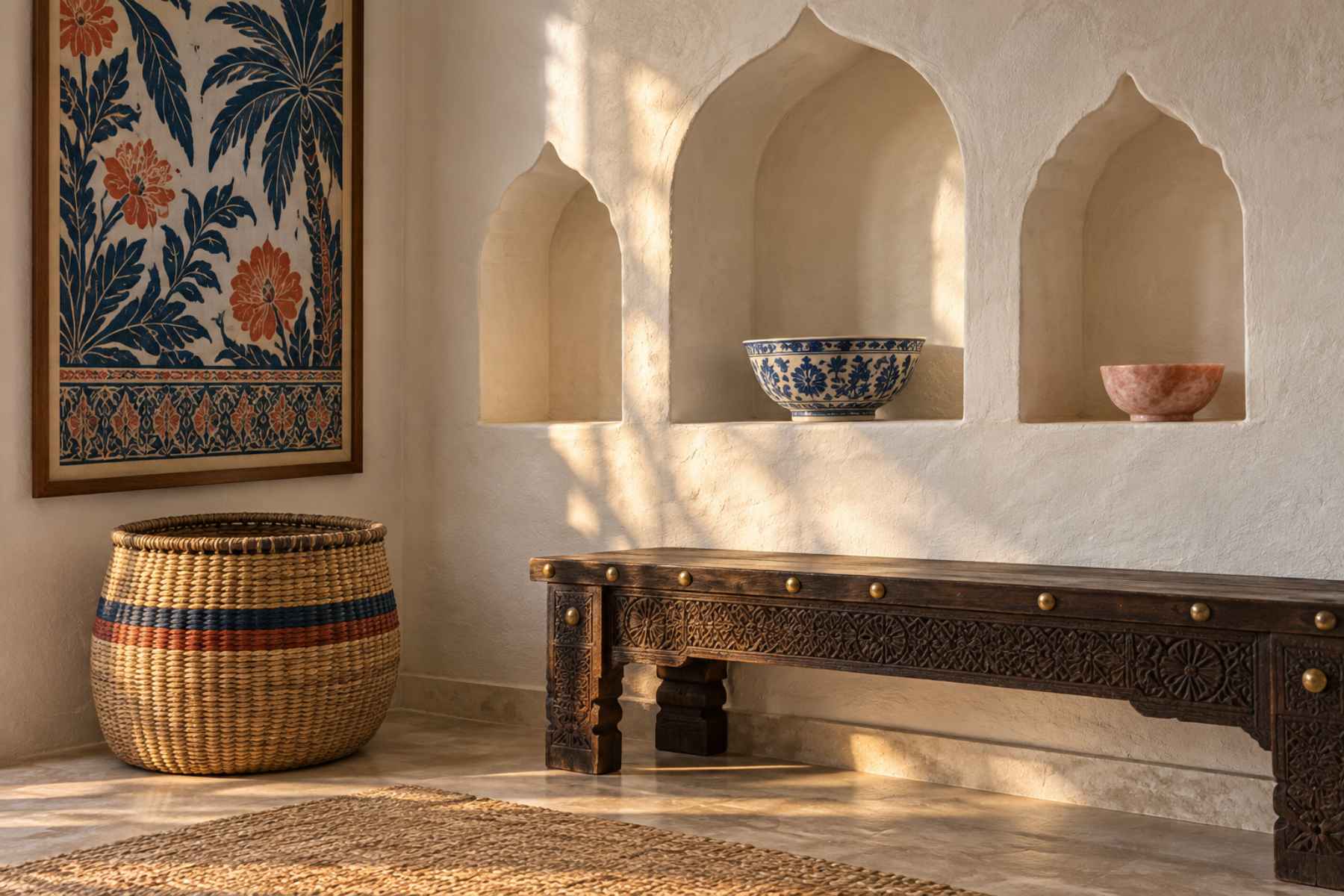
What it looks like: rows of small arched niches cut into a lime-plastered wall, framed in fine plasterwork, sometimes covering a whole back wall.
What it means: zidaka (singular kidaka, from daka, a niche) are the display system of the Swahili stone house. The grandest sets filled the ndani, the innermost room, visible from the courtyard, holding imported Chinese porcelain alongside the Qur’an, oil lamps and water jugs — proof that a family’s trade crossed the Indian Ocean. Their depth also makes a narrow room read as grander, which is why they were the backdrop for weddings.
How to live with it: the most useful idea on this list, and it costs nothing. A floating shelf shows objects in front of a wall; a niche shows them inside it, with a shadow line that reads as architecture. Three shallow recessed boxes painted the same lime white as the wall fake it convincingly. One object per niche, never two.
4. The kikoi — the Indian Ocean in a stripe
What it looks like: cotton with the pattern woven in rather than printed on — fine stripes or checks, often with knotted fringed ends.
What it means: the kikoi is the coast’s everyday cloth, worn wrapped at the waist, out of centuries of exchange between East Africans and their trading partners. Barawa on the Somali coast was famous for weaving it, and one variety, banadir, is named for the Somali textile region. Where the kanga talks, the kikoi is quiet: no message, no central motif, just structure.
How to live with it: the easiest textile here to use at volume, because a woven stripe never fights a patterned cushion. The diagnostic: hold it to the light and the pattern should be in the weave, not on the surface.
The highlands — sacred ground and skilled hands
5. The mugumo fig — the tree you do not plant
What it looks like: an enormous wild fig, buttressed and many-trunked, standing alone in farmland where everything around it was cleared.
What it means: in Kikuyu tradition the mugumo is where prayer and sacrifice happened — at droughts, at planting and harvest, at births, marriages and deaths — offered to Ngai, also addressed as Mwene Nyaga, roughly “owner of the dazzling light”. Crucially, a mugumo is not planted. It is recognised. That is why single enormous figs still stand in cleared fields and beside widened roads in central Kenya: felling one is a thing people decline to do.
How to live with it: take the principle, not the picture. Every good room has one thing not allowed to be moved for convenience — the piece everything else arranges itself around. For the wider motif, see our tree of life guide.
6. Kirinyaga — the mountain of brightness
What it looks like: a black rock summit above the snowline, visible a hundred kilometres away on a clear morning and invisible most afternoons.
What it means: Kirinyaga is the Kikuyu name for Mount Kenya, read as the mountain of brightness and linked to Mwene Nyaga, Ngai’s own name — the place where Ngai became visible, and the direction prayer faced. The country is named after the mountain, and the mountain is named for light on stone.
How to live with it: a mountain print is the most undersold piece of African wall art there is, because it brings altitude and cool colour into a palette that is usually all warmth. Hang one where the sightline is longest — distance is the subject. Our Mount Kilimanjaro print is Kirinyaga’s neighbour and the same idea.
7. The kiondo — the basket nobody owns
What it looks like: a handwoven bag of twined sisal with narrow bands of natural, rust and indigo, and leather handles.
What it means: the kiondo is Kikuyu and Kamba women’s work, twined by hand rather than coiled, and the technique is older than the material — it predates sisal’s arrival in the region in 1893. Now the interesting part. You have almost certainly heard that Japan patented the kiondo and stole it from Kenya. Kenya’s own Industrial Property Institute searched the Japanese registers and found nothing. The word KIONDO returns zero trademarks; the patent hits are industrial weaving processes, not a claim on the kiondo. KIPI calls the story a myth and explains why the basket was never patentable there: no novelty, because the technique had been public for generations. The real issue is the opposite of theft — the kiondo is a communal craft nobody owns, and Kenya has no framework for protecting traditional knowledge.
How to live with it: storage in plain sight. A handwoven sisal basket beside a sofa holds throws, hides clutter and adds the texture a styled room usually lacks. Buy from Kenyan women’s cooperatives where you can.
8. Kisii soapstone — pink stone from one small town
What it looks like: smooth carved bowls, birds and figures in stone running from pale pink through creamy white to grey, sometimes incised with fine lines and dyed, sometimes left bare.
What it means: nearly all of it comes from Tabaka, one town in the Kisii highlands, where Gusii artisans mine and carve by hand with no machinery — soil stripped back, pits dug with picks and shovels, stone cut with machetes and axes. The pits are backfilled and the deposit reportedly re-forms over five to ten years. Mining has traditionally been collective, organised through a call for help called risaga, and the craft is now the economic backbone of the town.
How to live with it: soapstone is the warm, matte, hand-cut counterweight to ceramic — one pale pink bowl on dark wood does more than three glazed ones. Kongo mintadi grave figures were soapstone too, for entirely different reasons; the contrast is in our Kongo guide.
The Rift and the north — objects that travel
9. The ekicholong — a stool that is also a pillow
What it looks like: a small, crisply shaped wooden seat on a narrow waist, carved from one piece with no joinery, about a brick’s height on end.
What it means: the ekicholong is Turkana, from Kenya’s arid north, and it does two jobs: a seat by day and a headrest at night, keeping an elaborate hairstyle off the ground. A man carves his own once he reaches a certain age and carries it for life, choosing a branching section of acacia or Balanites for grain strength. Nobody else uses it without permission, and it is often left at the owner’s grave beside his sandals.
How to live with it: as a plant stand, bedside perch or bathroom stool it is one of the most quietly perfect small objects in African design. Buy contemporary pieces; an old one with a worn seat belonged to a particular man, which is worth knowing before you put a candle on it.
10. The beaded milk gourd — wealth you can carry
What it looks like: a long narrow gourd in a leather sleeve, closed with a hide lid, trimmed with beadwork, cowries or metal.
What it means: in Kenya’s pastoral cultures the container is a wealth object, because what it holds is. Maasai and Pokot gourds carry milk, Samburu gourds are used for churning, and a small Maasai gourd was kept for blood from a slaughtered cow. Gourds were cut ripe, sun-dried and cleaned, fitted with hide, fibre or wood covers, and decorated by smoking, burning with heated metal, painting or beading. Among the Kikuyu a cow-horn cup with an iron handle signals respect: a young man arriving to ask for a woman’s hand was served porridge from it.
How to live with it: a gourd reads as sculpture, which means it needs nothing in it. Group two or three at different heights on an open shelf and the silhouettes do the work.
11. The enkang circle — a homestead as a plan
What it looks like: a ring of low loaf-shaped houses inside a thorn fence, open at the centre.
What it means: the enkang is the Maasai homestead, and the centre of the circle is the cattle enclosure. Everything faces inward toward the herd, because the herd is the household’s wealth, food and standing. The houses — enkaji — are built by women from a stick frame packed with mud, grass and cow dung, warm at night and cool at midday. One organising principle, applied without exception.
How to live with it: a layout lesson, not a motif. Most rooms are arranged along the walls, which leaves a dead centre. The enkang does the reverse: the valuable thing goes in the middle and everything points at it. Pull a seating group off the walls around one low table and the room feels both larger and more sociable.
12. Vigango — the posts that must never be moved
What it looks like: a tall flat plank of hardwood, three to nine feet high, abstractly human — a carved head on a long straight body covered in chip-carved pattern.
What it means: vigango (singular kigango) are Mijikenda memorial posts from coastal Kenya, carved by the male Gohu society for deceased members and installed with a costly ritual. A kigango is not a portrait of an ancestor but an incarnation of one, and it receives offerings. It is inalienable: anyone who disturbs one is believed to be cursed with misfortune or insanity, and the prohibition holds even for posts in abandoned homesteads, because the Giriama consider no kigango abandoned.
And yet close to three hundred verified vigango sit in American museums. They were taken, usually at night from occupied homesteads, sold locally for very little and resold into the Western art market for a great deal. Several institutions, including the Illinois State Museum, have now returned them to Kenya.
How to live with it: you do not. This is the one unambiguous walk-away in the article: if a dealer offers a tall carved plank with a flat abstract face and calls it a Kenyan grave marker, the answer is no, and the follow-up question is where it came from.
How to live with Kenyan symbols at home
Build the palette from lime and stone, not from red. Lime-plaster white, soapstone pink, sisal straw, dark teak and indigo, with coral or saffron as the one bright accent — cooler and more layered than the Maasai-red shorthand. The nearest palette we have published is the Tanzania colour palette.
Let one textile talk and the rest stay quiet. A framed kanga with a readable jina is the sentence in the room; kikoi stripes, sisal and plain linen are the structure around it.
Display inside the wall, not in front of it. The zidaka principle: recessed niches, one object each, same colour as the wall.
Weave, don’t print. Kikoi patterns are woven, kiondo is twined by hand, soapstone is cut with an axe. One genuinely handmade texture outperforms three printed ones.
If you are printing art at home to build a wall like this, paper weight and framing matter more than most people expect — our print, frame, hang and light guide walks through exactly what to buy.
What to look for when buying — and what to avoid
Never buy a vigango. Not a “tribal grave post”, not an “old Giriama figure”. They are stolen from living families and the trade is still running.
Check the kikoi in the light. Woven stripe, not printed. Knotted fringed ends are a good sign; a hemmed edge with surface-printed lines is a different product.
Read the kanga before you buy it. The jina is a real sentence and translation apps handle Swahili well enough. A proverb about secrets is a strange thing to hang in a hallway by accident.
Buy soapstone and baskets from Kenyan cooperatives. Both are handmade in places that depend on the income, and both are easy to find direct. If you design your own pieces, Creative Fabrica is where we source pattern and texture bundles.
And hold us to the same standard. Art inspired by a tradition should say so, which is how we describe our own work in the Essence of the Road Art shop.
FAQ
What do Kenyan symbols mean?
Kenyan symbols divide by region, not by one national system. On the Swahili coast they are about communication and status: the kanga’s printed proverb, the carved door, the display niche. In the highlands they are about sacred ground and craft: the mugumo fig, Kirinyaga, the kiondo, Kisii soapstone. In the Rift and the north they are about portable wealth and the herd. The Mijikenda vigango stand apart, as memorial posts that hold ancestors.
What does the writing on a kanga mean?
That strip of Swahili text is the jina, meaning “name”, and it carries the cloth’s message — a proverb, riddle, greeting or political slogan. Printed sayings began in the early 1900s and are now the whole point: a woman can wear a sentence she has chosen not to say aloud. Kangas are given as gifts, so the proverb matters as much as the pattern.
What do the colours of the Kenyan flag mean?
Black for the people of Kenya, red for the blood shed in the independence struggle, green for the land, and white for peace. At the centre is a Maasai shield in red, white and black with two crossed spears behind it, standing for the defence of that freedom. The flag was adopted on 12 December 1963 at independence.
Did Japan really patent the kiondo?
No. Kenya’s Industrial Property Institute searched the Japanese patent and trademark registers and found no kiondo claim — zero trademark hits for the word, and patent results covering industrial weaving processes rather than the basket. KIPI calls the story a myth and notes it could not have been patented there anyway, since the technique had been public for generations.
A closing note
Kenya’s national motto is one Swahili word: harambee. All pull together. After independence Jomo Kenyatta made it the organising idea of community self-help — the local fundraiser that builds the school, the clinic, the water tank — and it sits on the coat of arms.
It is also, improbably, a decorating principle.
Everything in this article was made by people who needed one object to do several jobs. A cloth that is also a message. A doorway that is also a declaration. A wall that is also a cabinet. A stool that is also a pillow. Nothing here was made to be looked at and nothing else.
That is what the gift-shop version loses. Choose the piece that works twice — that holds something, says something, or has a story someone can ask you about — and put it where it will be used, not where it will merely be seen. A room assembled that way pulls together, which is the whole idea.
Also read:
- 12 Tanzanian Symbols & Their Meanings: A Decor Lover’s Guide — the direct neighbour, and deliberately no overlap with this one
- 12 Ethiopian Symbols & Their Meanings: A Decor Lover’s Guide — the other East African guide
- 12 Kongo Symbols & Their Meanings — for the soapstone contrast
- A Respectful Guide to African Textiles and What They Mean — where kanga and kikoi sit among African cloth
- The Difference Between a Symbol and a Motif
- Print, Frame, Hang and Light: The Complete Guide
Shop the Essence of the Road Art collection
Every piece below is our own work — digital downloads you print at home, in the lime-and-indigo palette this article describes.
- Essence of the Road Art on Etsy — the full collection
- Adinkra Symbol Wall Art Set (5) — five African symbols, the closest set we make to a symbol-led gallery wall
- Mount Kilimanjaro Wall Art Printable — the East African highlands, and the Kirinyaga idea
- Africa Map Textured Collage Print — mixed-media surface, the nearest thing in the shop to woven cloth
- African Tribes Wall Art, Afrocentric Abstract Collage — figures and pattern, good beside a framed textile
- Afrocentric Wall Art Set (3), Earth Tone Terracotta and Africa Map — a three-piece wall in this palette