Moroccan Geometric Patterns: 10 Zellige Motifs Explained
By Essence of the Road Art · Published October 2026
This article contains affiliate links. If you buy through them, we may earn a small commission at no extra cost to you. We only feature pieces we would live with ourselves.
Quick answer: Moroccan geometric patterns are built from a small family of shapes, cut by hand from glazed clay and assembled into the mosaic called zellige (also spelled zellij). The base unit is the khatam, an eight-pointed star made of two overlapping squares. Around it sit crosses, squares, six-, twelve- and sixteen-pointed stars, rarer ten-fold rosettes, interlacing white strapwork and the lozenge net called darj wa ktaf. Craftsmen draw them with ruler and compass, in a tradition that runs from the twelfth-century Kutubiyya minaret in Marrakech to the Marinid madrasas of Fez (1323 to 1355) and is still alive today. At home, give the pattern one surface and keep the wall above it calm: our Abstract Africa Wall Art in beige and teal geometric is the print we would hang beside it.
Table of Contents
Why we wrote this
In August we saved a pin to our textiles board: a hand-drawn chart of Moroccan mosaic shapes, a few of them named. In the thirty days to early October it was seen 36,000 times and saved 273 times. A chart of tile shapes.
Those saves told us what people are asking for: the shapes, named. Yet most of what sits behind pins like that one stops at “timeless” and “intricate”. No dates, no craftsmen, no word for the star everyone is looking at.
So here is the longer answer: ten motifs you will meet on a Moroccan wall, how the tiles are cut, how the patterns are drawn, and an honest look at the phrase “sacred geometry”. It is the companion to our 12 Moroccan Symbols guide. That one reads the carpet and the amulet; this one reads the tiled wall.
We are not Moroccan, and we are not tile-makers. We make Afrocentric wall art and write about the visual traditions of the continent. Every name and date below was checked against published references, and where a meaning is modern rather than traditional, we say so.
A note on names and care
Zellige and zellij are the same Arabic word, zillīj, spelled by French and by English habit. It comes from a verb meaning “to slide”, after the smooth glazed surface. We use zellige, the spelling most decor readers search for.
Morocco’s visual culture has two great streams. The Amazigh stream lives in carpets, tattoos and silver, and its diamonds, zigzags and eyes are the subject of our Moroccan symbols guide. The geometry in this article belongs to the other stream: the Arab-Andalusi art of the cities, shared across medieval Morocco, Algeria, Tunisia and Muslim Spain. The Alhambra in Granada and the madrasas of Fez were tiled in the same decades.
What makes it Moroccan today is continuity. After the fifteenth century, cut-tile mosaic fell out of fashion almost everywhere else. Morocco never stopped making it, and Fez is still its most important centre of production. So name it properly. When a sportswear brand put a zellige-style pattern on another national team’s football kit in 2022, Morocco objected, and the brand acknowledged where the design came from.
One phrase needs care. “Sacred geometry” is a modern English label. The craftsmen’s own word for geometric ornament is tastir, line work, as opposed to tawriq, leaf work. We come back to this below.
Where the patterns come from
Seven dates are enough to place almost any Moroccan pattern you meet.
- 836. Eight-pointed stars and lozenges decorate the Great Mosque of Kairouan in Tunisia, among the earliest dated geometric ornament in the Islamic west.
- 11th century. Glazed tiles shaped as eight-pointed stars and crosses are in use at Qal’at Bani Hammad, in present-day Algeria.
- Mid-12th century. Bands of green and white ceramic go up on the minaret of the Kutubiyya Mosque in Marrakech. The historian Jonathan Bloom cites them as the earliest reliably dated zellige in Morocco.
- 1323 to 1355. The leap. Under the Marinid sultans, full cut-tile mosaic covers the lower walls of the Fez madrasas: al-Attarine (1323 to 1325), named for the perfume and spice market at its door, then Bou Inania (1350 to 1355).
- 1564 to 1565. The Saadian sultan Abdallah al-Ghalib completes the Ben Youssef Madrasa in Marrakech, the largest in Morocco, with 130 student rooms. In the Saadian Tombs nearby, the pieces become thinner and finer.
- 1672 to 1727. Sultan Moulay Ismail covers the monumental gates of his citadel at Meknes in zellige.
- 1993. The Hassan II Mosque opens in Casablanca after thousands of Moroccan artisans spend five years on its tile, plaster, marble and cedar.
The colours arrived in the same order. The earliest tilework is green and white. Yellow, blue and a dark manganese brown join in the fourteenth century, and red comes last, from the Saadian period onward.
How a zellige wall is made
It starts with a grey Miocene clay dug near Fez. The clay is shaped into squares about 10 cm across, glazed in a single colour and fired.
Then the cutting. A cutter chips each shape out of a glazed square with a menqach, a heavy hammer with a sharp edge, one piece at a time. A second craftsman bevels the edges so the pieces sit tight against each other. The shapes themselves are learned by heart.
Then the assembly, the part that surprises people. The pieces are laid face down on the ground, colour side hidden, in the pattern set by the maâlem, the master. Plaster is spread across the backs. Only when the panel has set and is lifted does anyone see the finished face.
Apprentices traditionally begin between the ages of six and fourteen and train for around ten years. The pipeline is thin: one 2018 count found only 7 of 400 trainees in Fez enrolled to learn zellige.
There is a second school. In Tétouan, in the north, tiles are cut to shape before they are fired, not after. The glaze comes out harder and longer-lasting, and the colours softer.
How the patterns are drawn
Every pattern is constructed on a grid, with a ruler and a compass and nothing else. Moroccan masters work with a body of construction rules known as hasba and qasma, and the same rules serve the tile-maker, the wood painter, the plaster carver and the brass worker. That is why a painted cedar ceiling and the tiled wall beneath it seem to rhyme.
A 2013 study in the Journal of Applied Crystallography measured the result. Mathematicians count seventeen possible ways for a flat pattern to repeat. Moroccan geometric woodwork uses five of them, and mostly two, led by the plain square grid with mirror lines. In everyday terms: Moroccan geometry is fourfold at heart. Learn what a square can do and you can read most of what follows.
The 10 motifs, one by one
The first four are the foundation. The next three are the stars that grow from it, and the last three are the lines and bricks that hold a wall together.
1. Khatam: the eight-pointed star
What it looks like: two squares of the same size, one turned 45 degrees, traced as a single star.
What to know: khatam, also written khatem, means “seal”. It is the unit most zellige grows from and one of the oldest shapes in the tradition: eight-pointed stars were already on the walls of Kairouan in 836. Its fuller name, the Seal of Solomon, and the symbol’s story are in our Moroccan symbols guide; here it matters as geometry.
2. Rub el Hizb: the star with a circle
What it looks like: the same two squares with every inner line kept and a small circle at the centre.
What to know: before it was decoration it was punctuation. Rubʿ means a quarter and ḥizb a group. The Qur’an is divided into 60 ahzab for recitation, each split into four, and this mark flags the quarters: 240 in all. It was also struck on coins in al-Andalus. To tell the two stars apart, look at the middle: the khatam is a solid star, the Rub el Hizb shows how it was made.
3. Star and cross
What it looks like: khatams set tip to tip on a square grid. The gap left between four stars is a cross with pointed arms.
What to know: this is one of the oldest tile pairings on record. The eleventh-century site of Qal’at Bani Hammad produced exactly these two tile shapes. English-language books call it the “Breath of the Compassionate”, a modern name popularised by the British geometer Keith Critchlow.
4. The square and the checkerboard
What it looks like: plain squares in two colours, sometimes with a small eight-pointed star at each crossing.
What to know: every piece of zellige mosaic begins as a glazed square, so a checkerboard is the craft showing its raw material. In later centuries, plain checkerboards became the quiet ground behind richer panels. It is the easiest Moroccan pattern to live with in a modern room.
5. Six- and twelve-pointed stars
What it looks like: stars built on the hexagon instead of the square, with six or twelve points.
What to know: the fourteenth-century workshops of Marinid Morocco and Nasrid Granada combined six- and twelve-pointed stars in one composition, with eight-pointed stars set between them. When a panel looks more like a snowflake than a compass rose, count the points: six or twelve means a hexagon is hiding underneath.
6. The sixteen-pointed star
What it looks like: a large rosette of sixteen points radiating from a centre, ringed by small khatams.
What to know: Moroccan craftsmen have a name for this composition: stachri bel mtammen, roughly “the sixteen with the eights”. The centre of a rosette is the na’ora, a word that also means a waterwheel. Double the square’s eight points and this is what you get, which is why it sits so easily among khatams.
7. The ten-fold rosette
What it looks like: ten petals around a ten-pointed star, with pentagons in the gaps.
What to know: five-fold geometry does not sit on a square grid, which makes it harder to design and rarer in the Maghreb than further east. Two places to find it are the al-Attarine and Bou Inania madrasas in Fez. If you spot a pentagon in Moroccan tile, you are looking at something unusual.
8. Strapwork: the white ribbon
What it looks like: narrow white bands that weave over and under each other, outlining every star and polygon.
What to know: strapwork is the drawing made visible; the ribbons follow the construction lines of the pattern. In the classic Marinid and Nasrid panels it separates every coloured piece. In much nineteenth- and twentieth-century zellige it is dropped and the polygons meet edge to edge, which makes it a useful clue to a panel’s age.
9. Darj wa ktaf: step and shoulder
What it looks like: a net of interlocking lozenges whose sides alternate straight and curved lines. Each cell resembles a palmette or a fleur-de-lis.
What to know: the craftsmen’s name means “step and shoulder”. Art historians call the motif sebka, from the Arabic for “net”. It rose to prominence on the Almohad minarets of the twelfth and thirteenth centuries, then spread into carved plaster and tile. On Marinid buildings such as Bou Inania it is picked out in green tile.
10. Bejmat herringbone
What it looks like: slim glazed bricks, about 12 by 4 cm, laid in a zigzag.
What to know: bejmat is zellige’s floor cousin, a rectangle made for paving and most often set in herringbone. No stars, no compass, and still unmistakably Moroccan. It is the easiest piece of the tradition to bring home.
Is it “sacred geometry”?
Partly, and it is worth being exact about which part.
What is documented. Religious buildings in the Islamic world avoided images of people and animals, so ornament went three ways: calligraphy, leaf forms and geometry. In a Moroccan madrasa you can see all three stacked on one wall: zellige on the lower part, a band of calligraphy at eye level, carved plaster above it, cedar at the top. The Rub el Hizb is a Qur’anic mark. And a pattern that can repeat in every direction without end is a natural image of the infinite.
What is interpretation. Twentieth-century writers such as Keith Critchlow argued that the patterns were made to lead the viewer toward an underlying reality, and David Wade wrote of decoration becoming a window onto the infinite. Other historians disagree. Doris Behrens-Abouseif argues that beauty in Arabic culture was enjoyed for its own sake, without religious or moral criteria attached.
What is missing. A key. We found no traditional source that assigns a meaning to each shape, the way an Adinkra chart does for the symbols in our African motifs guide. Claims that the hexagon “means” harmony or the octagon “means” rebirth come from modern books and social media. The craftsmen’s own names are workshop names: the seal, step and shoulder, the waterwheel.
Our reading: this geometry is devotional in where it was placed and in how patiently it was made, not in a dictionary of symbols. That is a sturdier kind of meaning, and it needs no invention.
How to draw a khatam in five steps
You need a pencil, a ruler and a basic geometry compass set.
- Draw a circle with the compass.
- Rule a horizontal and a vertical line through the centre. They cut the circle at four points.
- Join those four points. You have a square standing on its corner.
- Rule the two diagonal lines through the centre, halfway between the first pair. They cut the circle at four new points. Join these and you have a second square, sitting flat.
- Trace the outer outline of the two squares together and erase everything inside. That is the khatam.
Leave the inner lines in and add a small circle at the centre, and you have the Rub el Hizb. Repeat the star tip to tip, and crosses appear in the gaps: motif 3, drawn by you.
To go further, Eric Broug’s Islamic Geometric Patterns teaches the method step by step, and Jean-Marc Castéra’s Arabesques: Decorative Art in Morocco is the classic study of the Moroccan system.
How to live with Moroccan geometry at home
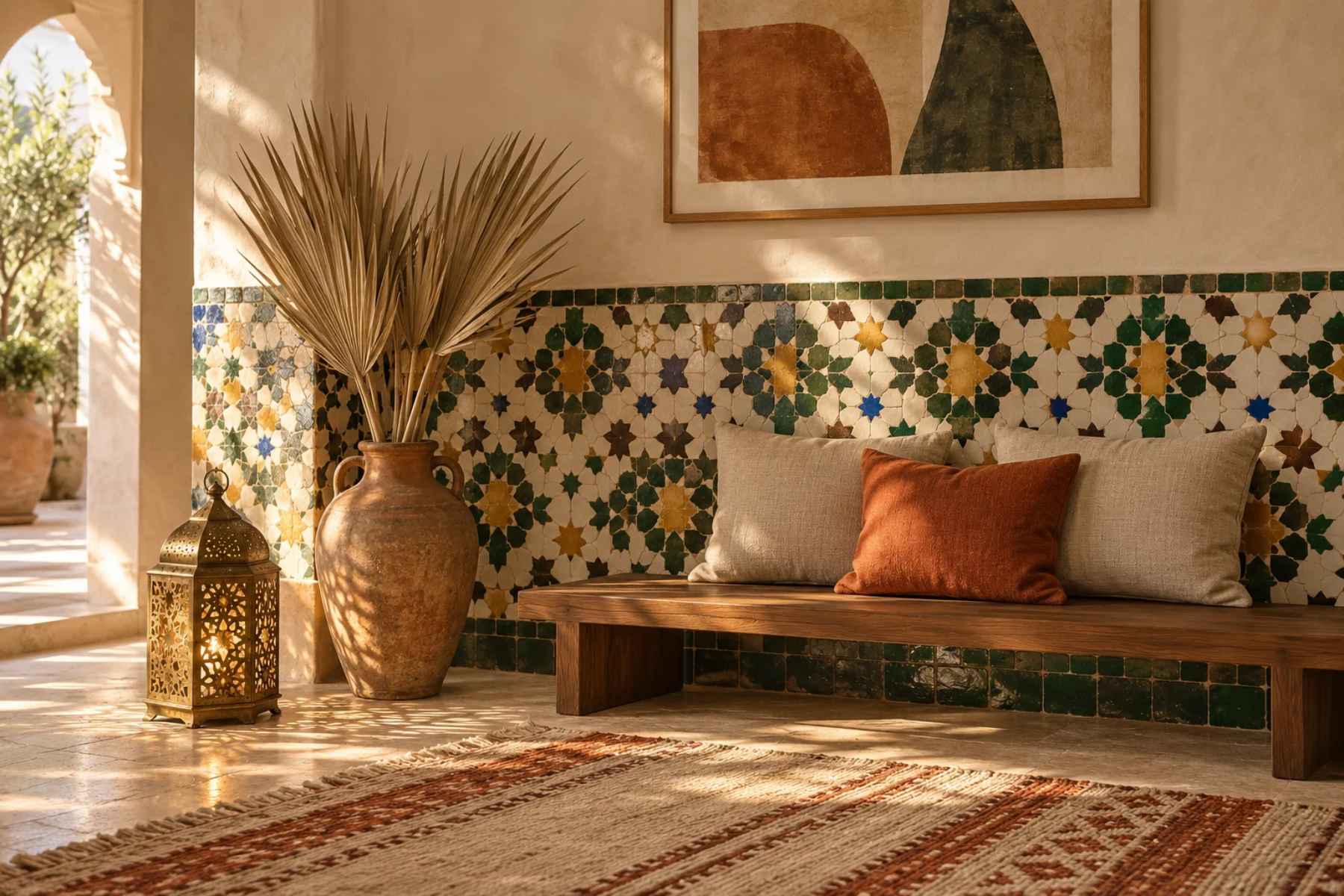
Give the pattern one surface. A zellige wall can hold thousands of pieces. In a home that energy belongs on one plane: a splashback, a fireplace surround, a shower wall or a floor. Then stop.
Put pattern low and art high. The madrasas keep zellige on the lower wall and change material above it. Borrow the layout: pattern below counter or dado height, a calm wall above, and one framed piece on that calm wall. Our Abstract Africa Wall Art in beige and teal geometric picks up zellige green without competing with it, and the Earth Tone Terracotta and Africa Map set of three does the same for a warmer scheme. They are our own geometry, not zellige.
Keep the traditional proportions of colour. White ground first, then green, honey yellow and dark brown, with blue as the accent. The white is what keeps a busy pattern calm. Our Moroccan colour palette guide gives five full schemes with hex codes.
Renting? Four removable pieces do the job: a peel-and-stick Moroccan tile splashback, a Moroccan tile stencil used on a canvas panel you can take with you, a pierced brass lantern that throws the pattern as shadow, and a framed print.
Mix with care. One geometry, one textile and one portrait in a shared earth palette is enough for a room. Our guide to mixing global motifs sets out the rule we use.
Pick the room. Tile-led pattern earns its place where water is: see our Afrocentric bathroom ideas and kitchen ideas. For the print above it, our print, frame, hang and light guide covers paper, frames and sizing.
What to look for when buying
Look for variation. Handmade zellige is cut and glazed by hand, so no two tiles are alike: the glaze pools, the edges chip, the surface ripples. A box of identical tiles is factory-made “zellige-look” ceramic. It costs less and is easier to lay, and it reads flatter on the wall. Know which one you are paying for.
Ask where it was made. Fez is the main centre and Tétouan the second, with the differences described above. A seller of the real thing will tell you which without hesitating.
Know the three formats. Cut mosaic, in stars and polygons, is the most labour and the highest price. Square field tile, about 10 cm, gives the glaze without the geometry. Bejmat, about 12 by 4 cm, is for floors and herringbone.
Designing your own prints or pattern papers? Creative Fabrica is where we source seamless Moroccan tile and geometric pattern bundles.
FAQ
What is the Moroccan eight-pointed star called?
Khatam, also written khatem, which means “seal”. It is made of two overlapping squares, one turned 45 degrees. When the inner lines are kept and a small circle is added at the centre, the figure is the Rub el Hizb, the mark that divides the Qur’an into quarters for recitation.
What is the difference between zellige and mosaic?
Zellige is one kind of mosaic. Roman-style mosaic builds pictures from small cubes of stone or glass. Zellige is glazed terracotta, cut by hand into precise geometric shapes that lock together like a puzzle, each piece a single colour.
Are Moroccan geometric patterns the same as Islamic geometric patterns?
They are one branch of the family. Moroccan work belongs to the western tradition shared with Andalusia, built mostly on the square and the eight-pointed star. Persian girih uses its own set of five standard shapes. Colour differs too: blues and turquoises dominate in the east, while western zellige sets yellows, greens, black and light brown against a white ground.
What colours are traditional in Moroccan zellige?
White, green, honey yellow, dark brown or black, and blue, with red arriving from the sixteenth century. Each colour comes from a mineral: copper for green, cobalt for blue, iron and manganese for the browns, tin for the white glaze.
Can I decorate with Moroccan geometric patterns if I’m not Moroccan?
Yes. This is the public face of Moroccan architecture, and it has travelled for centuries. Respect lies in the how: call it Moroccan, buy from Moroccan makers when you buy the real thing, and treat calligraphy differently from pattern, because those bands are very often Qur’anic text. Our respectful guide to African textiles sets out the wider approach.
Is zellige still made by hand?
Yes. Fez remains the centre, the shapes are still chipped out with a hammer, and a full apprenticeship still takes around ten years. The Hassan II Mosque in Casablanca, completed in 1993, is the largest modern showcase of the craft.
A closing note
The detail we keep returning to is the assembly. Face down. A master lays thousands of pieces colour side to the floor and trusts the drawing, and the wall is seen for the first time when it is turned over.
Pattern built with that much care can carry a room from a single surface. Give it that surface, learn three of its names, and let the rest of the room stay quiet. If you want one piece of our own geometry on the wall above, the beige and teal Abstract Africa print is where we would start.
Also read:
- 12 Moroccan Symbols & Their Meanings: A Decor Lover’s Guide — the Amazigh companion to this guide
- Moroccan Color Palette: 5 Souk-Inspired Schemes for a Soulful Home
- How to Mix Global Motifs
- African Motifs Explained: Adinkra, Kente and Mudcloth
- 12 Adire Patterns and Their Meanings: A Decor Lover’s Guide — the previous guide in this series
- Kente Cloth Patterns and Meanings: How to Read Ghana’s Royal Weave
- Mudcloth Patterns and Meanings
- African Color Palette Guide 2026
Further reading
The books and studies named in this article, for readers who want the primary material.
- Jean-Marc Castéra, Arabesques: Decorative Art in Morocco (1996)
- André Paccard, Traditional Islamic Craft in Moroccan Architecture (1980)
- Eric Broug, Islamic Geometric Patterns (2008)
- Keith Critchlow, Islamic Patterns: An Analytical and Cosmological Approach (1976)
- Youssef Aboufadil, Abdelmalek Thalal and My Ahmed El Idrissi Raghni, “Symmetry groups of Moroccan geometric woodwork patterns”, Journal of Applied Crystallography (2013)
- Jonathan Bloom, Architecture of the Islamic West: North Africa and the Iberian Peninsula, 700 to 1800 (2020)
A small invitation
If you are building a home around meaning rather than trend, you may like our free Afrocentric Gallery Wall Guide: a short curatorial reference for walls that mix textiles, symbols and prints, with three layout patterns, framing notes and the spacing rules we use at home. It arrives in one quiet email, just the PDF and a note from us.
Shop the Essence of the Road Art collection
Every piece below is our own work: digital downloads you print at home, in the earth and teal palette this article describes.
- Essence of the Road Art on Etsy — the full collection
- Abstract Africa Wall Art Printable, Beige Teal Geometric — the print we pitch in this article, in zellige green and plaster beige
- Abstract Africa Wall Art Printable, Geometric Map — a second geometric map for a pair
- Afrocentric Wall Art Set (3), Earth Tone, Abstract Terracotta and Africa Map — the warm scheme for the wall above the tile
- Navy Coral Africa Map Print, Abstract Pattern Poster — a bolder, pattern-led single
- Adinkra Symbol Wall Art Set (5) — five West African symbols for a symbol-led wall