12 Ghanaian Symbols and Their Meanings: A Decor Lover’s Guide
By Essence of the Road Art · Published July 2026
This article contains affiliate links. If you buy through our links, we may earn a small commission at no extra cost to you. We only recommend pieces we’d style in our own homes.
Ask most people outside Ghana to name a Ghanaian symbol and you will get one answer: adinkra. Usually one adinkra — Sankofa, or Gye Nyame. That is like being asked to name an English word and saying “the”.
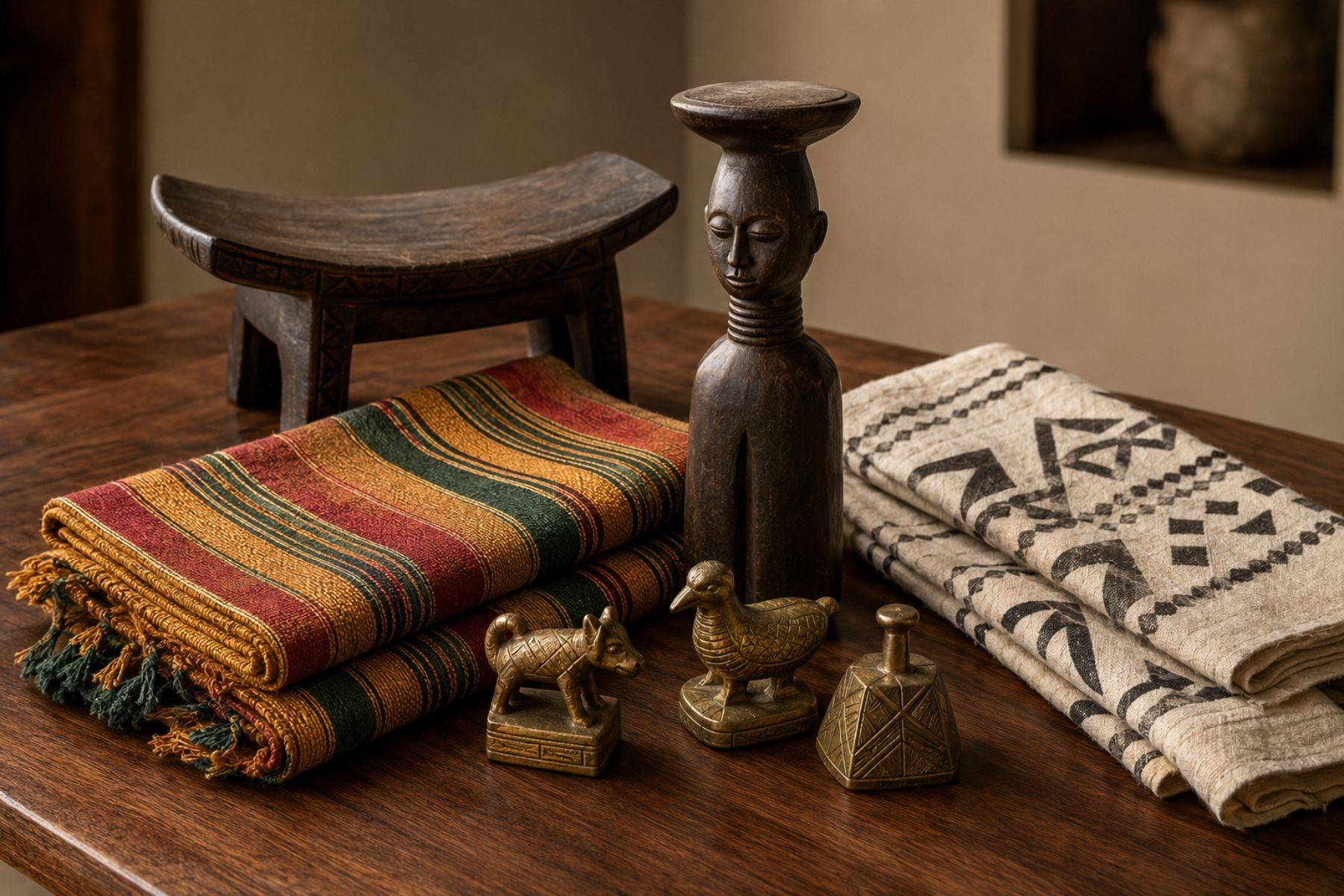
Adinkra is a magnificent system and we have written about it at length. But it is one branch of a visual language that also includes a stool that holds the soul of a nation, a cloth whose colours are a grammar, three million cast-brass weights each carrying a proverb, and a spider who stole the world’s stories. This guide is the wider vocabulary — twelve Ghanaian symbols across four families, what each one actually meant to the people who made it, and an honest note on which ones belong on a wall and which ones absolutely do not.
Quick answer. The twelve most significant Ghanaian symbols and their meanings fall into four families. The Stool: Sika Dwa Kofi (the Golden Stool — the soul of the Asante nation), the blackened ancestral stool (a family’s ancestors made present), and the Black Star (African freedom and unity). The Cloth: kente’s six-colour grammar (gold, green, blue, red, black, white), adinkra stamped cloth (proverbs pressed in bark dye), and the narrow-strip loom itself. The Hand: abrammuo gold weights (proverbs cast in brass), Akuaba (the figure carried in hope of a child), and the okyeame poma (the linguist’s staff). The Word: Gye Nyame (except for God), Sankofa (go back and get it), and Kwaku Ananse (the spider who owns the stories). Only some of these are decor — our Adinkra Symbol Wall Art Set of 5 covers the ones that are, and this guide is honest about the ones that are not.
Table of Contents
Before the symbols: a note on care
Two things worth saying up front, because they change how the rest of this reads.
Not everything in this list is decoration. Three of the twelve — the Golden Stool, the blackened ancestral stool, the Akuaba — are objects with ritual function. They are in this guide because you should be able to recognise them, and because recognising them is exactly what stops you buying a replica of something that was never meant to be bought. We will flag each one.
Ghana has an actual law about this. Under Ghana’s Copyright Act, 2005 (Act 690), works of folklore — explicitly naming kente and adinkra designs — are protected, with rights vested in the President in trust for the people of Ghana, and Section 64 requires authorisation from the National Folklore Board for commercial exploitation. The provision is contested by Ghanaian scholars and rarely enforced against small overseas sellers, but it exists, and it should end the assumption that these designs are free-for-all public domain. We cover the full picture in our guide to the difference between a symbol and a motif.
I. The Stool
In Akan thought a stool is not furniture. It is the seat of a person’s sunsum — their spirit — and by extension the seat of a lineage, a chieftaincy, or a nation. Ghana’s most important symbols are stools before they are anything else.
1. Sika Dwa Kofi — the Golden Stool
Meaning: the soul of the Asante nation.
Oral tradition tells it this way: around the turn of the eighteenth century, the priest Okomfo Anokye called down a stool of solid gold from the sky, and it came to rest at the feet of Osei Tutu I, first Asantehene of the Asante. The stool was not a throne. It was declared to house the soul of the Asante people — their unity, their vitality, their continuance.
Which is why nobody sits on it. Not the king. Each new Asantehene is lowered over the Golden Stool and raised again without ever touching it. It is not permitted to touch the ground.
In 1900 the British Governor of the Gold Coast, Sir Frederick Hodgson, stood before the Asante and demanded to be given the Golden Stool to sit on. What followed was the War of the Golden Stool, led by Yaa Asantewaa, the Queen Mother of Ejisu — the last major Anglo-Asante conflict, with casualties exceeding all the previous wars combined. Yaa Asantewaa was captured in 1901 and exiled to the Seychelles, where she died in 1921. The British never got the stool.
In decor: do not buy a “Golden Stool replica.” There is no such thing, and the object is not yours or ours to reproduce. What you can do is understand why an Asante stool form in a room carries weight — and choose an honest carved stool from a named maker rather than a costume version of a sacred one.
2. The blackened stool — ancestors made present
Meaning: a lineage, kept.
When an important person dies, their personal stool may be ritually blackened — traditionally with soot and egg yolk — and kept in the family’s stool room. The blackened stool becomes the ancestor’s seat in the world of the living. Libations are poured to it. It is consulted. It is not a memento; it is closer to a shrine.
In decor: this is the clearest “do not buy” in the list. A blackened Akan stool on the market has, by definition, left a family’s stool room, and the routes by which that happens are rarely clean. A plain contemporary carved stool used as a side table is a lovely thing and a completely different object. Know which one you are looking at.
3. The Black Star — freedom and unity
Meaning: African liberation.
The single black five-pointed star at the centre of Ghana’s flag stands for African freedom and unity. The flag — red, gold and green with the star at its heart — was designed by Theodosia Salome Okoh and adopted on 6 March 1957, the day Ghana became the first sub-Saharan African country to gain independence. Red for the blood of those who fought for it, gold for the country’s mineral wealth, green for its forests. The star itself is widely credited to Marcus Garvey’s Black Star Line, the shipping company founded to carry the diaspora home.
In decor: the Black Star is the one modern symbol in this list, and it is the most straightforwardly usable. It carries no ritual restriction and enormous meaning, particularly in a diaspora home. It works well small, in charcoal or gold, near an entryway.
II. The Cloth
Ghana gave the world two entirely different textile systems and most Western coverage collapses them into one. They are not one.
4. Kente — the six-colour grammar
Meaning: the colours are the message.
Kente is woven, on a narrow strip loom, in bands roughly four inches wide that are then sewn edge to edge. Every named cloth has a name, and many are named for a person, a proverb, or a historical event. But the fastest way into kente is its colour vocabulary:
| Colour | What it carries |
| Gold / yellow | Royalty, wealth, spiritual purity |
| Green | Growth, renewal, fertility, harvest |
| Blue | Peace, harmony, love |
| Red | Sacrifice, struggle, political passion |
| Black | Maturity, spiritual energy, the ancestors |
| White | Purity, festivity, victory |
One honest caveat, because you will not find it on most pages: these readings are widely published but not uniform. Different weavers, different families and different sources give slightly different emphases, and a cloth’s meaning also lives in its named pattern, not only its palette. Treat the table as a strong tendency, not a codebook. Our kente cloth patterns guide goes into the named cloths properly.
In decor: kente is loud and it should be. Do not tone it down with a grey wall. Use it as one saturated moment in a warm, restrained room — the Ghana colour palette guide has the exact supporting tones.
5. Adinkra — proverbs pressed in bark dye
Meaning: a written philosophy, stamped.
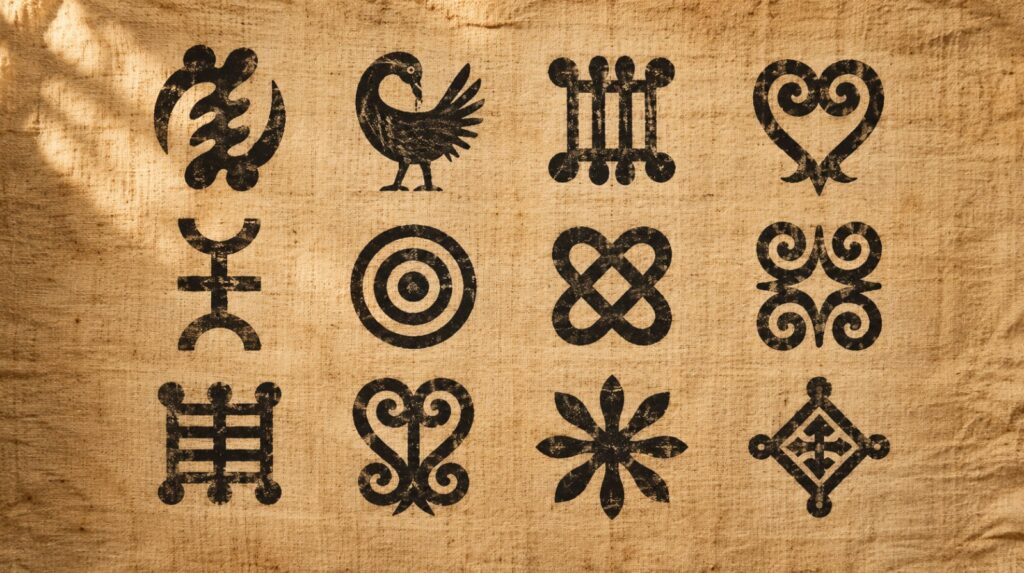
Adinkra is stamped, never woven — the opposite technique to kente. Calabash stamps five to eight centimetres square, carved by hand and slightly curved so the dye rolls on with a rocking motion. The dye, adinkra aduru, is boiled down from the inner bark of the badié tree until it thickens to near-black. The centre of production is Ntonso, about twenty kilometres northwest of Kumasi. The cloth was originally funerary — worn at burial rites to bid the dead farewell and remind the living of the proverbs they left behind.
There are more than a hundred symbols; sources count between 122 and 129, and new ones are still being made. It is a living script, not a museum set.
We are not going to re-explain the individual glyphs here — our Adinkra symbols and their meanings guide covers twenty-four of them in full, with the proverbs and the room-by-room notes.
In decor: adinkra is the most wall-ready thing Ghana makes, because it was designed to be read at a glance. One symbol per wall, framed with space around it.
6. The narrow-strip loom — the structure under everything
Meaning: the technique is the tradition.
This one is not a picture, and that is exactly why it belongs. West African narrow-strip weaving produces cloth in bands, woven by men on a horizontal loom, then hand-sewn together into a whole. The strip is why kente looks the way it does — the slight offsets where bands meet, the rhythm of the seams, the way a pattern steps rather than flows.
In decor: it is the single best test for whether a “kente” product is real. Genuine strip-woven cloth shows the seams. A digitally printed kente-pattern cushion does not. Once you have seen the difference you cannot unsee it, and it will save you money.
III. The Hand
Three objects, all small, all made to be held rather than hung.
7. Abrammuo — the gold weights
Meaning: proverbs cast in brass.
Between roughly 1400 and 1900, Akan goldsmiths cast around three million small brass weights — abrammuo in the singular, mrammuo collectively — used to weigh gold dust, which was the currency. Gold was placed on one pan of a scale and a weight on the other.
The weights are the reason this entry exists. The early ones are geometric, carrying forms that arrived along trans-Saharan trade routes from North African Islamic design. From the seventeenth century they became figurative: a bird, a dog, two men, a knot, a sandal, a drum. And they are almost never just objects — each figure typically references a proverb every Akan trader would have recognised. A whole moral vocabulary, cast by the lost-wax method, small enough to fit in a palm.
Owning a complete set raised a man’s standing considerably, and small sets were given to newly married men so they could enter trade respectably.
In decor: genuinely one of the best things you can collect from this list. They are small, portable, frequently available through legitimate dealers, and they were made to be handled. A group of three or five on a shelf or in a shallow tray reads beautifully and carries real history. Ask the seller which proverb each one references — a dealer who cannot answer probably has reproductions.
8. Akuaba — the figure carried in hope
Meaning: fertility, safe birth, the health of mother and child.
The Akuaba is the flat, disc-headed wooden figure most people have seen without knowing its name — high rounded forehead, ringed neck, small projecting arms, no legs to speak of.
The story is specific. A woman named Akua could not conceive. A shrine priest instructed her to have a small figure carved and to care for it as she would a real child — carry it, dress it, put it to bed. In time she gave birth to a daughter, and her neighbours said “Akua, wo ba ni” — Akua, this is your child. The name stuck.
The high forehead is generally read as wisdom, the ringed neck as health and prosperity — both are Akan beauty ideals as much as symbols. Women carried these figures on their backs the way they would carry an infant. Afterwards, the figure might be kept as a companion or left at the shrine as an offering.
In decor: handle with care and honesty. This is an object made for a woman’s private hope, and a museum vitrine or a styled console strips almost all of that away. If you want one, choose a contemporary carving made openly for sale by a named Ghanaian carver, place it somewhere considered rather than decorative, and know the story well enough to tell it.
9. Okyeame poma — the linguist’s staff
Meaning: authorised speech.
An Akan chief does not address people directly. The okyeame — usually translated “linguist,” though “spokesperson” is closer — speaks for him, and carries a staff topped with a carved and gold-leafed finial. The finial is the point: it is almost always a proverb rendered in three dimensions. A hand holding an egg (power must be held firmly enough not to drop it and gently enough not to crush it). A bird eating from a tree. Two men at a table.
The staff is not a badge of office so much as a statement of what kind of authority this court claims, spoken in a language everyone present can read.
In decor: an authentic okyeame poma is a court object; a decorative version is a prop. But the idea is one of the most useful in this whole guide — that an object’s job can be to hold a proverb in a room where people are talking. That is exactly what a well-chosen framed symbol does on a wall.
IV. The Word
10. Kwaku Ananse — the spider who owns the stories
Meaning: cunning, survival, the power of the weak.
Ananse means spider in Akan. Kwaku is the name given to a boy born on a Wednesday. Together: Kwaku Ananse, the trickster spider of Akan oral tradition, whose tales — anansesem, “spider stories” — go back at least to the sixteenth century and were traditionally told at night, it being considered unlucky to tell them by day.
Ananse is small, physically unimpressive, and wins by wit. He is greedy and often wrong. In the best-known story he sets out to gather all the world’s wisdom into a pot and hoard it — and loses it all, scattering wisdom across the world, which is why nobody has all of it and everybody has some.
He is also one of the most important cultural survivals of the transatlantic slave trade. Because Jamaica held the largest concentration of enslaved Asante in the Americas, the Jamaican Anancy tales are the best-preserved; he also travels as Ananse-Tori in Suriname, Anansi in Guyana, and Kuent’i Nanzi in Curaçao. A spider carried across an ocean in people’s memory.
In decor: the web, not the spider, is the usable form — a fine radial line motif reads as pattern to a casual eye and as Ananse to anyone who knows. It is a quiet way to put the diaspora’s oldest surviving story on a wall.
11. Sankofa — go back and get it
Meaning: it is not taboo to return for what you forgot.
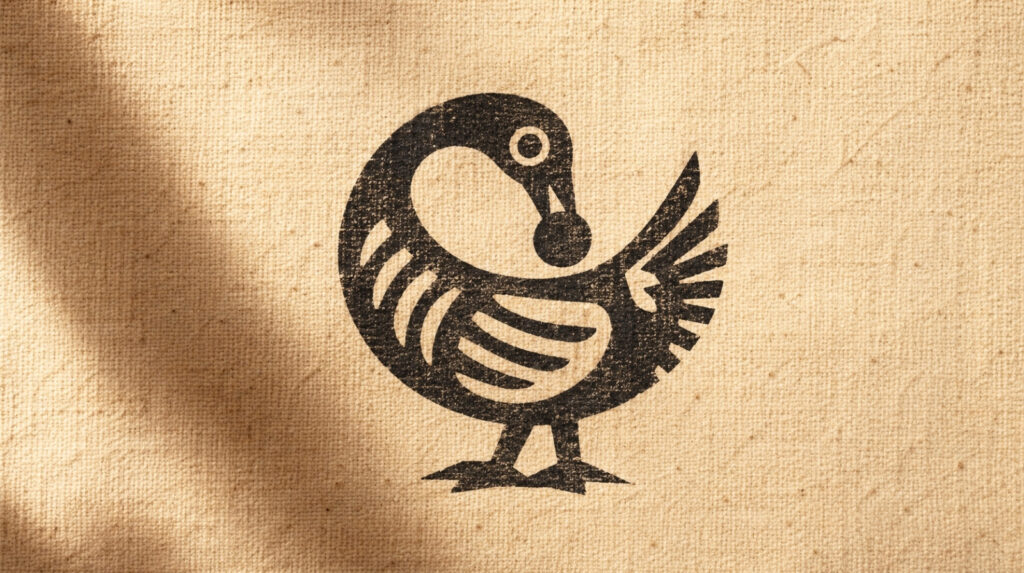
The most quoted adinkra in the world, and the one most often reproduced wrongly. From the Twi: san (return), ko (go), fa (fetch). The proverb: “Se wo were fi na wosan kofa a, yenkyiri” — it is not taboo to go back and fetch what you forgot.
It exists in two forms: a bird whose body faces forward while its head turns back to lift an egg, and an abstract spiral-heart. Popular sources will tell you confidently which one is “the original.” They disagree with each other. We have written the full picture — including what Sankofa actually asks of you, which is more demanding than the greeting-card version — in Sankofa symbol meaning.
In decor: it belongs where memory lives — above a desk, beside old photographs. And it is one of the few symbols in this guide we would put in a diaspora home without hesitation, because reaching back is precisely what it authorises.
12. Gye Nyame — except for God
Meaning: the supremacy of the divine, and the smallness of the human.
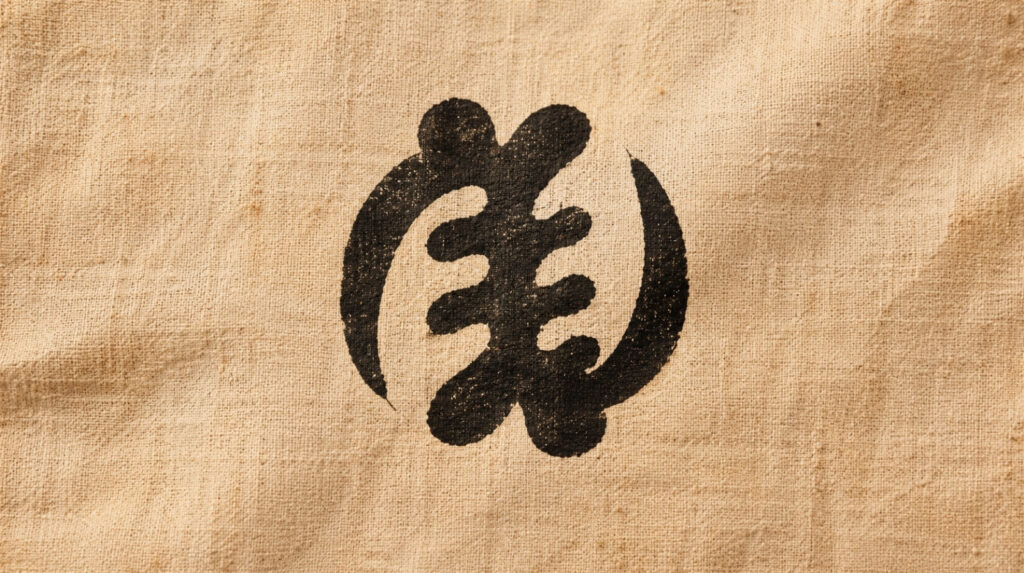
The most recognisable adinkra there is. Its proverb: “This great panorama of creation dates back to time immemorial; no one saw its beginning, and no one will see its end, except God.” It appears on Ghana’s currency, on presidential robes, on doorways, on jewellery worn across the diaspora.
In decor: traditionally placed above an entry — the first thing a visitor passes beneath. It is a declaration, not a mood, so we would not put it in a bedroom. Give it the doorway or the main wall, and give it room.
Which of the twelve actually belong on a wall
The short version, since this is a decor site and we would rather be useful than vague:
| Symbol | Live with it? |
| Gye Nyame, Sankofa, the Black Star | Yes — designed to be seen, no ritual restriction |
| Kente, adinkra cloth, strip weave | Yes — buy real, from Ghanaian makers where you can |
| Abrammuo gold weights | Yes — the best collectable here; ask for the proverb |
| Ananse (as web motif) | Yes — quiet and carries a whole literature |
| Okyeame poma | Only as an idea, not as a bought prop |
| Akuaba | With care — contemporary, named carver, considered placement |
| Blackened ancestral stool | No |
| The Golden Stool | No, and there is no replica |
Frequently asked questions
What are the main Ghanaian symbols and their meanings?
The best-known Ghanaian symbols and their meanings span four families: stools (the Golden Stool as the soul of the Asante nation, blackened stools as ancestral seats, the Black Star as African freedom), cloth (kente’s six-colour grammar and adinkra’s stamped proverbs), handheld objects (abrammuo gold weights, the Akuaba fertility figure, the linguist’s staff), and the word (Gye Nyame, Sankofa, and the Ananse stories). Adinkra is the most famous but it is one branch, not the whole tree.
What is the difference between adinkra and kente?
Technique, first: adinkra is stamped onto cloth with carved calabash blocks in bark dye; kente is woven on a narrow strip loom in coloured thread. Meaning, second: an adinkra symbol carries a specific proverb and can be read individually, while kente carries meaning through colour combinations and named patterns across the whole cloth. Adinkra reads like text; kente reads like textile. Both come from Ghana and both are sometimes worn together, but they are separate traditions with separate makers.
Is it disrespectful to decorate with Ghanaian symbols?
Not in itself — but it depends entirely on which symbol. Adinkra, kente and the Black Star are widely shared and were made to be seen; using them with knowledge of what they mean is appreciation. Ritual objects are different: blackened ancestral stools and, to a lesser degree, Akuaba figures had specific spiritual functions, and buying them as decoration removes them from that. The test we use: can you name the symbol, say what it meant, and would you be comfortable saying that to a Ghanaian?
Can I sell products using kente or adinkra designs?
Legally this is murkier than most sellers assume. Ghana’s Copyright Act 2005 (Act 690) names kente and adinkra as protected folklore and requires National Folklore Board authorisation for commercial use, with rights vested in the state in trust for the people. The provision is contested by Ghanaian academics and rarely enforced internationally, and it does not automatically bind sellers in other jurisdictions. But it exists. At minimum, credit the Akan origin, do not present a print as handmade cloth, and consider whether an original design inspired by the tradition serves you better than a reproduction of it.
Which Ghanaian symbol is best for a first piece?
Gye Nyame if you want a single anchoring statement near an entry, Sankofa if the room holds memory — photographs, a desk, family things — and the Black Star if you want something with modern political weight and no ritual restriction at all. All three read clearly at small scale and pair naturally with the warm terracotta, ochre and charcoal palette Ghanaian pieces were made to live in.
Related reading
- Adinkra Symbols and Their Meanings: The Ultimate Guide
- Sankofa Symbol Meaning: The Akan Proverb Behind the Bird
- Kente Cloth Patterns and Meanings: How to Read Ghana’s Royal Weave
- The Difference Between a Symbol and a Motif
- 12 Symbols & Their Meanings: The Symbolism in African Art — Senegal
- Ghana Colour Palette: The Warm Tones Behind the Cloth
Closing
Ghana’s visual language is not a set of shapes. It is a stool that cannot be sat on, a cloth whose seams prove it is real, three million small brass proverbs, and a spider who lost the world’s wisdom on purpose. Adinkra is the part that fits neatly in a frame — which is why it is the part the world took — but it is far from the whole.
If you want to start with the part that genuinely was made to be looked at, our Adinkra Symbol Wall Art Set of 5 gives you one symbol per sheet with the name and proverb kept attached, so the wall holds the words as well as the shape. That is the whole difference between owning a Ghanaian symbol and decorating with one.
Shop the Essence of the Road Art collection
- Essence of the Road Art on Etsy — the full printable collection
- Adinkra Symbol Wall Art Set (5) — one symbol per sheet, proverb kept
- Africa Map Textured Collage Print — mixed-media earth tones that sit well beside gold and green
- Baobab Tree of Life Print — warm symbolism for a living room
A small invitation
If you are building a home that holds meaning — not just style — you may like our free Afrocentric Gallery Wall Guide. It is the companion piece to this article: a curatorial reference for laying out walls that include symbols like the ones above, with three layout patterns, framing notes, and the spacing principles we keep coming back to in our own homes.
The guide is sent in one quiet email. No drip sequence, no pressure — just the PDF, and a note from us.
What’s next in this series
This is the first article in our country-by-country guide to the symbolism of African art. The next entries we are working through:
- The Symbolism in African Art: 12 Motifs & Their Meanings — Tanzania (Maasai shields, Tinga Tinga, Kanga proverbs)
- The Symbolism in African Art: 12 Motifs & Their Meanings — Senegal (Wolof gold, sous-verre painting, sacred geometry)
- The Symbolism in African Art: 12 Motifs & Their Meanings — Kongo (Cosmogram, nkisi, the four moments of the sun)
- The Symbolism in African Art: 12 Motifs & Their Meanings — South Africa (Ndebele geometry, Zulu beadwork, San rock art)
Each one will follow the same pattern: twelve symbols, the proverbs behind them, and notes on how to live with them at home. Slow design. Warm rooms. Real meaning.
Continue reading:
A Respectful Guide to African Textiles and What They Mean (The patterns tell you where they came from — if you listen…)
This article is part of the Wall Art Guides series at Essence of the Road Art — a home decor journal for soulful, Afrocentric and Afro-bohemian interiors.
- 24 African Symbols and Their Meanings: A Region-by-Region Guide

- 12 Kenyan Symbols and Their Meanings: A Decor Lover’s Guide
- Moroccan Geometric Patterns: 10 Zellige Motifs Explained

- 12 Adire Patterns and Their Meanings: A Decor Lover’s Guide
- 12 Ethiopian Symbols and Their Meanings: A Decor Lover’s Guide