How to Set Up a Gallery Wall – Print, Frame, Hang & Light Afrocentric Wall Art
By Essence of the Road Art · Published May 2026
How to set up a gallery wall: what this guide covers
Quick Answer: Setting up an Afrocentric gallery wall requires five things done well: quality printing, the right frames, reliable hanging hardware, intentional lighting, and a considered surface below the wall. Each of these has a budget option that genuinely works and a quality option that lasts longer or looks more polished. This guide covers all five, with specific Amazon product recommendations at both price points, so you can build the wall your room deserves regardless of where your budget sits today.
Learning how to set up a gallery wall sounds straightforward — pick your prints, buy some frames, hang them up. But the difference between a gallery wall that looks finished and one that looks like an afterthought almost always comes down to the five steps most guides skip: the paper you print on, the frames you choose, the hardware that actually holds everything level, the lighting that makes the art glow, and the surface below the wall that grounds the whole arrangement. This guide covers all five. We include specific Amazon product recommendations at both budget and quality price points — so you can build the wall your room deserves regardless of where your budget sits today.
Table of Contents
Step 1: Printing your art — paper types, home vs. print shop
If you are working with digital download art files, the paper you print on is the single biggest variable in the final result. The same file printed on cheap copy paper and on quality fine art cotton paper looks like two completely different works. This is not an exaggeration.
Everything below assumes the art is already chosen — printing is the last decision, not the first. If you are not there yet, how to choose the art in the first place covers style, scale and sourcing, and will save you printing something you end up not hanging.
Paper types: what each one does
Standard matte photo paper is the most accessible starting point. It is available at every office supply store and most supermarkets, works in any inkjet printer, and produces clean, accurate color with no glare. The limitation is weight — most standard matte photo paper feels noticeably thin in a frame, which can undermine an otherwise beautiful print.
Best for: Test prints, smaller sizes (4×6, 5×7), or art where color accuracy matters more than tactile quality.
Heavyweight matte photo paper (80–100 lb) solves the thinness problem. It is the same matte finish but with substantially more paper weight behind it — the difference is immediately obvious when you hold the finished print. This is the minimum we would recommend for anything going into a frame.
Best for: 8×10 through 11×14 sizes, most home printing situations.
Fine art cotton rag paper is the highest quality option available for home printing. It has a subtle texture — somewhere between smooth and linen — that adds a warmth and depth to Afrocentric portraits and earthy palette art that standard photo paper simply cannot replicate. Archival inks on cotton rag paper are also significantly more fade-resistant over time. The tradeoff: it is substantially more expensive and requires an inkjet printer with pigment-based inks (most Epson printers use pigment inks; many Canon and HP printers use dye-based inks, which can look less vibrant on fine art paper).
Best for: Statement pieces, 11×14 and above, portraits with warm skin tones, anything you plan to keep for years.
Lustre photo paper is a semi-gloss finish — not as reflective as full gloss, but with more sheen than matte. It makes botanical and nature-inspired prints sing. Avoid it for art with warm skin tones, where the semi-gloss can slightly flatten the richness of the tones.
Best for: Botanical prints, abstract art with saturated colors, any art where you want a little luminosity without full glare.
Home printing vs. print shop: the honest tradeoff
Home printing is the right choice for: sizes up to 11×14, frequent reprints, and anyone who wants control over paper choice and timing. A mid-range inkjet printer with pigment inks and quality paper produces results that genuinely rival professional output at smaller sizes.
If you are still choosing which art files to print, our DIY Printable African Wall Art guide covers Canva templates, AI-generated files, and the best sources for Afrocentric digital downloads.
Print shop printing (FedEx Office, Staples, Walgreens, or a local fine art printer) is the right choice for: sizes 16×20 and above, fine art output on cotton rag paper that your home printer cannot handle, and one-off pieces where the cost of a dedicated print is justified by the quality jump.
For the highest quality output at any size, seek out a local giclée printer — search “giclée printing near me” or “fine art printing services.” These are often used by galleries and professional artists. Expect to pay $20–$60 per print depending on size and paper, but the result is genuinely archival-quality work.
Amazon paper picks
Budget option — Uinkit 120 Sheets Presentation Paper Matte 8.5×11 (~$18 for 120 sheets) A reliable heavyweight matte paper that works in most home inkjet printers. Color accuracy is good, the weight is noticeably better than standard photo paper, and the price per sheet is very reasonable for building a gallery wall where you need multiple prints. →
Quality option — Epson Ultra Premium Presentation Paper Matte, 13×19, 50 sheets (~$30) Designed specifically for Epson pigment-ink printers. Produces rich, deep color with excellent skin-tone accuracy — this is what we print Afrocentric portraits on. The 13×19 sheet size allows printing up to 11×14 with a white border, which makes matting easier.
Fine art option — Hahnemühle Photo Rag, 308gsm, A3+, 25 sheets (~$55) Museum-quality cotton rag paper for archival Afrocentric art prints. This is the paper that makes a portrait look like it belongs in a gallery. Not necessary for every print — but for one or two statement pieces you plan to keep for a decade, the investment is worth it.
Step 2: Choosing and sourcing your frames
The frame is doing active design work whether you notice it or not. A well-matched frame disappears into the composition and makes the art feel inevitable. A mismatched frame creates a visual interruption every time you look at the wall.
Frame finishes for Afrocentric and Afro-bohemian rooms
Natural wood — light or dark is the most versatile finish for Afrocentric palettes. It adds warmth, grounds the art in an organic context, and works across mid-century modern, Afro-bohemian, and minimalist rooms without competing with the art. Walnut or oak tones in particular read as intentional and elevated.
Matte black is the cleanest, most modern choice. It recedes visually, making the art feel like it is floating. Particularly effective for abstract pieces and bold graphic art. Avoid it for rooms that already have a lot of dark furniture — the frames can disappear rather than anchor.
Antique brass or brushed gold adds a quiet luxury quality. Works especially well with editorial portraiture, indigo palettes, and earthy Afro-bohemian rooms. Avoid bright shiny gold — it reads as cheap next to the warmth of Afrocentric art.
White frames are a hard no for this aesthetic. They pull toward farmhouse or Scandinavian minimalism, both of which work against the warmth and depth that Afrocentric design is built on.
Sizing: the matting question
A print that sits flush in a frame at its full size looks fine. A print with a 1.5–2 inch cream or warm white mat around it looks considered. The mat adds visual breathing room, makes smaller prints feel more substantial, and is the single cheapest upgrade you can make to an existing frame situation.
The standard combination that works every time: an 8×10 print inside an 11×14 frame with a mat. The cost of a pre-cut mat is typically $3–$8; the visual difference is worth far more.
For more on pairing frame finishes with specific Afrocentric art styles, see our post on How to style Afrocentric wall art without the wall feeling cluttered.
Amazon frame picks
Budget option — Burnes of Boston Gallery Frame, Black, 11×14 (~$14) Clean, simple, no visual noise. The glass is clear rather than non-glare, which is fine for most rooms — non-glare glass is only necessary if the wall receives direct strong light. Well-reviewed for print clarity and easy assembly.
Natural wood option — Malden International Rustic Barn Wood Frame, 8×10 (~$16) A warm, slightly rustic natural wood frame that works beautifully with earthy Afrocentric palettes. The finish has real depth — it does not look painted or plastic. Available in multiple sizes.
Quality set option — upsimples 10 Pack Picture Frames Collage Wall Decor, mixed sizes (~$23–25) Brushed gold frames in a mixed-size set designed for gallery wall use. The consistency of finish across sizes makes gallery wall arrangements look more cohesive than buying frames individually from different sources. Gold works particularly well with the indigo and terracotta palette that defines the Afrocentric aesthetic.
Matting option — Crescent Pre-Cut Mat – Arctic White (~$8 for 4-pack) Pre-cut cream mats in the standard gallery size. The single most impactful $8 upgrade in a gallery wall setup.
Or you can cut with: Authentic Logan 301-1 Compact Classic 32″ Board Mounted Mat Cutter (features a fixed guide rail for precise cutting, a mat guide for measuring borders, a mat knife for downsizing, and a bevel cutter for creating openings.)
Rather skip the framing?
Every piece in our collection is also sold as a framed print, canvas or art print through Fine Art America: printed, framed and shipped to your door, ready to hang.


Step 3: Hanging hardware — strips, hooks, rails, and nails
This is where most gallery walls either hold firm for years or start quietly tilting by month three. The right hardware depends on your wall type, your frame weight, and whether you are in a rental.
Option A: Command Picture Hanging Strips (rental-safe, lightweight)
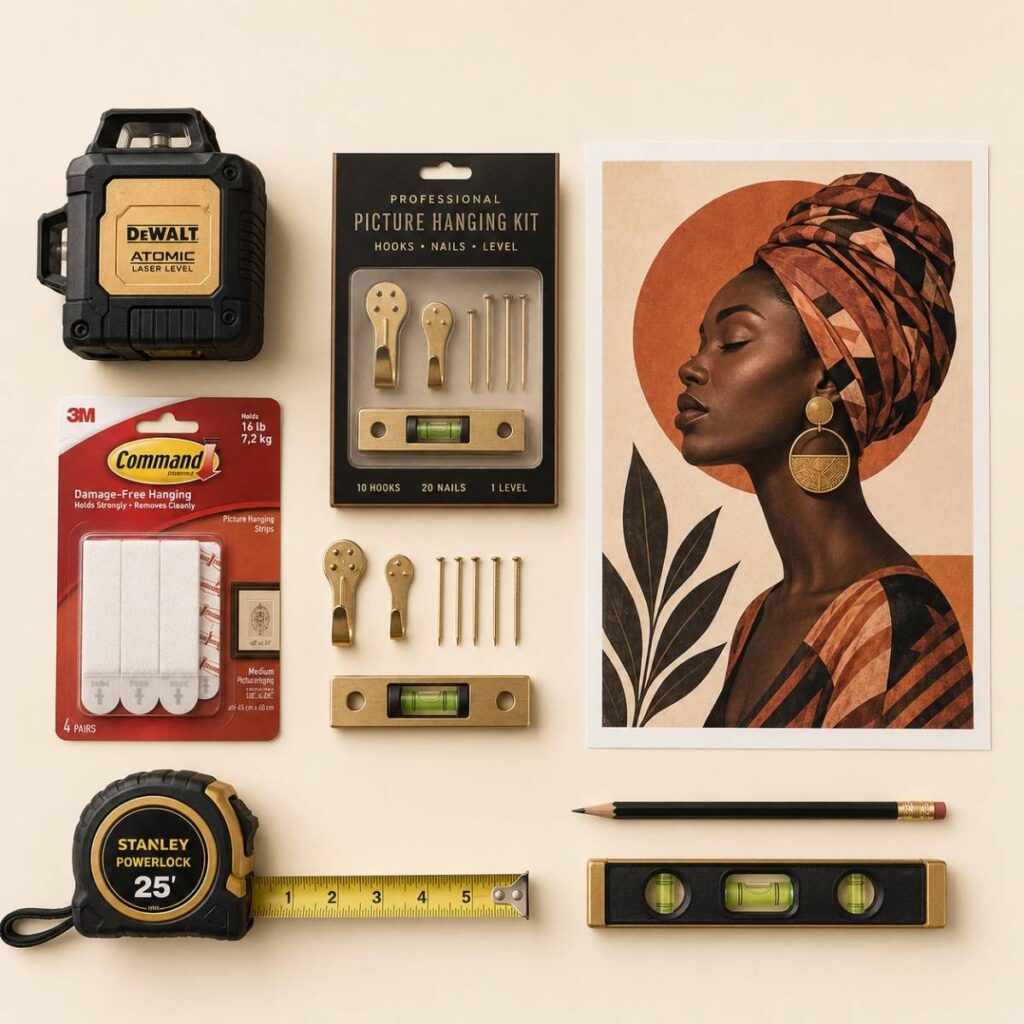
The standard choice for renters or anyone who needs to rearrange frequently. Command strips hold clean on painted drywall and release without damage when removed correctly. The critical rule: use the correct strip size for the frame weight. The large strips hold up to 16 lbs per pair — sufficient for most standard frames up to 16×20.
If you are decorating a rental and want the full damage-free gallery wall approach, our Afrohemian rental living room guide walks through the complete renter-friendly setup.
What they are not good for: Very heavy canvas frames, textured or unpainted brick walls, or anything you plan to leave for 5+ years without checking (adhesive can fail over time, particularly in humid rooms).
Budget option — Command Large Picture Hanging Strips, 14-pack (~$12) Holds up to 16 lbs per pair. Sufficient for most standard frames. This is the version to use — the small strips are genuinely only for very lightweight pieces, not standard frames.
Option B: OOK Professional Picture Hanging Kit (most complete for permanent walls)
For owned walls or renters who are comfortable with small nail holes, a proper picture hanging kit gives you everything in one box: assorted hooks, nails, a level, and a wire-hanging tool. The OOK brand is the professional standard — you will find their hooks in gallery installations as well as home settings.
Quality option — OOK 50-Piece Professional Picture Hanging Kit (~$15) Includes hooks rated for various weights, 1-nail and 2-nail options, a mini level, and clear sizing guidance. The 2-nail hooks are significantly more stable than single-nail hooks for larger frames — they prevent the tilting that single-nail hangers develop over time.
Option C: Picture Rail System (the permanent upgrade)
A picture rail is a horizontal track mounted near the ceiling from which pictures hang on adjustable hooks and wires. The advantages are significant: you can rearrange the entire gallery wall without touching the main wall, the wire heights are fully adjustable, and the ceiling-mounted rail leaves zero visible damage at the art level. This is the system used in galleries and in high-end home installations.
The installation requires mounting the rail into wall studs or using appropriate anchors — a one-time project that pays dividends indefinitely.
Quality option — Gallery System Heavy Duty Art Hanging System, 6-foot Rail (~$75–$95) The professional standard for residential and commercial gallery installations. Rail mounts near the ceiling; pictures hang on adjustable cables. For a full gallery wall of 5–8 pieces, this system eliminates virtually all the measurement and leveling work of traditional hanging. A significant investment that lasts indefinitely and protects your walls completely.
The hanging tool that prevents the most frustration
Regardless of which hanging method you choose, a laser level is the single tool that eliminates the most common gallery wall mistake: prints that are slightly off-level, creating a subtle visual tension you cannot identify but cannot stop noticing.
Budget option — Laser Level, RockSeed Cross Line Laser with Self-Leveling (~$20) Projects a horizontal laser line across the wall so you can align multiple frames with no measuring tape required. Under $20, saves hours of adjustment, and works for any future hanging project in the house.
Step 4: Lighting your gallery wall
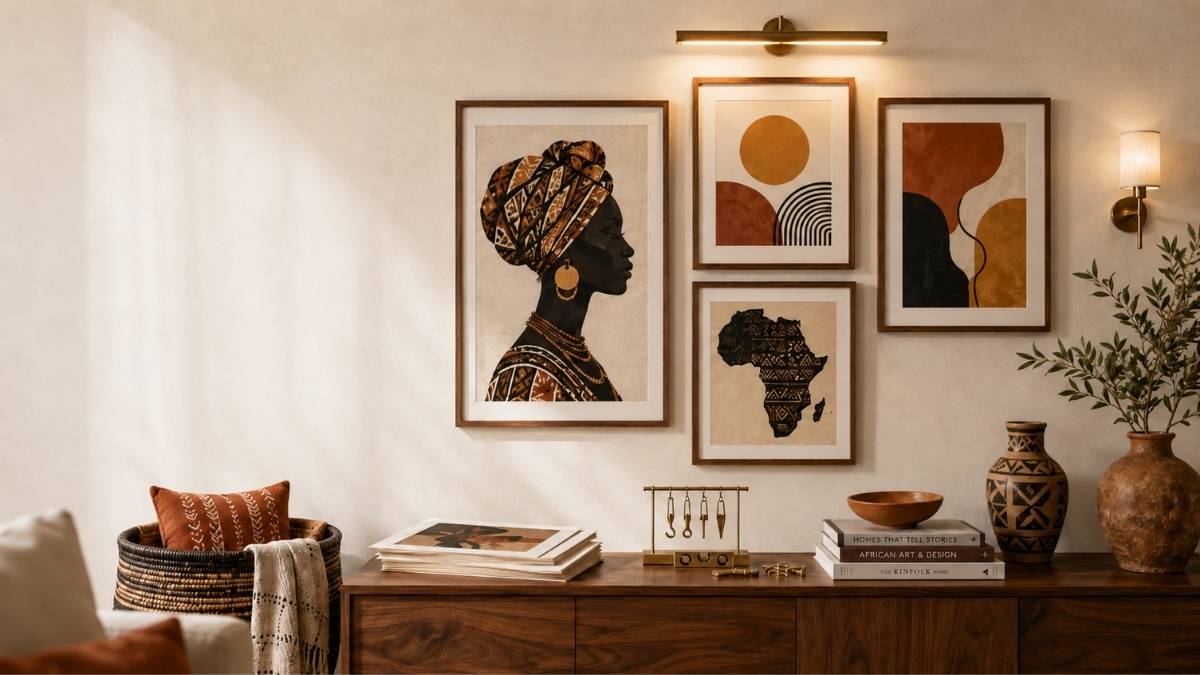
Lighting is the most underestimated element of a gallery wall. The same arrangement of art under flat overhead lighting and under a warm picture light are almost unrecognizable as the same wall. Good lighting does two things: it makes the art more visible in detail, and it creates a warm, focused glow that signals to any eye entering the room that this wall is worth looking at.
Picture lights (mounted above the art)
A picture light is a narrow bar-shaped light that mounts directly above a single piece or a gallery wall arrangement, directing warm-toned light downward across the art. They exist in hardwired versions (permanent, cleaner look) and plug-in or battery-powered versions (no installation, ideal for renters).
Budget option — 16″ Gold Picture Light for Wall, Battery Operated Rechargeable Art Light (~$23) Battery-powered means zero installation — attach it to the wall or directly to a frame with the included hardware. Warm white (2700K–3000K) color temperature is essential: cool white light flattens warm Afrocentric palettes. This version is surprisingly good quality for the price.
Quality option — Cocoweb 16″ Wall Mounted Slim Line Picture Light in Oil Rubbed Bronze (~$233) The standard recommended by interior designers for residential gallery walls. Plug-in version (no hardwiring required) with a 6-foot cord that runs discreetly down the wall. Antique bronze finish pairs naturally with warm wood and gold frames. The LED strip produces a perfectly even, glare-free warm light across the full width of a 3-piece gallery wall. Significantly brighter and more even than budget alternatives.
Track lighting and accent lighting
If your room has a track lighting system or recessed lights on dimmers, these can serve as gallery wall lighting when aimed correctly. The key is the beam angle: use narrow-beam (15–25 degree) bulbs to concentrate the light on the wall rather than flooding the room. Warm white bulbs at 2700K–3000K preserve the richness of Afrocentric color palettes.
Budget option — Philips 50W Equivalent Narrow Flood LED Bulb, Warm White, PAR20 (~$12 for 2-pack) For existing track or recessed fixtures. Narrow beam concentrates light on the wall. Warm white preserves color accuracy.
The color temperature rule you need to know
Every light source has a color temperature measured in Kelvin (K). For Afrocentric art with warm skin tones, terracotta, and ochre palettes: always use 2700K–3000K (warm white). Bulbs above 4000K (cool white or daylight) will make warm Afrocentric palettes look greenish or grey. This single detail is more important than the light fixture itself.
Step 5: The console or surface below the wall
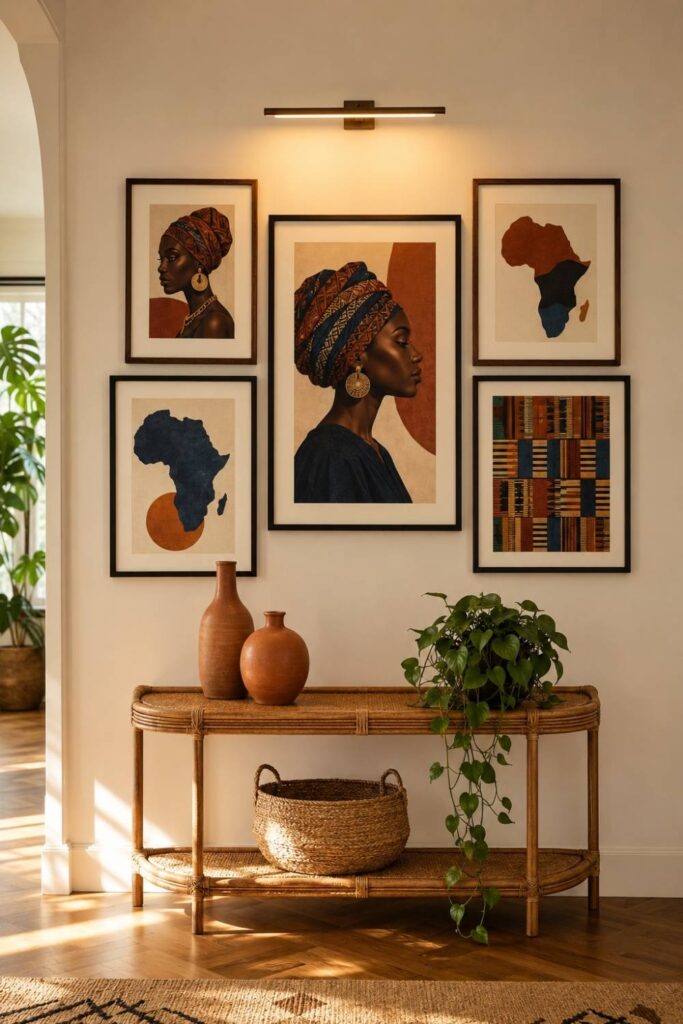
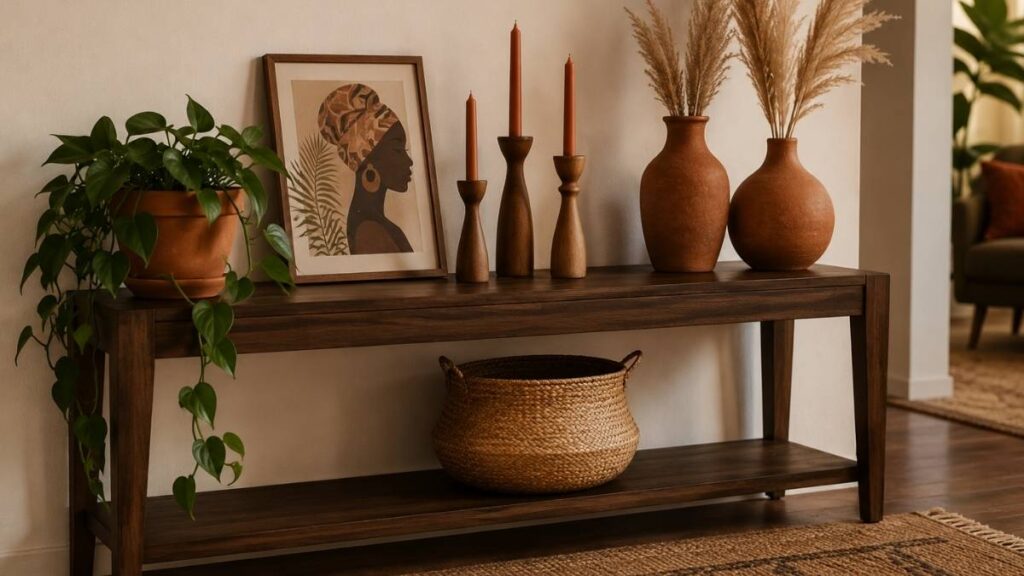
A gallery wall that floats above an empty floor feels unfinished. A surface below the wall — a console table, a narrow credenza, a low bookshelf, or even a wide windowsill — grounds the arrangement and creates a layered vignette rather than a flat decoration.
For Afrocentric and Afro-bohemian rooms, the console surface is also a styling opportunity. A few well-chosen objects — a terracotta vase, a woven basket, a trailing plant, a small sculptural piece — add the warmth and three-dimensionality that even the best gallery wall cannot provide on its own.
For full room styling ideas around a gallery wall, our Afro-bohemian living room guide shows how the wall, the furniture, and the accessories work together.
Console table options
Budget option — VASAGLE Narrow Console Table, Natural Wood and Black, 47 inches (~$60–$75) A clean, minimal console in a natural wood and black metal combination — one of the most versatile finishes for Afrocentric rooms. At 12 inches deep, it sits close to the wall without crowding the room. The open lower shelf allows for styling with baskets or books.
Quality option — Baxton Studio RT295C-OCC Sacramento Mid-Century Modern Scandinavian Style Console Table, Dark Walnut (~$104) A fuller, more design-forward console in warm brown with subtle wood grain. The proportions are generous enough to anchor a 5-piece gallery wall without looking dwarfed. If this specific option is unavailable, search for “narrow console table warm wood” on Amazon filtered by 4+ stars — the category has strong options in the $100–$180 range.
Console surface styling essentials (Amazon picks)
Terracotta planter or vase — Terracotta Ceramic Vase, Set of 2 (~$24) Small-batch look, earthy terracotta glaze that grounds any Afrocentric arrangement. The set of two allows height variation on the console surface.
Woven basket — Mkono Seagrass Belly Basket, Natural, Medium (~$22) A woven seagrass basket at floor level beside the console, or on the lower shelf, adds texture and organic warmth that is the visual language of Afro-bohemian interiors. Also functional as plant-pot cover or storage. →
Trailing plant — no recommendation needed. A pothos, philodendron, or trailing string of pearls in a terracotta or ceramic pot does more for the warmth of a gallery wall vignette than any purchasable accessory. Grow it, or buy a small one from a garden centre. Place it at one end of the console so it trails slightly toward the floor.
Sculptural candle holder — Bloomingville Mango Wood Taper Candle Holder, Set of 2 (~$28) Taper candles in warm clay, cream, or terracotta tones, in varied-height holders, add vertical interest and a sense of considered curation to a console surface. Never use white or grey candles with Afrocentric palettes.
The complete gallery wall toolkit: budget vs. quality
A summary of every product category with the budget and quality pick side by side. Build the wall you can afford today; upgrade individual elements over time.
| Category | Budget Pick | Approx. Price | Quality Pick | Approx. Price |
|---|---|---|---|---|
| Art paper (matte) | Uinkit Presentation Paper Matte | ~$18 | Epson Ultra Premium Matte | ~$30 |
| Art paper (fine art) | — | — | Hahnemühle Photo Rag | ~$55 |
| Frames (black/gold) | Burnes of Boston Gallery Frame | ~$14 | upsimples 10-Pack Gallery Frames | ~$24 |
| Frames (wood) | Malden Barn Wood Frame | ~$16 | Search “natural wood picture frame 4.5 stars” | ~$20–30 |
| Pre-cut mats | Crescent Pre-Cut Mat Cream | ~$8 | Crescent Pre-Cut Mat Cream | ~$8 |
| Hanging strips | Command Large Strips 14-pack | ~$12 | Command Large Strips 14-pack | ~$12 |
| Hanging kit (nails) | OOK 50-Piece Hanging Kit | ~$15 | OOK 50-Piece Hanging Kit | ~$15 |
| Picture rail system | — | — | Gallery System 6-ft Rail | ~$85 |
| Laser level | RockSeed Cross Line Laser Level | ~$20 | RockSeed Cross Line Laser Level | ~$20 |
| Picture light | 16″ Gold Rechargeable Art Light | ~$23 | Cocoweb 16″ Oil Rubbed Bronze LED | ~$230 |
| Console table | VASAGLE Narrow Console | ~$65 | Baxton Studio Sacramento Console | ~$104 |
| Terracotta vase | Terracotta Ceramic Vase Set of 2 | ~$24 | Terracotta Ceramic Vase Set of 2 | ~$24 |
| Woven basket | Mkono Seagrass Belly Basket | ~$22 | Mkono Seagrass Belly Basket | ~$22 |
| Candle holders | Bloomingville Mango Wood Set | ~$28 | Bloomingville Mango Wood Set | ~$28 |
| TOTAL (budget path) | ~$265 | |||
| TOTAL (quality path) | ~$645 |
Note: Frame prices are per frame — a 5-piece gallery wall needs 5 frames. All prices approximate and subject to change. The quality picture light (Cocoweb, ~$230) accounts for the largest share of the quality path total. For a more budget-conscious quality build, use the rechargeable $23 light and invest the difference in frames or fine art paper.
FAQ
Do I need a picture light for a gallery wall?
You do not need one, but the difference is significant enough that we would call it the highest-impact upgrade on this list. A warm picture light transforms a gallery wall from decoration to focal point — it makes the art visible in the evening when overhead lighting flatters nothing, and it creates the warm glow that makes a room feel considered rather than merely furnished. If you choose one upgrade from this guide beyond the basics, make it the lighting.
Are Command strips strong enough for framed art?
Command Large Picture Hanging Strips hold up to 16 lbs per pair of strips — sufficient for most standard frames up to 16×20 inches. Use two pairs for anything heavier or larger. The strips work best on smooth, clean, painted drywall. They do not work reliably on textured walls, unpainted brick, or surfaces with high humidity (bathrooms, kitchens). Follow the instructions precisely, particularly the 1-hour pressing and 1-hour wait before loading — skipping these steps is the most common reason for adhesive failure.
What is the best paper for printing Afrocentric art at home?
For portraits and warm-palette Afrocentric art, heavyweight matte photo paper (60–80 lb) is the best everyday choice — it handles warm skin tones accurately without the glare that glossy paper introduces. For statement pieces or anything 11×14 and above, fine art cotton rag paper (Hahnemühle Photo Rag or similar) gives gallery-level results. Avoid standard copy paper entirely — the thinness and low resolution make even excellent art look cheap.
How high should I hang my gallery wall?
The standard rule is to hang the visual center of your arrangement at eye level — approximately 57–60 inches from the floor to the center of the arrangement. This is the hanging height used in most galleries and applies well to most home rooms. For art hung above a console or sofa, aim for 6–8 inches of space between the top of the furniture and the bottom of the lowest frame in the arrangement.
Should all frames in a gallery wall match?
They do not need to match, but they need to be cohesive. The most reliable approach: pick two compatible finishes (for example, natural wood and matte black, or natural wood and antique brass) and use only those two throughout the arrangement. A gallery wall that mixes three or more frame finishes tends to look collected by accident rather than curated intentionally. Matching mat colors across all frames is a strong unifying element even when frame finishes vary.
How do I stop my gallery wall prints from fading?
Three things cause art prints to fade: UV light (direct sun), low-quality inks, and low-quality paper. For longevity: position your gallery wall away from direct sunlight, or use UV-filtering glazing (glass or acrylic) in your frames; print on fine art paper with archival pigment inks rather than dye-based inks; and choose a picture light with low UV output (LED picture lights produce virtually zero UV). A well-printed, well-lit, sun-protected print on quality paper will look the same in fifteen years as it does today.
For a full guide to finding and downloading Afrocentric art files worth printing, see our Best Afrocentric Wall Art Under $50 on Etsy post.
Final thoughts
A gallery wall is a long-term investment in how a room feels, not a one-afternoon project. The pieces you put on it, the frames you choose, the light you give it — these decisions compound. A wall that is built with care in Year One looks more intentional and more beautiful in Year Three, not less.
The practical steps in this guide are not complicated. Print on paper that respects the art. Frame in finishes that warm the composition rather than fight it. Hang with hardware that will hold. Light with warmth rather than glare. Build the surface below with a few well-chosen objects that add depth and life.
Do those five things and the wall will do the rest.
Also read:
- 24 African Symbols and Their Meanings: A Region-by-Region Guide

- 12 Kenyan Symbols and Their Meanings: A Decor Lover’s Guide

- Moroccan Geometric Patterns: 10 Zellige Motifs Explained

- 12 Adire Patterns and Their Meanings: A Decor Lover’s Guide

- 12 Ethiopian Symbols and Their Meanings: A Decor Lover’s Guide
- 15 Coffee Table Decor Ideas to Make Your Living Room Feel Warm, Collected and Personal