
12 Tanzanian Symbols & Their Meanings: A Decor Lover’s Guide
By Essence of the Road Art · Published June 2026
This article contains affiliate links. If you buy through our links, we may earn a small commission at no extra cost to you. We only recommend pieces we’d style in our own homes. As an Amazon Associate I earn from qualifying purchases.
Why we wrote this
Tanzania does not give you a single visual language. It gives you three.
There is the saturated, almost cartoon-bright wildlife of Tingatinga painting — leopards on yellow grounds, elephants in herds, baobabs leaning into the corner of the canvas — a style that did not exist before 1968 and that was invented, more or less by accident, by a self-taught man working in Dar es Salaam with bicycle enamel paint and salvaged ceiling boards.
There is the deep, walked-in red of the Maasai shuka — the cloth you have seen in every safari photograph, draped over the shoulder of a warrior standing in long grass with one foot resting on the other knee — a fabric that is not, despite appearances, ancient. The Maasai have been wearing the red shuka for roughly sixty years. Before that, they wore leather.
And there is the worn, dignified weight of Makonde mapiko masks — wooden faces with real human hair, carved on the Mueda Plateau where the Tanzania-Mozambique border has been more of a suggestion than a line for centuries — masks that are not decoration at all, that were carved to be worn in initiation rites, and that lose something essential the moment they are pinned to a wall.
These three traditions do not blend into one Tanzanian aesthetic. They sit side by side, each carrying its own history, its own theological weight, its own relationship to the wall you might consider hanging it on. The honest thing is to take them one at a time.
We are not Tanzanian. We make Afrocentric wall art, and most of what follows belongs to other people. We are writing it the way we would want someone writing about our own visual language to write — with care, with sources, and without flattening anything into a single image. Where a meaning is contested or layered, we have tried to say so. Where a piece carries weight that should slow you down before buying, we have tried to say that too.
This is the second piece in our Symbols & Meaning series. If you have not yet read the Morocco guide, it sits alongside this one.
📌 Quick Answer
The twelve most recognisable Tanzanian symbols come from three distinct visual traditions. From Tingatinga painting (born in Dar es Salaam in 1968): the elephant, the leopard, the giraffe, and the baobab tree — each carrying meanings of wisdom, independence, vision, and rooted endurance. From the Maasai shuka: the colour red, the colour blue, the checkered weave, and the Maasai cattle-cross motif — meanings of bravery, sky and rain, identity, and the central role of livestock. From Makonde mapiko masks carved on the Mueda Plateau: the helmet form, the human-hair detail, the female ancestor figure, and the shetani spirit form — meanings of rite-of-passage transformation, embodiment of the dead, matrilineal origin, and the dialogue between this world and the spirit world.
Table of Contents
A note on cultures, names, and care
Three streams sit underneath this article, and they did not arrive at the same time or from the same place.
Tingatinga painting is the youngest of the three. It began in 1968, when Edward Saidi Tingatinga — a self-taught painter from southern Tanzania who had worked as a gardener, a fruit vendor, and a hospital lab assistant — started painting wildlife on salvaged Masonite ceiling boards in Dar es Salaam, using bicycle enamel because he could not afford artists’ paints. Four years later, in 1972, he was killed by a stray police bullet at the age of forty, in circumstances that have never been fully explained. His students continued the school. Today the Tingatinga Arts Co-operative still sits where his first paintings were sold. The style is sixty years old and looks ancient. It is not.
The Maasai shuka is younger still as a textile, though the Maasai themselves have lived between southern Kenya and northern Tanzania for centuries. Before roughly the 1960s, the Maasai wore leather garments made from calf and sheep hide, softened with animal fat and dyed with natural ochre. The red plaid cotton shuka most people now think of as ancient Maasai dress is, historically, a more recent adoption — most likely arriving through trade with Scottish missionaries and merchants near Kilimanjaro, who exchanged brick-red fabrics for butter and cattle products. The Maasai took this foreign cloth, kept the red, and made it theirs. Today it is one of the most recognisable visual signs of Maasai identity in the world.
Makonde mapiko masks are the oldest of the three traditions, predating both. The Makonde are a matrilineal people living on the Mueda Plateau, on both sides of the Ruvuma River that separates southern Tanzania from northern Mozambique. Their carving tradition is older than the colonial-era contact that documented it, and the mapiko masks — used in initiation ceremonies for circumcised boys, danced by spiritual leaders to mark a young person’s passage from one stage of life into another — sit at the heart of it. The carving was traditionally a male craft, kept secret from the women of the village; the masks were burned after use rather than preserved. Most of what survives in museums and shops outside of Tanzania is either a more recent ceremonial copy or a piece made for the tourist trade.
We mention all of this because lumping three traditions together as “Tanzanian art” flattens differences that matter — and because the differences are the most interesting part.
A second note. Tingatinga animal symbolism, like Amazigh weaving symbolism, is ethnographic tendency rather than absolute rule. Different artists, different regions, and different families read the animals slightly differently. We have given the most widely-cited meanings below, with notes where the meaning is layered.
Tingatinga painting — wildlife as cultural memory
A short note on the form before we look at the symbols.
Tingatinga paintings are flat, saturated, almost cartoon-bright. There is no perspective in the European sense. The animals are usually outlined in black against a single-colour ground — often yellow, often a deep red, often a flat green that looks like a child’s idea of grass. The compositions are crowded; the colour palettes are loud. Walk into a gallery hung with Tingatinga work and the first impression is celebration. Wildlife as joy.
But the animals are not just animals. They are inherited cultural memory, the wildlife of a rural southern Tanzanian childhood painted by a man who left that childhood to work in a colonial city and never quite stopped looking back. Each animal carries a meaning that East Africans recognise immediately — qualities the painter attached to the creature, lifted from generations of village storytelling. Tingatinga paintings sit somewhere between portraiture and proverb.

1. The elephant — family, wisdom, gathering
The elephant is the heart-creature of Tingatinga symbolism, and arguably of East African cultural symbolism more broadly. Elephants carry meanings of family structure, matriarchal wisdom, intergenerational memory, and the slow weight of leadership. Elephant herds in the wild are led by the oldest female; her memory holds the locations of watering holes and the routes to take in years of drought. Younger elephants gather around her. The herd protects its young. None of this is metaphor on the savannah; all of it transfers cleanly onto the wall.
A Tingatinga elephant painting in a family living room is not a wildlife illustration. It is a quiet statement about how a household holds itself together — the older generation at the centre, the younger generation gathered close, memory as the substance that keeps the family upright through the dry season.
2. The leopard — independence and strategic patience
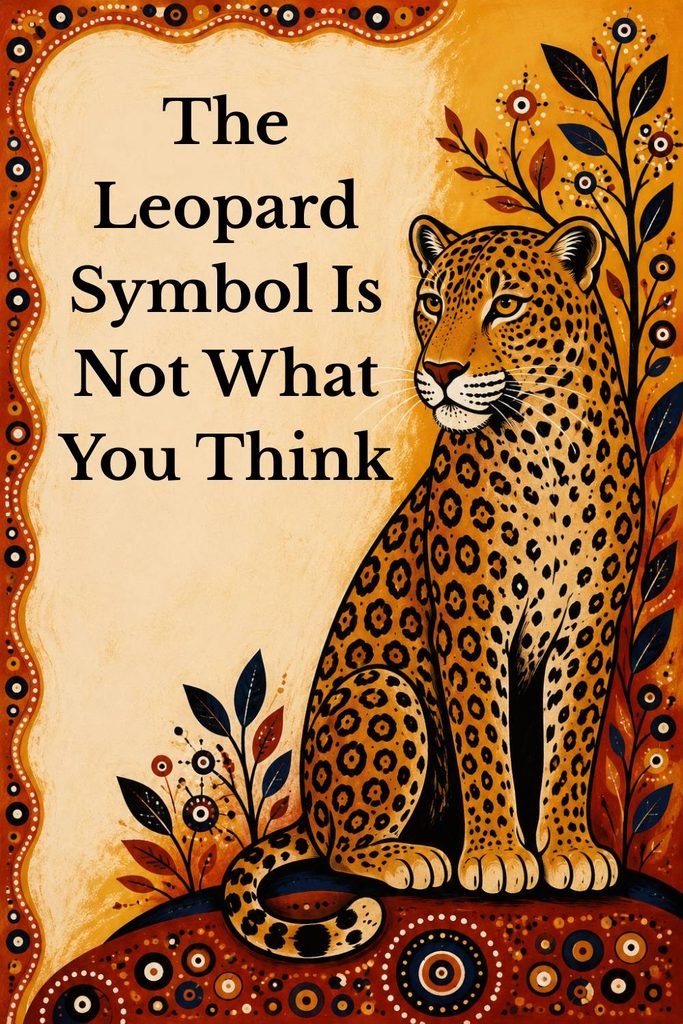
If the elephant is the herd, the leopard is the solitary. Leopards in Tingatinga symbolism stand for independence, strategic patience, the watchful self that does not need a crowd. Leopards hunt alone. They wait, sometimes for hours, before they move. When they move, they move once.
A leopard painting reads differently in a home office than it does in a living room. In the office, it is about the quality of patient attention — the willingness to wait for the right moment rather than to fill the day with motion. We would not hang a leopard in a child’s bedroom; it is not the right energy for that room. We would hang one in a working space where someone is doing slow, careful work that nobody is watching.

3. The giraffe — vision and gentle reach
The giraffe stands above almost everything else on the savannah, and what it sees from up there is part of what it means. Giraffes carry meanings of vision, of high perspective, of the gentle reach for what is just beyond — leaves no other animal can get to. Giraffes are also, in East African folklore, surprisingly peaceful: they rarely fight, they walk slowly, they keep their own counsel.
In decor: a Tingatinga giraffe works particularly well in a hallway or stairwell where the eye naturally moves upward. The animal’s verticality answers the architecture. There is also a quiet humour in it — a creature that has to spread its legs awkwardly wide to drink from a watering hole is, among other things, a reminder that vision and grace are not always the same thing.

4. The baobab — rooted endurance
The baobab tree was Edward Tingatinga’s favourite subject, by the account of those who knew him. It appears in countless Tingatinga paintings — leaning, gnarled, sometimes hollowed, often with birds nesting in its branches and animals gathering at its base. The baobab carries meanings of rooted endurance, of long memory, of the still centre around which the rest of life moves. Baobabs can live for over a thousand years. Some baobabs growing now in southern Tanzania were already standing when Edward’s great-great-great-grandparents were children.
In decor: a baobab Tingatinga painting reads as a quiet anchor in a room. It does not demand attention the way a leopard does. It just stays.

The Maasai shuka — red cloth, deep meaning
A short note on the cloth before we look at its elements.
The Maasai shuka is the rectangular piece of woven cotton cloth — usually one to two metres long, often red, often patterned with black stripes or with a fine check — that Maasai women and men wrap and knot around the body. It is worn as a wrap-skirt, as a shawl, as a blanket against the cold mountain mornings on the Serengeti and Maasai Mara plains, as a sling for carrying a baby, as bedding, as a sun-shade. One piece of cloth, used a dozen ways depending on the day.
The shuka’s history is the part that surprises people. As recently as the mid-twentieth century, the Maasai wore garments of leather softened with cow fat and dyed with red ochre. The shift to woven cotton cloth happened gradually through the colonial period and accelerated in the 1960s. The red plaid pattern most strongly associated with the Maasai today probably arrived through Scottish missionaries and traders, who bartered red-checked fabric for butter and other goods near Kilimanjaro. There is a real visual resemblance to a Scottish tartan, and the resemblance is not coincidence. What is interesting is that the Maasai took a foreign cloth and made it so completely their own that most of the world now thinks of it as ancient.

5. Red — bravery, blood, protection
The colour red is the centre of the shuka’s symbolism, and the meaning is layered. Red signifies bravery, strength, and unity. It signifies the blood of cattle, which is sacred to the Maasai and central to their economy and ritual life. It signifies kinship and vitality. In some traditional rituals, ochre and cow fat are mixed and rubbed onto the face — the colour applied directly to the body as a kind of marking. Red is also said, by Maasai elders, to deter wild predators — though whether that is its primary function or a story told around the primary function is a question for another conversation.
In decor: a red shuka draped over an armchair or folded across the foot of a bed is one of the most striking accents an Afrocentric or globally-layered room can carry. It does not match a palette. It anchors one.

6. Blue — sky, rain, and the survival of cattle
Blue is the second most meaningful colour in the Maasai colour vocabulary. It represents the sky — and by extension, rain, water, and the survival of livestock through the dry season. For a pastoralist people whose entire economy and culture is built around cattle, the sky that brings rain is not a backdrop. It is a working presence. Blue beadwork and blue shuka cloth carry that meaning forward into daily dress.
In decor: a blue-and-red striped shuka has a different energy than the classic red plaid. The blue lifts the red, the red grounds the blue, and the combination reads more meditative — like a textile that has thought about the sky.
7. The checkered weave — Maasai identity in a single pattern
The check pattern itself — the woven grid of red lines crossing black lines — has become, over the last sixty years, the single most visually recognisable sign of Maasai ethnicity. It functions almost as a tribal flag. The check signifies belonging to the Maasai community, the wearer’s identification with Maasai cultural values, and (in some readings) the interwoven nature of family, livestock, and land.
It also carries, quietly, the history of the cloth’s adoption: a pattern borrowed, modified, and so fully integrated into Maasai identity that the original source has been almost completely overwritten. Cultures do this kind of work all the time. The shuka is one of the cleaner examples we know of.
8. The cattle motif — the centre of everything
Cattle do not always appear directly in shuka cloth, but they appear constantly in Maasai beadwork that complements the shuka, in cattle-motif carvings, in painted gourds, in the geometry of certain beaded belts and collars. Cattle in Maasai symbolism are not livestock. They are wealth, identity, ritual currency, the gift exchanged at marriages, the centre of the cosmos. A Maasai man’s social standing is traditionally measured in cattle. Songs are sung to specific cattle. Children are sometimes named for the colouring of a particular animal.
In decor: a cattle-motif beaded piece, hung alongside a shuka, layers the meaning. The cloth is the visible identity. The cattle motif is what the identity is built around.
Makonde mapiko masks — faces from the Mueda Plateau
A note before we look at the symbols, because this section needs more care than the others.
Mapiko masks are not decor. They were carved on the Mueda Plateau to be worn in initiation ceremonies — danced by spiritual leaders to mark the passage of circumcised boys into the next stage of life, used to embody ancestors and spirits, traditionally burned after the ceremony was complete. The carving was a sacred craft, kept secret from the women of the village. The masks were not made to be looked at on a wall.
Most mapiko-style masks for sale outside Tanzania today are either contemporary pieces made for the tourist market by carvers in the Makonde tradition, or older pieces that have left their original context through routes that are not always clean. We are not saying you should never own one. We are saying you should know what you are buying, and that the meaning of these objects is heavier than the meaning of a Tingatinga painting.
With that on the table — here are four elements of mapiko meaning worth understanding.
9. The helmet form — transformation, not disguise
Many mapiko masks are lipiko in form — helmet masks rather than face masks. The wearer puts the helmet over the entire head and looks out through the mouth of the mask, his own face hidden completely. The helmet form signifies transformation, not concealment. When a Makonde dancer wears a mapiko, he is not pretending to be someone else; he is being entered, ritually, by another presence — an ancestor, a spirit, the embodied figure that the mask represents. The face is not gone. It is just no longer the relevant face.
This matters when you look at a mapiko on a wall. The mask is, in a real sense, empty — it is meant to be filled by a person and a presence, and outside of that context it is doing only half of what it was made to do.
10. Human hair on a wooden face — ancestors made visible
Many mapiko masks include real human hair, attached to the wood to form the mask’s hair, beard, or moustache. The hair is not stylistic. It is the most literal way of making the mask a portrait of a particular person — usually an ancestor — rather than a generic face. Combined with carved scarification marks, labrets, and facial features specific to the Makonde, the masks are deeply individuated. Each one is somebody.
This is the detail that often startles new collectors: the realisation that the hair is real, that it belonged to someone, that the mask was made to honour a specific person who lived and died on the Mueda Plateau.
11. The female ancestor figure — the matrilineal origin story
The Makonde are a matrilineal society — ancestry traced through the female line — and their origin story tells of the first man who sculpted a woman from wood. The wooden woman came to life and gave birth to the first children. She became, in the story, the venerated ancestress of the Makonde people. The female figure is therefore the protective ancestral form at the centre of Makonde art, and she appears throughout the carved tradition: in body masks worn by male dancers to embody female fertility, in standing figurines, in the maternal forms of the ujamaa “tree of life” sculptures that emerged from the modern Makonde school in the twentieth century.
In a Western decor context, a Makonde-tradition piece depicting a female ancestor reads as feminine and gentle. In its actual cultural context, it is closer to a household altar.
12. The shetani spirit form — the world that lives alongside ours
The shetani sculptures, developed from the 1950s onward in the modern Makonde school, depict spirits — sometimes playful, sometimes menacing, often grotesquely distorted in ways that European-trained eyes find unsettling. Shetani are not “demons” in the Christian sense; they are spirit-beings, neither wholly good nor wholly evil, that live alongside the human world and interact with it in ways that range from mischievous to dangerous. The most internationally famous Makonde artist of the modern era, George Lilanga (1934–2005), built his career on shetani imagery, and his work now sits in major museum collections worldwide.
In decor: a shetani-form Makonde sculpture is a strong, specific choice. It works best in a room with art that can hold its own — a contemporary Afrocentric gallery wall, a curated bookshelf, a space where the piece is in conversation with other deliberate objects rather than sitting alone trying to fill a corner.
How to live with Tanzanian symbols at home
A short, practical section.
Choose one tradition per room, not all three. A Tingatinga painting, a Maasai shuka, and a Makonde sculpture can co-exist in a home, but they probably should not co-exist in the same room. Each tradition has its own visual weight and its own cultural register. Layering all three at once flattens what makes each of them distinct.
Let Tingatinga be loud. A Tingatinga painting is meant to be saturated, crowded, joyful. Do not try to tone one down with a muted frame or hang it where a sofa swallows it. Give it a wall. Let the colour do its work.
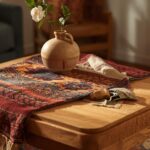
Let the shuka be a textile, not a wall hanging. The shuka is woven cloth meant to be wrapped, draped, folded, and used. We would not hang one stretched and pinned like a tapestry. Drape it over the back of a chair. Fold it across the foot of a bed. Use it the way it was made to be used.
Be careful with mapiko masks. As we said above, mapiko were not made to live on walls, and the older the piece, the more questions are worth asking about how it left Tanzania in the first place. If you choose to live with a Makonde-tradition piece, prefer a contemporary work made openly for sale by a named carver, ideally one connected to a cooperative in southern Tanzania. The meaning travels better when the provenance is clean.
Honour the matrilineal context. Where a Makonde piece depicts the female ancestress, give it the placement that context implies — a quiet, central spot rather than a dark hallway. The meaning is in how you live with it, not just in the wood.
What to look for when buying — and what to avoid
Four signals matter most when choosing Tanzanian-symbol decor.
1. Origin clarity. Where was the piece made, and by whom? A Tingatinga painting from the Tingatinga Arts Co-operative in Dar es Salaam, signed by a named artist, is a different object from a Tingatinga-style print mass-produced for Western retailers. A Maasai shuka woven in East Africa and sold by a Maasai cooperative supports the community whose visual identity it carries. A “Tanzanian-style” object with no origin information is usually a costume version.
2. Material integrity. A real Tingatinga is enamel paint on board or canvas, often with visible brushwork — the descendants of bicycle paint on Masonite. A real shuka is woven cotton with a tactile weight; cheaper polyester versions exist but they wear differently and feel synthetic in the hand. A genuine mapiko-tradition mask is carved from a single block of wood — traditionally a lightweight wood like sycamore fig — and shows tool marks. If a piece is suspiciously light, suspiciously smooth, or suspiciously cheap, it is probably not what its label claims.
3. Symbol accuracy. Tingatinga animal symbolism is consistent across artists once you know the vocabulary. A “Tingatinga-style” painting that shows animals in poses or compositions that no actual Tingatinga painter would use is a copy of the surface without the grammar. Look for the flat ground, the strong black outline, the crowded composition, the signature.
4. Artist credit. A named Tingatinga painter, a named Makonde carver, a Maasai cooperative with a documented connection to specific communities — these are signs that someone in the supply chain is being paid for their cultural work. An unsigned piece sold through an aggregator usually means someone is not.
For wall art specifically, our own Indigo Archives — Quiet Afrocentric Luxury Collection is not Tanzanian — it is Afrocentric, in indigo, cream, and charcoal — but it sits comfortably alongside a Tingatinga or a shuka without competing with either. Use code ARCHIVE15 for repeat-buyer pricing.
If you are looking for affordable framing options for a Tingatinga painting or for a folded shuka displayed in a deep shadow box, Amazon carries solid options in the under-$50 range. We will return to specific product picks in our upcoming guide on the best frames for culturally-rooted wall art.
FAQ
What is the most famous Tanzanian art style?
Tingatinga painting is the most internationally recognised Tanzanian art form. Created in 1968 by Edward Saidi Tingatinga in Dar es Salaam, the style is characterised by flat, saturated colour, bold black outlines, and wildlife or village-life subjects. Tingatinga-style paintings now sit in galleries and homes around the world, and the Tingatinga Arts Co-operative still operates from the location where Edward sold his first paintings. The Maasai shuka and Makonde mapiko masks are equally significant as visual traditions but are recognised more as cultural artefacts than as a named art movement.
Is the Maasai shuka really only sixty years old?
The red plaid cotton shuka most associated with the Maasai today was adopted in roughly the 1960s, most likely through trade with Scottish missionaries and merchants. Before that, the Maasai wore leather garments dyed with natural ochre. What is ancient is the colour vocabulary — red for bravery, blue for sky and rain, the central role of red ochre — and the cultural meaning the Maasai have attached to the cloth. The textile is recent. The meaning it carries is not.
Are Tingatinga animal symbols cultural rules or one painter’s invention?
They are East African cultural tendencies that Tingatinga and his school drew on, not personal invention. Animals like the elephant, the leopard, and the lion carry symbolic meanings in many East African oral traditions that long predate Tingatinga. What Edward did was channel that inherited symbolism into a new visual form — flat, bright, bicycle-enamel saturation on Masonite board. The meanings are real and pre-existing; the style is new.
Is it disrespectful to hang a Makonde mask on my wall?
This one deserves a careful answer. Mapiko masks were not made for display. They were carved for initiation ceremonies, danced by spiritual leaders, and traditionally burned afterwards. A mapiko on a wall, divorced from the dance and the dancer, is doing only a fraction of what it was made to do. Whether that is disrespectful depends largely on the piece’s origin and on how you live with it. A contemporary Makonde-tradition piece, openly carved for sale by a named artist working in southern Tanzania, hung in a thoughtful place, is one thing. An older piece of uncertain provenance, hung as exotic decoration without context, is closer to something else. Ask questions before you buy. The questions are part of the respect.
What is the difference between Tingatinga, Maasai, and Makonde?
These are three completely separate cultural traditions that share a country.
- Tingatinga is a painting style, named after one twentieth-century artist, practiced today by a cooperative of artists in Dar es Salaam and beyond. It is an art movement.
- Maasai is an ethnic group of approximately 1.5 million people, semi-nomadic pastoralists living mostly in southern Kenya and northern Tanzania, recognisable for their red shuka cloth and intricate beadwork.
- Makonde is also an ethnic group, matrilineal carvers and farmers living on the Mueda Plateau in southern Tanzania and northern Mozambique, known for their wooden masks and sculptural tradition.
They are not three faces of the same culture. They are three cultures that happen to share political borders.
What colours work best with Tanzanian decor pieces?
Warm earth tones — terracotta, ochre, soft cream, deep charcoal — provide a quiet container for the saturation of a Tingatinga painting or the brightness of a shuka without competing with them. Indigo and cream work particularly well with all three traditions, which is part of why our Indigo Decor guide suggests that palette as a foundation for culturally-layered rooms. Avoid white-on-white minimalism with Tanzanian pieces; the colour saturation needs a ground to rest on, and white walls flatten what should sing.
A closing note
A Tingatinga elephant painted in 2026 carries the same meaning Edward Saidi Tingatinga gave it on a salvaged ceiling board in 1968 — and the same meaning his Makua grandmother gave it in a southern Tanzanian village in the 1930s, when she told him stories under a baobab. That kind of continuity, carried across a single lifetime that touched both the colonial era and the era of international art markets, is rarer than it looks. It is also the actual point of culturally-rooted decor.
If you take one thing from this piece, let it be this: Tanzania is not a single aesthetic. It is at least three, layered onto a country whose borders are colonial inventions and whose people have been making meaning out of paint, cloth, and wood for longer than any of those borders have existed. When you bring a piece of Tanzania into your home, you are joining a specific conversation — the Tingatinga conversation, or the Maasai conversation, or the Makonde conversation. Not all of them at once. The right response is attention. Look at what you have chosen. Know which conversation it belongs to. Place it where its quiet work can be done.
That, as best as we can tell, is the difference between styling a room and making a home.
“They’re not simply depicting wildlife. They’re painting qualities: wisdom, independence, joy, resilience.” — TingaTinga Art Cooperative, on animal symbolism in the school’s paintings
We would add: which is exactly why a Tingatinga elephant on a living-room wall reads differently from a wildlife photograph. The photograph shows an elephant. The painting holds a household together.
Also read:
- 12 Moroccan Symbols & Their Meanings: A Decor Lover’s Guide
- What’s Actually Trending in Global Decor in 2026: A Pinterest Data Analysis
- Indigo Decor: A Quiet Luxury Guide to Afrocentric Wall Art in Blue Tones
- A Respectful Guide to African Textiles and What They Mean
- How to Mix Global Motifs at Home Without Losing Yourself
- 15 Afrocentric Wall Art Ideas for a Modern Living Room