12 Ethiopian Symbols and Their Meanings: A Decor Lover’s Guide
By Essence of the Road Art · Published September 2026
This article contains affiliate links. If you buy through them, we may earn a small commission at no extra cost to you. We only feature pieces we would live with ourselves.
Why we wrote this
Most African symbol systems in this series had to be reconstructed. Adinkra meanings were recorded late, Kongo cosmology travelled the Atlantic in pieces, and mudcloth patterns pass between generations with no written key at all.
Ethiopia is the exception, and it changes how this article has to be read.
Here the symbols come with a paper trail: a script still in liturgical use after fifteen centuries, illuminated manuscripts on parchment, churches carved downward out of solid rock in the twelfth century and still holding services on Sunday, painted scrolls made to a named person’s height. Almost nothing in this article is a guess.
That produces a different problem. Because Ethiopian material is so well documented, so photogenic and so easy to buy in reproduction, it gets lifted faster and understood less than anything else on the continent. The interlaced cross is printed on tote bags. The Lion of Judah is a font choice. Ge’ez characters get used as decorative shapes by people who do not know they are syllables.
So this guide does the opposite. Twelve symbols, in three groups — the Orthodox tradition, the imperial and national vocabulary, and the woven objects of daily life — with what each one says, and an honest note on which belong on a wall and which do not.
We are not Ethiopian. We make Afrocentric wall art, and most of what follows belongs to other people. We have written it the way we would want someone writing about our own visual language to write: with sources, with care, and without turning a cosmology into a colour scheme.
This is the newest guide in our Symbols & Meaning series. Readers of the Kongo guide will recognise the shape of it — though Ethiopia sits at the opposite end of the continent, and of the documentary record.
📌 Quick Answer
The twelve most significant Ethiopian symbols fall into three families. From the Orthodox tradition: the interlaced cross, the Aksum stelae, Bete Giyorgis, the tabot, the telsem talisman and the two-eyed painted face — eternity without beginning, doors carved for the dead, faith cut downward into stone, the presence kept hidden, geometry made to protect, and a moral system expressed through whether a figure faces you. From the imperial vocabulary: the Lion of Judah, the Ge’ez fidel and the green-yellow-red tricolour — Solomonic descent, a script that is also a pattern, and the three colours that became pan-African. From everyday life: tilet weaving, the mesob basket and the jebena — skill counted thread by thread, hospitality with a shape, and time measured in three rounds. Of these, the cross, the tilet border, basketry and the jebena are the ones we recommend living with; the tabot cannot be owned and the telsem was never decoration. For a symbol-led gallery wall, our Adinkra Symbol Wall Art Set (5) is the closest printable set we make.
Table of Contents
A note on names, faith and care
Three things are worth setting straight before the symbols.
Ethiopia is not one people. More than eighty languages are spoken there. The vocabulary below leans on the Christian highlands — Amhara, Tigrayan and the older Aksumite kingdom — because that is the tradition that produced the crosses, the manuscripts and the churches. Oromo, Harari, Sidama, Konso, Gurage and many other peoples have their own symbol systems, none of which we can cover properly here.
Most of this is religious, and still in use. The Ethiopian Orthodox Tewahedo Church is one of the oldest Christian institutions on earth, and the cross, the tabot and the painted icon are working objects in a living faith, not historical artefacts. That does not make them off-limits as decor, but it changes the register: a cross print is closer to a crucifix than to a geometric motif.
The Orthodox tradition — faith drawn as pattern
1. The Ethiopian cross — interlace with no beginning
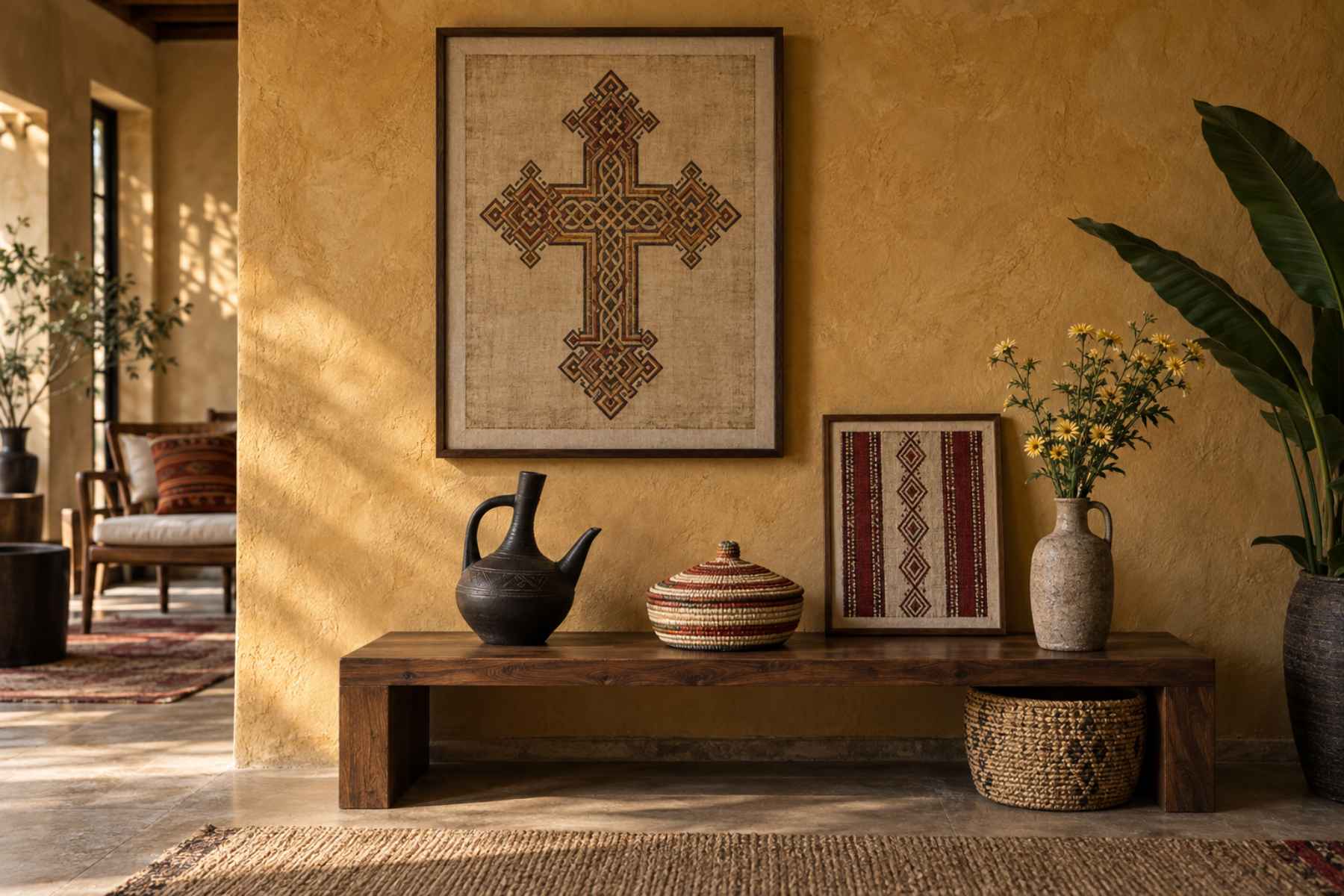
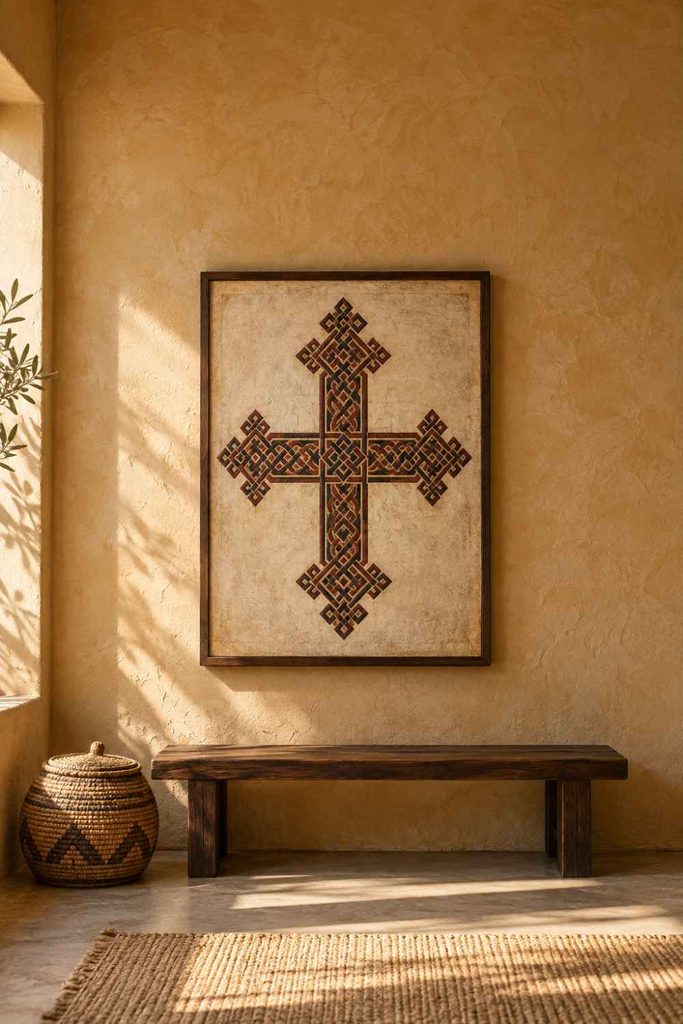
What it looks like: a cross whose arms dissolve into dense, woven latticework — knots, loops and voids, often with no straight edge anywhere and no figure of Christ.
What it means: the interlace is the point. The line has no beginning and no end, which reads as eternity and everlasting life, and the knotting is protective: evil is understood to get caught in the pattern and never reach the wearer. Styles are regional — Aksum, Lalibela and Gondar forms are distinct enough to place a cross geographically — and there are four working types: the processional cross, the clergy hand cross, the staff cross of wandering monks, and the neck cross worn on a mateb cord.
How to live with it: this is the most beautiful and most misused Ethiopian motif. Frame one, hang it alone, and let the knotwork be read rather than glanced at.
2. The Aksum stelae — doors carved for the dead
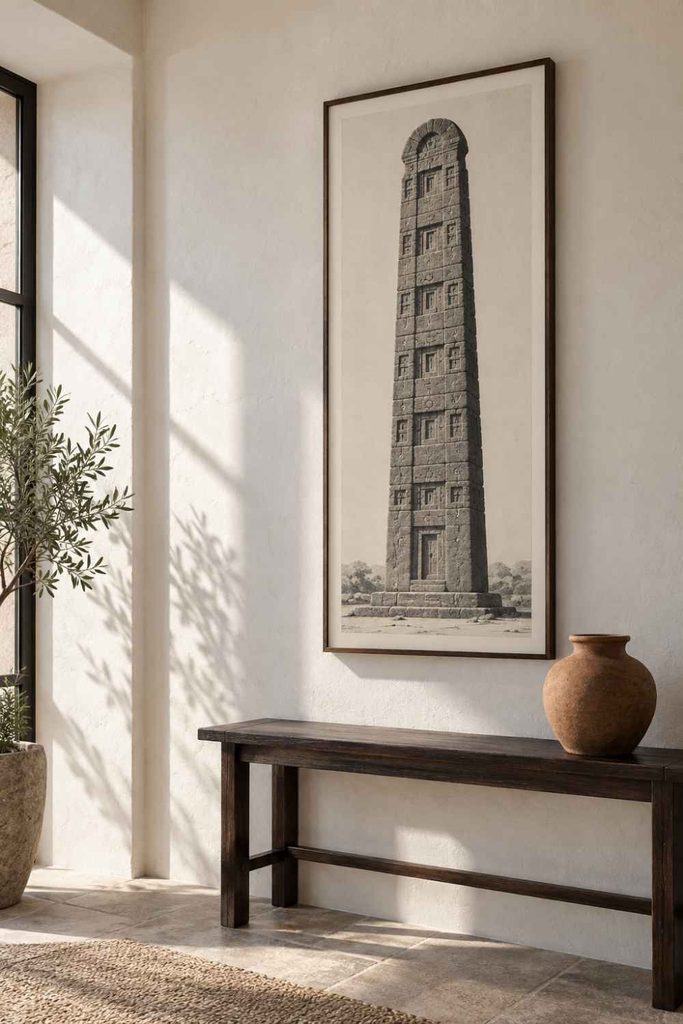
What it looks like: enormous single blocks of granite standing upright, their faces carved with rows of false windows, projecting beam-ends, and a door at the base that opens onto nothing.
What it means: raised in the third and fourth centuries, the stelae mark elite burials, and the carving turns each stone into a multi-storey building — in one case thirteen storeys, in a kingdom whose real buildings rarely passed three. The door at the foot imitates wood, complete with a lock — a house built for someone who is not coming back out, and scale advertises rank: the tallest was cut to stand around ninety-seven feet and fell, probably while being raised.
How to live with it: the usable idea is the false window — stacked, rhythmic, architectural, and carrying no religious weight. It translates beautifully into a tall, narrow print.
3. Bete Giyorgis — a church cut downward as a cross
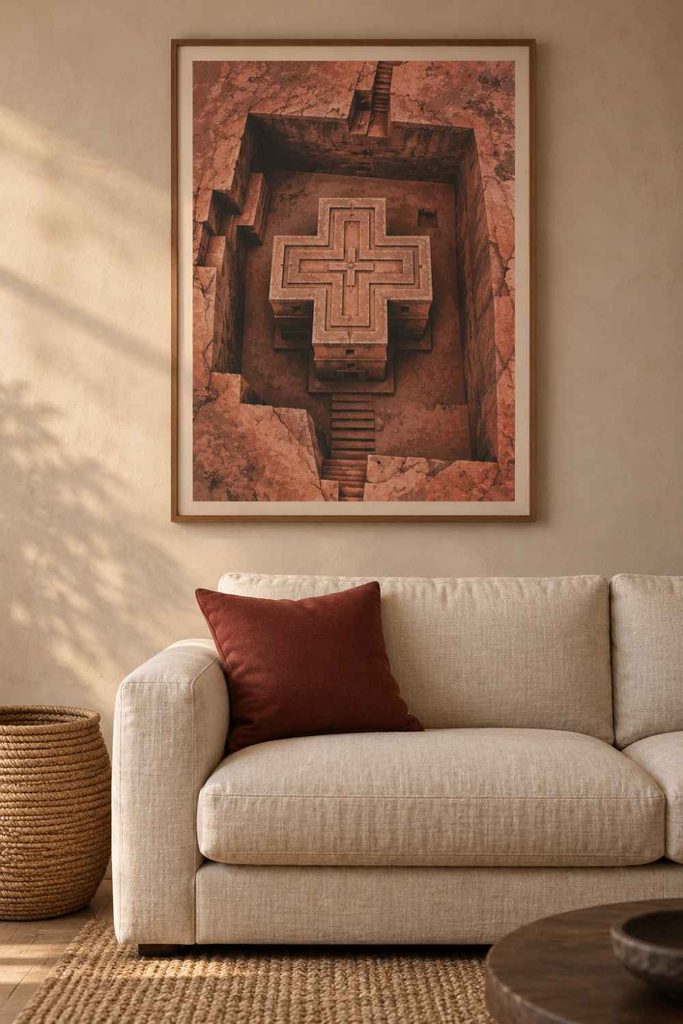
What it looks like: a perfect equal-armed cross, sunk into the ground, cut from a single block of rose-red volcanic rock.
What it means: Lalibela’s eleven rock-hewn churches were carved in the twelfth and thirteenth centuries under the Zagwe king Gebre Meskel Lalibela, conceived as a new Jerusalem for pilgrims who could no longer safely reach the old one. Bete Giyorgis, the Church of Saint George, is the most famous: masons began at ground level and cut down, removing everything that was not church. It is subtractive architecture, and it has been in continuous use for eight centuries.
How to live with it: seen from above, the equal-armed plan is one of the strongest graphic forms in African architecture. A credited aerial photograph is a striking and legitimate piece of wall art.
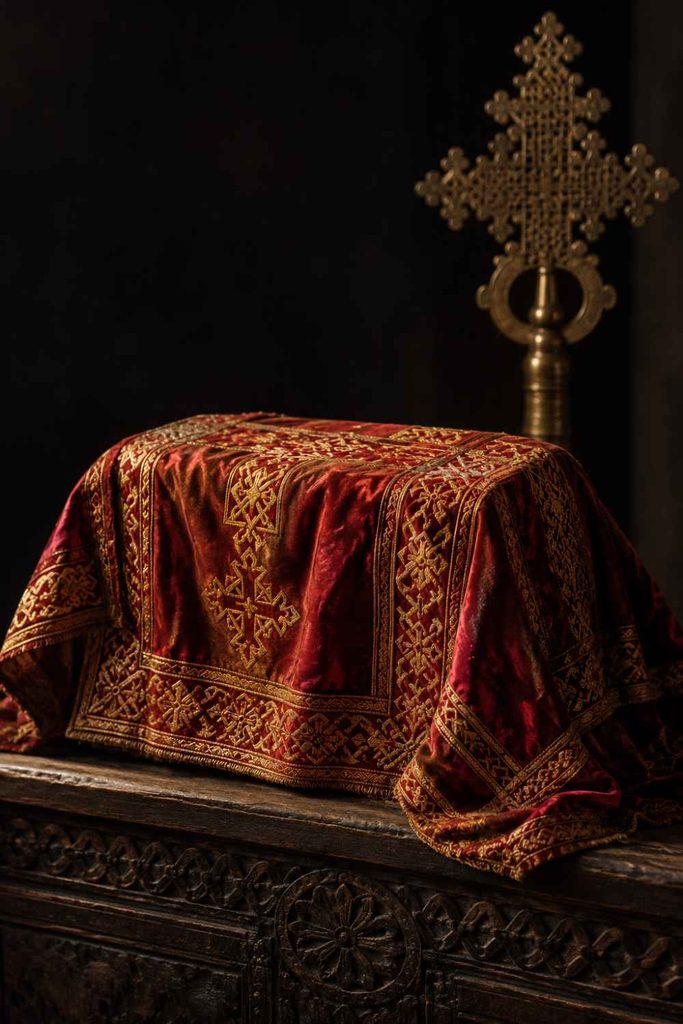
4. The tabot — the most important object nobody sees
What it looks like: you do not know. Almost nobody does.
What it means: every Ethiopian Orthodox church holds a tabot, a consecrated tablet of wood, marble or alabaster standing in for the Ark of the Covenant and inscribed with the name of Christ and the church’s saint. It lives wrapped in cloth in the bete mekdes, the holy of holies, where only clergy may enter. At Timkat it is carried out on a priest’s head, still wrapped, under silk umbrellas, and circles the church three times. Axum’s Church of Our Lady Mary of Zion claims to hold the original Ark, seen by one appointed guardian.
How to live with it: you do not. It belongs here because it explains something useful — in this tradition the holiest thing is the one deliberately hidden, the reverse of how decor works.
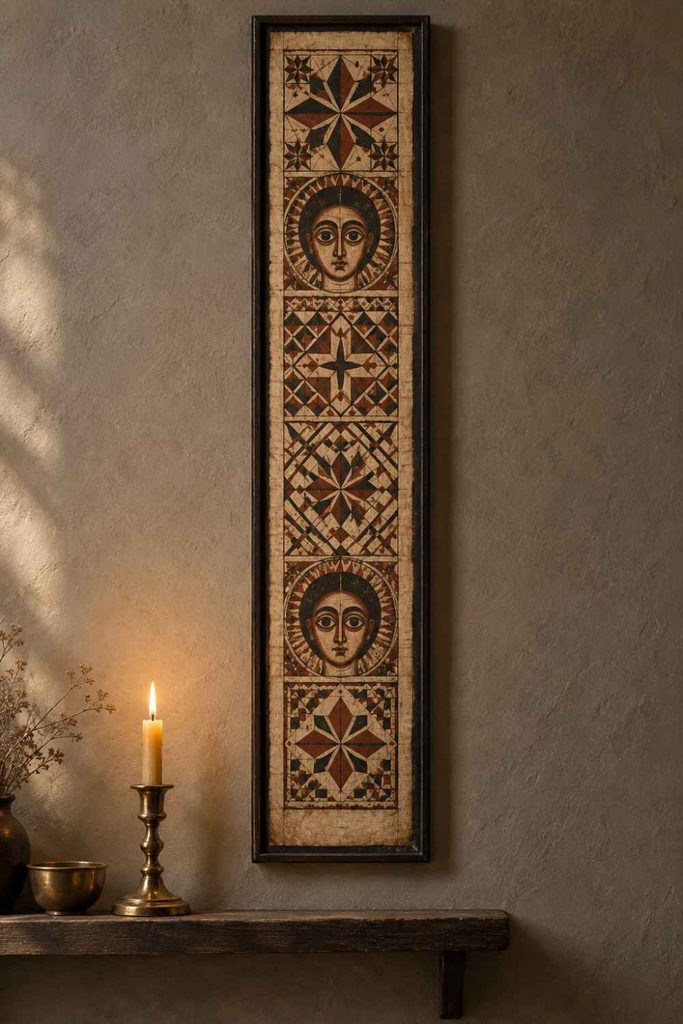
5. Telsem — geometry that was meant to work
What it looks like: dense geometric diagrams on parchment — eight-pointed stars, grids, interlocking lines — interrupted by frontal faces with enormous staring eyes.
What it means: these are healing scrolls, made by debtera, unordained church scholars who also practised traditional medicine. A scroll was cut to the length of the person it was made for, and written in black ink, with the client’s name and the names of the Trinity in red. The geometry is not ornament: the interlocking lines are understood to trap demons, and in the ritual the painted eyes hold the sufferer’s gaze until the illness leaves.
How to live with it: carefully, and preferably not. A credited museum reproduction is a different matter from a “tribal talisman print”.
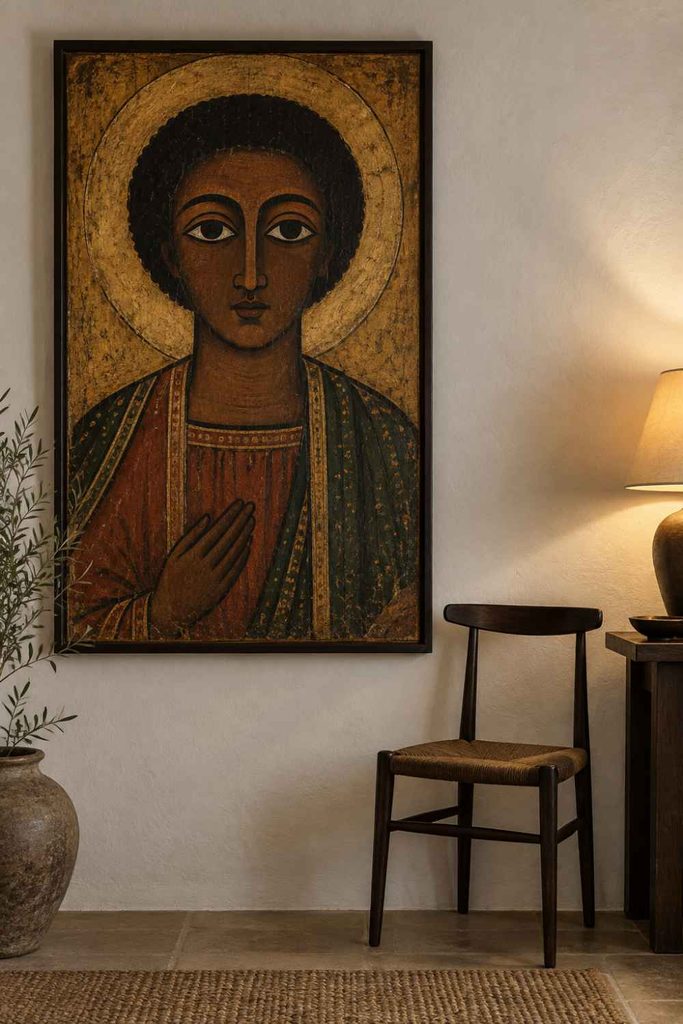
6. The two-eyed face — how Ethiopian painting shows a soul
What it looks like: flat, frontal figures with large almond eyes, saints on horseback, the Virgin and Child, all of it in earth reds, deep greens, ochres and black outline.
What it means: Ethiopian icon painting runs one of the clearest moral conventions in world art. Holy figures always face you with both eyes visible. Evil figures — Judas, executioners, demons — are turned into profile with a single eye showing. You can read the ethics of a crowded painting from across the room without knowing a single saint’s name.
How to live with it: the most quietly useful idea here. A portrait that meets the viewer’s eye holds a room differently from one that looks away, and you can choose art on exactly that basis, in any style.
Kingship, script and nation
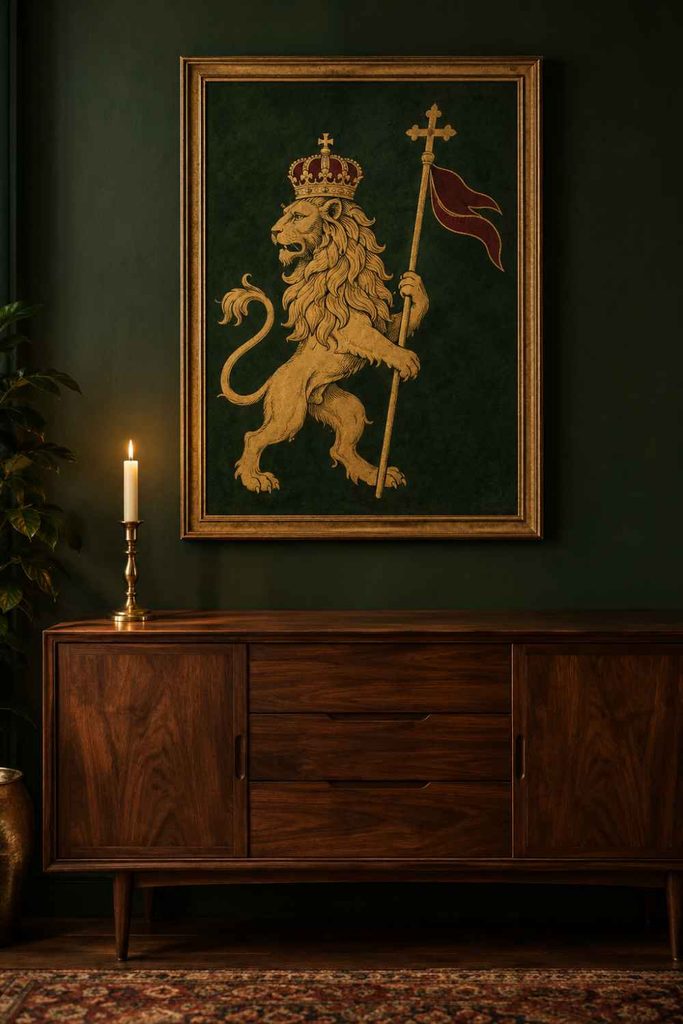
7. The Lion of Judah — a lineage claimed in an animal
What it looks like: a crowned lion, standing, holding a cross-topped staff with a pennant.
What it means: the fourteenth-century Kebra Nagast traces Ethiopia’s rulers to Menelik I, son of King Solomon and the Queen of Sheba. On that claim the Solomonic dynasty ruled from 1270 until 1974, and the imperial title opened not with the emperor’s name but with Moa Ambassa ze imnegede Yehuda — Conquering Lion of the Tribe of Judah — placing a biblical authority above the throne. Historians treat the descent as legend rather than genealogy, which has never reduced its power. With Haile Selassie’s coronation in 1930 the lion travelled into Rastafari, where it still stands for that same unbroken sovereignty.
How to live with it: used knowingly it is a serious emblem of Black sovereignty; used as a generic gym-poster lion it is nothing. The crown and the staff are the difference.
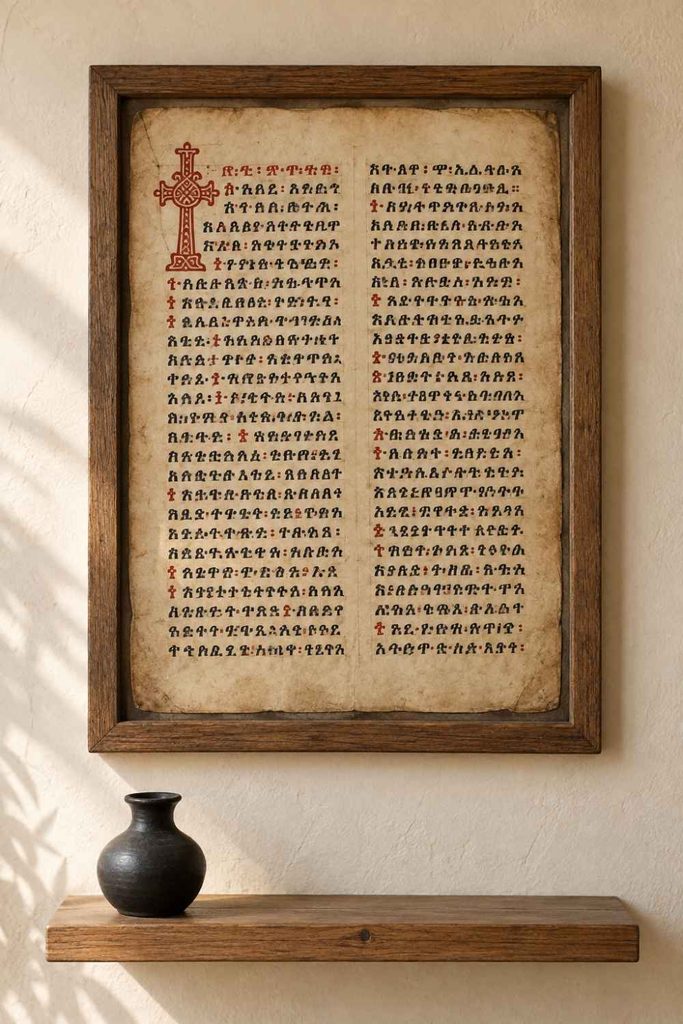
8. The Ge’ez fidel — a script that is also a pattern
What it looks like: compact, upright characters, each one squarish and self-contained, set in dense even blocks.
What it means: Ge’ez is not an alphabet. It is an abugida: thirty-three base consonants, each modified into seven vowel forms, giving 231 characters in which every single one is a whole syllable. It emerged in the Aksumite kingdom and is still the liturgical script of the Ethiopian Orthodox Church and the writing system of Amharic and Tigrinya. Because each character is a complete sound and roughly square, a page of Ge’ez reads visually closer to woven cloth than to a Latin paragraph.
How to live with it: never as decorative shapes — every character says something. A framed Ge’ez manuscript facsimile, or a word rendered correctly by someone who reads it, is the honest version, and typographically stunning.
9. Green, yellow, red — the colours that became pan-African
What it looks like: three horizontal bands, green at the top, then yellow, then red.
What it means: Menelik II combined three existing pennants into a single rectangular tricolour on 11 October 1897 — one year after Ethiopian forces defeated Italy at Adwa. Older church readings give red for faith and power, yellow for the church and peace, green for the land’s abundance. But the decisive fact is the one outside Ethiopia: as the African state that defeated a European army and kept its sovereignty, Ethiopia became the reference point for every independence movement that followed. Ghana took the colours in 1957, and a long list followed. Green, yellow and red are pan-African because they were Ethiopian first.
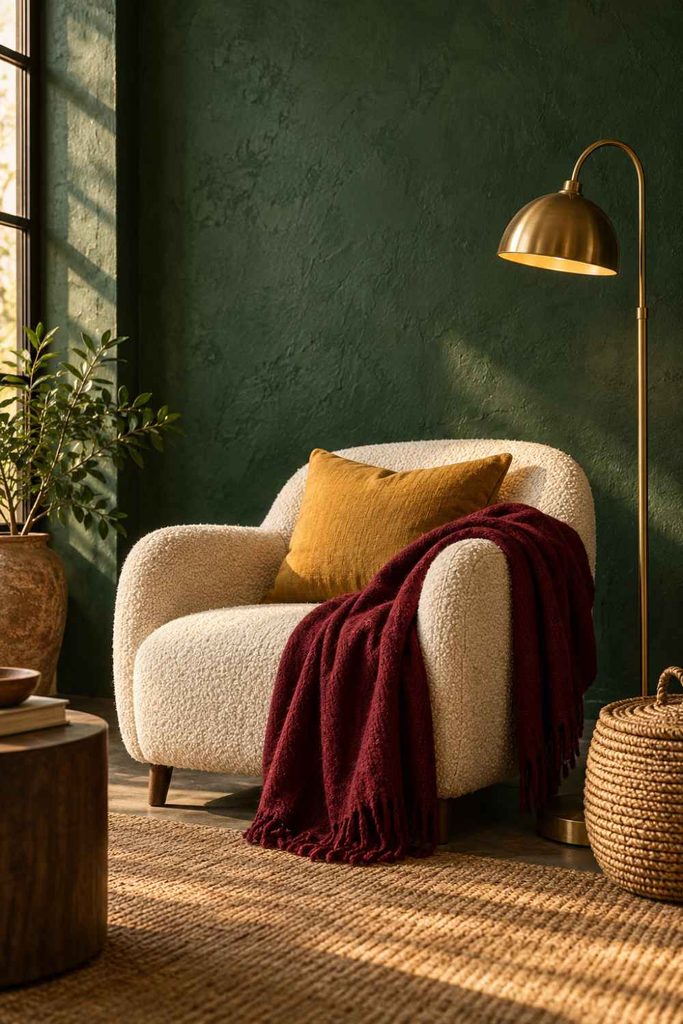
How to live with it: as a palette, not a flag. Deep forest green, ochre-gold and oxblood red against lime plaster and dark wood is one of the richest schemes in this series.
The woven and the everyday
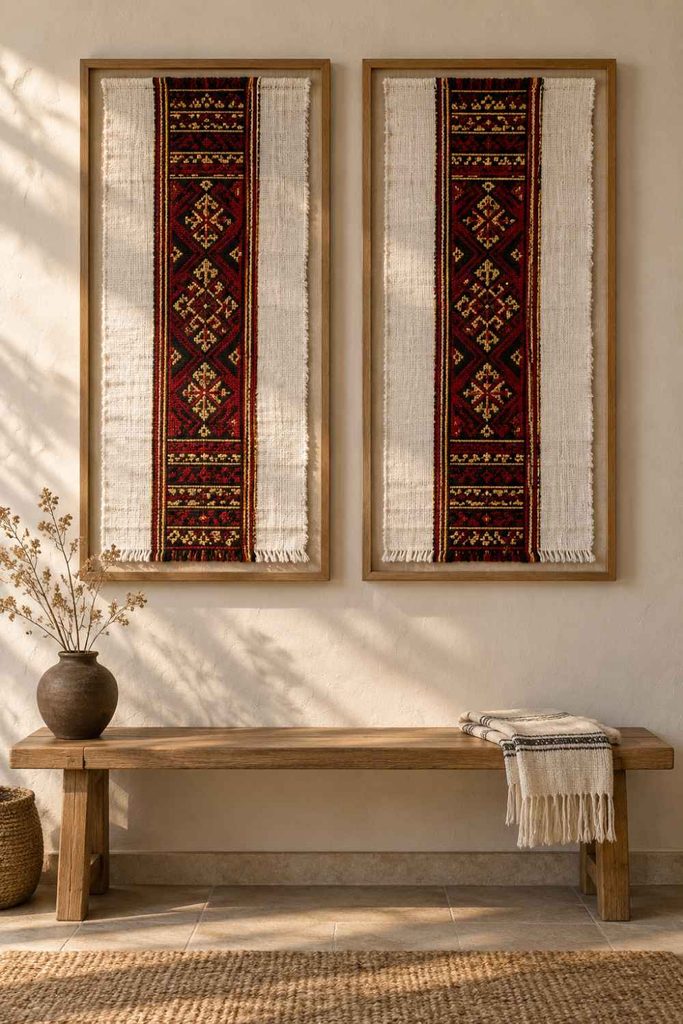
10. Tilet — the border woven thread by thread
What it looks like: a band of fine geometric pattern — crosses, diamonds, lattices, stepped edges — running down the front, hem and cuffs of a white cotton dress.
What it means: tibeb is the broad word for this woven embellishment; tilet is the more elaborate panel version that covers whole sections of a habesha kemis. Both use supplementary weft threads, so the weaver tracks every extra thread across the loom, row by row, holding the design in memory. Gondar, Gojjam, Shewa and Tigray each developed their own motif styles, and the Dorze weavers of Shiro Meda in Addis Ababa are considered the finest. A bridal kemis with full tilet panelling takes six to eight weeks.
How to live with it: framed as a textile panel this is the single best Ethiopian piece for a modern wall — graphic, fine-scaled, and unmistakably handmade. Buy woven, not printed, and the difference will be visible from the doorway.
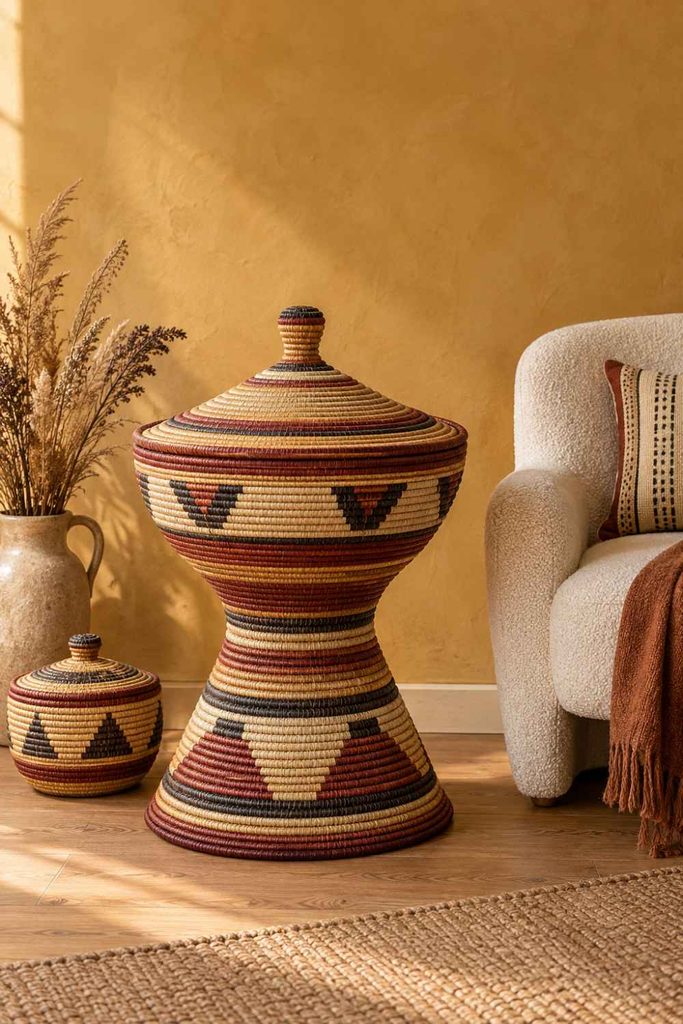
11. The mesob — a basket that is also a table
What it looks like: a tall hourglass of coiled grass with a domed lid, banded in concentric rings of red, ochre, black and natural straw.
What it means: the mesob holds injera and serves as the table itself — people sit around it and eat from a shared platter set on top, which makes it the physical shape of Ethiopian hospitality. It is woven from local grass and partially dyed palm leaf, and it is a Harari tradition above all, with Harar work prized for the most complex designs. Mesob baskets are also used in funeral ceremonies to support a bereaved family. Ethiopia put one on the ten birr note, which tells you how thoroughly it stands for the country’s own table.
How to live with it: freely — this is the easiest entry point in the article. A mesob works as a side table, a lidded store, or a sculptural object beside a sofa. Coiled Ethiopian and Ethiopian-style baskets are widely available, and they bring the palette into a room without a single symbol on the wall.
12. The jebena — three rounds and a blessing
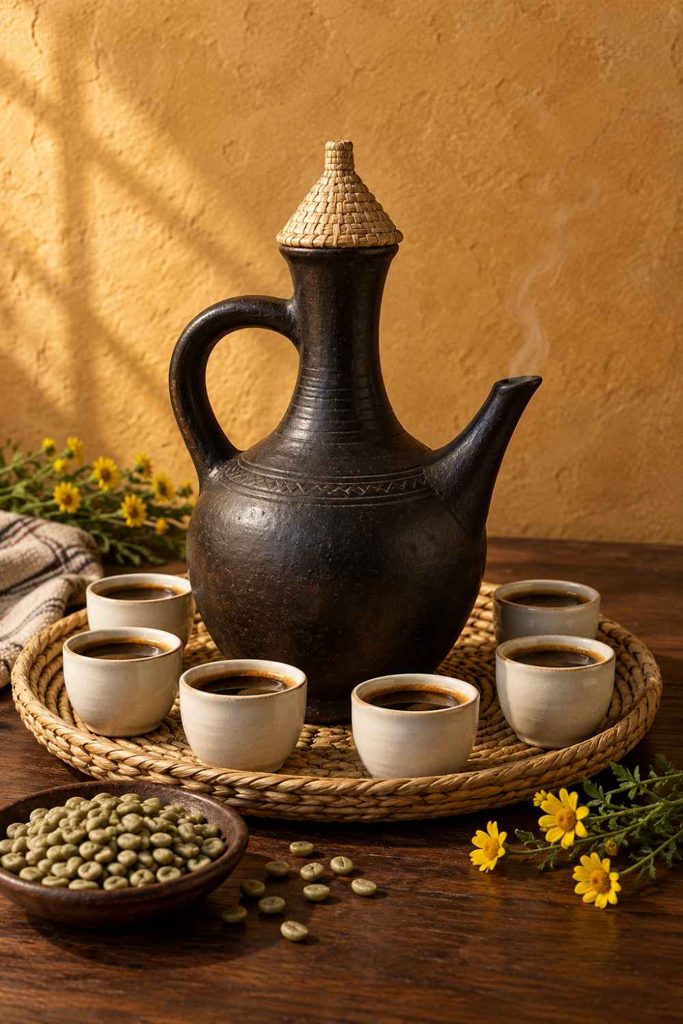
What it looks like: a round-bellied black clay pot with a long curved neck, a straw lid, and a spout set to one side.
What it means: Coffea arabica is native to the forests of southwestern Ethiopia, and the Kaffa region is the most commonly cited source of the word coffee itself. The ceremony built around it is unhurried on purpose: beans roasted in the room, ground by hand, brewed in the jebena and poured in three rounds — abol, tona and baraka. The third name means blessing. Leaving before it is poured is the one real breach of etiquette: the ceremony is not about caffeine, it is a structure for keeping people in a room together for two hours.
How to live with it: a jebena and cup set on a tray with a coiled basket is an honest, useful, beautiful piece of Ethiopian material culture, and the only symbol on this list you can serve someone out of.
How to live with Ethiopian symbols at home
Give the cross a wall, not a slot. Hung between two botanical prints an interlaced cross reads as a shape; hung alone at generous scale it reads as what it is.
Use tilet as the workhorse. Where the cross needs reverence, a framed woven border just needs a good frame. Two panels in the same palette, framed identically, make an excellent pair above a sofa or a bed.
Build the palette from the materials. Lime plaster, black clay, granite, raffia grass, parchment, silver and handspun cotton give you ochre, oxblood, deep forest green, chalk white, charcoal and warm stone. For a single accent, take the yellow of the adey abeba — the daisy that covers the highlands each September for Enkutatash, the Ethiopian new year, on 11 September. This sits close to the scheme in our Afro-boho colour guide.
Repeat texture, not motif. One cross, one woven panel, then grass, clay and plaster doing the rest. Three coiled baskets read as a collection; three crosses read as a shop.
Light it warm. These are pigment, clay and fibre traditions, and a cool bulb kills all three.
If you are printing digital art at home to build a wall like this, paper weight and sizing matter more than most people expect — we walk through both in our print, frame, hang and light guide.
What to look for when buying — and what to avoid
Buy the woven and the useful; leave the consecrated alone. Tilet panels, baskets, jebenas and contemporary prints by Ethiopian artists were made to be owned. Tabots are not for sale by any legitimate route, and antique healing scrolls were commissioned for one named person’s illness.
Check whether the cross was cast or stamped. A hand-finished Aksum, Lalibela or Gondar cross has slight asymmetries and a back that shows the work. A stamped sheet-metal copy does not, and should be priced as the decorative object it is.
Drop the word “Coptic” unless the piece is Egyptian. It is the clearest signal that a seller is repeating a listing template rather than describing what they have.
Buy from Ethiopian and diaspora makers where you can. Weavers, silversmiths and basket cooperatives working in these traditions are not hard to find, and buying from them puts the money where the visual language came from. If you design your own pieces, Creative Fabrica is where we source geometric pattern and script-friendly font bundles.
If you are buying printable art instead — including ours — hold the description to the same standard as the object. Art inspired by a tradition should say so, and we try to hold ourselves to that in our Etsy shop.
FAQ
What do Ethiopian symbols mean?
Most Ethiopian symbols carry either religious or dynastic meaning. The interlaced cross stands for eternal life and protection through a line with no beginning; the Lion of Judah asserts descent from Solomon; the tabot represents the presence of God; telsem geometry was made to trap harm. The everyday objects — tilet weaving, the mesob, the jebena — carry meanings of skill, hospitality and shared time rather than doctrine.
What is the difference between an Ethiopian cross and a Coptic cross?
They are different traditions. Coptic crosses are Egyptian; Ethiopian crosses come from the Ethiopian Orthodox Tewahedo Church, which has been administratively independent since 1959 and has its own regional styles in Aksum, Lalibela and Gondar. Ethiopian crosses are also distinctive for their dense interlace and their usual absence of a figure of Christ.
Is it disrespectful to hang an Ethiopian cross at home?
Not in itself — it is a Christian symbol, openly worn and openly sold. The disrespect is in treating it as an abstract pattern. Know what the interlace means, hang it with room around it, and describe it accurately if someone asks.
What are the Ethiopian colours and what do they stand for?
Green, yellow and red, in that order from the top. Traditional church readings give red for faith and power, yellow for the church and peace, and green for the fertility of the land. They became the pan-African colours after Ethiopia’s victory at Adwa in 1896 made it the symbol of African sovereignty — Ghana adopted them in 1957 and many states followed. We compare palettes across several countries in our African colour palette guide.
How is Ethiopian symbolism different from West African symbolism?
West African systems like Adinkra are largely proverbial — each mark condenses a saying about conduct. Ethiopian symbolism is mostly liturgical and dynastic, tied to a written church tradition and a royal lineage. You can see the contrast clearly against our Adinkra guide, and we unpack the general distinction in the difference between a symbol and a motif.
A closing note
There is a detail in Ethiopian painting we keep coming back to. A saint faces you. A traitor is turned sideways, with one eye. The whole moral weight of a picture rests on the direction of a gaze — and any visitor, literate or not, Ethiopian or not, can read it instantly.
That is a confident piece of design. It assumes the viewer is paying attention, and rewards them for it.
Most of what gets sold as African decor assumes the opposite: that the buyer wants the look and not the meaning. Ethiopia makes that position hard to hold. The cross has a grammar. The script has syllables. The scroll was cut to somebody’s body. The coffee is poured three times, and the third round is called the blessing.
You can live with all of it. We would encourage you to. Just know which conversation you have joined — and then hang the thing where someone will look at it properly.
Also read:
- 12 South African Symbols & Their Meanings: A Decor Lover’s Guide — the previous guide in this series
- 12 Kongo Symbols & Their Meanings: A Decor Lover’s Guide — Central Africa, and the interlace comparison
- 12 Ghanaian Symbols & Their Meanings — the West African contrast
- 12 Senegalese Symbols & Their Meanings
- 12 Tanzanian Symbols & Their Meanings: A Decor Lover’s Guide — the nearest neighbour geographically
- 12 Moroccan Symbols & Their Meanings: A Decor Lover’s Guide — the first in this series
- A Respectful Guide to African Textiles and What They Mean — where tilet sits among African weaving
- Tree of Life Symbolism in African Art
- How to Mix Global Motifs at Home Without Losing Yourself
Shop the Essence of the Road Art collection
Every piece below is our own work — digital downloads you print at home, in the ochre-and-oxblood palette this article describes.
- Essence of the Road Art on Etsy — the full collection
- Adinkra Symbol Wall Art Set (5) — five African symbols, the closest set we make to a symbol-led gallery wall
- Mount Kilimanjaro Wall Art Printable — East African highlands, good beside a cross print
- Africa Map Textured Collage Print — mixed-media surface, the nearest thing in the shop to woven cloth
- Afrocentric Wall Art Set (3), Earth Tone Terracotta and Africa Map — a three-piece wall in exactly this palette
- Baobab Tree of Life Print — earth-tone botanical, the gentlest way into African symbolism