Teranga at Home: The Senegalese Way of Welcome as a Design Philosophy
By Essence of the Road Art · Published June 2026
This article contains affiliate links. If you buy through our links, we may earn a small commission at no extra cost to you. We only recommend pieces we’d style in our own homes.
Why we wrote this
There is a small ceremony that happens hundreds of thousands of times every day across Senegal, and it does not look like a ceremony at all.
A kettle of green Chinese gunpowder tea boils over a small charcoal stove. Mint leaves and a startling amount of sugar go in. The pour is from a height — the tea is lifted at least a foot above the small glasses and dropped in a thin steady stream, and the higher the pour the better the foam. Three rounds. Each round takes about twenty minutes. The first round is bitter. The second is sweeter. The third is sweetest of all. By the time the three glasses have passed, an hour or two has gone by — sometimes more — and the people sitting around the tea have talked about things they would not have talked about in five minutes.
This is attaya, the Senegalese tea ritual, and it is one expression of a deeper concept the Wolof call teranga. The word is usually translated as hospitality. The translation is almost right, in the way cosiness is almost right for hygge — close enough to point you in the direction, not close enough to tell you what you are looking at. Teranga is hospitality the way the ocean is water. The smaller word is technically accurate. It just does not begin to describe the scale.
This article is about teranga at home. Teranga as a way of designing a home. Not as a motif, not as a single object to add to a shelf, but as an organising principle that changes which chairs you buy, where you place them, how the light falls in the afternoon, what sits on the table when no guest is expected, and how long the room invites somebody to stay.
It is also, we will admit honestly, an article about something we have noticed and want to write about before someone else does — which is that the Western design world has a particular pattern of taking a culturally-rooted concept and making a global decor movement out of it (hygge in 2016, wabi-sabi for thirty years before that, lagom and friluftsliv and ikigai in various smaller waves). Teranga sits there, fully formed, hundreds of years old, with everything a decor concept needs to travel — and almost nobody outside Senegal has written about it from that angle. The question of whether it should travel that way, and on whose terms, is part of what we want to think through here. Carefully, because the answer is not as simple as it looks.
📌 Quick Answer
Teranga is a Wolof word, central to Senegalese culture, that means hospitality, generosity, and the practice of welcoming a stranger as you would welcome family. It is not a symbol or a motif — it is a way of being in the world that shapes homes, meals, conversation, and the rhythm of a day. As a design philosophy, teranga organises a room around five gestures: offering tea, offering water, offering a seat, offering shade and soft light, and offering time. A teranga-leaning home is not defined by a single object on a wall. It is defined by what happens when somebody knocks on the door — and by whether the room was already ready for them before they arrived.
Table of Contents
What teranga actually is
The word teranga comes from the Wolof language, the most widely spoken language in Senegal alongside French, and it is so central to Senegalese national identity that the country itself is sometimes called the Land of Teranga. The national football team is the Lions of Teranga. The chef Pierre Thiam, who runs the New York restaurant by the same name, has called teranga “the most important value” in Senegalese culture, and has described it this way: when you walk into a Senegalese household, “everyone moves so that you can fit in the circle and share their food and drink.”
The textbook translation is hospitality, and the textbook is doing its best, but the word carries more weight than that. Teranga includes respect, community, generosity, solidarity, and the conviction that a stranger arriving at your door is not an interruption but, in the old Wolof phrase, a gift from heaven. There is a saying — variously rendered in different Senegalese communities — that refusing hospitality to a visitor brings misfortune. This is not metaphor. It is closer to the way an electrician thinks about grounding.
The roots of the practice are partly environmental. The Sahel region, which Senegal sits on the western edge of, is harsh. For most of the centuries that human beings have lived there, the survival of any individual household depended on the willingness of other households to take a stranger in — because tomorrow it might be you, lost on a road, hungry, at someone else’s door. Hospitality in this context is not a personality trait or a politeness. It is a piece of social infrastructure. Refusing to feed a traveller is the equivalent of refusing to maintain the road.
What is striking about teranga is how completely it has survived the transition from village life to twenty-first century urban Senegal. Walk into a market in Dakar, and a vendor will offer you tea. Take a taxi, and the driver may insist you come to his cousin’s place for lunch. Visit a family for what was supposed to be a half-hour conversation, and three hours later you will still be there, drinking the third round of attaya, having met every neighbour who walked past while you were sitting on the bench outside.
This is the concept. The question of what to do with it, as a design philosophy for a home in Brooklyn or Berlin or Budapest, is the rest of the article.
A short detour: how cultural concepts become design movements
Before we go further, a question that has been sitting in the background of every article we have written in this series, and that the teranga conversation makes unavoidable.
How does a culturally-rooted concept turn into a global design movement, and what happens to it along the way?
The clearest recent example is hygge. Until about 2015, hygge was a Danish word that most non-Danes had never heard of. It described an everyday Danish experience — candle-lit warmth, close company, the particular contentment of being indoors while it is dark and cold outside — and it had been in active use in Danish for roughly two centuries, since the early 1800s. Then, in September 2016, Penguin published Meik Wiking’s The Little Book of Hygge. Wiking was CEO of the Copenhagen-based Happiness Research Institute. The book was small, cream-coloured, full of candles. It sold over a million copies. By 2017 the word hygge was on the Collins Dictionary shortlist for word of the year. By 2018 the word was attached to candle ranges at Target, throw blankets at IKEA, scented diffusers at every mid-market gift shop in the English-speaking world.
The transformation was studied, in 2020, in an academic article in the Journal of Design History — Malene Breunig and Shona Kallestrup, both Scandinavian design scholars, asked what exactly had happened. Their answer, in short: the concept of hygge as experienced in Denmark had been translated, by London publishing houses and the design industries that followed them, into a marketable Anglophone product. The Danish concept was about an atmosphere and an experience. The translated concept, they argued, became increasingly about objects you could buy. The shift was small at first and then total.
This is not the only example. Wabi-sabi, the Japanese aesthetic concept centred on the beauty of impermanence, irregularity, and patina, was largely unknown in the English-speaking design world until Leonard Koren’s 1994 book Wabi-Sabi for Artists, Designers, Poets & Philosophers. Thirty years later, wabi-sabi is a stock descriptor in mid-market interior design — usually meaning, in practice, “linen sofa, raw plaster wall, dried branch in a clay vase.” The original concept is much stranger and more rigorous than that. Lagom, the Swedish principle of just enough, had its own publishing wave around 2017. Friluftsliv, the Norwegian concept of life lived outdoors, has been quietly drifting through wellness blogs since about 2019. Ikigai, the Japanese concept of having a reason to wake up in the morning, has been turning into a Venn diagram on LinkedIn since roughly 2018.
There is a pattern. A real concept, with deep cultural roots, gets condensed into a transportable phrase. Someone writes a small book about it. The book sells. A range of products follows. Within five years, the concept is everywhere — and within ten years, most of the people using the word have never asked anyone from its country of origin what it actually means.
Two things go wrong in this process, and one thing goes right.
What goes wrong, in order. First, the concept loses its rigour. Wabi-sabi in 1994 was a particular Buddhist aesthetic with a particular philosophical history; wabi-sabi in 2026 is mostly a marketing word for “imperfect-looking.” Second, the people whose culture the concept came from often stop being included in the conversation. The Danish design historians who wrote about hygge in 2020 spent much of their article asking who actually benefited from the boom — and the answer was largely English-language publishers and Western retail chains. The Danes themselves, as a culture, did not get noticeably more hygge. They just got more international visitors expecting them to be.
What goes right. The good version of this kind of cultural translation does happen, when it happens, by accident. When the concept lands well, it gives people a vocabulary they did not previously have — a word for an experience they may have already wanted but could not name. The reader who buys The Little Book of Hygge, lights a candle, and starts to spend more evenings in real conversation with people they care about, has not stolen anything from Denmark. They have learned something from it. The question is whether they keep learning, or stop at the candle.
This brings us to teranga. The concept is, by the standards of every other example in this short list, an obvious next candidate. It is a real word with real cultural depth. It describes an experience that many people in stressed Western societies want — the practice of welcome, the slowing of time, the offering of presence — and that has no comfortable English-language word attached. It has a country of origin with a living tradition still actively practising it.
We are writing this article in full awareness that we may be at the very beginning of the teranga-into-decor-movement curve. We do not know whether the curve will rise, or how high, or who will own the story when it does. What we do know is what we want the article to be, on the small chance that it ends up being one of the earlier English-language pieces written about it:
A piece that names the concept honestly, points to its actual cultural source, refuses to compress it into a list of objects, and — when it does talk about objects, which it will, because this is a decor blog — names where the objects come from and who made them.
That is what the rest of this article is.
The five gestures of teranga
A note on the structure of this section, because it is different from how we usually organise these articles. We are not listing teranga symbols — there is no codified symbol set, as the existing Senegal motifs guide already discussed. Instead, we have organised teranga into five gestures of welcome — five distinct actions that, in our reading of the tradition, recur in almost every teranga interaction. Each gesture has its own characteristic objects, its own placement in a room, its own piece of advice for someone trying to design around it.
1. The offering of tea — attaya, and the geometry of time
We described the attaya ceremony briefly at the top of this article. We will say a little more here, because the tea is where teranga is condensed most clearly — the gesture where the concept becomes physical.
Attaya is three rounds of green tea, brewed strong, sweetened heavily, and poured from height. The whole ceremony takes between an hour and two hours. The point is not the tea. The point is the time. A culture that organises its hospitality around a two-hour pour is a culture that has made a decision about pace — that the relationships sitting around the kettle are worth more than whatever was on the calendar after this. The three rounds of attaya, in some interpretations, carry their own meaning: the first bitter like life, the second sweet like love, the third gentle like death. We mention this not because the meaning is fixed (it varies by community) but because the fact of meaning is the point. The tea is not just tea. It is a way of marking that the hours sitting around this table count differently from the hours that came before.
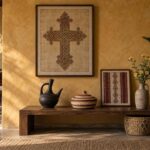
In a home: a small Moroccan-style tea service — a brass teapot, six small glasses, perhaps a small tray — placed where it can be reached without leaving the room. This is not a display. It is a working object. The room is set up so that making tea for an unexpected guest is a one-arm reach.
2. The offering of water — the calabash on the table
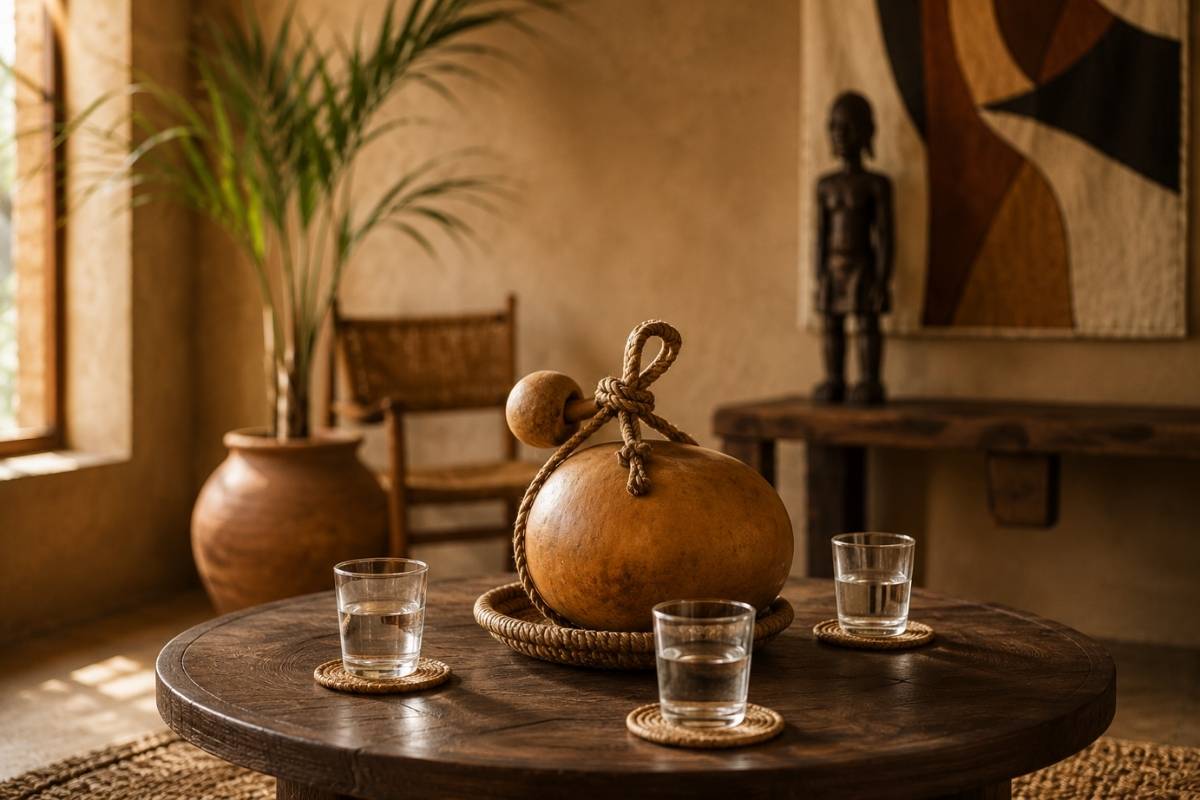
In rural Senegal, in homes where running water is not a given, there is often a calabash — a hollowed gourd, dried and smoothed, sometimes pyrographed with geometric patterns — that sits with clean drinking water in it, near the entrance. Anybody who comes through the door is offered water before anything else. The offering is reflexive. You do not ask whether the guest is thirsty. You give them water and let them decide.
The deeper meaning here is layered. Water in the Sahel is the scarce resource, and offering it before any other transaction is the most concrete way a household can signal that the visitor is treated as family. The Wolof phrase translates approximately as the stranger is a gift. The water gesture is the practical, daily form of that phrase.
In a home with running water in the kitchen, the gesture translates differently — but it does translate. A pitcher on a side table by the entrance, a stack of small clay or ceramic cups, perhaps a small bowl of dates or fresh fruit. The offering does not need to be elaborate. It needs to be ready, and it needs to be first.
3. The offering of a seat — low, soft, and always one extra
Senegalese living rooms are traditionally arranged for community, not for individual comfort. Seating is often low — closer to the floor than a Western sofa — and the seats are typically grouped in a way that makes it easy to add another. A bench, a long padded floor cushion, a woven mat unrolled across a corner of the room.
The principle is simple. A teranga room can absorb an extra person without rearranging itself. If your sofa seats three, and a fourth person arrives, the question is not where do we put them but how do we make room. A room designed for teranga answers that question in advance. There is always somewhere to sit. There is always a way to bring somebody into the circle.
This is, we think, one of the gestures that Western interior design has most quietly lost — without anyone particularly intending to lose it. The trend over the last fifty years has been towards spaces designed for the people who live there, with little room for the people who might. A teranga room moves in the opposite direction: it is designed for the people who live there and for whoever arrives.
In practical terms: pair a low sofa with a floor cushion or two, a woven mat that can be unrolled when needed, and an ottoman or pouf that doubles as a seat. The room does not need to look like a Dakar living room; it needs to behave like one.
4. The offering of shade — light as welcome
In Senegal, where the sun is fierce for most of the year, shade is one of the most precious gifts a household can offer. A guest arriving at noon, hot and exhausted from walking, is shown to the shaded side of the courtyard before anything else.
In a home thousands of miles away from the Senegalese sun, the equivalent gesture is soft light. The teranga room is rarely brightly lit. It is lit warmly — table lamps rather than overhead fixtures, candles in the evening, daylight diffused through linen curtains rather than full and direct through bare glass. The lighting is doing a specific job: it is softening the room into a place where you can stay. Bright overhead light, by contrast, sends a message that the room is for activity that has a clear end point. Soft light says the opposite.
This is the gesture that most overlaps with hygge, by the way. Hygge is also, at its core, about lighting. The Danish concept and the Senegalese concept arrive at similar conclusions from completely different climates — long dark winters on one side, fierce summer sun on the other — and the convergent answer is that warm low light is the visual condition under which people stay longer in a room. There is something deeply human in this. We do not, as a species, linger under fluorescent strip lighting. We linger under candles.
5. The offering of time — the rhythm a room sets
This is the gesture that ties the other four together, and it is the hardest to design for because it is not a physical object.
A teranga room moves slowly. Time inside the room is different from time outside it. The attaya takes two hours; the conversation takes longer; the meal is shared from a common bowl; nobody is checking a phone. The room signals this in every detail — the seating that invites sinking in, the lighting that says you can stay until it gets dark, the absence of the visible markers of a productivity-driven space (no desk, no calendar on the wall, no clock in obvious sight, no screen demanding attention).
Designing for time is mostly about removing — taking out the objects that pull a room back into the rhythm of work and the schedule. A teranga living room does not have a TV as the focal point. It does not have a desk pushed into the corner. The phone goes face-down on the table when a guest sits down. None of these are rules. They are gentle defaults the room sets, the way a library sets a default for quiet.
The phrase we keep coming back to, writing this section: a room that knows you have nowhere else to be. That is the rhythm teranga sets.
A teranga-influenced room, piece by piece
A short, practical assembly.
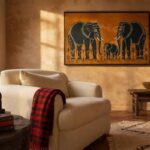
The seating layer. A low linen-upholstered sofa in cream or warm clay, paired with two floor cushions in indigo or terracotta, and one ottoman or pouf in a textured natural fibre. The configuration accommodates four to six people comfortably and seven without complaint.
The tea station. A small tray on a side table or low stool, holding a brass or stoneware teapot, four to six small glasses, a small sugar bowl, and a folded linen napkin. Within reach of where people sit. Not displayed — kept.
The water gesture. A clay or earthenware pitcher with a matching set of small cups, placed near the entry to the room (a console table, a sideboard, a shelf by the door). A small bowl of dates, dried figs, or seasonal fruit alongside.
The mat. A woven natural-fibre mat — jute, sisal, or Senegalese-style woven grass — rolled and standing in a corner, ready to unroll when a fourth or fifth guest arrives.
The light. Two table lamps with warm-tone bulbs, a string of low-temperature candles in glass holders, and curtains in unbleached linen or cotton that diffuse afternoon light rather than block it. No overhead fixture as the primary light source.
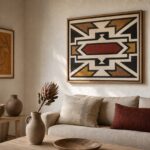
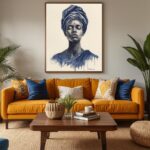
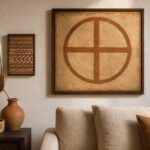
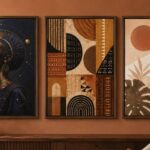
The art. One or two pieces on the wall, indigo and cream in palette, with subjects that reinforce the room’s quietness rather than competing for attention. Our own Indigo Archives — Quiet Afrocentric Luxury Collection was designed with exactly this kind of room in mind. Use code ARCHIVE15 for repeat-buyer pricing.
The textiles. A folded indigo cloth across the back of the sofa, a woven throw on the floor cushion, a runner across the side table where the tea sits. Texture rather than pattern carries this layer.
What is missing — and intentionally. No television in the visual centre. No desk. No piles of mail. No bright pendant light demanding attention. The teranga room is spacious in the sense that there is room for time inside it.
For affordable starting points on the lamps, ceramics, and woven mats, Amazon carries solid options in the under-$50 range — we will return to specific picks in our upcoming guide on the best frames for culturally-rooted wall art, and you can pair them with the wall art collection above.
What teranga is not — and why the distinction matters
Five honest sentences before we wrap up, because the meta-section earlier laid out the risk and we owe it the follow-through.
Teranga is not African boho. It is a specific Senegalese, predominantly Wolof, concept with a documented history, a living practice, and a country attached. Mixing it into a generic “African-inspired” aesthetic flattens what makes it distinctive.
Teranga is not a single object you can buy. You cannot buy teranga the way you cannot buy hygge or wabi-sabi — and the publishing industries of the last decade have taught us, painfully, that the moment a concept is reduced to a shopping list is the moment it begins to mean nothing.
Teranga is not a personal lifestyle brand. It is a community practice, embedded in a culture that has been doing it for centuries. It is fine to learn from it and to draw on it. It is less fine to extract it.
Teranga is not an excuse to skip the symbols. If you are designing around teranga, the wall art, the calabashes, the textiles, the attaya set should ideally come from sources that name the Senegalese artisan or community they came from. The framework and the objects belong together.
Teranga is not finished as soon as the guest leaves. The deeper version of the practice is that the room is always ready — that the tea station is set up not for guests but as a default, that the extra seat is there before anyone has been invited. The most teranga-leaning home is the home where nothing changes when company arrives, because the welcome was already built in.
Where to find the objects, and what to look for
A short, practical guide.
For Senegalese textiles — indigo cloths, woven mats, calabashes — Etsy hosts a number of Senegalese artisans and resellers who name the source. Fair-trade marketplaces (Ten Thousand Villages, Fair Trade Federation member shops) carry calabashes and indigo pieces with documented provenance. Specialty African design retailers in the US and Europe often work directly with cooperatives in Dakar or Saint-Louis.
For the attaya tea set itself — small heat-resistant glasses, a brass or stainless teapot, a small charcoal stove if you want to be authentic — Moroccan and Middle Eastern import shops carry close equivalents at every price point. The traditional Senegalese setup uses Chinese gunpowder green tea (any tea importer carries this) and fresh mint leaves. Amazon carries reasonable starter sets in the $25–$50 range.
For the wall art and the colour ground of the room — this is where our own work lives. The Indigo Archives collection is designed in indigo, cream, and charcoal, with Afrocentric subjects that pair naturally with Senegalese textiles and calabashes without competing with them. Use ARCHIVE15 at checkout.
Four signals matter most when buying.
1. Named makers. A seller who names the artisan, the cooperative, or the region of Senegal a piece comes from has done some of the cultural work for you. A generic “African” listing has not.
2. Material integrity. A real calabash is a dried gourd, lightweight and grainy. A real indigo cloth is woven cotton, with the irregular variation of hand-dyeing. Plastic-feel or machine-perfect substitutes carry the look but not the meaning.
3. Fair pricing. A handmade calabash sold for $4 is not handmade. The economics do not work. If a piece is suspiciously cheap, somebody upstream is being underpaid — usually the artisan.
4. Cultural specificity. A seller who can tell you which Senegalese tradition a piece comes from — Wolof, Manjak, Serer, the indigo cooperatives of Saint-Louis — is operating with care. A seller who just says “African” is selling aesthetic, not provenance.
FAQ
What is teranga in Senegalese culture?
Teranga is the Wolof word for hospitality, generosity, and the practice of welcoming a stranger as you would welcome family. It is one of the defining concepts of Senegalese national identity, instilled from childhood, woven into daily life through tea ceremonies, communal meals, and the everyday gesture of making room in a circle for whoever arrives. The word does not translate cleanly into English — the closest equivalents (hospitality, generosity, welcome) each catch part of it but miss the depth. Senegal is sometimes called the Land of Teranga, and the national football team is the Lions of Teranga.
Is teranga the same as hygge?
No — but they are useful to compare. Hygge is a Danish concept centred on cosiness, intimacy, and warm safety from the cold and dark outside. Teranga is a Senegalese concept centred on welcome, generosity, and the offering of one’s resources to a guest or stranger. Hygge is primarily about the people already inside the home (and their comfort). Teranga is primarily about the people arriving (and how they are received). Both organise homes around warm low light, slow time, shared food and drink, and the rhythm of staying rather than rushing. Both refuse to be captured in a single object on a shelf. They are siblings, not twins.
Can I design my home around teranga if I am not Senegalese?
Yes, with care. The principles of teranga — making room, offering before being asked, building a home around welcome rather than productivity — are not culturally exclusive. They are practices that anyone can learn from and adapt. What matters is honouring the source: knowing where the concept comes from, citing the Wolof culture that shaped it, sourcing objects from Senegalese artisans where possible, and not reducing teranga to a marketing word for “neutral living room with a clay pot.” If you remember it is a Senegalese concept and treat it that way, you are doing the work of cultural respect. If you forget, you are doing something else.
What is the attaya tea ceremony?
Attaya (also spelled ataya, ataaya) is the Senegalese tea ritual: three rounds of strong Chinese gunpowder green tea, brewed with mint and a large amount of sugar, poured from height to create foam, and shared slowly with whoever is sitting around the kettle. Each round takes about twenty minutes; the full ceremony lasts one to two hours. In Senegalese tradition the three rounds carry their own meaning — sometimes interpreted as bitter as life, sweet as love, gentle as death, though the reading varies by community. The deeper point is time: attaya is a ritual organised around the willingness to spend two hours talking to somebody.
How is teranga different from “hospitality” in English?
The English word hospitality implies a host actively receiving a guest — usually a planned guest, sometimes a paid relationship, often a temporary one. Teranga is broader. It includes hospitality but also covers anyone arriving unexpectedly (the stranger at the door, the relative who showed up without warning, the friend’s friend whom nobody has met before), and it covers them with the same warmth as a planned guest. It is closer to a posture toward the world than a service offered to a particular person. The hospitality industry treats hospitality as a product. Teranga treats it as the default state of being a household.
What objects are central to a teranga-influenced home?
Five core objects: an attaya tea set (small teapot, small glasses, tray); a water pitcher with small cups placed near the entry; low seating with the capacity to expand for an extra guest (a long sofa plus floor cushions plus a woven mat); soft, warm lighting that diffuses afternoon and evening light; and one or two pieces of cultural art that ground the room’s palette. The principle behind all of them is that the room is ready before anyone arrives. None of them is bought to perform welcome. They are kept because welcome is the room’s default.
Is there a risk of cultural appropriation in styling a home around teranga?
There is a risk, and we have tried to write this article honestly about it. The risk is not in learning from teranga — cultural learning across borders is a basic human practice and has always been. The risk is in extracting teranga: turning it into a marketing word for “ethnic-looking décor,” sourcing the objects from anywhere except the Senegalese artisans who actually make them, and forgetting the country and the language the concept came from. The cleanest path is to keep teranga named, cited, and sourced — to know it is Wolof, to know it is Senegalese, to know who made the calabash on your table and where the indigo cloth came from. If those three things are true, you are doing the work. If they are not, you are doing something the design industry has done before, several times, and that it has been gently criticised for after.
A closing note
There is a saying, in Wolof tradition, that the stranger is a gift from heaven. We have come back to that phrase several times writing this article, because it is the part of teranga that takes the longest to settle into the bones of a non-Senegalese reader.
In most of the design conversations that shape Western homes — open-plan minimalism, productive living, the room as personal statement — the stranger is, at best, an interruption. The unexpected knock at the door is something a well-designed home is supposed to resist. Teranga proposes the opposite: that the well-designed home is the one that has been quietly waiting for the knock, that has tea ready, water poured, a mat that can unroll, a place in the circle that does not yet have a person in it but might in twenty minutes.
If you take one thing from this article, let it be this: teranga is not a style. It is not an aesthetic. It is a posture toward arrival — toward the people who show up in your home expected or unexpected, scheduled or unscheduled, family or someone you have not met yet. The aesthetic follows from the posture, not the other way round. A linen sofa and an indigo cloth do not make a room teranga. A room that is ready when somebody arrives — that is teranga, in any palette, in any country, in any climate.
We will keep writing about it. We hope, slightly, that we are early. We are very aware that if we are right about where the design conversation is heading, somebody else will eventually write the bestselling small cream-coloured book, and somebody else will eventually launch the Target candle range, and somebody else will eventually compress all of this into the easy phrase that loses everything that mattered. That is fine. The phrase will travel. What we have tried to do here is leave a longer version of the answer available, with the Wolof source intact, in case anyone comes looking for it later.
If you are styling around teranga now: do it carefully. Name the source. Buy from Senegalese makers where you can. Keep the tea station set up, the mat ready, the seat free. Let the room be ready for the knock.
That, as best as we can tell, is the difference between styling a room and making a home where people want to stay.
“Teranga is about the way we treat our guests. It’s about the way that when you come into a Senegalese household, everyone moves so that you can fit in the circle and share their food and drink.” — Pierre Thiam, Senegalese chef, restaurateur, and founder of Teranga restaurant in New York
We would add: which is exactly why teranga cannot be bought in a candle range. It is the moving, not the candle. The candle helps. The moving is the practice.
Also read:
- 12 Symbols & Their Meanings: The Symbolism in African Art — Senegal — the catalogue this article extends
- Senegal Interior Design Style Ideas for Soulful, Stylish Apartments
- 12 Moroccan Symbols & Their Meanings: A Decor Lover’s Guide
- 12 Tanzanian Symbols & Their Meanings: A Decor Lover’s Guide
- How to Mix Global Motifs at Home Without Losing Yourself
- Indigo Decor: A Quiet Luxury Guide to Afrocentric Wall Art in Blue Tones
- A Respectful Guide to African Textiles and What They Mean
Sources & further reading
The meta-reflexive section of this article — on how culturally-rooted concepts become global design movements — draws on the following sources.
On hygge:
- Meik Wiking, The Little Book of Hygge: The Danish Way to Live Well (London: Penguin, 2016). The book that catalysed the international hygge phenomenon. Over one million copies sold worldwide; hygge was on the Collins Dictionary shortlist for word of the year in 2016.
- Malene Breunig and Shona Kallestrup, “Translating Hygge: A Danish Design Myth and Its Anglophone Appropriation,” Journal of Design History, vol. 33, no. 2 (May 2020), pp. 158–174. DOI: 10.1093/jdh/epz056. A peer-reviewed analysis of how the Danish concept was transformed by London publishing houses and Anglophone design media into a marketable commodity.
On wabi-sabi:
- Leonard Koren, Wabi-Sabi for Artists, Designers, Poets & Philosophers (Berkeley: Stone Bridge Press, 1994). The book most credited with introducing the Japanese aesthetic concept to English-speaking designers.
On teranga and Senegalese hospitality:
- Pierre Thiam, in conversation with The Splendid Table and The New York Times, on teranga as “the most important value” in Senegalese culture.
- Senegalese tea culture, with reference to academic work on attaya and West African tea traditions (see also Wikipedia’s documented sourcing on the three-stage ceremony).
- Cultural-context interviews collected by Culture Trip (“Why Senegal Is the Country of Teranga,” 2019) and FunTimes Magazine (“Teranga: Unraveling Senegal’s Unique Essence of Hospitality,” 2024).
We have tried to cite primary and peer-reviewed sources where the argument depends on them. Where we have used decor and culture journalism, we have done so for cultural context rather than for the academic case.