Tanzania Color Palette: Zanzibar Turquoise to Serengeti Gold
By Essence of the Road Art · Published July 2026
This article contains affiliate links. If you buy through them, we may earn a small commission at no extra cost to you. We only feature pieces we would live with ourselves.
Most countries give you one landscape to color a room with. Tanzania hands you four: an ocean the color of oxidized copper, an island that smells of cloves, a plain of gold grass that runs to the horizon, and a mountain wearing snow on the equator. Then, as if that were not enough, it adds a fifth palette that people made from scratch — Tingatinga painting, born in Dar es Salaam from bicycle enamel and hardboard.
That range is why the tanzania color palette deserves its own guide rather than a footnote in our African color palette overview. Cool water and warm spice, pale stone and near-black wood, savanna gold and glacier white: Tanzania is the continent’s best argument that a single country can furnish every room in a house without repeating itself. Below are five schemes with real hex codes, the history inside each one, and the art and objects that carry them home.
This is the color companion to our 12 Tanzanian symbols guide — that piece decodes the motifs, this one supplies their palettes.
Quick answer: The signature tanzania color palette pairs Zanzibar’s ocean turquoise with warm spice cinnamon, carved-wood dark brown and coral-stone white in a 60-30-10 rhythm — white and wood as the ground, turquoise as the lead color, spice as the accent. It is the rare scheme that delivers energy without heat. The one-step version is our Afrocentric Modern Beach Wall Art Set of 3, which hangs the coast in three frames.
Table of Contents
What makes Tanzanian color different
Tanzania’s schemes split along an axis no other palette in this series has: coast versus interior. The Swahili coast is a trading culture — a thousand years of dhows crossing to Arabia, India and back, carrying cloves, cinnamon, brass and carved wood. Its colors are worldly and layered: turquoise shallows, spice browns, coral-stone white. The interior answers with the oldest colors on earth — savanna gold, acacia green, volcanic slate — landscape at a scale that makes any room feel bigger for referencing it.
The practical consequence: Tanzania gives you a cool-energy palette and a warm-calm palette from a single country, plus one joyous outlier in Tingatinga. Where our Senegal guide is a study in one temperament, Tanzania is a menu.
1. Zanzibar Coast — the signature scheme
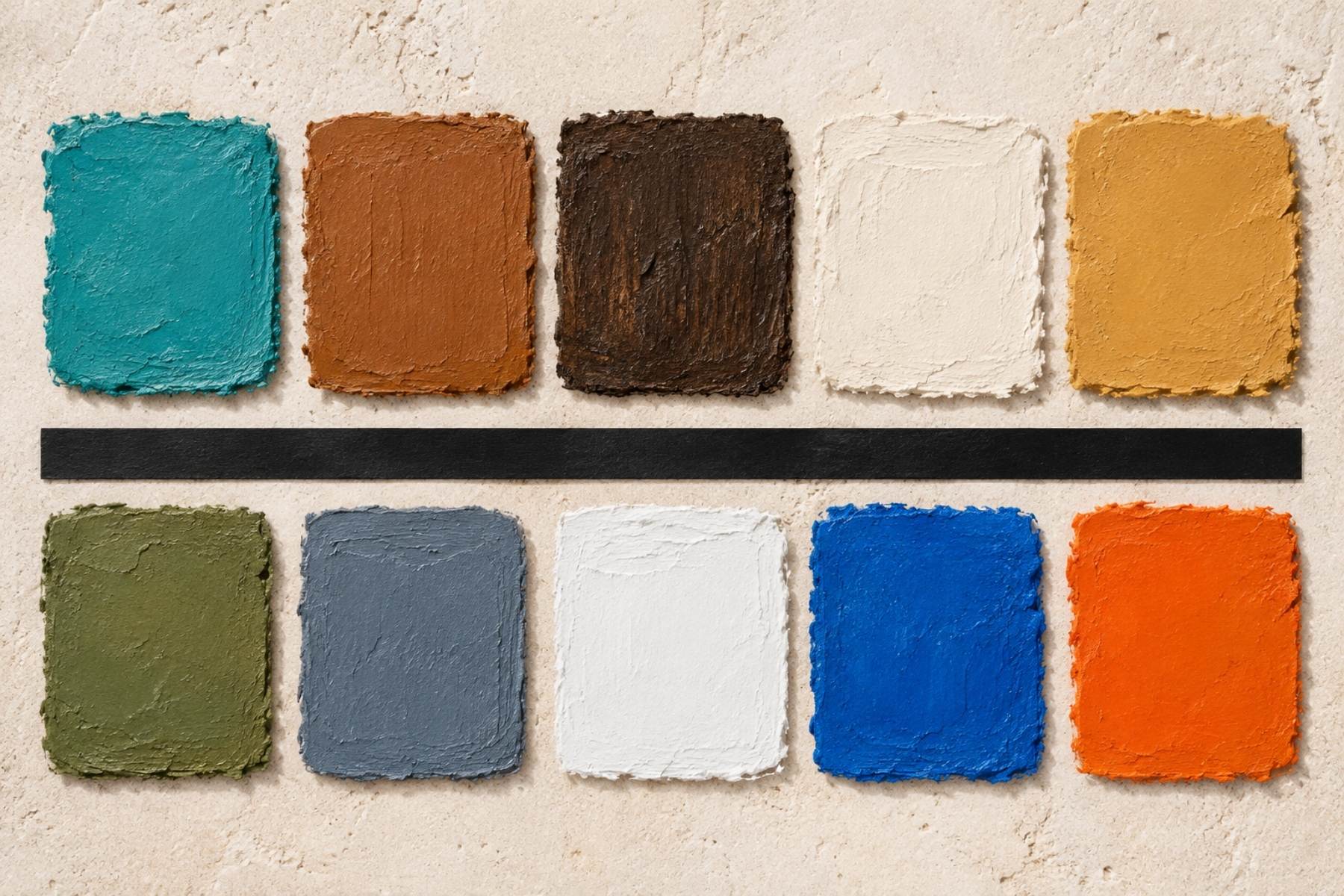
Zanzibar turquoise #3E9C9C · Spice cinnamon #A8613A · Carved wood #4A342A · Coral white #F2E9DC · Brass stud #B08D4A
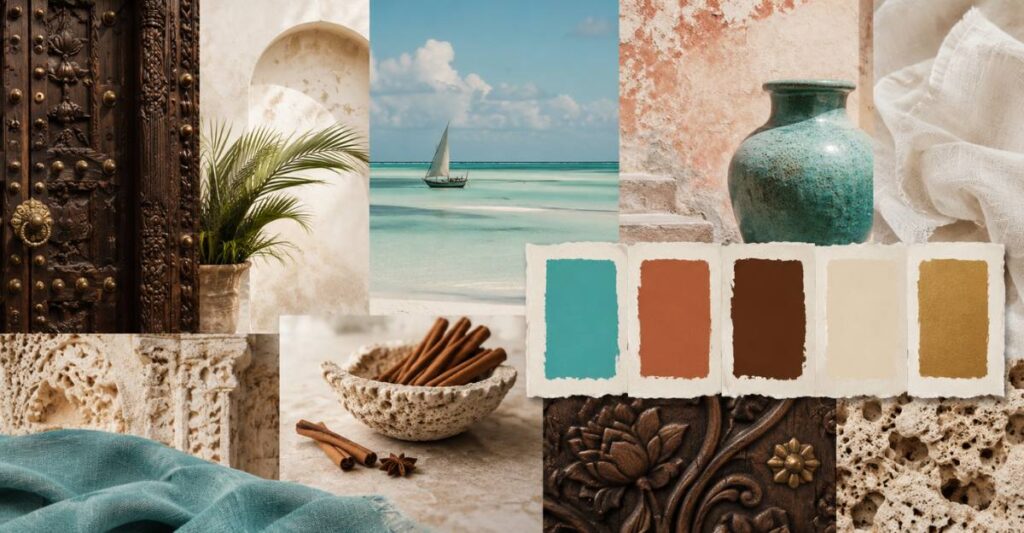
Where the color comes from. Stone Town is built from coral rag — porous coral stone cut from old reefs — lime-washed to a soft white that takes the light like linen. Against it stand the famous doors: dense, near-black hardwood, carved with lotus and rope motifs and studded with brass, each one announcing the trade and standing of the household behind it. The turquoise is the Indian Ocean over sand flats at noon, and the cinnamon is literal cargo — the spice trade that named the islands.
What it means and how it feels. Cool water plus warm spice is the rarest pairing in interior color, and it is Zanzibar’s default setting. The white does 60 percent of the work, turquoise leads, wood and brass punctuate. The impression is a trading port at its most composed: breezy, a little opulent, never hot. Sunrooms, bathrooms and bright kitchens take it naturally.
Hang it: the Afrocentric Modern Beach Set of 3 or the cooler Beige & Teal Abstract Africa Map. Layer it: a turquoise glazed ceramic vase and one dark-wood object with real carving.
2. Spice Route — the clove and cinnamon scheme
Cinnamon #A8613A · Clove brown #5C3A28 · Cardamom cream #EFE3CE · Nutmeg gold #C08A45 · Dhow-sail white #F4F0E5
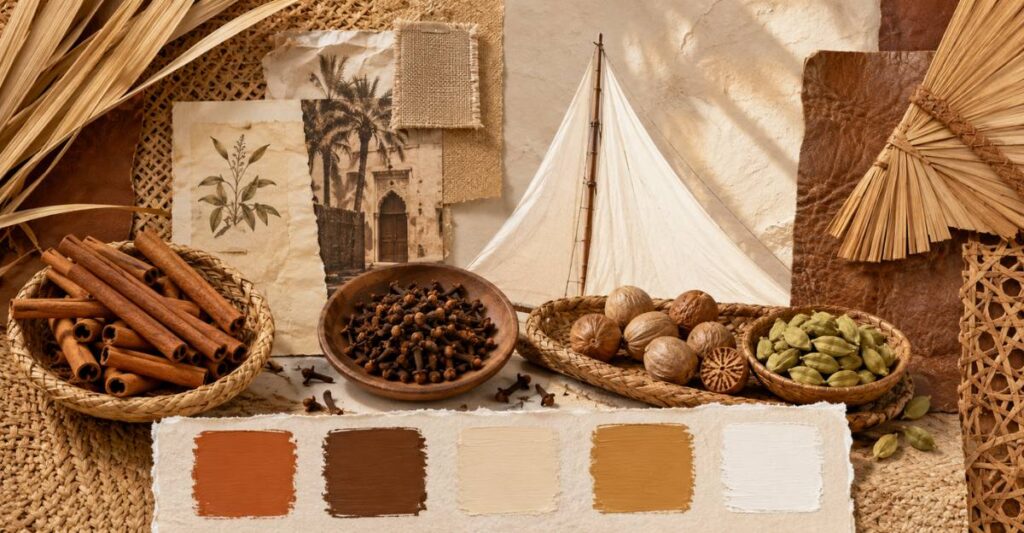
Where the color comes from. In the nineteenth century Zanzibar grew most of the world’s cloves, and the plantation islands still perfume the air when the harvest dries in the sun. This palette is the drying mat itself: cinnamon quills, clove buds, nutmeg and cardamom on woven fiber, with the triangular white of a dhow sail passing behind. These are colors you can smell.
What it means and how it feels. Spice Route is Zanzibar with the ocean turned off — all warmth, no blue. It behaves like a classic brown-family neutral scheme but with more perfume: cream walls, cinnamon and clove in leather, rattan and textiles, nutmeg gold in the light fixtures. Dining rooms and dens love it; it is the Tanzanian cousin of Morocco’s Fes leather scheme from our Moroccan color palette guide.
Hang it: the Earth Tone Abstract Africa Map or the Africa Map Textured Collage print. Layer it: a rattan and seagrass basket set — the texture is half the palette.
3. Serengeti Gold — the savanna scheme
Savanna gold #C9A44C · Dry grass #D9C08A · Acacia green #6B7D4A · Dust red #A5613C · Storm gray #6E6A61
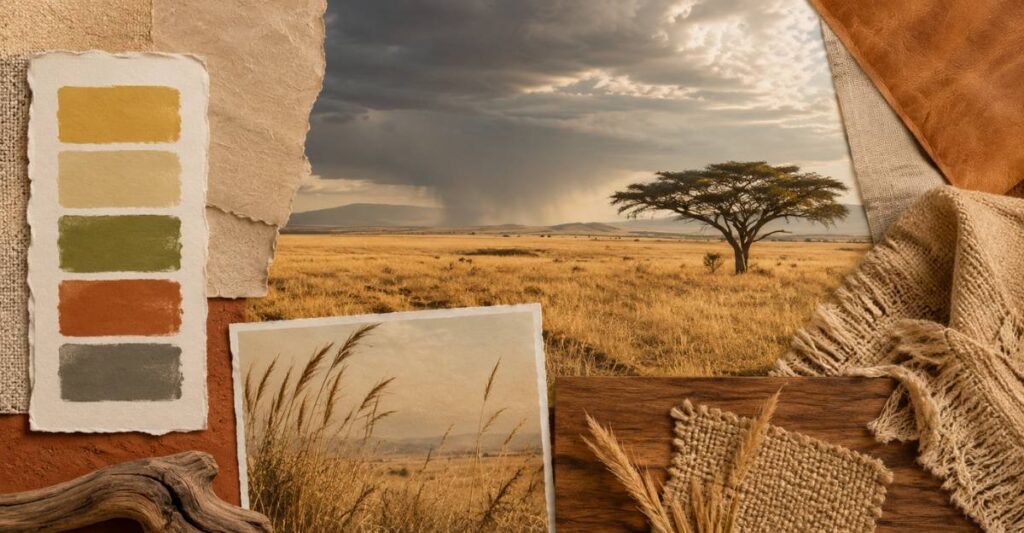
Where the color comes from. The Serengeti’s name comes from the Maasai siringet — the place where the land runs on forever — and its color is seasonal mathematics. Long rains turn the plain green; the dry season cures it to gold; migration and dust redden the edges; and on the horizon, almost always, a blue-gray storm is either arriving or leaving. The flat-topped acacia supplies the one architectural green.
What it means and how it feels. This is the palette of scale. Gold-on-gold with olive green and one storm-gray accent makes rooms feel wider and lower-lit, like late afternoon on the plain. It is the warmest scheme in this guide that never tips into orange, which makes it the safest choice for living rooms that already hold wood and leather. Storm gray on a single wall or in the largest textile is the move most people miss.
Hang it: the Afrocentric Elephant print is the savanna in one frame; pair it with the Baobab Tree of Life print. Layer it: a mustard and olive woven throw.
4. Kilimanjaro Highlands — the slate and snow scheme
Kilimanjaro slate #5B6670 · Glacier white #F1F2EE · Moorland heather #8B7D8F · Forest belt green #3F5C46 · Volcanic char #2B2C2A
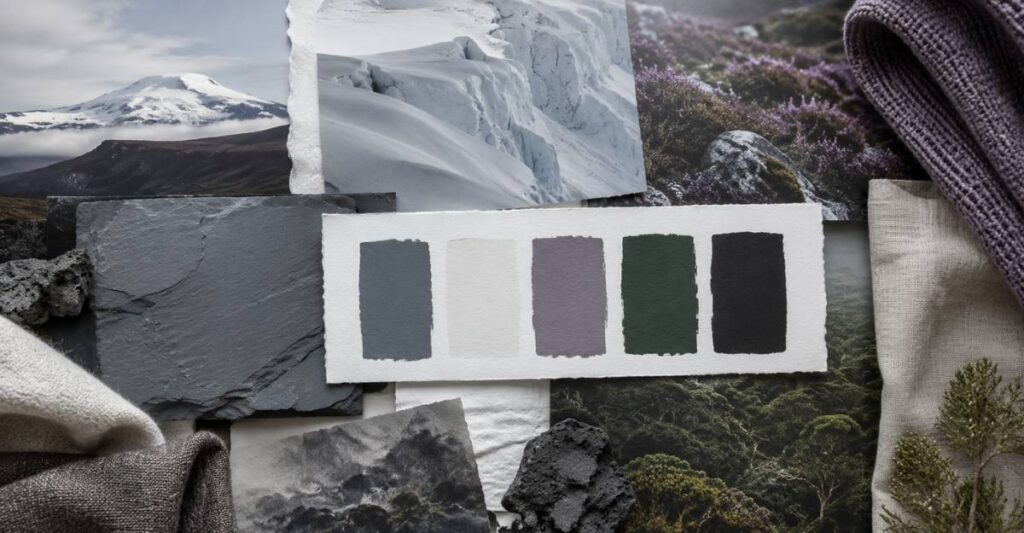
Where the color comes from. Kilimanjaro is a color gradient you can climb. The mountain rises through coffee farms and rainforest into heather moorland, then alpine desert, and finally the summit ice fields — snow sitting three degrees south of the equator. Slate is the volcanic rock of the upper slopes; heather is the strange purple-gray of the moorland zone; char is the old lava underfoot.
What it means and how it feels. This is Tanzania’s cool-and-quiet register — the closest thing East Africa offers to Scandinavian calm, but with more mineral depth. Slate walls or textiles, glacier white linens, one heather accent and a line of black: bedrooms and studies settle instantly under it. Of the five schemes it is the most forgiving of gray northern light, which makes it the pick for readers outside the tropics.
Hang it: our Mount Kilimanjaro print is the literal source, and the Vintage Africa Map, dark painterly matches its weight. Layer it: a slate gray waffle-knit throw.
5. Tingatinga Brights — the painted scheme
Enamel blue #1F6BB0 · Enamel orange #E07B28 · Leaf green #3E8E4E · Sun yellow #EFC72E · Blackboard black #1E1E1E
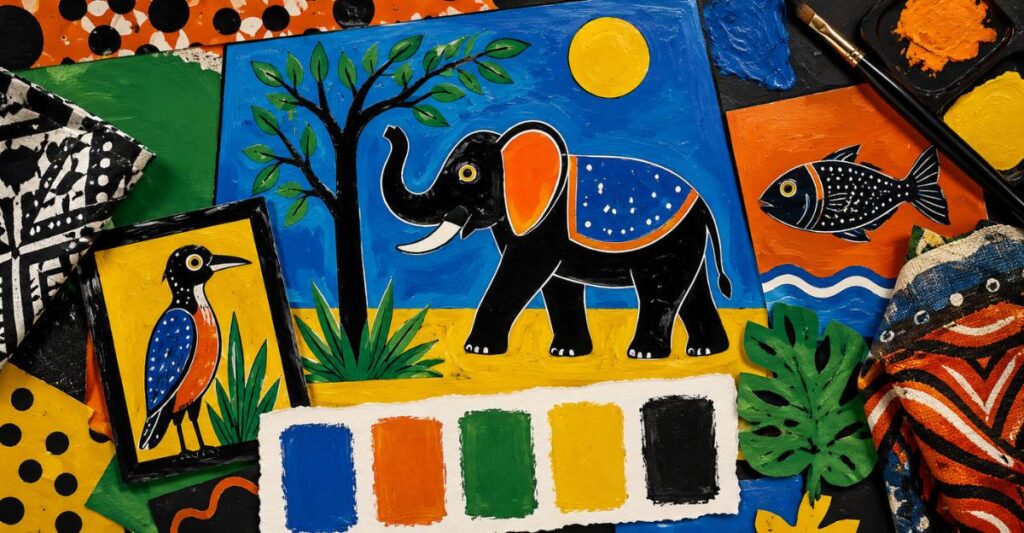
Where the color comes from. In late-1960s Dar es Salaam, Edward Saidi Tingatinga began painting birds, fish and animals on hardboard squares using bicycle enamel — the high-gloss industrial paint at hand. The style he founded, now simply called Tingatinga, kept the materials’ signature: flat, saturated, outlined color with cartoon-bright confidence. It became East Africa’s most recognizable popular art movement, still painted cooperatively in Dar today. Our Tanzanian symbols guide tells the story of its best-loved motif, the elephant.
What it means and how it feels. Tingatinga is joy as a color system — the palette of a style invented by an artist who used what he had and made the whole region smile. At home it works exactly like Ndebele brights from our continental guide: at full strength in a child’s room or creative studio, or as one electric framed piece against calm neutrals anywhere else. Never dilute it; its power is the full-volume commitment.
Hang it: the Colorful Afrocentric Africa Map poster carries the enamel energy, or the colorful editorial Black Woman print. Layer it: a set of bright color-block cotton cushion covers.
Building a whole home from one country
Because the five schemes share an undercoat — coral white, carved wood, a thread of gold — Tanzania is the rare tanzania color palette source you can run through an entire floor plan without it feeling themed. Assign by function: Serengeti Gold in the living room, where its width and warmth host best; Zanzibar Coast in the kitchen and bathroom, where turquoise stays crisp against tile and water; Spice Route in the dining room, where cinnamon and clove flatter food, candlelight and wood; Kilimanjaro Highlands in the bedroom and study, the two rooms that earn its quiet; and Tingatinga wherever the household actually plays — a kid’s room, a studio, the hallway that needs one grin.
The trick that makes it cohere is repetition of the undercoat, not the lead colors. Keep every room’s white the same coral-stone warm white, repeat the dark carved wood at least once per room — a frame, a bowl, a mirror — and let brass appear in small doses everywhere. Guests will read the house as one voice with five moods, which is precisely how the country itself works: the same light, four landscapes.
If you are choosing between starting warm or cool, start warm. Serengeti and Spice rooms forgive more furniture styles and more clutter; the cool schemes reward editing. Move toward Zanzibar and Kilimanjaro as the rooms get smaller, wetter or quieter.
A note on sources, briefly
Tanzania’s colors are trade, land and invention in equal measure: coral stone cut from reefs, cinnamon dried in plantation sun, savanna grass cured by a season, enamel borrowed from bicycles and turned into a national art. Name the source when you use the scheme — a turquoise bathroom is nice, but a bathroom that knows about Stone Town’s doors and how sails is a story.
Tanzania’s colour comes from coast and light. For the opposite register — colour that comes from cloth and city — the Nigeria palette runs adire indigo through to full-volume Lagos yellow.
How to choose between the five
Run the temperature test first. Rooms that overheat or face strong sun want Zanzibar Coast or Kilimanjaro Highlands — the two cool anchors. Rooms that feel cold or dim want Spice Route or Serengeti Gold — the two warm ones. Tingatinga is not a room temperature; it is a personality dose, added one frame or one cushion at a time.
Then run the energy test: Zanzibar and Tingatinga are awake, Serengeti and Spice are settled, Kilimanjaro is asleep in the best sense. Match that to what the room is for, keep the 60-30-10 discipline from our continental guide, and let exactly one color surprise.
The 10-minute version: hang the palette
Printable art tests a scheme before a single wall changes. Download a set above, print at home or at a local shop (our printing guide covers sizes and paper), and live with it for two weeks. Black frames suit the Kilimanjaro and Tingatinga schemes; oak suits the coast and savanna. A set of 11×14 oak-finish frames covers a trio wall, and Vecteezy’s mockup library previews the wall before you print.
Frequently asked questions
What colors represent Tanzania?
The coast contributes turquoise, spice cinnamon, carved-wood brown and coral-stone white; the interior adds savanna gold, acacia green and Kilimanjaro’s slate and glacier white; and Tingatinga painting supplies the enamel brights. The national flag adds its own code — green for the land, blue for the ocean, gold for minerals, black for the people.
What is Tingatinga art and what colors does it use?
Tingatinga is East Africa’s best-known popular painting style, founded in Dar es Salaam around 1968 by Edward Saidi Tingatinga, who painted animals and birds on hardboard in glossy bicycle enamel. Its palette is flat, outlined and saturated: enamel blue, orange, green, sun yellow and black, usually on a single-color background.
Why does Zanzibar decor mix turquoise with brown?
Because the island does. Stone Town pairs the Indian Ocean’s turquoise shallows with lime-washed coral stone, near-black carved doors and the browns of the spice trade — so the combination of cool water color and warm wood-and-spice tones is historically native, not a designer invention. It is also practical: the warm tones stop turquoise from reading cold indoors.
Which tanzania color palette works in a dark or north-facing room?
Spice Route and Serengeti Gold carry their own warmth and survive dim light best. Kilimanjaro Highlands also works if you keep the glacier-white share high — it is designed to be calm in gray light, the way the mountain itself sits in cloud.
How do I use these palettes without the safari-lodge cliché?
Skip the animal-print shortcuts and let landscape and craft colors do the work: savanna gold as a textile family rather than a leopard pattern, carved wood as one real object rather than themed furniture, Tingatinga as authentic art rather than generic safari prints. Grounding each color in its actual source is what separates homage from theme park.
What wall art fits a tanzania color palette?
Match the scheme: coastal sets for Zanzibar turquoise, the Kilimanjaro print for the highlands, elephant and baobab prints for the savanna, and a bright editorial piece for Tingatinga energy. Our Tanzanian symbols guide pairs each motif with its meaning if you want the wall to say something specific.
Zanzibar turquoise and Serengeti gold both appear, renamed, in the 2026 trend palette.