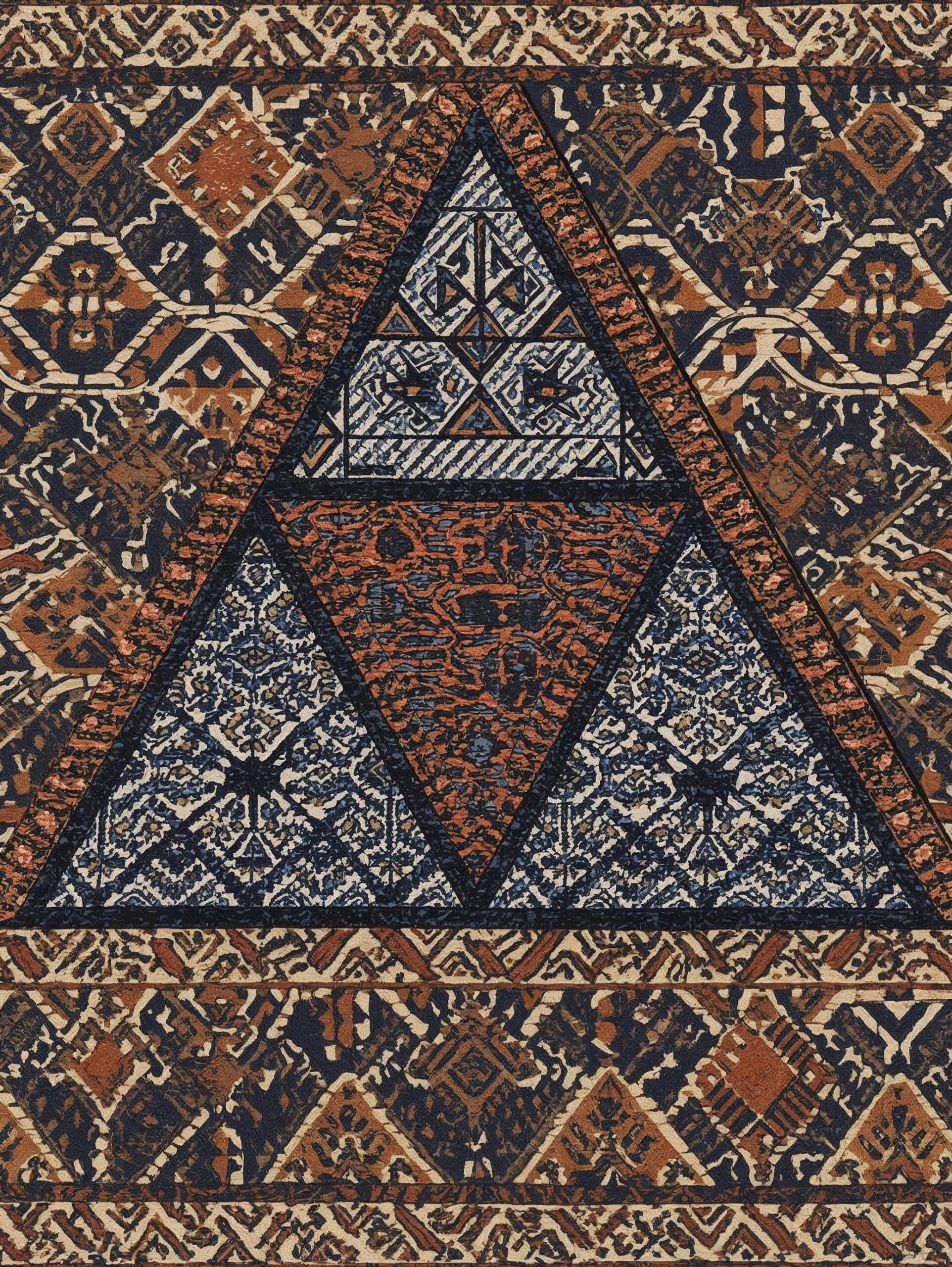
Afro-Bohemian Decor 101: How to Style African Heritage With Boho Warmth in 2026
By Essence of the Road Art · Published May 2026
Affiliate disclosure: Essence of the Road Art is a participant in the Amazon Services LLC Associates Program. As an Amazon Associate, we earn from qualifying purchases. This post also contains links to our Etsy shop and other affiliate partners. We only recommend pieces we would live with ourselves.
Introduction
Afro-Bohemian decor is not a shortcut for making a room look travelled. It is a considered way of layering African heritage, handmade texture, relaxed bohemian forms, and contemporary restraint until the space feels rooted rather than decorated.
At its strongest, the style begins with earth: clay, sand, wood, raffia, bone, tobacco brown, and old gold. Then it adds rhythm through African textiles, wall art, baskets, sculptural objects, and plant life. The result is not loud by default. It can be quiet, architectural, maximalist, or minimal – as long as every layer has a reason to be there.
This guide walks through the foundations of Afro-Bohemian decor for 2026: what the style means, why it is rising now, which colours and materials hold it together, how to use wall art as the narrative layer, and how to honour the cultures behind the objects rather than flattening them into trend language.
Quick answer: Afro-bohemian decor is African heritage styled with bohemian warmth, and in 2026 it starts from a restrained earth base: mocha, clay, terracotta, ochre, warm cream, tobacco brown and softened black. Colour still belongs — indigo, rust, marigold, deep green and aged brass all qualify — but the rule is to assign it deliberately rather than remove it. The working formula is five colours: mocha foundation, terracotta warmth, cream breathing room, ochre glow, and one grounding dark.
Table of Contents
What Afro-Bohemian Decor Actually Means
Afro-Bohemian decor sits at the meeting point of two design languages. The African side brings pattern, symbolism, ancestral craft, textile history, carved forms, beadwork, basketry, and a deep relationship with material. The bohemian side brings looseness: layered rugs, mixed eras, personal objects, plants, low seating, and a room that does not feel over-managed.
The mistake is treating Afro-Bohemian as a costume. A mudcloth pillow, a rattan chair, and a mask on the wall do not automatically make a room culturally grounded. The better approach is to build a clear foundation first, then introduce heritage pieces with enough space around them to be seen. One strong textile with a known origin is more convincing than ten anonymous “tribal” patterns fighting for attention.
Think of Afro-Bohemian decor as a collected interior with African materials and references in the foreground. It is less about matching everything and more about creating visual logic: repeated tones, repeated fibres, a steady frame style, and art that carries the story upward onto the walls.
Why 2026 Is the Year for Afro-Bohemian Decor
In 2026, homes are moving away from flat beige minimalism and toward rooms with cultural memory, texture, and visible authorship. Pinterest Predicts 2026 named Afrohemian Decor as a key home trend, noting rising searches around Afrobohemian home decor, adire fabric, Berber motifs, Ethiopian art, rattan accent chairs, and bamboo beaded curtains.
That search growth matters because it points to a specific buyer mood: people are not only searching for “boho living room” anymore. They are looking for African boho living rooms, Ethiopian wall art, Nigerian textiles, woven baskets, and natural fibre rugs. The language is more precise, and the design expectation is more precise too.
For an Afrocentric wall art shop, this is useful because the wall is often the easiest entry point. A renter may not replace a sofa. A new homeowner may not buy carved furniture immediately. But a pair of earth-toned portraits, an Africa map print, or a symbolic Adinkra series can shift the entire room without asking the buyer to redesign from zero.
The 2026 Palette: Earth First, Colour With Discipline
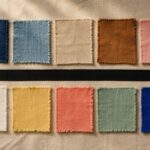
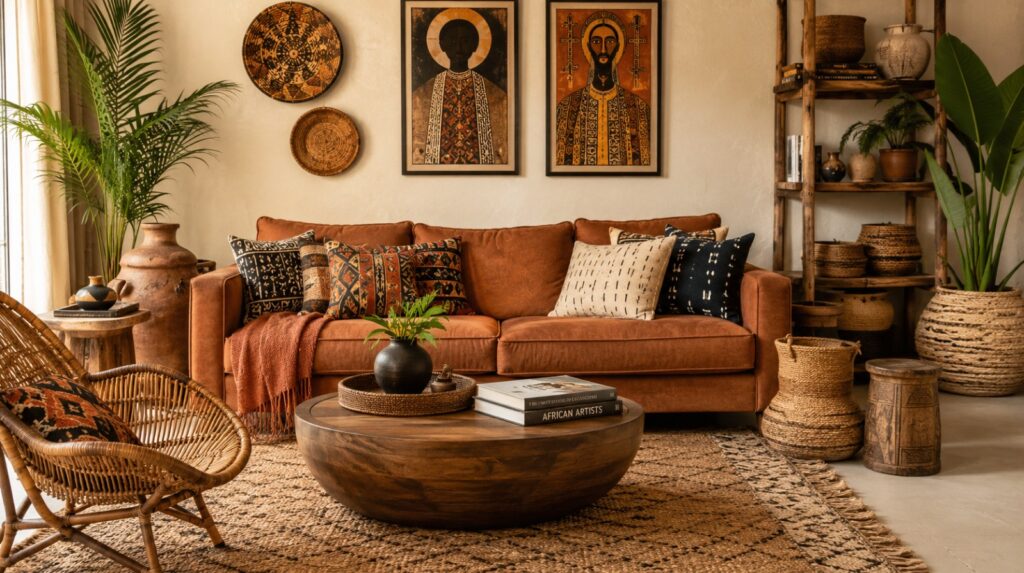
The cleanest Afro-Bohemian rooms in 2026 start with a restrained base: mocha, clay, terracotta, ochre, warm cream, tobacco brown, stone, and softened black. These tones give African textiles and Afrocentric wall art somewhere to land. Without that base, pattern becomes noise; with it, pattern becomes rhythm.
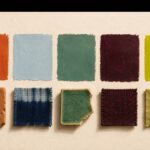
Colour can still be rich. Indigo belongs here. So does rust, marigold, deep green, mineral blue, burgundy, and aged brass. The rule is not to remove colour; it is to assign colour a job. Let terracotta warm the room, let cream give the eye somewhere to rest, let charcoal sharpen the edges, and let one deeper accent – indigo, teal, or forest green – create weight.
A useful five-colour formula: mocha foundation, terracotta warmth, cream breathing room, ochre glow, and one grounding dark. When the wall art, textiles, and accessories all sit inside this palette, the room can hold many objects without feeling scattered.

Pin this palette for your next room refresh.
Elements 1-7: Foundations That Make the Look Feel Collected
1. The Earth-Toned Base
Start with the quieter surfaces: wall colour, sofa, rug, curtains, and larger furniture. Linen, warm white, taupe, clay, walnut, and jute create the field. Once that field is calm, a graphic mudcloth print or bold portrait does not have to compete for attention.
2. African Textiles With a Named Origin
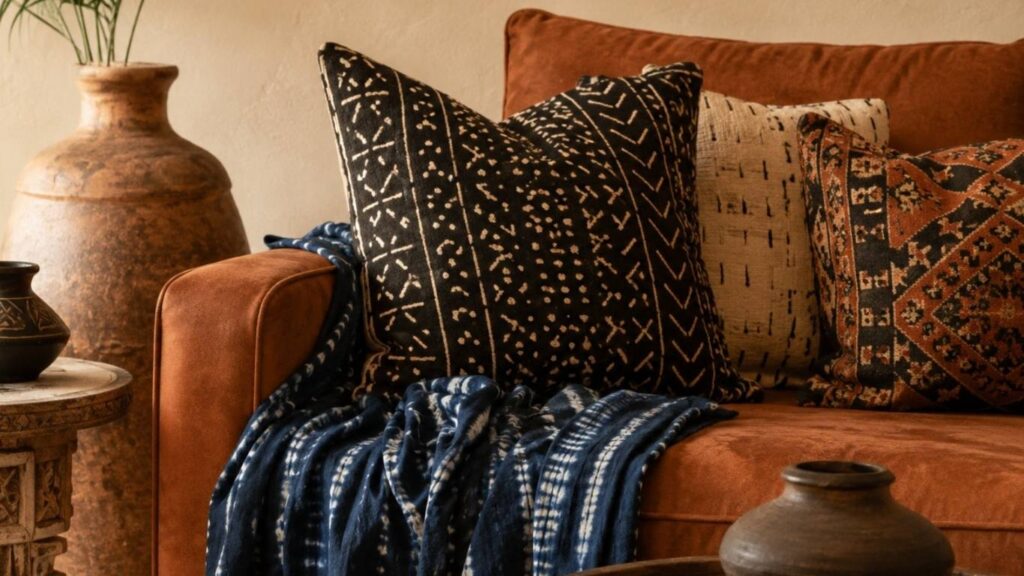
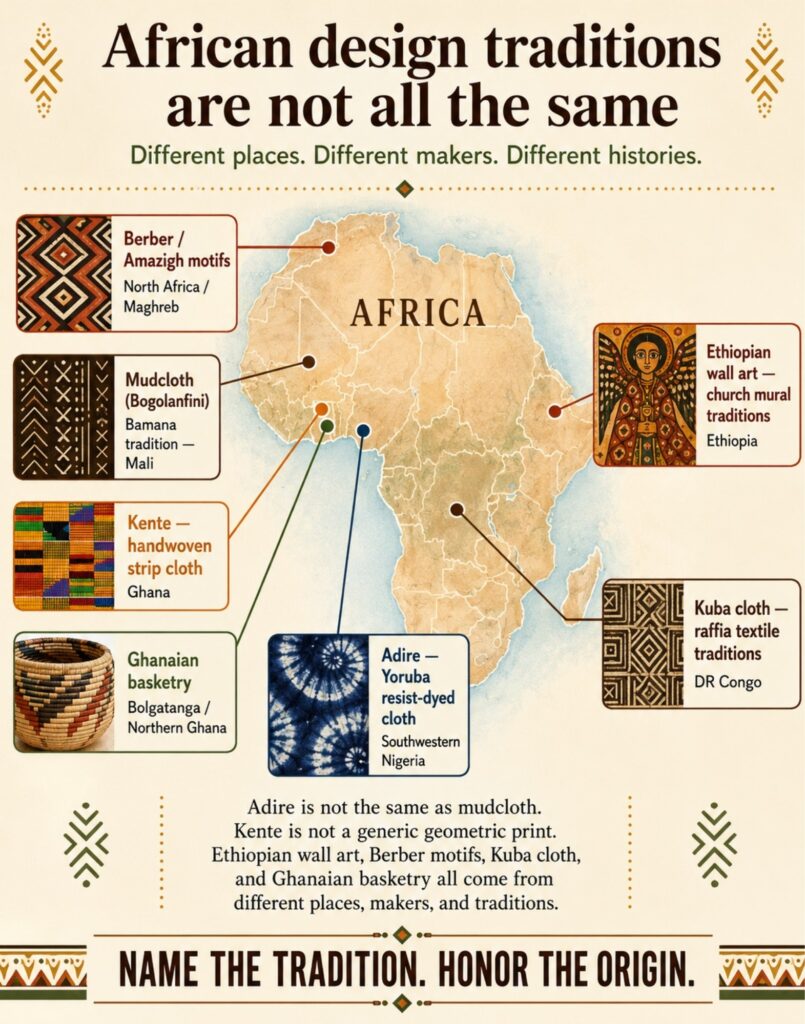
Use textiles as more than pattern. Adire, mudcloth, kente-inspired geometry, Kuba cloth, and Ankara references each carry different histories and visual structures. Choose one dominant textile language per zone: adire pillows on the sofa, a mudcloth-style throw over a chair, or a woven textile framed as wall art. The room feels more intentional when the textile is named, understood, and not reduced to a generic print.
3. Woven Baskets and Natural Fibre Texture
Baskets are one of the strongest bridges between African craft and bohemian layering. Hang them in a tight cluster above a console, use one oversized basket as a planter, or place shallow woven bowls on open shelving. Keep the surrounding wall simple so the weave reads as sculpture.
4. Hand-Carved Wood, Clay, and Stone
Afro-Bohemian rooms need weight. A carved stool, clay vessel, wooden bead garland, small sculpture, or stone tray keeps the room from becoming all fabric and softness. These harder materials also echo the handmade nature of the style without forcing every surface to carry pattern.
5. Afrocentric Wall Art as the Narrative Layer
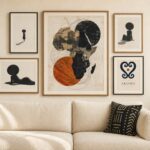
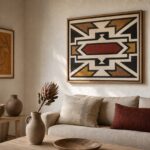
Wall art is where the room says what it means. A black woman portrait, an Africa map, an Adinkra symbol series, or an abstract print inspired by African textiles can act as the visual anchor. Keep the art large enough to hold its own. Over a sofa, a single piece or gallery arrangement should span roughly two-thirds of the furniture width.
6. Plants as Shape, Not Filler
Greenery works best when it has a clear silhouette. A tall palm beside a portrait, a snake plant in a woven basket, or trailing greenery on a shelf can soften the architecture of the room. Avoid scattering small plants everywhere; one sculptural plant usually does more than six nervous ones.
7. Negative Space
The most overlooked element is empty wall. Afro-Bohemian decor needs air because many of its objects carry visual density. A basket wall needs quiet margins. A symbolic print needs space around the frame. A patterned throw needs a plain sofa beneath it. Empty space is not absence; it is how the important pieces keep their authority.
Ideas 8-14: Styling Afro-Bohemian Decor Room by Room
8. The Living Room Anchor Wall
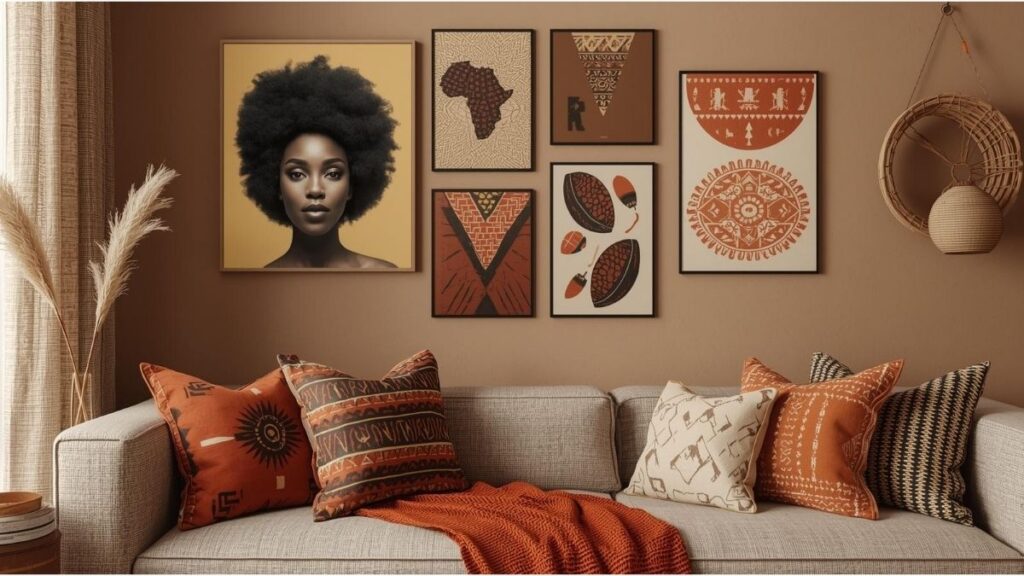
Choose one wall to carry the story. For a clean look, hang one oversized Afrocentric portrait above the sofa. For a more collected look, build a five- or seven-piece gallery using portraits, symbols, textile-inspired abstracts, and one smaller map print. Keep frames in one finish – oak, black, or walnut – so the mix reads curated rather than improvised.
9. The Sofa With Restraint
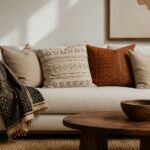
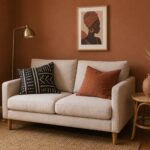
Use two patterned pillows, one solid pillow, and one throw. That is enough. A sofa covered in competing prints can flatten the art on the wall behind it. Let the strongest pattern sit closest to the centre, then repeat one colour from the wall art so the sofa and art speak to each other.
10. The Reading Corner Portrait
A single black woman portrait beside a chair can make a corner feel personal without filling the entire room. Add a floor lamp, a small side table, and a woven basket for books or blankets. This works especially well for apartments because it creates a designed moment without requiring a full gallery wall.
11. The Entry Console
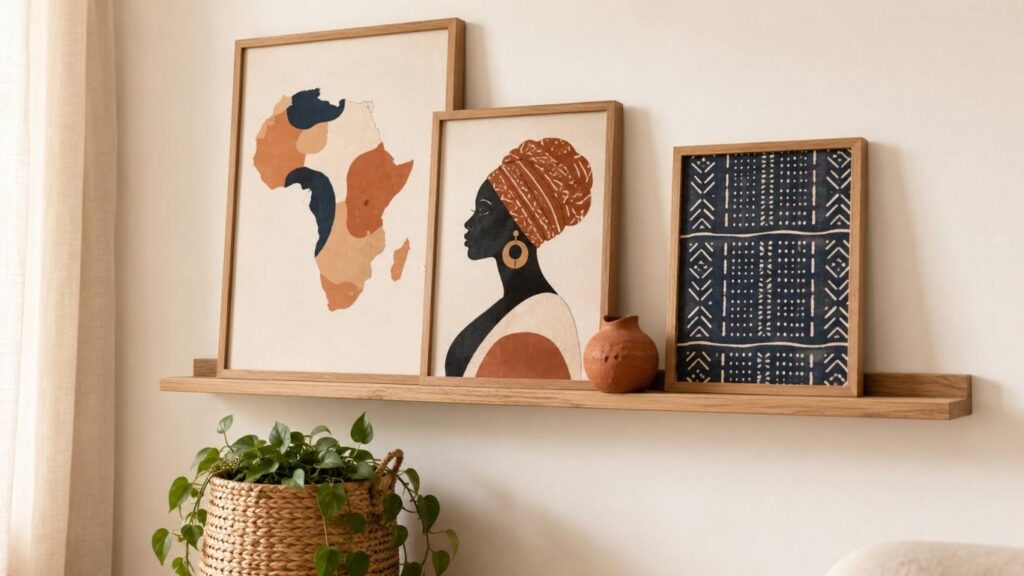
An entryway is a good place for a smaller Afro-Bohemian statement. Lean a framed Africa map or symbolic print on the console, place a clay vessel beside it, then add one shallow basket or wooden bowl for keys. The first view of the home feels considered, not over-styled.
12. The Bedroom Textile Moment
In the bedroom, keep the wall art calmer and let texture lead. A warm-toned portrait above the bed, linen bedding, a mudcloth-style lumbar pillow, and rattan or wood side tables can create a grounded room. Avoid too many saturated colours here; the bedroom benefits from depth more than drama.

13. The Dining Shelf
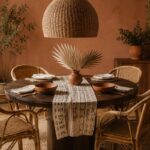
Open shelving in a dining area can hold Afro-Bohemian detail without overwhelming the table. Mix two framed mini prints, one stack of bowls, one basket, and one plant. Vary height and material, but keep the palette narrow: cream, wood, clay, black, and one textile colour.
Dining rooms reward this style more than most, because the table is already the anchor — the full dining room breakdown walks through chairs, runners and the wall behind the table.
14. The Renter-Friendly Ledge Wall
A picture ledge is the easiest way to test the style without committing to many nail holes. Layer three prints at different heights, add one small object in front, and rotate pieces seasonally. It is also the best format for printable wall art because frames can move with you.
If you like DIY prints, mudcloth-pattern digital papers from Creative Fabrica print beautifully on textured matte paper.
How to Keep Afro-Bohemian Decor From Looking Busy
The goal is layered, not crowded. The difference comes down to repetition and editing. Repeat one wood tone, one frame finish, one warm neutral, and one textile colour across the room. This gives the eye a path to follow.
Use one dominant pattern per area. If the rug is busy, keep the sofa pillows simpler. If the gallery wall is graphic, let the console underneath stay quiet. If the bedding carries pattern, choose calmer wall art. Afro-Bohemian style can hold complexity, but it should not ask every object to speak at the same volume.
Scale also matters. Many small objects can make a room feel uncertain. A few larger pieces – one oversized print, one tall plant, one substantial basket, one carved stool – give the room confidence. Edit until each object has either beauty, function, cultural meaning, or all three.
Cultural Respect and Ethical Sourcing
Afro-Bohemian decor works only when appreciation is stronger than extraction. Learn the names of the materials you use. Adire is not the same as mudcloth. Kente is not a generic geometric print. Ethiopian wall art, Berber motifs, Kuba cloth, and Ghanaian basketry all come from different places, makers, and traditions.
Buy from African artists, diaspora-owned shops, fair-trade sources, and makers who identify the origin of their work. When shopping for prints, textiles, or objects, look for product descriptions that explain the inspiration and avoid vague language that treats “tribal” as a catch-all aesthetic. If a piece uses a sacred symbol or ceremonial object, understand whether it belongs in a private home and how it should be represented.
Respect also shows up in restraint. You do not need to display every reference at once. A room can honour African heritage through one meaningful portrait, one named textile, one handmade basket, and one well-chosen colour story. Specificity is what keeps the style from becoming costume.
Shop the Afro-Bohemian Look
For most homes, wall art is the cleanest starting point. It adds cultural presence before the buyer has to change furniture, paint, or flooring. In the Essence of the Road Art Etsy shop, the strongest Afro-Bohemian pairings are warm-toned black woman portraits, earth-coloured Africa map prints, Adinkra-inspired symbol sets, and abstract pieces that echo textile rhythm without copying textile craft.
This week’s Afro-Bohemian starter look: one oversized black woman portrait from Essence of the Road Art · two natural oak frames · one woven basket planter · a clay vase · a linen throw · one adire-inspired pillow · one warm picture light.
For the pieces around the art – frames, picture lights, ledges, baskets, and console tables – keep a simple rule: choose materials that look better with age. Oak, walnut, clay, linen, raffia, rattan, brass, and matte black will outlast trend language.
Frequently Asked Questions
What is Afro-Bohemian decor?
Afro-Bohemian decor is an interior style that layers African heritage, artisan materials, Afrocentric art, and relaxed bohemian forms. It often includes African textiles, woven baskets, natural fibres, carved wood, clay, plants, and wall art with cultural or symbolic meaning.
Is Afro-Bohemian decor the same as Afrocentric decor?
They overlap, but they are not identical. Afrocentric decor centres African and African-diaspora identity, symbols, art, and heritage. Afro-Bohemian decor adds the bohemian language of layering, informal arrangements, mixed eras, plants, and soft natural textures.
What colours work best for Afro-Bohemian decor in 2026?
The strongest palette is earthy and edited: mocha, terracotta, clay, ochre, cream, walnut, charcoal, and one deeper accent such as indigo, teal, or forest green. This palette keeps African textiles and wall art visually connected even when the room includes mixed materials.
How do I start if my room is very plain?
Start with one wall and one textile. Add a large Afrocentric print above the sofa or bed, then repeat one colour from that artwork in a pillow, throw, or basket. Once those two pieces work together, add texture slowly.
What wall art works best with Afro-Bohemian decor?
Black woman portraits, Africa map prints, Adinkra-inspired symbols, textile-inspired abstracts, Ethiopian-inspired art, and warm earth-toned gallery sets all work well. Choose art with enough scale; small pieces can disappear against layered textiles and baskets.
Can Afro-Bohemian decor be minimalist?
Yes. A minimalist Afro-Bohemian room might use a cream wall, linen sofa, one oversized portrait, one woven basket, one clay vessel, and one sculptural plant. The style does not require clutter; it requires material depth and cultural intention.
How do I use African textiles without overdoing it?
Choose one hero textile per zone. Use adire on pillows, mudcloth as a throw, or a framed textile-inspired print on the wall – not all of them in equal strength in the same corner. Repeat one colour from the textile elsewhere so it feels integrated.
Is Afro-Bohemian decor renter-friendly?
Very. Printable wall art, removable picture strips, picture ledges, baskets, textiles, and plants can change the room without permanent renovation. Choose standard-size frames so your art can move with you.
How do I avoid cultural appropriation in Afro-Bohemian decor?
Buy from African or diaspora artists when possible, learn the names and origins of the pieces you use, and avoid generic “tribal” language. Do not use sacred symbols or ceremonial objects as empty decoration. A respectful room has context, credit, and restraint.
What is the easiest Afro-Bohemian update for 2026?
Replace one generic print with a large Afrocentric piece, then add one natural fibre element below it – a woven basket, rattan chair, jute rug, or clay vessel. That single vertical relationship, art above texture, gives the room a clear direction.
Closing Note
Afro-Bohemian decor is strongest when it feels lived with, not assembled for a trend cycle. Begin with earth, choose pattern with knowledge, give handmade objects room to breathe, and let the wall art carry the clearest story. A room does not need to say everything at once. It only needs one honest starting point.
Browse the Essence of the Road Art Etsy shop for warm-toned Afrocentric printables, or pin this guide to your Afro-Bohemian decor board before planning your next room refresh.
Related reading on Essence of the Road Art:
- Moroccan Geometric Patterns: 10 Zellige Motifs Explained
- 12 Adire Patterns and Their Meanings: A Decor Lover’s Guide
- 12 Ethiopian Symbols and Their Meanings: A Decor Lover’s Guide
- 15 Coffee Table Decor Ideas to Make Your Living Room Feel Warm, Collected and Personal

- Afrocentric Home Decor Beyond Wall Art: 9 Everyday Pieces That Carry the Same Design
- 15 Mudcloth Pillows for Modern Homes: A Curated Buying Guide