12 South African Symbols and Their Meanings: A Decor Lover’s Guide
By Essence of the Road Art · Published July 2026
Why we wrote this
South Africa gives you three visual languages that could not be less alike.
There is Ndebele wall painting — hard-edged geometry in electric blue, hot pink and yellow, every shape outlined in thick black, painted freehand on the outside of houses by women who use no ruler, no pencil line, and no masking tape. It is the boldest colour work on the continent, and considerably younger than most people assume.
There is Zulu beadwork — tiny glass beads worked into panels where the colours are not chosen for prettiness at all. They are a code. A beaded panel can say I am waiting for you, or you have hurt me, or I am married, and for a long time it was read fluently by everyone who needed to.
And there is San rock art — ochre and charcoal figures painted onto stone across southern Africa, some of it among the oldest surviving art anywhere on earth. Eland, hunters, half-human figures with animal heads. Not decoration, and for a long stretch of the twentieth century not even recognised as art by the people writing about it.
Three traditions, three completely different logics. One is architecture. One is language. One is religion. They do not merge into a single “South African style,” and the very common habit of selling a bright zigzag as “tribal African design” flattens the most specific of the three into the vaguest possible label. Ndebele geometry is not generic. It belongs to particular people, in a particular province, and much of it can be dated to within a decade.
We are not South African. We make Afrocentric wall art, and most of what follows belongs to other people. We are writing it the way we would want someone writing about our own visual language to write — with care, with sources, and without pretending the pretty parts have no history attached. Where a meaning is contested or varies by region, we have tried to say so. Where a piece carries weight that should slow you down before buying, we have tried to say that too.
This is the fifth piece in our Symbols & Meaning series. If you have not yet read the Kongo guide, it sits alongside this one.
📌 Quick Answer
The twelve most recognisable South African symbols come from three distinct visual traditions. From Ndebele wall painting in Mpumalanga: the painted house front, the black outline, the chevron and stepped gable, the modern-object motif (aeroplanes, staircases, streetlights), and the canvas work of Esther Mahlangu — meanings of identity and announcement, colour discipline, architectural rhythm, a living tradition absorbing the present, and heritage carried onto the world stage. From Zulu beadwork: the triangle, the colour white, red and black, and the ucu love letter — meanings of family (father, mother, child), purity and true love, passion or heartache, longing and marriage, and a message addressed to one specific person. From San rock art: the eland and the therianthrope — meanings of spiritual potency and the shaman in trance. Of these, Ndebele geometry and Zulu-inspired beadwork are the ones we recommend living with; specific documented San sacred panels should not be reproduced as decor.
Table of Contents
A note on cultures, names, and care
Three streams sit underneath this article, and they are separated by tens of thousands of years.
San rock art is the oldest by an enormous margin. Painted across southern Africa — with the richest concentrations in the Drakensberg — it spans a range so long that some sites are among the earliest surviving art anywhere on earth. The San are not a single people either; the term covers many groups with distinct languages, and their descendants are living communities today, not a historical footnote. For much of the colonial period the paintings were read as naive hunting scenes. That interpretation has been overturned, substantially through the testimony of San descendants, in favour of an understanding of the art as religious — a record of trance experience.
Zulu beadwork in its glass-bead form depends on trade: the beads themselves arrived through European and Indian Ocean trade networks, and the tradition as we know it developed with them. What is old is the practice of encoding social and romantic information in adornment; what is comparatively recent is the specific glass-bead vocabulary. It is a living tradition, still made, still worn, still read.
Ndebele wall painting is the youngest of the three. It developed as communities moved from grass structures to mud-walled homes, and it has always been women’s work applied to the outside of the house. The saturated palette everyone associates with it — the cobalt, the hot pink, the acid yellow — arrived with commercially available acrylic paint in the twentieth century. Earlier work used earth pigments, lime, and ochre, and looked entirely different. The tradition is old; the colours are modern.
We mention all of this because lumping three traditions together as “South African art” flattens differences that matter — and because the differences are the most interesting part.
A second note, and an important one. Zulu beadwork colour symbolism is regional and variable, not a fixed dictionary. Many published “Zulu colour charts” online are far more confident than the evidence supports, and meanings shift between districts, eras, and families. We have given the most widely-cited readings below, and we have flagged the uncertainty rather than smoothing it over.
Ndebele wall painting — geometry as announcement
1. The painted house front — a wall that tells the street
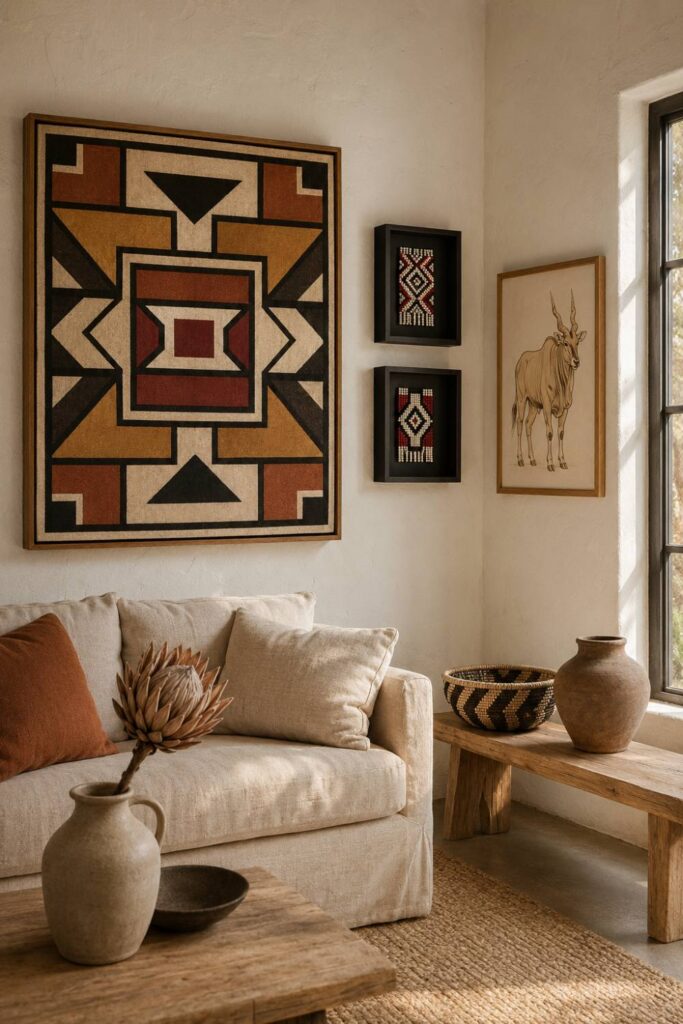
What it looks like: a house facade divided into bold geometric fields — rectangles, triangles, chevrons, stepped forms — every shape bounded by a thick black line.
What it means: Ndebele wall painting is public communication. Applied by women to the exterior of the home, it announced who lived there and what had happened to the household. Patterns marked births, deaths, marriages, and a son’s departure for initiation school. A neighbour walking past could read the year’s events off the wall.
The technique matters as much as the meaning: it is painted freehand, with the black outline laid down in a single confident pass, no guidelines and no tape. That is not a folk-art quirk — it is a very high level of draughtsmanship.
How to live with it: Ndebele geometry works beautifully in a modern room, and the safest approach is to treat it as structure rather than costume: one bold framed panel, or a single painted alcove, set against calm walls. What we would avoid is scattering “Ndebele-style” zigzags across cushions, throws, lampshades and a rug simultaneously, which turns a specific architectural language into wallpaper.
2. The black outline — the discipline that holds the colour
What it looks like: every colour field bounded by a heavy black line.
What it means: the outline is the engineering. It is what allows the tradition to place hot pink beside turquoise beside acid yellow without the composition collapsing into noise. The black does the refereeing, giving the eye a route through the design and holding each colour in its own territory.
How to live with it: this is the most transferable lesson in the whole article, and it applies to any room, African-influenced or not. Strong colour needs a hard edge. If you want a saturated palette and it keeps looking chaotic, the missing element is almost always a dark line — black frames, charcoal trim, a dark timber edge.
3. The chevron and the stepped gable — architecture first
What it looks like: repeated V-forms, and stair-stepped shapes rising toward a peak.
What it means: these are the backbone shapes of the tradition, and they derive in part from the built environment itself — the gable, the roofline, the stepped edge of a wall. They are architectural before they are decorative, which is precisely why they read as structural rather than fussy.
How to live with it: the same shape changes character entirely with palette. A chevron in clay and cream reads as sophisticated; a chevron in primary colours reads as a nursery. Let the geometry do the work and keep the colour disciplined.
4. The aeroplane and the staircase — a tradition absorbing the present
What it looks like: recognisable modern objects — a plane, a staircase, a razor blade, a streetlight — abstracted into the geometry.
What it means: this is our favourite detail in South African design. Ndebele painters took the twentieth century directly into the pattern vocabulary. When aeroplanes began crossing overhead, aeroplanes appeared on walls. Staircases, electric lights and telephone poles all entered the language. The tradition was never frozen; it kept describing the world as the world changed, which is exactly what a living tradition does.
How to live with it: treat it as permission. A heritage-informed room is allowed to contain the present — a modern lamp, a contemporary chair, a piece of new art. You are not obliged to decorate as though it is still 1890.
5. Esther Mahlangu and the move onto canvas
What it looks like: Ndebele geometry on canvas, on cars, on aircraft, on sneakers, in international galleries.
What it means: born in 1935, Esther Mahlangu learned the tradition from her mother and grandmother at around ten years old, and became the artist who carried it onto the world stage — painting a BMW art car, exhibiting internationally, and insisting throughout that the work remain identifiably Ndebele rather than dissolve into a generic global style. She is the reason a great many people outside South Africa know this visual language at all, and she trained younger women to continue it.
How to live with it: where you can, buy a print by a named living artist working in the tradition rather than an anonymous “Ndebele-style” file. It costs a little more and it means something entirely different — both to you and to the person who made it.
Zulu beadwork — colour as sentence
6. The triangle — father, mother, child
What it looks like: the single geometric unit of traditional Zulu beadwork.
What it means: the triangle is the alphabet of the system. Its three points are commonly read as father, mother and child, and its orientation carries information — a triangle pointing one way can indicate an unmarried woman, the other way a married one, and two triangles joined base to base or point to point generate further meanings again. The shape is doing grammatical work, not decorative work.
How to live with it: a framed beaded panel is a small, high-impact piece, and unlike a large textile it suits a narrow wall, a bookshelf, or a bedside — anywhere someone will stand close enough to see the beads catch light.
7. White — purity and true love
What it means: white is the clearest positive in the code, read as purity and true love, and it frequently serves as the ground against which the rest of the message sits. In a beaded panel heavy with white, the tone is usually open and hopeful.
How to live with it: white-and-blue beadwork is the easiest palette to live with and reads calm in almost any room — a good first piece if you are new to the tradition.
8. Red and black — passion, heartache, longing, marriage
What it means: red carries strong feeling in both directions — passion and longing, but also heartache and anger. The same colour can mean I burn for you or you have wounded me, and the surrounding beads decide which. Black carries longing, absence, and the difficulty of waiting; combined with white it frequently signals marriage.
This two-sidedness is the part most colour charts flatten. Red is not simply “love.” It is intensity, and intensity cuts both ways.
How to live with it: a red-and-black beaded piece is closer to a letter than to a decorative object. It deserves a position where it can be looked at properly, and an owner who can say what it means.
9. Yellow, blue and green — wealth, faithfulness, contentment
What it means: yellow is generally read as wealth and abundance, blue as faithfulness — the constancy of the sky — and green as contentment, growth, and domestic peace.
The honest caveat, again: these readings vary by region, era and family. Treat the palette as a meaningful language rather than a lookup table, and be wary of any source that presents a single definitive chart.
How to live with it: if you are choosing a piece for a bedroom or a family room, choosing by message rather than by decor palette is a more interesting way to buy. A panel reading as contentment and faithfulness is a better thing to wake up to than one that merely matched the curtains.
10. The ucu — a letter written in glass
What it looks like: a small beaded panel or necklace, traditionally given rather than sold.
What it means: the ucu is the best-known expression of the code — a beaded message made by a young woman for one particular person, its colours and arrangement carrying a specific statement about her feelings and intentions. It is correspondence, executed in glass beads, and it was designed to be read by its recipient and by the community around them.
How to live with it: if you own one, understand that it was addressed to somebody. That is not a reason to avoid it — it is a reason to hang it thoughtfully, and to be able to explain what it is when someone asks.
San rock art — the oldest layer
11. The eland — the animal that carried the message
What it looks like: a large antelope, painted with noticeably more care and often at greater scale than the human figures around it.
What it means: the eland is the most significant animal in San rock art, understood as carrying particular spiritual potency and acting as an intermediary between people, the ancestors, and the divine. It appears far more often, and is painted far more carefully, than its role as a food source would explain. Other animals carry their own associations: the rhebuck is linked with rain, and was painted when rain was being asked for during drought.
How to live with it: a single line-drawn eland in ochre on a pale ground is one of the most understated pieces of African-origin wall art available. It suits a minimal, earth-toned room, and it carries age without heaviness.
12. The therianthrope — the shaman becoming the animal
What it looks like: a figure that is part human and part animal — an antelope head on a human body, hooves instead of feet, a posture no body could hold.
What it means: these figures are widely interpreted as depictions of trance experience: the shaman in altered state, becoming the animal. Read that way, San rock art is not a record of daily hunting life but of religious experience — a picture of what it felt like from the inside. That interpretation, developed substantially through the testimony of San descendants, replaced a long period in which European scholars dismissed the paintings as primitive decoration.
How to live with it: this is sacred art of genuine antiquity, connected to living descendant communities. Abstracted, line-inspired work in the spirit of the tradition is reasonable. Reproducing a specific documented rock panel as a decorative print is not something we would do, and not something we would sell.
How to live with South African symbols at home
Let one language lead. Ndebele colour, Zulu beadwork and San ochre can coexist in a home, but not at equal volume. Choose which one is speaking and let the other two whisper. A room with a big Ndebele panel, two small beaded frames and nothing else competing is coherent; a room with all three at full strength is a gift shop.
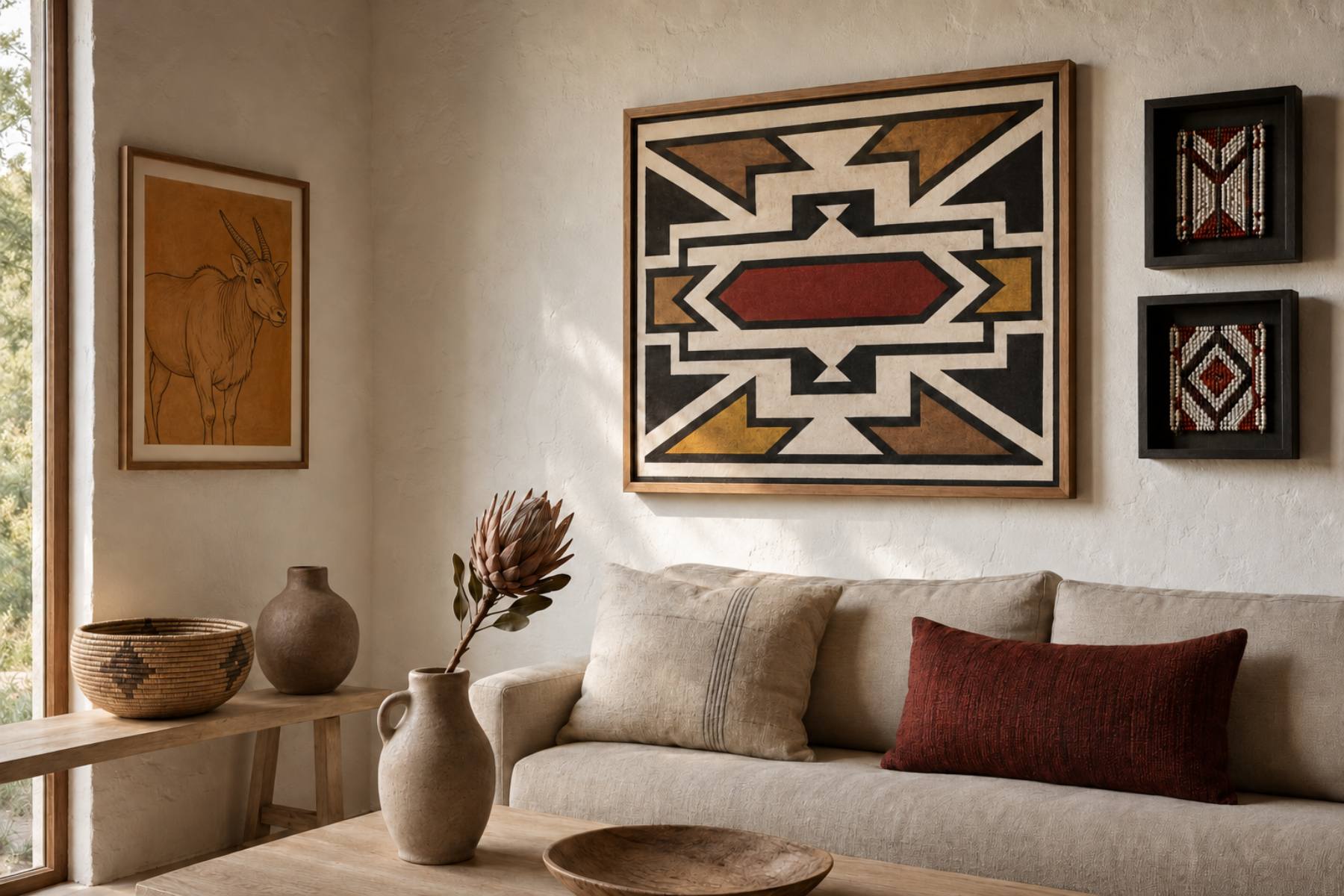
Scale Ndebele up, scale beadwork down. Ndebele work is architectural and reads best large — roughly two-thirds the width of the furniture beneath it. Beadwork is intricate and reads best small and close. Getting these the wrong way round is the most common mistake with both.
Frame for the tradition, not for the room. Plain black extends Ndebele’s own outline and is almost always right. Beadwork needs a deep box frame so the beads sit away from the glass and keep their shadow — the texture is half the point. Ochre-toned San-inspired prints want warm oak; black can feel severe against soft ochre.
Echo one colour, once. Take a single colour from your lead artwork and repeat it exactly once elsewhere in the room — a cushion, a stem, a book spine. That one echo makes a piece look placed rather than hung. Two echoes start to look like a theme.
Pair San work with materials, not other art. Ochre and charcoal on a pale ground sits better beside linen, unglazed ceramic, pale wood and raw plaster than beside another picture. Think of it as texture with a figure in it.
Light everything warm. All three are pigment traditions, and cool white bulbs drain them. A warm bulb in a lamp rather than an overhead brings the colour back — this matters most for the ochres.
If you are printing digital art at home to build a wall like this, print size and paper weight matter more than most people expect — we walk through both in our print, frame, hang and light guide.
What to look for when buying — and what to avoid
Be specific in how you describe it. “Ndebele-inspired geometric print” is honest and accurate. “Tribal African pattern” erases exactly the specificity that makes the work worth owning.
Buy from named artists where the tradition has them. Ndebele painting has a living, internationally recognised practitioner in Esther Mahlangu and a generation she trained. Anonymous “Ndebele-style” files are a different proposition entirely.
For beadwork, buy from South African cooperatives. Zulu beadwork is still made and still sold by the women who make it. Buying from a cooperative means the money reaches the tradition, and you usually get an accurate account of what the piece says.
Avoid reproductions of documented San panels. The paintings are sacred, ancient, and connected to living communities. Line-inspired work is fine; photographic reproduction of a specific site as wall decor is not.
Be sceptical of confident colour charts. If a seller tells you a beaded piece means one precise thing with no regional caveat, they are probably repeating something they found online.
If you are buying printable art instead — including ours — hold the description to the same standard as the object. Art inspired by a tradition should say so plainly. We try to hold ourselves to that in our Etsy shop, and you should hold us to it too.
FAQ
What do Ndebele patterns mean?
They function as identity and announcement. Painted by women on the exteriors of houses, they communicated family status and life events — births, marriages, deaths, and a son leaving for initiation. The shapes are largely architectural: rectangles, triangles, chevrons and stepped forms, always bounded by a heavy black outline.
Are Ndebele patterns ancient?
The tradition has deep roots, but the saturated palette everyone recognises is relatively modern — it arrived with commercially available acrylic paint in the twentieth century. Earlier work used earth pigments, lime and ochre and looked very different. Old tradition, new colours.
What do the colours mean in Zulu beadwork?
Broadly: white for purity and true love, red for passion or heartache, black for longing and — with white — marriage, yellow for wealth, blue for faithfulness, green for contentment. Meanings vary by region, era and family, so treat this as a living language rather than a fixed chart.
What is a Zulu love letter?
The ucu — a small beaded panel or necklace made by a young woman for one specific person, whose colours and arrangement carry a statement about her feelings and intentions. It is correspondence rather than decoration.
How old is San rock art?
Southern African rock art spans an enormous timeframe, with some sites among the oldest surviving art anywhere on earth. It represents one of the longest continuous artistic traditions in human history, and the San are living peoples, not a historical footnote.
Can I decorate with San rock art imagery?
Abstracted, line-inspired work in the spirit of the tradition is reasonable. Reproducing specific documented sacred panels as decor is not, given the art’s religious function and its connection to living descendant communities.
What colours work best with South African decor pieces?
For Ndebele, keep the room neutral — chalk, oatmeal, clay — and let the artwork carry all the colour. For beadwork and San-inspired pieces, work in clay, cream, ochre and charcoal. That palette sits very close to our Afro-boho colour guide.
A closing note
An Ndebele woman painting an aeroplane onto the front of her house sometime in the twentieth century was doing something quietly radical and completely ordinary at the same time. She was using a pattern language older than her grandmother to describe a machine her grandmother never saw. Nothing about that is a compromise. It is what a living tradition does — it keeps describing the world, and the world keeps changing.
That is the thread running through all three traditions here, even though they share almost nothing else. Zulu beadwork took foreign glass beads and built a language out of them. The Maasai did something similar with Scottish cloth, as we wrote in the Tanzania guide. San painters recorded not the animals in front of them but the experience of leaving their own bodies. In every case the tradition absorbed something and made it entirely its own.
If you take one thing from this piece, let it be that South Africa is not a single aesthetic. It is at least three, separated by tens of thousands of years, and the specificity is the value. When you bring a piece of this country into your home, you are joining a specific conversation — the Ndebele conversation, or the Zulu conversation, or the San conversation. Not all of them at once.
The right response is attention. Look at what you have chosen. Know which conversation it belongs to. Place it where its quiet work can be done.
That, as best as we can tell, is the difference between styling a room and making a home.
“The elaborately painted patterns heralded news of important life events — a birth, a death, a wedding, or a boy heading off to initiation school.” — on the function of Ndebele house painting
We would add: which is exactly why an Ndebele panel reads differently from a geometric abstract. The abstract arranges shapes. The Ndebele wall was telling the street what had happened to a family that year.
Also read:
- 12 Kongo Symbols & Their Meanings: A Decor Lover’s Guide — fourth in this series
- 12 Senegalese Symbols & Their Meanings — third in this series
- 12 Tanzanian Symbols & Their Meanings: A Decor Lover’s Guide — second in this series
- 12 Moroccan Symbols & Their Meanings: A Decor Lover’s Guide — first in this series
- African Motifs Explained: Adinkra, Kente and Mudcloth
- A Respectful Guide to African Textiles and What They Mean
- How to Mix Global Motifs at Home Without Losing Yourself
Shop the Essence of the Road Art collection
Every piece below is our own work — digital downloads you print at home, in the clay-and-ochre palette this article describes.
- Essence of the Road Art on Etsy — the full collection
- Protea Wall Art Printable, King Protea Print — the King Protea is South Africa’s national flower, and the most directly South African piece we make
- Navy Coral Africa Map Print — bold, colour-forward, for a wall that can take Ndebele-level saturation
- Adinkra Symbol Wall Art Set (5) — five African symbols, if the symbol-language part of this article is what drew you in
- Elephant Wall Art Printable, Neutral Earth Tone — a single animal in ochre tones, the quiet end of this palette