How to Style Afrocentric Wall Art Without Making a Room Feel Busy (2026 Guide)
By Essence of the Road Art · Published April 2026
This article contains affiliate links. If you buy through them, we may earn a small commission at no extra cost to you. We only feature pieces we would live with ourselves.
Introduction
The most common failure mode of an afrocentric home is not “too little” — it is “too much.” Beautiful pieces collected too quickly, hung too close, competing for the same eye-line, saying the same thing in slightly different ways. The result is a room that should feel soulful and instead feels loud.
Understanding how to style afrocentric wall art is essential for creating a unique and meaningful home environment. When you learn how to style afrocentric wall art properly, you can ensure each piece complements the others and contributes to a cohesive look.
This 2026 styling guide is the full playbook for the opposite outcome. How to style afrocentric wall art so that every piece has room to breathe, every composition reads intentional, and how to style afrocentric wall art in the room feels collected rather than cluttered. By mastering how to style afrocentric wall art, you create a harmonious space that reflects your personality. These are the rules we use in our own styling practice, translated from hundreds of mood boards, reader projects, and our own Essence of the Road Art gallery walls. This guide will explain how to style afrocentric wall art effectively.
Eight sections walk you through the principles in order: the governing rule, the proportion formulas, the placement logic, the palette discipline, and the five-minute reset that pulls any room back from the edge of overcrowding.
This guide assumes you have already chosen the pieces. If you are still deciding what to put on the wall — style, size, subject, where to buy it — start with our guide to choosing afrocentric wall art, then come back here for the styling.
Quick answer: How to style afrocentric wall art without the room feeling busy comes down to three rules. Hold the palette at 60-30-10 — sixty percent warm neutral, thirty percent terracotta or ochre, ten percent indigo, charcoal or brass. Choose one statement piece to anchor the wall, not five competing for attention. Then size art to furniture: two-thirds to three-quarters of the sofa, bed or console width, hung eight to ten inches above a headboard. When a room reads busy, it is almost always the ratio that is broken, not the art.
Table of Contents
The “Collected, Not Cluttered” Principle
The core principle is simple. Collected means every piece earns its place by carrying meaning, palette coherence, and breathing room around it. Cluttered means filling space for the sake of filling space.
The quick test we use on every room we consult: walk through the room, stop in front of the wall art, and ask — “If I removed any single piece from this composition, would the wall feel less alive, or would it feel like relief?” If removing any piece feels like relief, that piece does not belong, or the whole wall is over-filled. A collected wall survives editing; a cluttered wall collapses under it.
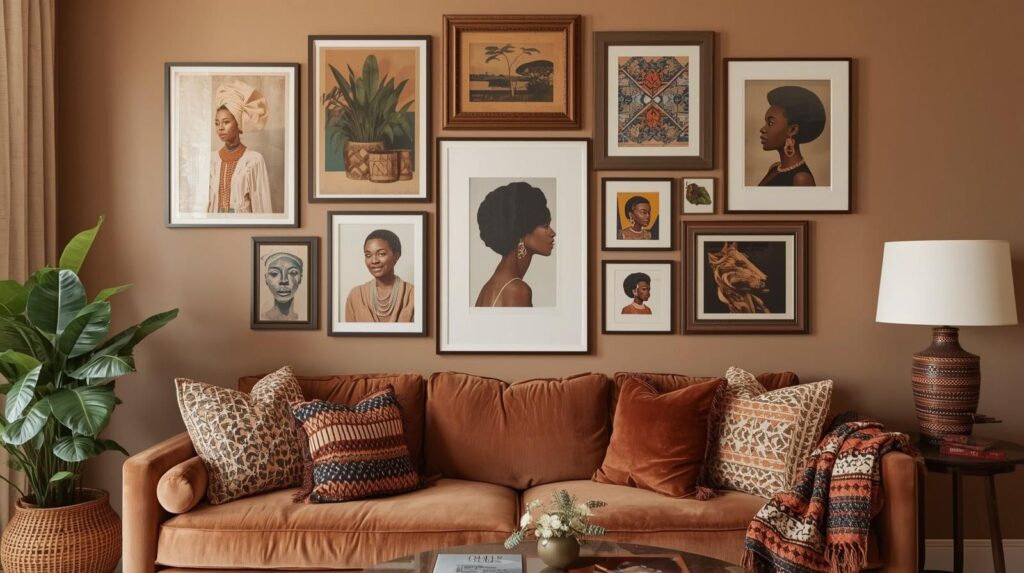
The 60-30-10 Rule for Afrocentric Rooms
Borrowed from interior design classics but adapted for afro-boho and afrocentric palettes. The distribution:
- 60 percent dominant tone — the warm neutral foundation (mocha mousse, cream, warm taupe, or cream linen). Walls, sofa, rug.
- 30 percent secondary tone — the earth warmth (terracotta, ochre, clay). Accent walls, larger pillows, curtains, ceramics.
- 10 percent accent tone — the depth colour (indigo, transformative teal, charcoal, or brass). Single accent pieces, frames, small hardware, art pops.
When readers tell us their afrocentric room “feels busy,” nine times out of ten the 60-30-10 ratio is broken — they have thirty percent terracotta and forty percent deep accent. Restore the ratio and the room calms down without moving any furniture.
Where to Place Your Statement Piece
Every afrocentric room needs one clear statement piece. Not five. One. It is the anchor around which everything else organises.
Three reliable statement locations:
Understanding how to style afrocentric wall art can transform your space. By choosing the right pieces and arrangement, you can elevate your decor.
- Over the sofa, centred. Classic, safe, and always works. Size at two-thirds the sofa’s width.
- Above the bed, centred. Intimate and calming. Single piece sized at roughly two-thirds the bed’s width.
- At the end of a sightline. If your living room has a long hallway or a doorway view, placing the statement piece at the end of that sightline pulls the whole space together.
Once the statement piece is placed, every other piece of wall art in the room should be quieter. Same palette, smaller scale, supporting role. When every wall has a statement, no wall has a statement.
Learning how to style afrocentric wall art involves selecting pieces that resonate with you, arranging them thoughtfully, and considering the overall vibe you wish to create. This process helps you discover how to style afrocentric wall art in a way that feels both personal and inviting.
Sizing Art to Furniture — The Real Rules
These four proportion rules save more rooms than any other styling advice:
Over a sofa: the artwork (or full gallery wall composition) should span two-thirds to three-quarters of the sofa’s width. Wider than the sofa looks top-heavy; narrower than half looks lost.
Over a bed: same rule. Two-thirds of the bed’s width, centred, with eight to ten inches above the headboard or pillows.
Over a console: two-thirds to three-quarters of the console’s width. The leaning-print approach (medium print resting on the console behind the sofa) is the exception — it reads collected rather than proportional.
Over a reading chair or nightstand: size the art to the chair’s back width, hung at seated eye level. Seated eye level is lower than standing — around forty-eight to fifty-two inches from the floor.
When you follow these four rules and nothing else, most “why does this room feel off” problems disappear.
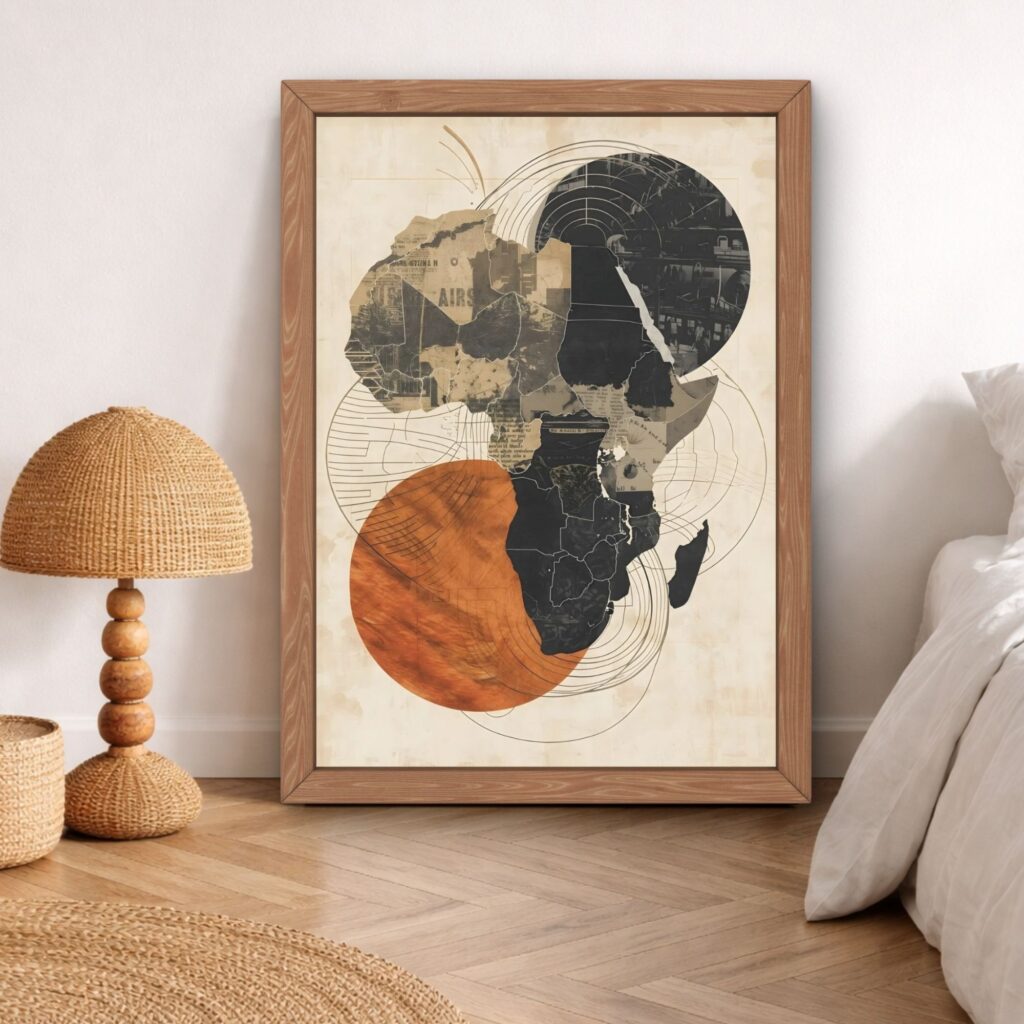
One practical advantage of printable wall art: you can size the file to your furniture exactly, rather than hoping a shop sells the right dimensions. The Abstract Africa Wall Art Printable from our Etsy shop ships in five print ratios — 2:3, 3:4, 4:5, 5:7, and 11×14 — so you can match the sofa, bed, or console proportions above without compromise.
The Breathing Room Principle
Breathing room is negative space — the empty surface around a piece of art that lets the piece feel complete. Afrocentric art, in particular, rewards breathing room. The palette is warm, the symbolism is often layered, and the eye needs a pause.
Three breathing-room rules:
Rule 1 — At least one quiet wall per room. One major wall should carry little or no art. The eye needs a place to rest. In a small room, two quiet walls.
Rule 2 — Space between frames stays consistent. Two to three inches between every frame in a gallery wall. Vary this and the composition starts to read random.
Rule 3 — No wall art within twelve inches of a ceiling, window, or door frame. These are structural edges the eye already reads. Placing art too close to them creates visual clash.
A room with breathing room feels bigger than it is. A room without breathing room feels smaller than it is. Breathing room is free, and it is the single most undervalued styling tool.
Mixing Symbolic Art Without Losing Focus
By focusing on how to style afrocentric wall art, you can transform your living areas into spaces filled with inspiration and depth. Each piece can tell a story when curated thoughtfully, showcasing how to style afrocentric wall art harmoniously.
Afrocentric art carries deep symbolism — Adinkra, Ankh, Tree of Life, Africa maps, ancestral portraits. Mixing multiple symbolic pieces can deepen a room’s story or scatter it. The difference is intention.
Our three rules for mixing symbols:
Rule 1 — Three symbols maximum per room. More than three and the room starts to read like a display case rather than a home.
Rule 2 — Symbols should relate, not compete. Sankofa (return and retrieve), Gye Nyame (supremacy of the divine), and a Tree of Life print share a thematic register — wisdom, roots, continuity. An Adinkra print next to an Afrofuturist geometric print next to a feminine portrait next to an Africa map tries to say too many things.
Rule 3 — Give the main symbol the biggest frame. If Sankofa is the heart of your wall, size it larger than the supporting pieces. Symbolic hierarchy reinforces visual hierarchy.
Color Matching Without Matchy-Matchy
Matchy-matchy is what happens when the palette is too tight. Every throw pillow exactly matches the rug, which exactly matches the art, which exactly matches the vase. The room reads like a furniture showroom.
Collected colour matching has a different logic:
- Pick a five-colour palette and use every colour at least twice but never identically. Terracotta appears in a pillow and in a framed art print — but at slightly different tones, one clay-ier, one brick-ier.
- Let wood tones do half the palette work. Warm oak, warm walnut, and natural jute are all “colours” even when we do not notice them.
- Break the palette once per room. A single unexpected tone — a forgotten green plant, a vintage brass piece, a book spine — keeps the room from reading too curated.
The sweet spot is cohesive but loose. The room looks composed, but not staged.
The 5-Minute Room Reset
When a room feels busy, try this reset before you buy anything new. Five minutes, five moves:
- Remove one piece of wall art from the busiest wall. Live with the change for a week.
- Edit one side table. Take everything off, wipe it clean, put back only the three objects you love most.
- Repaint or reposition one frame that feels out of place.
- Swap one bright white element (throw, lampshade, pillow cover) for a warm off-white or cream.
- Turn off the overhead light. Use only your lamps at three different heights.
Nine times out of ten, the reset is all the room needed. The problem was not “not enough stuff.” It was “too much stuff with not enough breathing space.”
Frequently Asked Questions
How many pieces of wall art should a living room have?
A well-styled afrocentric living room usually carries one statement wall (three to seven pieces in a gallery or one oversized piece), plus one or two small quieter pieces elsewhere — a leaning print on a console, a small symbolic piece above a reading chair. Total: five to nine pieces across the whole room, with at least one major wall left quiet.
What does “collected, not cluttered” actually mean?
Collected means every piece earns its place through meaning, palette coherence, and breathing room around it. Cluttered means pieces are filling space rather than carrying it. The quick test: if removing any single piece would feel like relief, the composition is cluttered; if it would feel like loss, it is collected.
What is the correct height to hang afrocentric wall art?
Centre point fifty-seven to fifty-nine inches from the floor — standard museum eye level. For seated areas (reading chairs, nightstands), drop to forty-eight to fifty-two inches. Over a sofa, leave eight to ten inches between the sofa top and the frame bottom. Over a bed, six to eight inches above the headboard or pillows.
How do I know if my gallery wall is too busy?
Three quick tests. First: can you describe the wall in one sentence? If you need more than a sentence, it is too busy. Second: remove any one piece — does the wall feel less alive or does it feel like relief? Relief means too busy. Third: does the wall have breathing room at the edges? If pieces run to within twelve inches of a ceiling or window frame, it is too busy.
Can I mix afrocentric prints with other art styles?
Yes — if the palette stays unified and the total count stays modest. Pair afrocentric portraits with botanical prints, line drawings, or abstract pieces, as long as all share warm tones and the afrocentric pieces remain the focal points. The style can vary; the palette should not.
How do I style afrocentric wall art in a small apartment?
To truly understand how to style afrocentric wall art, it’s important to balance the different elements in your room. This guide will offer insights into how to style afrocentric wall art for maximum impact while maintaining an inviting atmosphere.
Restraint. One statement piece over the sofa or bed, plus one or two small quieter pieces elsewhere. Keep the palette tight, leave at least one wall quiet, and use the vertical space above eye level for a single piece rather than a cluster. Small rooms reward intentional negative space.
What is the 60-30-10 rule for afrocentric rooms?
A palette distribution formula: sixty percent dominant warm neutral (mocha mousse, cream, warm taupe), thirty percent secondary earth tone (terracotta, ochre, clay), ten percent accent (indigo, teal, charcoal, or brass). When a room feels busy, the ratio is usually broken — too much thirty and ten, not enough sixty.
How do I avoid a “themed” afrocentric look?
Three moves. First, limit symbolic pieces to three per room maximum. Second, keep the palette warm and modern rather than “safari.” Third, mix afrocentric pieces with non-afrocentric textures (linen, bouclé, oak) so the room reads like a home with culture, not a display of culture.
Should my frames all match?
For a calm, editorial afrocentric gallery, yes — matched frames read more curated. For a travel-inspired or layered wall, two clearly related frame finishes (two woods, or one wood plus one brass) work. Never mix more than two frame finishes on a single wall.
What is the biggest styling mistake with afrocentric wall art?
Hanging too many pieces too close together with no breathing room. This is the single most common issue we see in reader home tours. The fix is almost always subtraction — remove one or two pieces, add two to three inches of spacing between the remaining ones, and suddenly the wall reads intentional.
Closing Note
Styling afrocentric wall art well is less about what you add and more about what you are brave enough to leave out. The collected home is made in the editing — one piece removed, one inch of breathing room added, one wall left quiet on purpose. Trust the palette, trust the proportions, and trust that restraint almost always tells a stronger story than abundance.
Related reading on Essence of the Road Art
Save this styling guide to your afrocentric home Pinterest board for your next room refresh — or explore our Essence of the Road Art Etsy shop for printable wall art sized for the proportion rules above, or start with our bestselling 3-piece Afrocentric Wall Art Set in Earth Tones for an instant gallery wall.
Remember, mastering how to style afrocentric wall art is not just about the pieces you choose but also about how they interact within your space. Take the time to explore different arrangements to discover how to style afrocentric wall art that resonates with your aesthetic.
Ultimately, learning how to style afrocentric wall art is an art form in itself, allowing you to express your individuality while celebrating the rich cultural significance of each piece.