
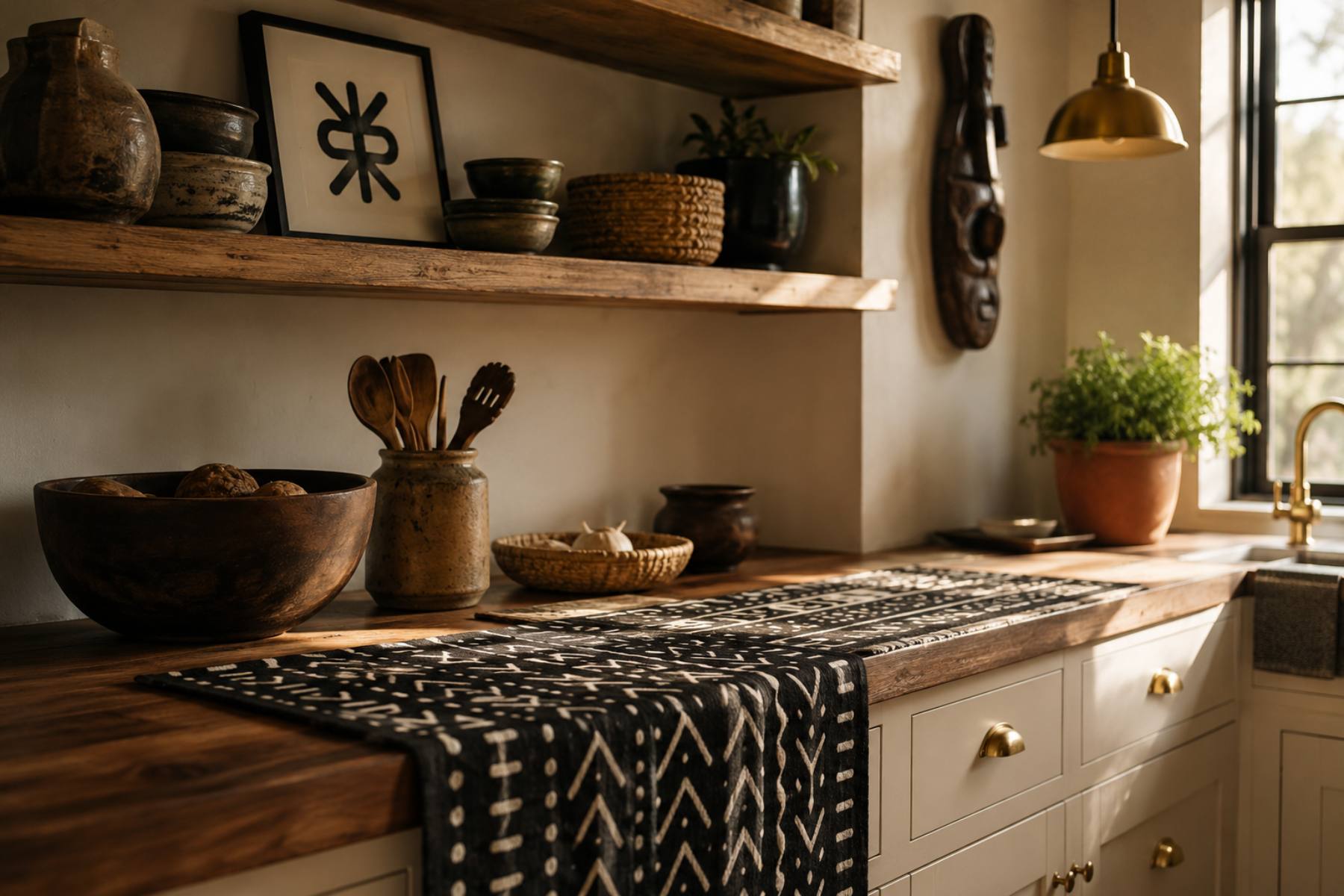
15 Afrocentric Kitchen Ideas for a Warm, Soulful Cooking Space
By Essence of the Road Art · Published July 2026
The kitchen is the most-used room in most homes — and the one most likely to be styled as an afterthought, left in whatever chrome-and-white the builder chose. Afrocentric kitchens argue the opposite case: the room where meals are made and people inevitably gather deserves the same warmth, texture and cultural depth as the living room wall.
The good news is that kitchens convert cheaply. Cabinets and counters are the expensive bones, but almost nothing on this list touches them — these are fifteen ideas ordered from ten-minute swaps to weekend projects, each one layerable on top of whatever kitchen you already have. Most are rental-safe; all of them obey the same warm earth palette that runs through every room in this style.
Quick answer: Afrocentric kitchen ideas work best when they warm the most-used room in the house: brass cabinet hardware swapped over chrome, a terracotta accent wall, a mudcloth runner across the counter, open shelving styled with hand-thrown stoneware and woven baskets, framed Adinkra or botanical art, linen tea towels on brass hooks, and a tall plant in a terracotta pot. Earth tones throughout — never bright white or cool grey — and one cultural anchor piece the room can gather around.
Table of Contents
The palette rule, kitchen edition
Before the fifteen: kitchens have more hard, shiny surfaces than any other room, which is why they go cold so easily. The fix is the same 60-30-10 warmth rhythm we use everywhere — cream and wood as the base, terracotta and ochre as the middle voice, brass and black as the accents — plus one kitchen-specific rule: every visible plastic thing you replace with clay, wood or metal pays double, because plastic is where kitchens leak their warmth. For the full color system behind this, the African color palette guide has the hex codes; for a brighter, market-inspired kitchen direction, the Makola Market scheme in our Ghana color palette guide was practically written for cooking spaces.
1. Swap chrome hardware for brass
The fastest visual upgrade in any kitchen. Matte brass cabinet pulls and drawer handles — and the faucet, if the budget stretches — instantly warm every element around them, because hardware is the jewelry of a kitchen and chrome is the wrong metal for this outfit. Budget $80–200 depending on cabinet count; a screwdriver and an hour is the whole install. Renters: keep the old pulls in a labeled bag and swap back at move-out.
2. Paint a terracotta accent wall
Pick the smallest wall — behind the breakfast nook, around the window, above the counter — and paint it warm terracotta or soft clay. Proven codes: Farrow & Ball Red Earth, Benjamin Moore Spiced Pumpkin, Sherwin-Williams Cavern Clay. One wall reads intentional; a whole terracotta kitchen reads like the inside of a flowerpot. Test the swatch under your actual evening bulbs before committing — kitchen lighting distorts paint more than any other room’s.
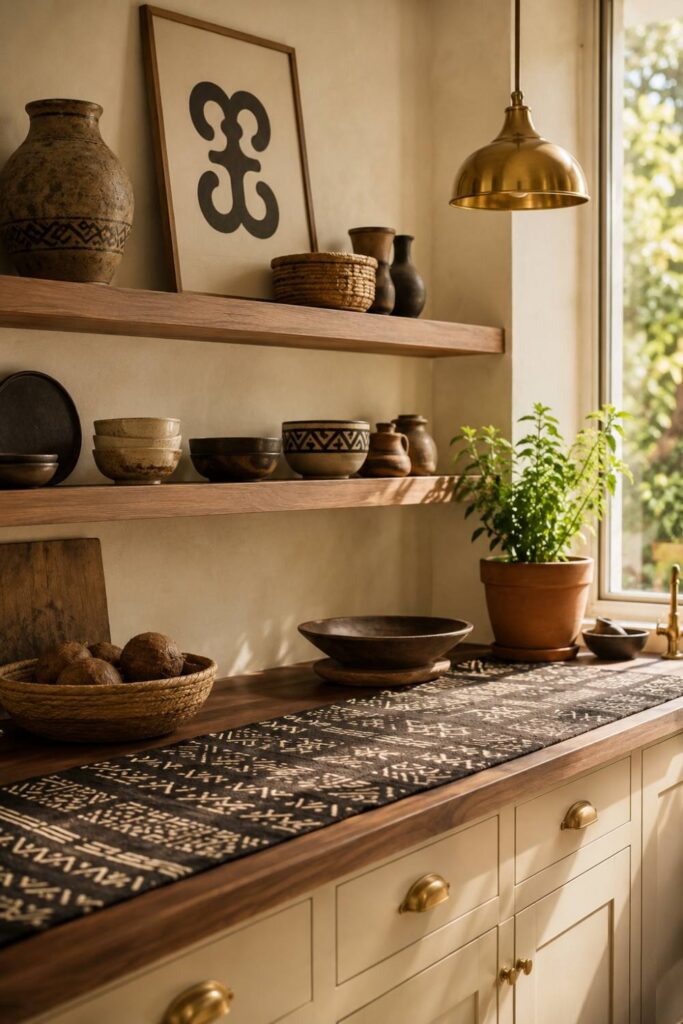
3. Drape a mudcloth runner across the counter or table
The cultural textile layer, kitchen-sized. A mudcloth table runner across an island, peninsula or breakfast table adds pattern and story in thirty seconds; leave 6–12 inches of bare surface at each end so it reads draped, not upholstered. Heavy cotton, hand-washable, and endlessly re-stylable — what the patterns actually mean is covered in our African textiles guide.
4. Open shelving styled with stoneware
Take the doors off one upper cabinet (save the hinges and doors — renters again) and style the shelves like a vignette: hand-thrown stoneware plates and bowls, one woven basket, one clay vessel, a short stack of cookbooks with earthy spines. The trick that keeps it kitchen rather than shop display: everything visible must be something you actually use weekly. Open shelving of untouchable decor collects grease and resentment in equal measure.
5. Frame an Adinkra symbol near the cooking zone
One symbol print — Sankofa, Gye Nyame or Nyansapo — framed in thin oak, hung or leaned where the cook’s eye lands between tasks. It is a small piece doing large work: cultural depth in the room that has the least of it. Our Adinkra Symbol Set of 5 gives five coordinated symbols to choose among (rotate them seasonally, since the frame does not care), and the meanings guide helps you pick the proverb the kitchen should say.
6. Hand-thrown clay vessels on the counter
Replace the plastic utensil crock and steel canisters with two or three stoneware vessels — one for utensils, one for oils, one for the small loose things every counter accumulates. Uneven glaze is the feature, not the flaw; this is the difference between surfaces that look supplied and surfaces that look kept.
7. A woven basket for produce
Onions, garlic, tomatoes and lemons do their best work on display. A woven produce basket — or better, a genuine Bolga basket from a Ghanaian weaver on Etsy — turns necessity into styling, and the produce itself becomes part of the palette. Plastic fruit bowls, like all kitchen plastic, quietly tax the whole room.
8. Replace the flush ceiling light with a brass or woven pendant
The single biggest lighting change available. A brass or rattan pendant over the island or table drops the light source into the room, warms it (2700K bulb, as everywhere), and adds the vertical presence kitchens usually lack. Rentals with immovable fixtures: a plug-in pendant swagged from a ceiling hook achieves 90% of the effect with zero wiring.
9. Linen tea towels on brass hooks
Retire the printed novelty towels. Oat, terracotta and charcoal linen tea towels hung on small brass hooks turn a pure utility object into part of the textile story — and they photograph like they cost five times their price. Never adhesive plastic hooks; the hook is visible hardware and plays by hardware rules.
10. Wooden cutting boards as leaning decor
Three boards — walnut, acacia, olive — leaning against the backsplash do double duty as workhorse and warmth. Vary the heights, oil them monthly, and let the knife marks accumulate; a scarred board is the kitchen equivalent of a well-read book.
11. Terracotta or zellige backsplash (the big swing)
If a real renovation is on the table, warm terracotta tile or Moroccan-inspired zellige transforms the room more than any other single surface — the hand-glazed variation does at wall scale what stoneware does at counter scale. Budget $800–2,000 installed. Everyone else: a temporary peel-and-stick version in warm tones gets surprisingly close for $100, and comes off with a hairdryer at lease’s end.
12. Display African and diaspora cookbooks
Yewande Komolafe, Pierre Thiam, Marcus Samuelsson — cookbooks from African and diasporic chefs, stacked on the counter or open on a small easel. They are the rare decor object that talks back: the styling layer and the dinner plan in one. Two or three visible; the rest can live in the shelf rotation.
13. A small Sankofa above the sink
Eye-level at the window above the sink is the most-viewed few square inches in the whole house — the spot where you stand, hands busy, mind loose, several times a day. A small framed Sankofa there is the quietest idea on this list and the one readers mention most. The free Sankofa print sized down to 8×10 fits the spot exactly, and costs an email address.
14. Wood and clay at the sink line
Wooden dish brushes standing in a small clay holder, a bar of olive-oil soap on a wooden dish, a linen towel on its brass hook — the sink zone is five objects, and when all five are natural materials the most utilitarian corner of the house becomes, improbably, a vignette. Total cost under $30, replaceable forever.
15. One tall plant in a terracotta pot
A Sansevieria, Bird of Paradise or tall pothos in the corner the counters can’t use. The plant softens every hard surface in the room and adds the living layer that kitchens — all appliances and edges — need more than any other room. Low light? The pothos forgives; truly no light? A large dried arrangement in a floor-standing clay vessel does the same vertical work.
The rental kitchen version, summarized
Skip ideas 2 and 11 (paint and tile); do everything else. Hardware swaps reverse with a screwdriver, the pendant swags from a hook, shelving doors rehang in ten minutes, and every textile, vessel, basket, board and plant moves out with you. A renter running ideas 1, 3–10 and 12–15 changes the kitchen more than most owners ever do — the whole approach shares DNA with our Afrohemian rental living room guide, where the lease is treated as a design constraint, not a prohibition.
Small-kitchen adaptations
Galley and studio kitchens run the same list at reduced dosage. Hardware, towels-on-hooks and the sink line (1, 9, 14) work at any square footage unchanged. Open shelving (4) becomes a single floating shelf — one board, three objects. The runner (3) moves to whatever surface eats breakfast, even a 24-inch counter gap. Art shrinks to one piece: the 8×10 Sankofa above the sink (13) is the gallery in a galley. Skip entirely: the floor plant (a windowsill herb pot in terracotta stands in) and the leaning cutting boards if counter inches are precious. The palette rule compensates for everything you omit — in a small kitchen, warmth per square inch simply concentrates, which is why tiny warm kitchens routinely out-charm large cold ones.
The weekend order
Day one morning: hardware (1) and hooks-plus-towels (9) — the room already reads differently at lunch. Day one afternoon: counter styling — vessels (6), basket (7), boards (10), sink line (14). Day two: the wall layer — art (5, 13), open shelving (4), runner (3), plant (15), cookbooks (12). Paint (2) and pendant (8) take their own weekend; the backsplash (11) takes its own budget meeting. Photograph the room before starting — the before-and-after is the cheapest motivation on the list, and the version you post is the one that convinces a friend her kitchen deserves the same weekend. Keep the receipts list too; the total consistently surprises people who assumed soulful meant expensive.
What it all costs, honestly
Tier one — the $150 weekend: towels and hooks (9), sink line (14), produce basket (7), clay vessels (6), boards from the thrift run (10), and the free Sankofa framed (13). The kitchen already reads intentional. Tier two — the $300–450 layer: hardware (1), runner (3), plant (15), cookbooks (12), Adinkra set for the rotating frame (5). Tier three — the owner projects: paint (2) at $60 of materials, pendant (8) at $80–200, backsplash (11) at real-renovation money. Notice the shape of that ladder: four-fifths of the visual result lives in the first two tiers, which is the entire argument of this article compressed into a budget.
The gathering kitchen
One last reframe before the FAQ. Kitchens in the cultures this style draws from were never backdrops — they are where the talking happens, where recipes are inherited sideways while hands work, where guests end up no matter how nice the living room is. Style for that reality: a stool or two that invite lingering, the coffee or tea corner given vignette status (tray, clay mugs, the good beans visible), warm light that flatters conversation after dark, and nothing so precious it can’t survive a crowded Sunday. The fifteen ideas above make the room beautiful; keeping it usable by many hands at once is what makes it afrocentric in the older sense of the word — the room as the village square of the house. Style accordingly: the mug shelf reachable by guests without asking, the stool that says stay, the light that makes ordinary Tuesday dinner look like an occasion. If your gatherings spill toward the table, our housewarming gift guide doubles as a hosting-gear list in disguise.
Frequently asked questions
Can I do afrocentric kitchen styling in a rental?
Yes — thirteen of the fifteen ideas are rental-friendly. Skip the paint and permanent backsplash; everything else works with no permanent changes, and the summary section above sequences it.
What if my kitchen has white modern cabinets?
Layer warmth around them: brass hardware, terracotta accents, mudcloth runner, framed art, stoneware, plants. White cabinets read as canvas once the warm layers accumulate — it is cool grey cabinetry that genuinely fights the palette, and even that loses to enough brass and clay.
Where do I shop afrocentric kitchen pieces on a budget?
Amazon for hardware, pendants, towels and basic stoneware (links throughout); Etsy for authentic mudcloth, Bolga baskets and the framed Adinkra art that anchors the room; thrift stores for wooden boards, clay vessels and brass hooks, which they produce in embarrassing abundance.
Is a mudcloth runner food-safe near prep areas?
Yes — mudcloth is heavy woven cotton and hand-washes like any table linen. Keep it clear of the actual cutting-and-splatter zone, wash it regularly, and retire it to the bench when it earns its stains.
Which single idea changes the most?
For effort-to-effect, the hardware swap (1). For emotional effect, the Sankofa above the sink (13) — small, nearly free, and seen more times a day than everything else in this article combined.
Related reading
- 15 Afrocentric Home Office Ideas for a Soulful Workspace
- 12 Adinkra Symbols & Their Meanings: The Symbolism in African Art — Ghana
- Ghana Color Palette: Kente Gold, Red Clay and the Colors of Accra
- Mudcloth Pillows for Modern Homes: 15 Curated Picks
- A Beginner’s Guide to Afrocentric Decor in 2026
Closing
An afrocentric kitchen is built around warmth, texture and use — the heart of the home styled like it knows it. Start with the ten-minute swaps, let the palette do the coordinating, and keep one rule above all the others: if it is plastic and visible, its days are numbered. The room where everything happens deserves objects with something to say. And when the first dinner guest picks up the framed symbol by the stove and asks what it means, you will have the answer — which is the moment this whole list was really for.