Kente Cloth Patterns and Meanings: How to Read Ghana’s Royal Weave
By Essence of the Road Art · Published July 2026
This article contains affiliate links. If you buy through them, we may earn a small commission at no extra cost to you. We only feature pieces we would live with ourselves.
Most guides treat kente as a colour story — bright, Ghanaian, celebratory — and stop there. But kente was never only colour. Among the Asante of Ghana it is a written language: every cloth carries a name, most names carry a proverb, and the weaver assembles colour, pattern and proverb the way a poet assembles a line. A cloth woven for a king’s enstoolment says something a graduation cloth does not, and both are legible to anyone who has learned the grammar.
This guide teaches that grammar. You will learn how a kente cloth is actually built, what the colours mean, the names of the great cloths and the smaller woven motifs inside them, and — the part almost no decor article covers — how to bring kente cloth patterns and meanings into a modern home without the result reading as a costume. It is the companion piece to our 12 Adinkra symbols guide, which covers Ghana’s stamped symbol language; kente is the woven one. For the wider family of Ghanaian textiles, our African motifs explained overview sets adinkra, kente and mudcloth side by side.
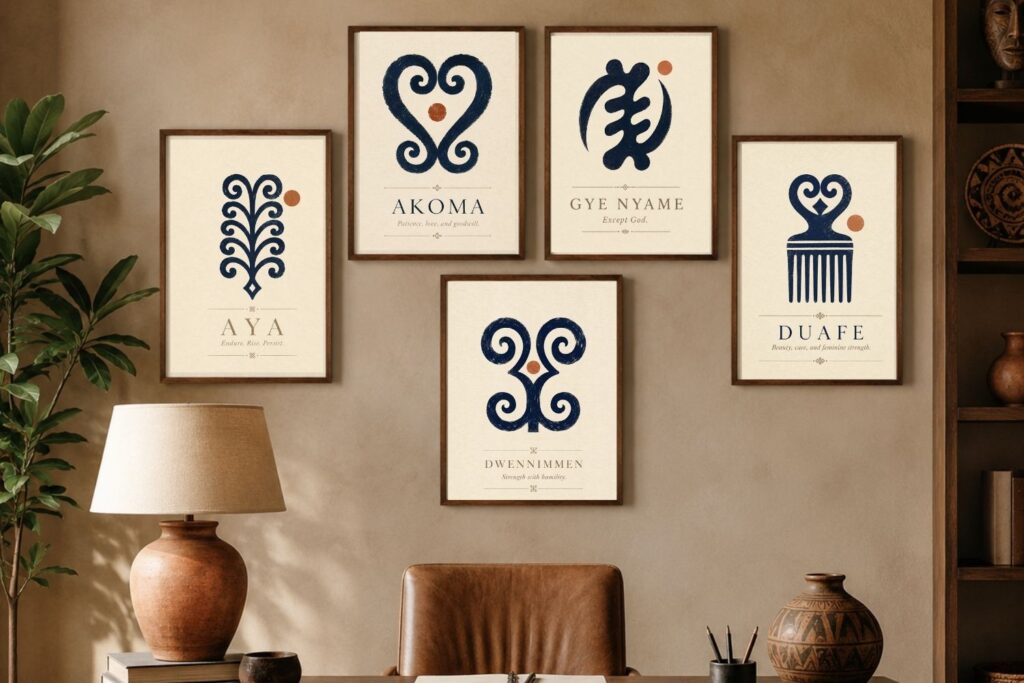
Quick answer: Kente cloth patterns and meanings work on three layers at once — colour (gold for royalty, green for growth, red for sacrifice, blue for peace, black for maturity), the named weft motifs woven into each strip (such as Babadua for cooperation or Mframadan for resilience), and the overall cloth name, which usually references a proverb or a person. To read a cloth, name its dominant colour, then its repeating motif, then the whole pattern. The quickest way to bring the language home is our Adinkra Symbol five-piece set, which pairs the same Ghanaian design vocabulary with wall-ready art.
Table of Contents
How a kente cloth is actually built
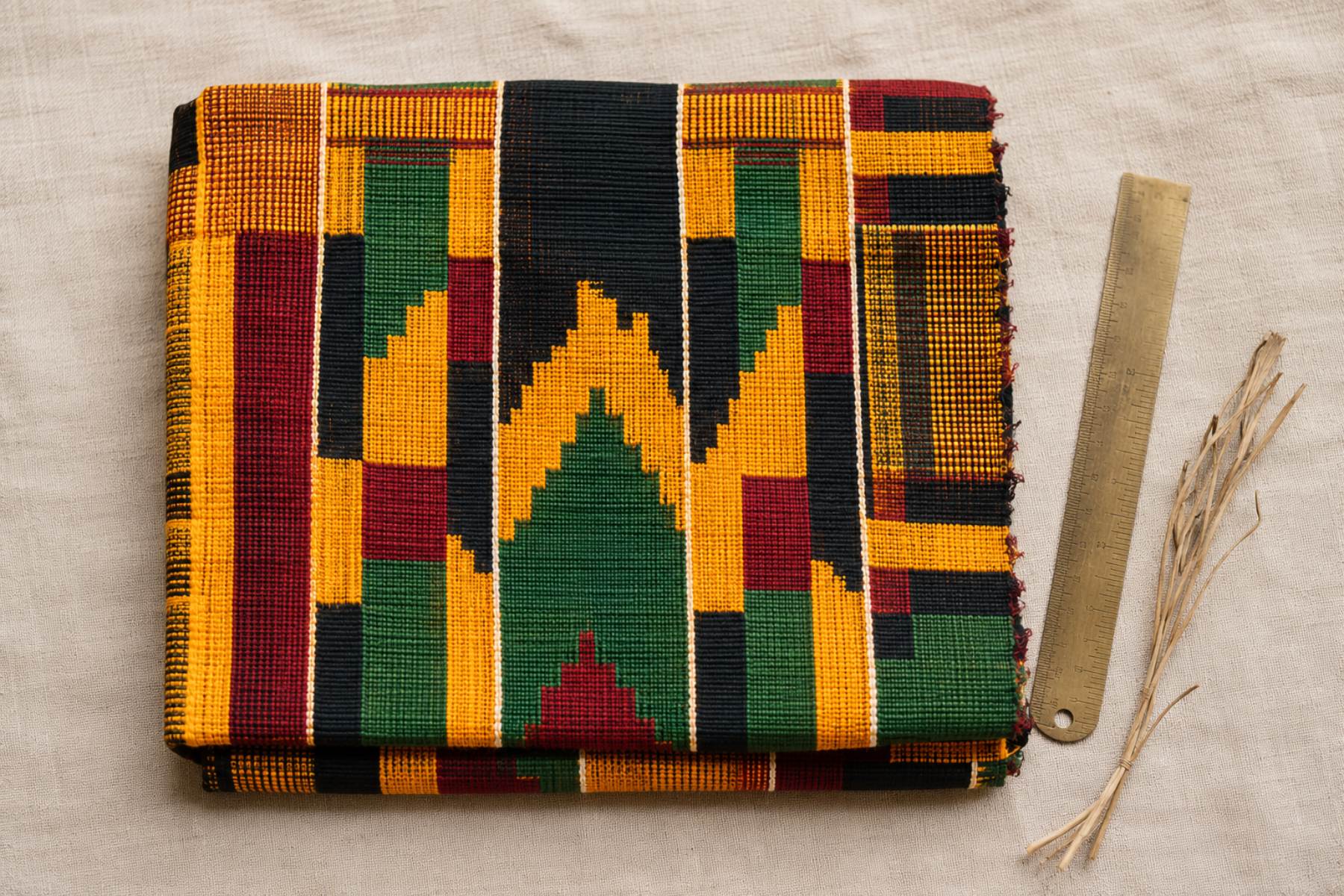
Before meaning, mechanics — because the meaning lives in the structure. Kente (its Akan name is *nwentoma*, “woven cloth”) is made on a narrow horizontal loom that produces a strip roughly four inches wide. A weaver builds many of these strips, then sews them selvedge to selvedge into a single large cloth. This is why kente always reads as vertical columns: you are looking at individual strips standing shoulder to shoulder.
Within each strip, two systems of design run at once. The lengthwise threads — the warp — create the background stripes that run the whole length of the cloth. The crosswise threads — the weft — are packed in tightly to build the dense blocks of geometric pattern that interrupt the stripes. Master weavers alternate warp-faced sections (where the vertical stripe dominates) with weft-faced blocks (where the horizontal motif takes over), and it is the rhythm between them that gives a great cloth its music.
Two Ghanaian traditions weave kente. The Asante cloths from around Bonwire, near Kumasi, are the ones most people picture: dense, jewel-toned, deeply codified. The Ewe of southeastern Ghana and Togo weave *kete* as well, often with softer colours and figurative motifs — birds, stools, hands — rather than the Asante emphasis on pure geometry and proverb. Both are kente; both are hand-woven strip by strip. When you understand that a cloth is an assembly of authored strips, the names below stop being decoration and start being sentences.

The colour grammar of kente
Colour is the first thing you read, and in kente it is never arbitrary. Each colour carries an agreed meaning, and weavers choose the dominant colour to set the emotional key of the whole cloth — the way a composer chooses a key signature. These are the colours you will meet most often and what they carry in Asante tradition.
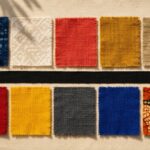
Gold and yellow speak of royalty, wealth, high status and spiritual purity — the colour of the metal that built Asante power, and the reason so many ceremonial cloths glow. Green is growth, renewal, fertility and the health of the land, the colour of planting and harvest. Blue carries peace, harmony and love, associated with the sky and with Nyame, the sky-god. Red is the colour of heightened feeling — political passion, sacrifice, and the blood shed in struggle; deep reds also belong to mourning and funerary rites. Black signals maturity, spiritual depth and connection to the ancestors, which is why it, too, appears at funerals as often as at coronations. White is purification and festivity, the colour of sanctified and joyful occasions. Beyond the core, maroon and purple lean feminine and earthbound, tied to healing and to Asaase Yaa the earth; pink softens red into tenderness and calm; silver and grey belong to serenity and the moon.
The practical lesson for a home is the same one weavers follow: decide what the room should *say* before you assign the colour. A study that celebrates achievement wants gold and black; a bedroom that wants to feel like peace wants blue and bone; a family room built around growth and vitality wants green and red-clay warmth. Our Ghana colour palette guide translates these exact meanings into five room-ready schemes with hex codes, so you can borrow the grammar without owning a loom.

Named kente cloths and their meanings
Here is where kente becomes literature. Whole cloths — specific combinations of warp, colour and motif — carry names, and those names are how Ghanaians refer to them. Some honour proverbs, some honour people, and the greatest are reserved for royalty. This is a reader’s field guide to the most storied, drawn from Asante weaving tradition and offered with the humility that kente scholarship demands, since names and readings vary between weaving families.
Adweneasa — often translated “my skill is exhausted” or “fullness of ornamentation” — is the master cloth. In an Adweneasa, the weaver fills nearly every block with intricate weft designs, holding nothing in reserve; it was historically reserved for kings and the highest occasions. To own one is to own a weaver’s entire vocabulary at once.
Sika Futuro, “gold dust,” speaks of wealth and royal status, a reference to the gold that was Asante currency and glory. Oyokoman, “the Oyoko nation,” carries the red, gold and green of the royal Oyoko clan and evokes national unity, particularly the reconciliation of a people after conflict. Fathia Fata Nkrumah — “Fathia is a befitting wife for Nkrumah” — was named for the Egyptian wife of Ghana’s first president, Kwame Nkrumah, and commemorates a union and a moment of Pan-African hope.
Emaa Da, “it has never happened before,” celebrates originality and exceptional, novel achievement — a cloth for a first, for a breakthrough. Obaakofo Mmu Man, “one person does not rule a nation,” is a cloth of participatory governance and shared responsibility, a woven argument for consensus. Wofro Dua Pa A, from the proverb “when you climb a good tree you are given a push,” honours worthy endeavours and the community’s duty to support them.
You do not need to memorise the catalogue. The point is orientation: when you next see a kente cloth, know that its arrangement is chosen, that it likely has a name, and that the name almost certainly points outward to a proverb or a person. That awareness is what separates respect from mere consumption — and it is exactly the awareness we try to build into our own Ghanaian-inspired wall art.
Weft motifs: the smaller words inside the cloth
If the cloth name is the sentence, the weft motifs are the words. These are the repeating geometric blocks woven into the strips, each with its own name and meaning, combined by the weaver to build the larger statement. A handful appear again and again, and learning them lets you read the interior of almost any Asante cloth.
Babadua takes its name from a hard, segmented reed and appears as tight horizontal bars stacked like bamboo joints; it stands for strength through cooperation and the resilience of things bound together. Mframadan, “the wind-resistant house,” is a motif of fortitude and preparedness — a home built to survive the storm, and by extension a life built to survive adversity. Nkyimkyim, the zigzag, is the motif of life’s twists and the adaptability they demand; it shares its name and lesson with the Nkyinkyim adinkra symbol. Nkyemfre, “potsherds,” honours the wisdom that comes from service and long experience, the knowledge held in broken and mended things. Owia Repue, “the rising sun,” carries progress, vitality and renewal.
Read together, these motifs explain why a single kente cloth can feel so dense with intention: a weaver might set Mframadan beside Babadua to say, in effect, that resilience and cooperation build a house that stands. Our African textiles meaning guide places these woven words in the wider context of African cloth, from Mali’s mudcloth to the wax prints of the coast.
Kente for the Ewe: the second tradition
It is worth pausing on the Ewe kete of southeastern Ghana, because it corrects a common flattening. Where Asante kente prizes geometric abstraction and royal proverb, Ewe weavers often incorporate representational motifs — a bird, a hand, a drum, a stool — woven directly into the cloth, and historically used a wider, softer range of colours. Ewe kete was less bound to the court and more woven for community and personal commission, which gives many Ewe cloths a warmer, more narrative feeling. Recognising both traditions keeps “kente” from collapsing into a single stereotype, and it gives you a richer visual library to draw on when you choose art for a room: the crisp, jewel-toned Asante register reads as elevated and ceremonial, while the Ewe register reads as storytelling and warmth.
How to use kente cloth patterns and meanings at home
This is the question decor articles dodge, so let us answer it directly: how do you bring a cloth this loud, this meaningful and this culturally specific into a contemporary home without the room turning into a theme park? The line between homage and costume is intention plus restraint, and four rules keep you on the right side of it.
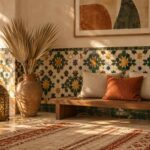
First, let kente be the accent, not the theme. A single framed kente-inspired print above a console, one authentic strip folded over a bench, or a pair of cushions in a kente-derived palette will always read more sophisticated than a room where everything shouts Ghana at once. The cloth was designed to be the most important thing in the room; give it room to be that, against calm bone walls and honest wood.
Second, use the colour meanings on purpose. Because you now know that gold is royalty and green is growth, you can choose a gold-and-black kente register for a home office you want to feel accomplished, or a green-and-cream one for a nursery you want to feel like new life. When the colour choice follows the meaning, the room gains a quiet coherence that guests feel without being able to name.
Third, source real craft where you can. Nothing dignifies a kente-inspired scheme like the presence of one genuine, weaver-made object — a Bonwire strip, an Ewe kete panel, a Ghanaian-made basket — sitting among the prints and cushions. It shifts the whole arrangement from imitation to homage, and it puts money in the hands of the tradition you are borrowing from. Look for makers who name their weavers and their region rather than mass-produced “kente print” marketed as the real cloth.
Fourth, pair the woven with the still. Kente’s density wants quiet company: plain linen, a matte-black frame, a single-line drawing, unglazed ceramic. Our guide to styling African prints works through the mixing in detail, and the beginner’s guide to Afrocentric decor covers the foundations if you are just starting to build the look.
Kente-inspired art versus the real cloth: buying honestly
There is an honest distinction worth naming. Authentic kente — hand-woven in Ghana, strip by strip — is a significant object, often expensive, and best bought directly from Ghanaian weavers or reputable importers who credit them. Kente *inspired* art and textiles, which borrow the palette and geometry into prints, cushions and posters, are a different and legitimate category, so long as they are described honestly as inspired-by rather than sold as the genuine handwoven cloth.
For most homes, the graceful path is both: a few pieces of kente-inspired art to carry the colour and rhythm across a wall, and — when you are ready — one real Ghanaian cloth as the anchor. Our own prints sit firmly in the inspired-by category and say so; the Adinkra Symbol five-piece set carries the Ghanaian design language in a form you can hang this week, and our colourful editorial prints echo the Makola-market brightness that lives in kente’s bolder cloths. If you craft, and want to build your own kente-derived patterns for cushions or stationery, the geometric SVG and pattern libraries at Creative Fabrica are what we reach for in our own production. To display an authentic strip, a simple float frame protects the cloth while letting the weave breathe.
Frequently asked questions
What do kente cloth patterns and meanings actually represent?
They represent three layers of meaning stacked together: colour, motif and cloth name. Colour sets the emotional key — gold for royalty, green for growth, red for sacrifice, blue for peace, black for maturity. The woven weft motifs, such as Babadua or Mframadan, act as words for concepts like cooperation and resilience. The overall cloth name, often drawn from a proverb or named for a person, is the full sentence. Reading a cloth means reading all three at once.
Can I decorate with kente if I am not Ghanaian?
Respectful use is welcome in most contexts, and the guardrails are straightforward. Use the colours and motifs with an awareness of their meanings, credit the Asante and Ewe traditions when asked, and never present kente-inspired prints as genuine handwoven cloth. Buying real Ghanaian-made kente or textiles to sit alongside your scheme is the strongest form of respect, because it supports the weavers directly.
What is the difference between kente and adinkra?
They are two different Ghanaian visual languages. Kente is woven — meaning is built into cloth through colour, strip and motif. Adinkra is stamped or printed — individual symbols pressed onto cloth, each standing for a proverb or concept. Kente speaks through combination and colour; adinkra speaks through discrete symbols. Our adinkra symbols guide covers the stamped language in full.
Which kente colours work best in a small or neutral home?
Anchor the scheme on bone, cream or warm straw walls and let the saturated kente colours live only in the art and textiles, where they read as jewels rather than noise. A gold-and-black register suits a study; a green-and-cream register keeps a small bedroom calm and open. Reserve the full royal chord of gold, red, green and black for a single gallery wall rather than the whole room.
Is machine-printed kente disrespectful?
Not inherently — printed kente-inspired fabric is a widespread and accepted category worldwide, including within Ghana, for clothing and decor. What matters is honesty and intent: describing printed cloth as inspired-by rather than passing it off as handwoven, and understanding the meanings you are displaying rather than treating them as generic pattern. Held to those standards, kente-inspired decor honours the tradition rather than diluting it.
Related reading
- 12 Adinkra Symbols and Their Meanings: The Symbolism in African Art
- African Motifs Explained: Adinkra, Kente and Mudcloth
- Ghana Color Palette: Kente Gold, Red Clay and the Colors of Accra
- Understanding African Textiles: Meaning for Home Decor
- Adinkra 5-Piece Gallery Wall: How to Build One at Home
Closing
Kente rewards the person who learns to read it. Once you know that gold is royalty and green is growth, that Babadua means cooperation and Mframadan means a house built to withstand the wind, a kente cloth stops being merely beautiful and becomes articulate — and a room that borrows its grammar with intention carries that articulacy quietly, in a way guests feel before they understand. Start with the meanings, choose one register that matches what your space should say, and build it in layers: art that carries the colour, textiles that carry the rhythm, and, when you are ready, one genuine Ghanaian cloth as the anchor. The first layer is a single click — the Adinkra Symbol five-piece set hangs the Ghanaian vocabulary in an afternoon.