
Afrocentric Home Decor Beyond Wall Art: 9 Everyday Pieces That Carry the Same Design
By Essence of the Road Art · Published August 2026
This article contains affiliate links. If you buy through them, we may earn a small commission at no extra cost to you. We only feature pieces we would live with ourselves.
Most people treat Afrocentric decor as a wall decision. You find a print you love – an Africa map in terracotta, a Black woman portrait in indigo – you frame it, you hang it, and then you stand in the doorway and the room still does not feel like anything. The art is good. The room is unchanged.
That is not a taste failure. A single framed print on a white wall is an object in a room; it is not a room. What makes a space feel considered is the same visual language turning up two or three times, in different materials, at different volumes. Once you notice it you cannot stop noticing it: in the rooms that work, the colour on the wall is also in the cushion, and faintly again in the thing on the shelf.
What has changed is that this is now cheap to do. The same artwork that hangs on your wall can be printed onto a throw pillow, a shower curtain, a tote bag or a mug – which means the echo does not have to be a lucky find at a homeware shop. It can be the piece you already chose.
Quick answer: the fastest way to make afrocentric home decor feel like a room rather than a purchase is to take one design and let it appear three times at three volumes – one large piece of wall art, one textile that repeats a single colour from it, and one small everyday object. Same artwork, three materials, decreasing loudness. Start by choosing the wall piece, because everything else takes its cue from that palette. Something like the Africa Map Textured Collage Print gives you terracotta, charcoal and bone to build outward from.
Table of Contents
The rule of three: statement, echo, whisper
The formula is simple enough to hold in your head while you shop.
- One statement piece. The wall art. Full pattern, full colour, hung at eye level and large enough to look deliberate. This is the only place the design appears at full volume.
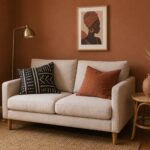
- One echo. A pillow, a throw, a curtain – something soft that repeats one colour from the artwork, not the whole design. If your print is terracotta, charcoal and bone, the echo is terracotta. Just terracotta.
- One whisper. A mug on the shelf, a notebook on the desk, a tote hanging by the door. Nobody consciously registers these. They do the work anyway.
And then the failure mode, which is worth saying plainly because almost everyone does it at least once:
Do not put the same motif on six objects. That is a gift shop, not a home. The moment the Africa map is on the wall and the pillow and the mug and the tote and the shower curtain, the room stops reading as personal and starts reading as merchandise. Three appearances is a theme. Six is a shop window.
If you are still working out the underlying formula – the palette, the textures, the balance between pattern and plain – start with our Afro-Bohemian Decor 101 guide and our afro-boho living room ideas. This article assumes you already have a design you like and want to know where else it can go.
The 9 everyday pieces, and what each one is actually for
Every piece below can be made from the same artwork you hang on the wall. For each one: what it does in a room, which design suits it, and one honest limitation, because not everything works everywhere.
1. Throw pillow – the lowest-risk way to add pattern
A pillow is the cheapest mistake you can make and the fastest win. It is small, it is movable, and if you hate it in the living room it goes on the bedroom chair. This is where bold pattern belongs: a piece like Three African Women Silhouettes or the Africa Map Collage reads beautifully at 18 inches square, where the pattern is close enough to actually see.
The limitation: one printed pillow on a sofa looks like a sample. Two looks like a decision. Buy in pairs, or pair one printed pillow with two plain ones in a colour taken from the print. If you would rather sew your own, we have a whole guide to DIY mudcloth pillow covers, and a round-up of mudcloth pillows for modern homes. You will also need pillow inserts – always one size larger than the cover, or it sags.


2. Duvet cover – the biggest surface in the house
A duvet is roughly two square metres of pattern facing you every time you walk into the bedroom. That is a lot of artwork. The instinct is to go bold; the correct move is the opposite. A minimal piece – Minimalist Black Woman Silhouette with Gold Circle – holds up at that scale because there is enough plain ground in it to breathe.
The limitation: this is the one item on the list where I would think twice. A patterned duvet dominates a bedroom completely, and bedrooms are the rooms people most often want calm. If your bedroom already has an anchor piece above the bed, a printed duvet will fight it. Choose one or the other, never both. Our afro-boho bedroom sanctuary guide covers the calmer version.
3. Shower curtain – the most overlooked wall in the house
A shower curtain is a two-metre rectangle of blank fabric hanging in a small room, and almost everyone treats it as plumbing. It is the single best-value surface in a house. A warm textured piece like the Africa Map Collage in terracotta turns a functional bathroom into a considered one for less than the cost of a framed print – and it solves the problem of a bathroom with no wall space, which most bathrooms have.
The limitation: steam and repeated washing are hard on printed fabric, so expect a printed curtain to have a shorter life than a print on your wall. Use a separate liner behind it and it lasts considerably longer. For everything else in that room, see our Afrocentric bathroom ideas. A set of decent shower curtain rings makes a surprising difference to how the whole thing hangs.
4. Bath towel – colour echo only
Towels are where restraint pays. A towel is handled, folded, stacked and looked at from a metre away, and a busy pattern on one gets tiring fast. If you use a printed towel at all, treat it as the echo rather than the statement – one colour from your wall art, carried across. The Minimalist Silhouette works here because it is mostly ground with one shape.
The limitation: printed towels fade unevenly where they are folded, and a strong pattern will show that within a year. Honestly, this is the one place where I would take plain towels in a colour drawn from your artwork over a printed one. The look is the same and it ages better.
5. Beach towel or beach sheet – the one place bold always wins
Everything I just said about restraint stops applying at the beach. A beach towel is meant to be seen from a distance, on sand, in full sun, and the bolder the pattern the better it works. This is the natural home for Three African Women Silhouettes or the colourful Africa map in navy and coral – both hold their shape at two metres and both look like something rather than like a towel.
The limitation: beach towels are seasonal, so this is a summer purchase rather than a year-round one. A beach sheet – the larger, thinner version – doubles as a picnic blanket and a sofa throw in winter, which makes it better value.
6. Tote bag – the piece that leaves the house
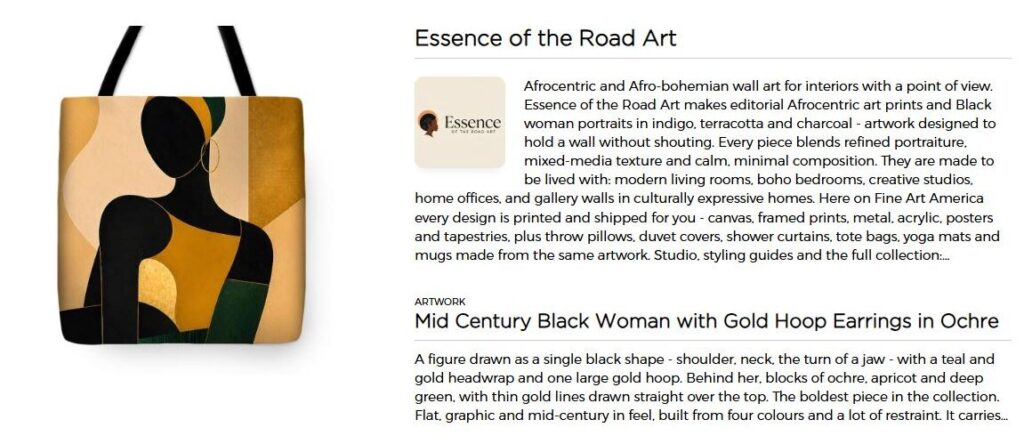
A tote is the only item on this list other people see. It is also, quietly, the cheapest advertising you will ever do for your own taste. A graphic design works best because it has to read at a glance across a street: Mid Century Black Woman with Gold Hoop Earrings or Black Woman Reading in Indigo – the reading one in particular gets remarked on in libraries and bookshops, which is exactly where you want it.
The limitation: printed canvas totes are not built for weekly grocery loads. Keep one for books, markets and the gym, and keep something sturdier for the heavy shop.
7. Weekender bag – the travel piece
If there is one object that suits this shop’s name, it is a weekender. A textured map design – the Africa Map Collage in African textile patterns – on a bag that goes to an airport is a nice piece of circular logic: a map of the continent, on the thing you travel with.
The limitation: weekender bags are the most expensive item on this list by some distance, and they take a beating. This is a considered gift rather than an impulse buy – which is also what makes it a good one.
8. Yoga mat – calm designs only
A yoga mat is a ritual object. You look down at it for an hour at a time, which is a completely different relationship from a pillow you glance past. Busy pattern is genuinely distracting to practise on. Use the quietest thing you own: the Minimalist Silhouette with Gold Circle or the botanical leaf and geometric shapes – mostly empty ground, one shape, nothing competing for attention.
The limitation: a printed mat is a decorative object more than a performance one. If you practise seriously and need particular grip, buy the mat you need and put the design on the bag it lives in instead.
9. Coffee mug – the cheapest way into a whole aesthetic
A mug is the smallest possible commitment to a look, which is exactly why it works. It is also the single best gift item here: under twenty dollars, useful, personal, and it does not require knowing anything about the recipient’s decor. Black Woman Reading in Indigo on a mug is close to unbeatable as a gift for a reader.
The limitation: mugs live in a cupboard, so their decorative effect is close to zero unless you have open shelving. Buy it because it is a good object, not because it will change the kitchen. For that, see our Afrocentric kitchen ideas.
Three more worth knowing about
A tapestry is the renter’s answer to both a rug and a headboard – a large piece of soft wall art that hangs from a curtain rod and leaves no holes. The baobab tree of life is the piece for this; it is tall, symmetrical and reads well from across a room.
A spiral notebook is the whisper item for anyone who works from home. It sits on a desk all day doing quiet work. An Adinkra symbol on the cover – Aya, endure and persist – is a better desk object than a motivational poster.
A jigsaw puzzle is the surprise on this list. A 1000-piece Africa map or a family silhouette is an unexpectedly good gift for a Black family – something to do together that is also about who you are. It is the one item here that is an activity rather than an object.
Four things not to do
- Do not match. Coordinate. The identical print on the wall and on the pillow reads as a set bought from a catalogue. Take a colour across, not the whole image.
- Do not put pattern on anything that gets wet and folded daily. Bath towels, hand towels and bath mats fade unevenly along the fold lines. Plain, in a colour from your art, wins.
- Do not start with the wall art if the room has no anchor colour yet. Start with the pillow. It is around thirty dollars to be wrong instead of sixty, and you will know within a week whether that terracotta is the terracotta your room wanted.
- Do not buy everything at once. Rooms that look collected were collected. Buy the statement piece, live with it for a month, then buy the echo. The gap is what makes it look unplanned.
Print it yourself, or have it made
There are two honest routes, and which one suits you has nothing to do with budget alone – it has to do with how much of the work you want to do.
| Print it yourself | Have it made | |
| Cost | About $8 for the file, plus printing and framing | $16 art print, $38 canvas, $61 framed |
| Effort | Print, trim, mount, frame, hang | None – it arrives finished |
| What you can make | Wall art only | Wall art, pillows, towels, bags, mugs, mats, tapestries |
| Sizes | Every ratio, print as many as you like | One size per order |
| Best for | Gallery walls, multiple rooms, tight budget | One good piece, gifts, no time to spare |
If you are printing your own, our guide to printing, framing, hanging and lighting wall art covers the paper weights, frame sources and hanging hardware that actually make a difference – it is the difference between a print that looks bought and one that looks homemade.
And if you want the objects rather than the files, every design in this article exists as a finished, shipped product. The wall art versions live on Etsy as instant downloads; the pillows, towels, bags and mugs are printed and posted for you.
Frequently asked questions
What is the difference between Afrocentric and Afro-bohemian decor?
Afrocentric decor centres African and diaspora heritage – symbols, textiles, portraiture, the continent itself – as the subject of the room. Afro-bohemian is a styling language: earth tones, natural fibres, layered texture, plants, negative space. Most rooms people love are both. We break the distinction down properly in Afrofuturism vs Afrocentric vs Afro-Boho.
How many patterned objects is too many in one room?
Three appearances of one design is a theme. Beyond that it starts reading as merchandise rather than as a home. A useful test: stand in the doorway and count how many times you can see the same motif without turning your head. If the answer is more than two, move something.
Can I mix Afrocentric prints with furniture I already own?
Almost always, yes – and it usually looks better than a room bought as a scheme. Earth-tone Afrocentric art sits naturally with oak, walnut, rattan, jute, linen and leather, which covers most furniture people already have. The place it struggles is high-gloss white and chrome; there you want the bolder, more graphic pieces rather than the textured earthy ones.
Do printed home decor items fade?
Printed textiles fade with washing and direct sun, more than paper art behind glass does. Wash covers cold and inside out, keep printed textiles out of a south-facing window, and use a liner behind a shower curtain. A pillow cover treated properly holds its colour for years; a bath towel washed twice a week will not.
What is the cheapest way to start with Afrocentric home decor?
A single printable file and a frame you already own. A digital download costs around eight dollars, prints at home or at a local shop, and tells you within a week whether that palette works in your light. If it does, build outward. The Afrocentric Wall Art Set of 3 in earth tones is a good starting point because it gives you three pieces and a full palette for the price of one framed print.
Related reading
- A Beginner’s Guide to Afrocentric Decor – start here if the whole look is new to you
- Afro-Bohemian Decor 101 – the underlying formula, palette and texture rules
- Afrocentric Wall Art: The Complete Guide – everything about choosing and hanging the statement piece
- Afro-Boho Living Room Ideas – where the rule of three is easiest to see in practice
- Afrocentric Bathroom Ideas – the room most people forget entirely
Closing
The reason a single print rarely transforms a room is not that the print was wrong. It is that one appearance of anything reads as an accident. Two reads as a coincidence. Three reads as a choice – and a room full of choices is what people mean when they say a space feels like someone.
So pick the piece you actually love first. Hang it properly, at eye level, large enough to mean it. Then live with it for a few weeks and see which colour in it your room keeps asking for – and put that colour on something soft. The African Women Wall Art Set of 3 is a good place to begin, because a set of three gives you the palette and the statement piece in one purchase, and everything else you add afterwards has something to answer to.
Shop the Essence of the Road Art collection
- Essence of the Road Art on Etsy – the full collection of printable wall art
- Africa Map Textured Collage Print – the terracotta and charcoal palette used throughout this article
- African Women Wall Art Set (3) – statement piece and palette in one purchase
- Black Woman Silhouette Prints (Set of 3) – the minimal designs that work best on soft goods
- Baobab Tree of Life Print – the tapestry piece
- Adinkra Symbol Wall Art Set (5) – for the notebook and small-object route
- Protea Wall Art Printable – the botanical option for bedrooms and bathrooms