

15 Coffee Table Decor Ideas to Make Your Living Room Feel Warm, Collected and Personal
By Essence of the Road Art · Published August 2026
This article contains affiliate links. If you buy through them, we may earn a small commission at no extra cost to you. We only feature pieces we would live with ourselves.
There is a particular kind of disappointment that comes from a living room that is technically finished. The sofa arrived. The rug fits. The walls are painted a colour you spent three weekends choosing. And still, when you walk in, the room greets you like a hotel lobby — pleasant, competent, and not really yours.
Nine times out of ten, the coffee table is where that feeling is coming from. It sits at the exact centre of the room, at the exact height of your gaze when you sink into the sofa, and it is the one surface in the house that is impossible to look away from. A styled coffee table does not just hold objects. It tells whoever walks in what you love, where you have been, and what you find beautiful. Get it right and the room stops looking arranged and starts looking lived in — warm, collected, unmistakably yours.
Quick answer The best coffee table decor ideas follow one simple formula: an anchor (a stack of books or a tray), something with height (a vase, a candlestick, a sculptural object), something with texture (woven, carved, or handwoven cloth), one object that actually means something to you, and roughly one third of the surface left empty. Three to five objects is plenty. If you want the table to feel warm and personal rather than merchandised, let the “meaning” piece be something with a story — a hand-carved bowl, a piece of indigo cloth, an art book you have actually read — and echo one colour from your wall art, such as the terracotta in our Earth Tone Africa Map & Botanical Set of 3, so the table and the wall clearly belong to the same room.
Table of Contents
The formula: Anchor + Height + Texture + Meaning + Breathing Room
Most coffee table advice is a shopping list. This is a structure, which is more useful, because it works with what you already own and it tells you why something is not working.
Anchor
The anchor is the flat, heavy, horizontal thing that stops the arrangement from floating. Usually it is a stack of two or three large-format books. Sometimes it is a tray. Occasionally it is a slab of stone or a low wooden platter. Whatever it is, it is the largest footprint on the table and everything else clusters around or on top of it.
Height
Height is the thing that makes a coffee table read as styled rather than cleared. Without it, the table is a flat plane of objects at the same altitude and your eye slides straight off. One tall element — a vase with dried stems, a sculptural candlestick, a slim carved figure — is usually enough. Two is the maximum on a standard table.
Texture
Texture is where warmth lives. Glass and lacquer are cool and reflective; raffia, rattan, unglazed clay, carved wood and handwoven cloth absorb light and soften a room instantly. If your living room feels cold or too modern, you almost certainly have a texture deficit, not a colour problem.
Meaning
This is the part almost every “coffee table styling” article skips, and it is the entire difference between a home and a showroom. One object on that table should be something you could tell a story about. Not expensive. Not rare. Just yours.
Breathing Room
Leave about one third of the tabletop visually quiet. Not because minimalism is superior, but because empty space is what makes the occupied space read as intentional. It is also where the coffee cup goes, which matters more than any of this.
Fix a coffee table that always looks cluttered
1. Give everything a tray, and give the tray a job
A tray is a boundary. The moment you put one down, the objects inside it become a composition and the objects outside it become clutter you can see. Round trays soften rectangular tables; woven raffia or rattan trays do double duty by adding texture at the same time. Everything that lives on the table permanently goes in the tray. Everything that arrives during the day — the remote, the mail, your reading glasses — lives outside it and gets cleared at night. That single rule does more for a coffee table than any purchase.
2. Work in odd numbers, and let one object dominate
Three objects, or five. Even numbers pair off and read as symmetrical, which is calm but slightly stiff. Odd numbers create a small, pleasant tension your eye keeps resolving. And within that group, one object should clearly be the largest — the star. When two objects compete for that role, the arrangement looks indecisive.
3. Leave a third of the surface empty on purpose
If you take one thing from this list, take this. Photograph your table from standing height. If more than two thirds of the wood is covered, remove objects — starting with the smallest — until it is not. Small objects are almost always the culprits: a coaster set, three candles, a bowl of decorative spheres. Each is innocent. Together they are noise.
Fill a coffee table that looks empty and unfinished
4. Anchor with large-format books you would actually open
Two or three oversized books, stacked largest to smallest, instantly give a table gravity. Choose spines and covers in colours that appear elsewhere in the room — cream, ochre, charcoal, terracotta. And choose books with real content: monographs on Black artists and photographers, African textile and architecture surveys, travel and design volumes. A guest who picks one up and finds it interesting has just had a conversation with your house.
5. Add one tall, sculptural thing
The single fastest fix for a flat table. A hand-thrown terracotta vase with three dried palm or pampas stems adds thirty centimetres of height and a warm, matte, earthy surface at the same time. Keep the stems loose and asymmetrical — a tight, symmetrical arrangement reads as a hotel reception desk.
6. Bring in something alive
One small living thing changes the temperature of a room more than any object. A trailing plant in a small woven seagrass basket planter, a single stem in a bud vase, a bowl of citrus in winter. If you have no light and no patience, dried stems and preserved grasses are an honest substitute — they still read as organic, and they last a year.
Break the flatness: vary height, weight and finish
7. Build a low–mid–tall triangle
Imagine a triangle across the tabletop. Put the tallest object at one point, a medium object at the second, and a low, flat one at the third. Your eye travels the triangle instead of scanning a flat line, and the arrangement suddenly looks like someone made a decision. This is the trick stylists use and never explain.
8. Mix one hard, one soft, one matte, one reflective
Four finishes in a small space is the sweet spot: carved wood (hard), a folded textile or a soft-edged book (soft), unglazed ceramic (matte), and one small brass or glass element (reflective). The reflective piece matters — a brass tray, a small mirrored dish, a glass candle holder catches lamplight in the evening and stops an all-earth-tone table from going flat after dark.
Make it look collected, not merchandised
9. Include one object with a story you can actually tell
A carved wooden bowl. A cowrie shell dish. A small brass measure from a market. A stone from a beach you still think about. The object does not have to be valuable or old — it has to be specific. If you want to understand why certain objects carry weight in African design traditions, our guide to cowrie shells and their meaning in decor is a good place to start, and the same logic applies to anything you choose to keep in your sightline every day.
10. Let one thing be handmade, imperfect, or slightly worn
Perfectly matched objects are what make a room look bought rather than gathered. One visibly handmade piece — a bowl with a thumbprint in the glaze, a basket with a slightly uneven weave, a piece of cloth with a mended corner — signals a human being lives here. It also gives the eye a place to rest, because irregularity is restful in a way that machine precision never is.
11. Rotate, don’t restyle
The most collected-looking homes are not styled once and photographed. They change slowly. Keep a small shelf or drawer of coffee table objects and swap two of them every season — a linen runner and cool ceramics in summer, a folded linen throw draped over one corner and a candle in autumn. You are not buying more. You are giving the same pieces a rest so they look new again.
How to make a neutral living room feel Afrocentric without redecorating everything
This is the section most people actually come for. You have a beige or greige living room, you love Afrocentric and Afro-bohemian interiors, and you do not want the result to look like a themed restaurant. The good news: you need three things, not thirty.
12. The three-signal rule: one cultural reference, one tactile material, one intentional colour
An atmosphere shift needs exactly three signals to register. More than that and the room starts announcing itself; fewer and it reads as accidental.
Signal one — a cultural or artistic reference. Usually the wall art, because it is the largest and most legible surface in the room. An Adinkra-inspired print, a Black woman portrait, an abstract Africa map. This is the piece that names the aesthetic.
Signal two — a tactile material. Something you would want to touch: raffia, rattan, carved dark wood, mudcloth, unglazed terracotta, hand-beaten brass. This is the piece that makes it feel warm rather than decorative.
Signal three — one intentional colour. A single, committed colour that appears two or three times at different sizes. Indigo, terracotta, ochre, deep rust, or a warm charcoal. Not a rainbow — one colour, repeated.
Two combinations that work almost anywhere:
- An Adinkra-inspired print on the wall + a woven basket or tray on the coffee table + an indigo accent (a folded cloth, a ceramic, a cushion). Our Adinkra Symbol Wall Art Set of 5 covers the first signal in one purchase, and the Indigo Afrocentric Bundle of 18 gives you a full year of indigo rotation.
- A Black woman portrait + a carved dark-wood bowl + terracotta pottery. The Black Woman Silhouette Set of 3 is the quietest version of this; the Baobab Tree of Life print is the warmer, more symbolic one.
If you would rather buy a finished, framed piece than print your own, the same artwork is available ready-to-hang on canvas, metal and framed paper through our Fine Art America gallery — the Baobab Tree with Sun and the Abstract Silhouette with Hoop Earrings are the two that pair most easily with a warm neutral room.
13. Connect the coffee table to the wall art above it
This is the link almost nobody makes, and it is why a room can contain beautiful art and a beautiful coffee table and still feel disjointed. Pick one element from the artwork — a colour, a material, a shape — and repeat it on the table, roughly a metre and a half below.
If the print above the sofa has terracotta in it, put an unglazed terracotta vessel on the table. If it is an indigo piece, fold a strip of indigo cloth under the tray. If the artwork is a geometric Africa map, echo the geometry with an angular wooden object rather than a round one. The eye reads the repetition as intention, even when it cannot say why. Our full method for this is in how to style Afrocentric wall art, and if the wall itself is still empty, slim oak frames in a set of three or a set of six are the cheapest way to make printable art look expensive. A picture ledge is the renter-friendly alternative, and a battery-operated picture light above the art will change the whole room after sunset for less than the price of a lamp.
Add colour without creating chaos
14. Repeat one colour three times, at three different sizes
Fear of colour is really fear of colour appearing once. A single rust cushion in a beige room looks like a mistake; three rust things at three different scales look like a decision. So: a large one (a throw, a rug border, the dominant colour in your wall art), a medium one (a vase, a book cover, a bowl), and a small one (a candle, a bead, a stitched detail on a cloth).
Keep the number of colours low and the number of repetitions high. Two colours repeated three times each will always look more sophisticated than six colours used once. If you want a ready-made palette that already works with Afrocentric art, we mapped the exact codes in our Afro-boho colour palette guide.
Style for the life you actually have
15. Round the corners, lower the stakes, keep it movable
If you have small children, a large dog, or a coffee table that doubles as a dining table three nights a week, elaborate styling is not a design failure waiting to happen — it is just the wrong brief. Style for the real room instead.
Use a shallow round or oval tray so there are no corners at shin height. Choose wood, basketry and thick ceramic over glass and thin porcelain. Keep the whole arrangement inside the tray so it can be lifted off in one motion when the table becomes a homework desk or a puzzle station. Put the fragile, meaningful object on a shelf at eye level and let the coffee table carry the sturdy version of the same idea. A small carved bowl survives childhood. A blown-glass sculpture does not.
And if the table is genuinely small — under about 90 centimetres — the whole formula compresses to three pieces: one tray, one book, one compact sculptural object. Nothing more. Small tables look best confident and sparse, not crowded with miniatures.
Coffee table styling recipes
When you know what is wrong with the room but not what to put on the table, start here.
| Your room feels… | Coffee-table combination |
| Too beige | Art book + terracotta vessel + dark wood object + greenery |
| Too cold or too modern | Woven tray + handmade pottery + candle + one sculptural object |
| Too busy | Three-book stack + a single vessel + one meaningful object |
| Too generic | Book on Black art or design + artisan object + textile accent |
| Too dark | Cream ceramics + brass + light-covered books + greenery |
| Small | One tray + one book + one compact sculptural object |
| Family-friendly | Rounded tray + books + wooden object; skip fragile glass |
| Afro-boho | Indigo textile + carved wood + woven object + warm ceramic |
Print that table, or photograph it. It answers the question far faster than scrolling.
Seven coffee table styling mistakes worth fixing tonight
- Everything is the same height. The most common error, and the easiest to fix — add one tall thing.
- Too many small objects. Five items under ten centimetres read as clutter, not as a collection.
- No tray, no boundary. Without an edge, the arrangement leaks across the table.
- Matching sets. A three-piece “coffee table decor set” bought together looks bought together.
- Nothing personal. Beautiful, anonymous objects make a beautiful, anonymous room.
- The table ignores the wall. No shared colour or material between the art above and the table below.
- It is styled for a photograph, not a life. If you cannot put a cup down, the styling is wrong.
The pieces worth investing in
You do not need a new room. You need, at most, five things — and you probably already own two of them.
A woven tray or basket is the highest-return purchase; it adds texture and boundary in one move, and a seagrass basket planter doubles as a plant home when the table is cleared. An unglazed terracotta vase (this one) covers height and warmth together. A soft linen throw (50 × 60) folded over one corner of the table softens hard edges and reads instantly as lived-in. An authentic mudcloth cushion (Encounter168) on the sofa behind puts a genuine African textile in the same sightline as the table — and if you want to understand what the patterns actually say before you buy, read our African textiles meaning guide first.
For the wall above, printable art is the least expensive route by a wide margin: you buy the file once, print it at the size your wall needs, and spend the saved money on the frame. Every design in the Essence of the Road Art shop is a 300 dpi digital download, and the Africa Map Textured Collage and King Protea botanical print are the two that most often end up above a coffee table styled the way this article describes. If you like making things yourself, a pack of African mudcloth digital papers will cover a stack of book jackets, a tray liner and a set of coasters in an afternoon.
The art above the coffee table
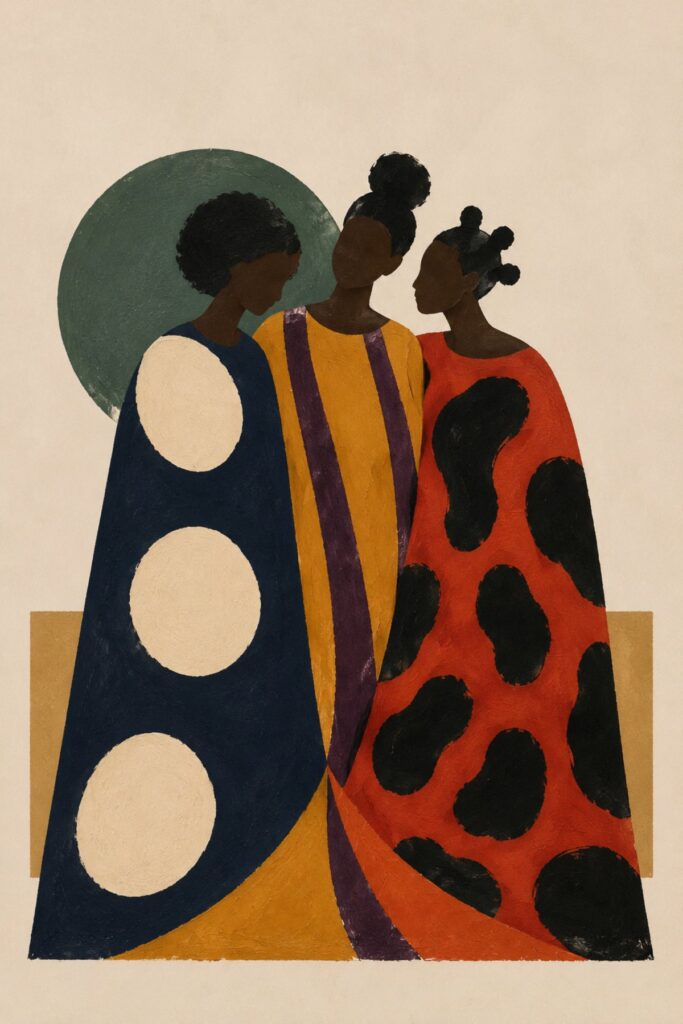
A styled coffee table looks finished when the wall above the sofa answers it. These three pieces from our collection pick up warm wood, cream and terracotta.


Frequently asked questions
What should I put on a coffee table?
Three to five objects that between them cover five jobs: an anchor (a stack of two or three large books, or a tray), something tall (a vase with stems, a candlestick, a sculptural piece), something textural (woven, carved, or unglazed), one object that means something to you personally, and empty space — roughly a third of the surface. If you have those five, the specific objects matter far less than most decorating advice suggests.
How many items should be on a coffee table?
Three to five for a standard table, and three for anything under about 90 centimetres. Group them in odd numbers, and make sure one object is clearly the largest so the eye has a starting point. If you are counting more than seven things, you are looking at clutter rather than a composition — remove the smallest items first, because small objects create visual noise out of proportion to their size.
How do I decorate a coffee table without making it look cluttered?
Contain and subtract. Put a tray down and rule that everything permanent lives inside it; anything that arrives during the day lives outside it and gets cleared each evening. Then photograph the table from standing height — the camera is much more honest than your eye — and remove objects until at least a third of the surface is visibly empty. Clutter is almost never caused by one big object; it is caused by four or five small ones.
How do I add Afrocentric decor to a modern living room?
Use three signals rather than a whole scheme: one cultural or artistic reference (usually the wall art — an Adinkra-inspired print, a Black woman portrait, an abstract Africa map), one tactile material (raffia, carved wood, mudcloth, unglazed terracotta, brass), and one intentional colour repeated two or three times at different scales, such as indigo, terracotta or ochre. That is enough to shift the atmosphere of a neutral room without turning it into a themed space, and it works in a rental because nothing structural changes.
Should coffee table decor match wall art?
It should not match — it should rhyme. Pull one element out of the artwork and repeat it on the table below: a colour, a material, or a shape. Terracotta in the print, a terracotta vessel on the table. Indigo in the print, a folded indigo cloth under the tray. Geometric artwork, angular objects rather than round ones. Matching everything exactly makes a room look like a catalogue page; one deliberate echo makes it look designed.
Related reading
- Afro-Boho Living Room Ideas — the full room, not just the table
- How to Style Afrocentric Wall Art — sizing, spacing and hanging heights above a sofa
- Afrocentric Home Decor Beyond Wall Art — textiles, objects and materials that carry the aesthetic
- Modern Cozy Living Room — how to warm up a room that feels too minimal
- Afro-Boho Colour Palette 2026 — exact colour codes that work with Afrocentric art
- Afro-Bohemian Decor 101 — the foundational formula behind the whole style
Closing
A coffee table is a small surface with a disproportionate job. It is the first thing you see from the doorway, the last thing you look at before you turn the lamp off, and the only place in a living room where you can say something specific about yourself without redecorating anything. That is why the formula ends with meaning and breathing room rather than with a shopping list.
Start with what you own. Clear the table completely, then put back only five things: the anchor, the tall thing, the textural thing, the object with a story, and nothing else. Live with it for a week. If the room still feels unfinished, the missing signal is almost always on the wall rather than on the table — and the fastest, least expensive fix is a printable set you can size to your own space. The Earth Tone Africa Map & Botanical Set of 3 was designed for exactly this room: warm terracotta and cream, quiet enough for a neutral scheme, specific enough that the room finally sounds like you.
Shop the Essence of the Road Art collection
- Essence of the Road Art on Etsy — the full printable collection
- Earth Tone Africa Map & Botanical Set (3) — the terracotta set this article is built around
- Black Woman Silhouette Prints, Set of 3 — quiet, neutral, works above any sofa
- Adinkra Symbol Wall Art Set (5) — the cultural signal in a single purchase
- Indigo Afrocentric Wall Art Bundle (18) — a year of indigo rotation
- Baobab Tree of Life Print — warm, symbolic, earth-tone
- Ready-to-hang canvas and framed prints on Fine Art America — if you would rather not print and frame it yourself