DIY Sankofa Wall Art: Print, Frame & Hang in One Afternoon
By Essence of the Road Art · Published July 2026
DIY Sankofa wall art is the fastest way to bring a meaningful Adinkra symbol into your home — download a 300 DPI Sankofa printable, print it on warm cream cardstock at home or at a local print shop, frame it in thin oak or matte black, and hang it at eye level. The whole project takes one afternoon, costs under $25, and produces a piece that carries the Akan meaning “go back and fetch what you have forgotten.”
Quick answer: Start with our free Sankofa print — a 300 DPI, 3:4 ratio file sent straight to your inbox that frames cleanly at 9×12, 12×16, 15×20 or 18×24 inches. Print it on 65 lb warm cream cardstock (home inkjet or $3–7 at a print shop), slide it into a thin oak or matte-black frame, and hang it with its center 57–60 inches from the floor. Total cost with a new frame: under $25.
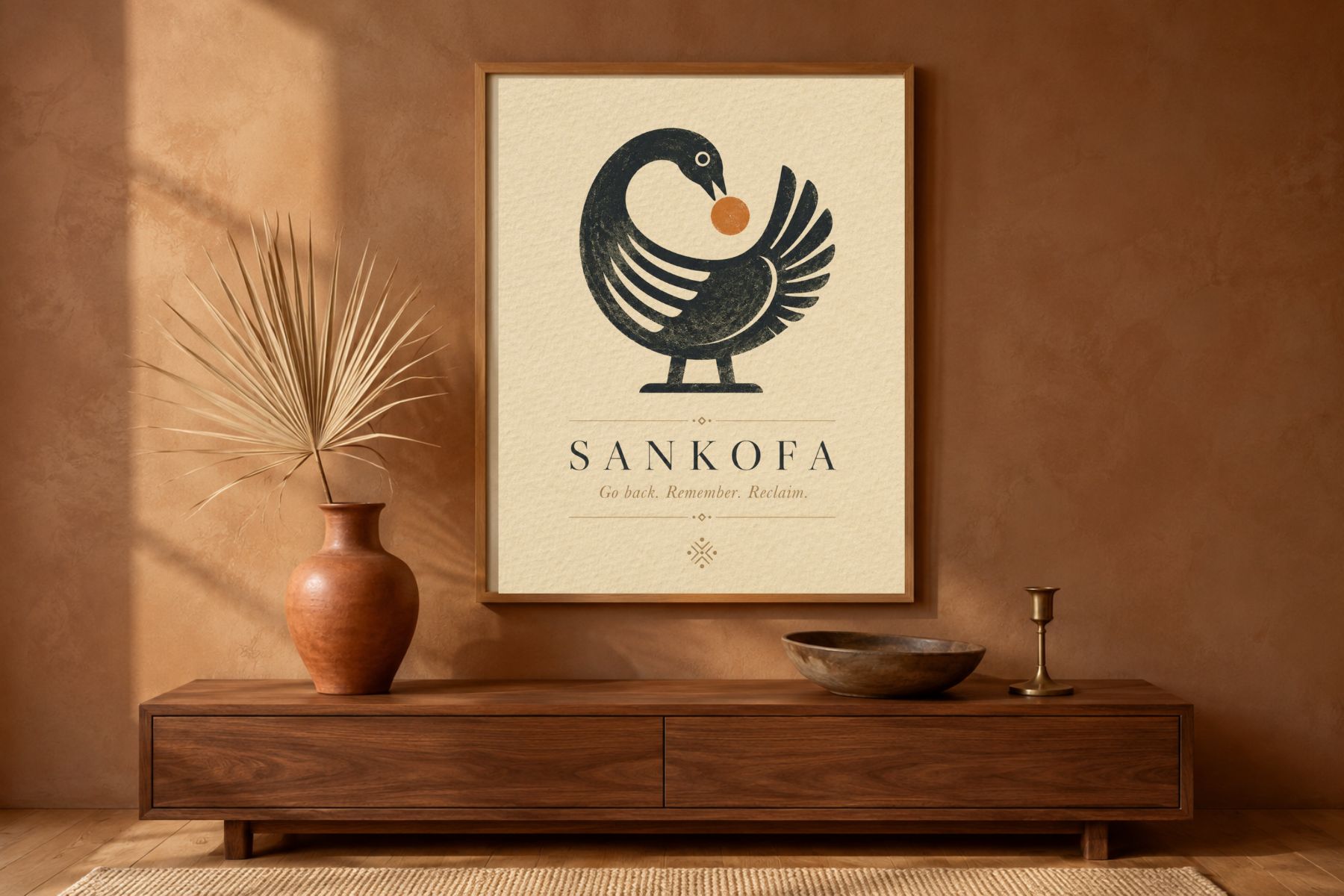
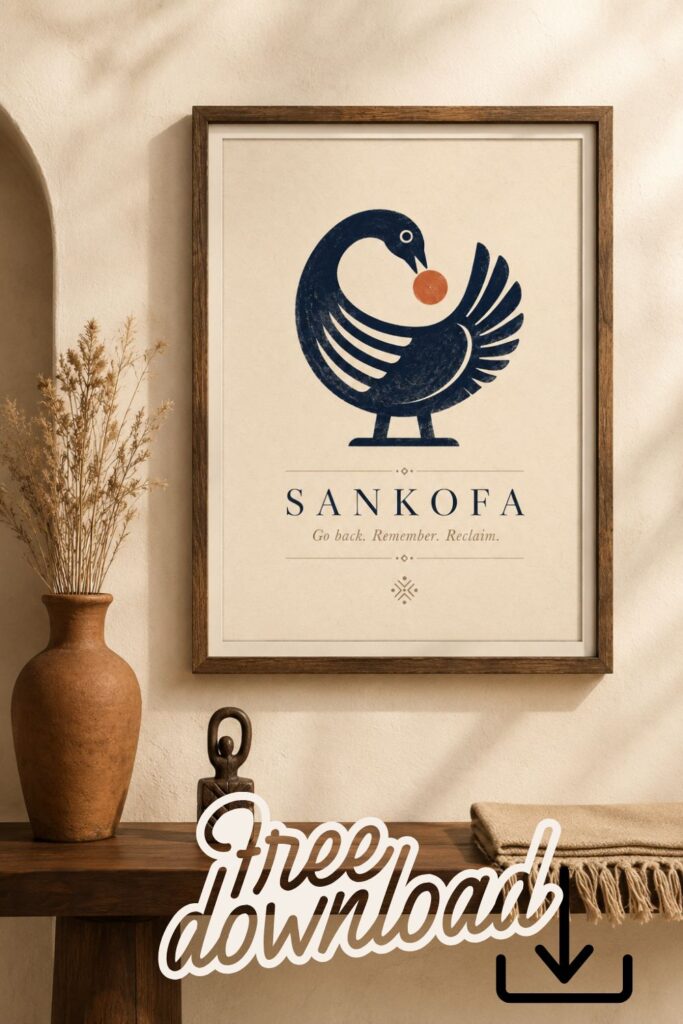
Sankofa is one of the most recognised Adinkra symbols from Ghana — a bird looking backward over its body, often holding a small egg in its beak. The meaning is gentle and exact: there is no shame in returning for what was left behind. For most homes this is exactly the kind of art worth living with — soulful, culturally rooted, and visually quiet enough to stay on the wall for years. This tutorial walks through every step, every material, and every mistake we have made so you don’t have to.
Table of Contents
What Sankofa actually means (the short version)
The symbol comes from the Akan people of Ghana, part of the Adinkra system of visual proverbs traditionally stamped onto ceremonial cloth. The word breaks into san (return), ko (go), fa (fetch): “go back and get it.” The bird’s body faces forward — progress — while the head turns back to retrieve an egg: knowledge, memory, the generations behind you.
It is not a symbol of nostalgia. It is a symbol of repair — the discipline of returning for what was forgotten rather than pretending it was never lost. That is why it works as daily wall art in a way trend-driven prints don’t: the meaning renews instead of dating. We tell the full story — the origin, the myths, the diaspora journey — on the free Sankofa print page, and the wider symbol system it belongs to is covered in our 12 Adinkra symbols guide. Here, the focus is the making.
From Ghana to your wall: why this symbol travels
Part of what makes Sankofa the right first DIY piece is how far the symbol has already traveled. Adinkra symbols were stamped onto cloth for Akan ceremonies; when the transatlantic slave trade scattered West African peoples across the Americas, most physical objects were lost — but symbols survive in memory where objects can’t. Sankofa crossed the ocean as an idea, and it resurfaced everywhere the diaspora rebuilt: in quilt patterns, in ironwork (the gates of some historic Black neighborhoods in the American South carry it), in university logos, in tattoos, and — most relevantly here — on the walls of homes where “go back and fetch it” is not an abstraction but a family instruction.
That is why a printed Sankofa behaves differently from decor-store art. Hang a generic abstract and the wall is styled; hang Sankofa and the wall says something — about memory, about repair, about honoring what came before. It also explains the symbol’s quiet surge every February: Black History Month displays reach for Sankofa first because no other single image summarizes the assignment as cleanly. If you print one piece this year, print it before February and let it stay.
What you need (under $25, one trip)
The printable. Our free Sankofa print was built for exactly this tutorial — 300 DPI, warm cream tone, 3:4 ratio, with the proverb and translation printed on the file. Join the list and it arrives in your inbox along with a welcome discount code for anything else in the shop. Download once, reuse at any size up to the source resolution.
The paper. Warm cream or natural-white cardstock, 65 lb (176 gsm) or heavier. This is the decision that separates “art print” from “office printout” — bright white paper reads cold and corporate under the black symbol, while warm cream gives it the cloth-like quietness the symbol traditionally lived on. A pack of 65 lb cream cardstock costs $10–14 and covers years of reprints and gifts.
The frame. Thin natural oak or matte black, in the size you printed. 12×16 is the most flexible default; 9×12 suits smaller walls and desks. A thin oak 12×16 frame runs $15–25; thrift stores regularly turn up solid wood frames for $3–8 that only need the old print removed.
The hanging hardware. A single picture nail if you can drill, or Command picture-hanging strips if you rent — they hold a 12×16 frame without complaint and leave no mark.
Step-by-step: the one-afternoon build
Step 1 — Download. Get the free Sankofa printable and save it somewhere you will find again — a “Printables” folder pays for itself the day you want a second copy for a gift.
Step 2 — Print. Two routes, both good:
At home: use an inkjet if you have one — inkjets lay warmer, richer blacks on cardstock than laser printers. Set print quality to “best,” media type to “cardstock” or “heavy matte,” and print a draft on ordinary paper first to check the crop. The most common home-printing failure is letting the printer “fit to page” and shave the margins — set scale to 100% instead.
At a print shop: FedEx Office, Staples, or an independent shop will print a single 12×16 on premium matte stock for $3–7. Two sentences to say at the counter: “300 DPI file, print at 100% scale on your warmest matte cardstock — no gloss.” Gloss is the enemy here; it turns the symbol’s matte dignity into a poster.
Step 3 — Frame. Clean the frame glass on both sides (one fingerprint inside the glass will haunt you), center the print, and make sure it sits perfectly flat against the backing — any curl shows as a shadow within weeks. If the print is smaller than the frame, add a cream mat rather than floating it loose; an 8×10 print matted into an 11×14 frame looks deliberate and gallery-finished.
Step 4 — Hang. Find the wall your eye lands on when you enter the room. Hang the print so its center sits 57–60 inches from the floor — the gallery standard that survives every trend. Step back to the doorway, look, adjust once, and stop adjusting.
If you want to see the result before you commit to a wall, generate a mockup of your actual room first — our 30 paste-ready AI prompts for afrocentric room mockups include a framed-symbol scene you can adapt in one line.
Where to hang Sankofa for the most meaning
Above the desk if you want the reminder during working hours — Sankofa reads differently at 3 p.m. on a hard day than any motivational poster ever will. Above the bed if you want the symbol present at the edges of the day, first thing seen and last. In the entryway if you want the meaning to greet you — and everyone who visits — at the threshold. In a child’s room, Sankofa quietly does what a lecture can’t: it normalizes going back to fix what went wrong.
There is no wrong wall. Sankofa was always a household symbol — stamped into cloth, carved into stools, painted onto pottery — never a museum piece. The only real rule is light: hang it where daylight or a warm lamp reaches it, because the cream paper comes alive in warm light and goes flat in shadow.
Styling the wall around it: the console recipe
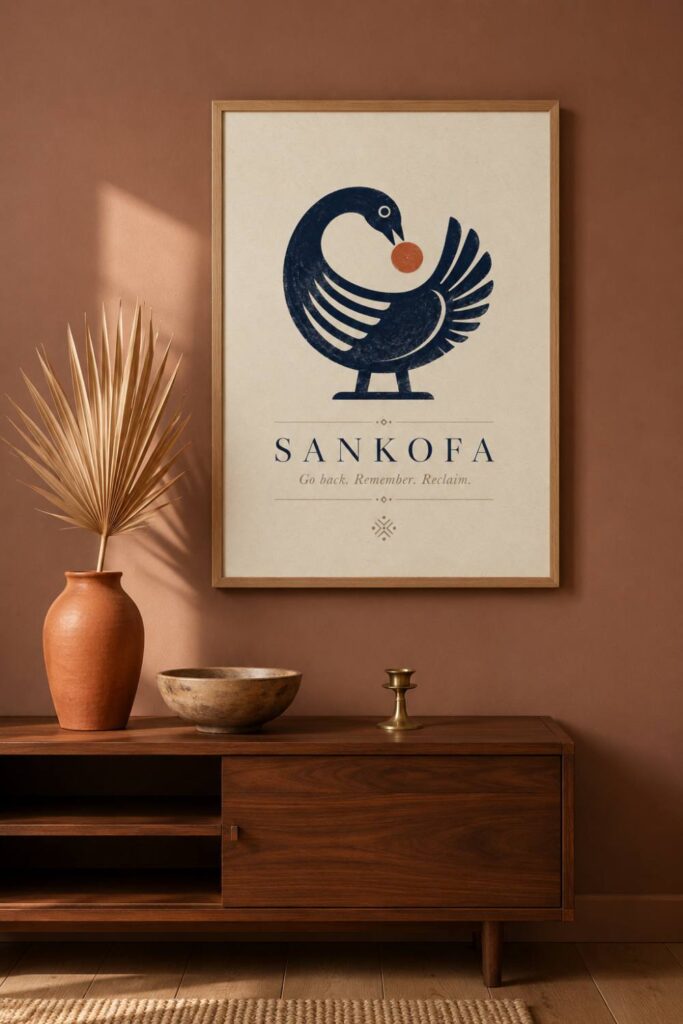
The fastest way to make one print look curated rather than lonely is the console recipe, and it works under any framed Sankofa within an hour.
Start with the surface below the print — a console, dresser, low shelf or desk. Place three objects in a loose triangle: something tall on one side (a terracotta vase with a dried palm frond or pampas stem), something low and round in the middle distance (a hand-thrown clay bowl, which can hold keys and quietly echo the shell-and-clay materials Adinkra cloth was stamped beside), and something small with shine (a brass candle holder or small brass dish) to pick up warm light. Leave at least a third of the surface empty — the emptiness is doing design work.
Then check the light. A warm-white bulb (2700K) in a nearby lamp changes the cream paper from “printed this morning” to “has always lived here.” If the print hangs in a hallway or above a desk, a small battery picture light is a $20 upgrade that makes a $25 DIY piece read like a gallery purchase.
What not to add: a second symbol crowded six inches away (give each proverb its own breathing room), word-art or quote prints in the same sightline (they compete with a symbol that is already a sentence), and anything glossy directly beside the matte print.
The gift version
A framed Sankofa is one of the best-kept secrets in meaningful gifting, because the proverb fits nearly every threshold moment. For a graduation: go back and fetch what you learned. For a housewarming: bring what mattered into the new place — it slots naturally into the ideas in our Afrocentric housewarming gift guide. For a friend rebuilding after a hard season, it says what a card can’t.
The build is identical to the tutorial above — print, cream cardstock, thin oak frame — and lands under $25 where a comparable framed print ships for $60+. Print a small card with the proverb and its translation for the back of the frame; the moment the recipient reads it is the gift.
What the whole project costs
The free printable costs an email address. Cardstock: $10–14 for a pack that yields twenty prints. Frame: $15–25 new, $3–8 thrifted. Print-shop route instead of home printing: $3–7 per print. Hanging strips: about $1 per frame from a multi-pack. First build lands at $16–40 depending on the frame; every print after that — gifts, second rooms, size upgrades — costs under $5, which is the quiet economic argument for printable art generally: you are buying the design once and the object at cost, forever. It’s the same logic behind every printable in the shop, just demonstrated here for free.
Growing it into a gallery wall
One framed symbol is a complete piece. But Sankofa also works as the anchor of something larger, and this is where most readers go next.
The classic build is the five-symbol Adinkra wall: Sankofa plus Gye Nyame, Dwennimmen, Nyansapo and Mate Masie — five proverbs, one visual language, one palette. Our Adinkra Symbol Wall Art Set of 5 was designed exactly for this, in the same warm-cream-and-black language as the free print, and the step-by-step 5-piece gallery wall guide covers the layout, spacing and hanging order.
If you’d rather mix than multiply, Sankofa pairs beautifully with one abstract Africa map in earth tones — symbol and continent, meaning and geography — or with a neutral botanical trio for a softer, layered wall. Keep every frame in the same family (all thin oak, or all matte black) and let the art vary instead.
For the difference between Adinkra and the other great West African pattern systems — kente’s woven color, mudcloth’s painted geometry — our African motifs explained guide is the natural next read.
Five common mistakes to avoid
1. Printing at the wrong DPI. A 72 DPI image pulled off social media will pixelate at 12×16. Use the 300 DPI source file only — this is non-negotiable and the reason the free download exists.
2. Bright white paper. Reads as office printout. Warm cream or natural white, always.
3. Wrong scale for the wall. A 5×7 Sankofa floating alone above a sofa reads as an afterthought. Default to 12×16 or larger above any console, bed or desk; save the small sizes for shelves and desks.
4. Glossy finish. Gloss turns a contemplative symbol into a poster and throws reflections across the black ink. Matte, every time.
5. Hanging too high. The most common hanging error in every home. Center at 57–60 inches — which is lower than most people’s instinct — and the piece joins the room instead of supervising it.
Frequently asked questions
Is it disrespectful to DIY a sacred symbol like Sankofa?
No — Sankofa was always meant to be a household and craft symbol, stamped onto cloth, carved into stools, woven into baskets. Printing it thoughtfully and displaying it in your home is consistent with how the Akan have used it for centuries. What matters is knowing what it means, sourcing the file from a culturally aware designer rather than a generic stock site, and treating the piece as more than decoration.
What size should the Sankofa print be?
12×16 inches is the most flexible default — large enough to read from across the room, small enough for most consoles, desks and beds. For a feature wall or above a sofa, scale to 18×24. The free file’s 3:4 ratio frames cleanly at 9×12, 12×16, 15×20 and 18×24 without cropping.
Can I print Sankofa on canvas or wood?
Yes — both are traditional substrates for Adinkra symbols. Local print shops offer 12×16 canvas prints for $25–50 (ask for matte finish). For wood, print onto transfer paper at home, or commission a local woodworker to laser-engrave the symbol onto reclaimed wood — usually under $80 and a genuine heirloom.
Is the free print really free? What’s the catch?
You trade your email address: the file arrives in your inbox along with one welcome email containing a discount code for the shop. Unsubscribe anytime. The print is for personal use — gift copies are fine, resale is not.
I’m outside the US — does the file work with A4 and A3 paper?
Yes. The file’s 3:4 ratio doesn’t match A-series paper exactly (A4 is 1:1.414), so print at 100% scale onto the larger sheet and trim the even border, or frame with a mat that absorbs the difference. A4 comfortably carries the 9×12 size; A3 carries 12×16. Never let the print dialog stretch the file to “fill” the page — the symbol’s proportions are the design.
How do I keep the print from fading?
Keep it out of direct sunlight — pigment inkjet prints and shop-printed matte stock hold color for years on a normal wall, but a south-facing window in full sun will pale any paper print in a season. If the only wall you love is a bright one, this is the argument for the canvas or engraved-wood version, or simply reprint each year — with a downloaded file, replacement costs pocket change, which framed store art can never say.
Are there other Adinkra symbols I should know?
Gye Nyame (the supremacy of God), Dwennimmen (strength in humility), Nyansapo (the wisdom knot) and Mate Masie (“what I hear, I keep”) are the most loved. Each carries its own proverb and visual signature — all twelve are covered in our Adinkra symbols guide.
Related reading
- 12 Adinkra Symbols & Their Meanings: The Symbolism in African Art — Ghana
- Adinkra 5-Piece Gallery Wall: How to Build One at Home
- African Motifs Explained: Adinkra, Kente, and Mudcloth
- DIY Printable African Wall Art: Free Templates Guide
- How to Set Up a Gallery Wall — Print, Frame, Hang & Light
One afternoon, one symbol, one wall
Sankofa is one of the few symbols small enough to print at home and large enough in meaning to carry a whole wall. Print it once, frame it well, hang it where you will see it every day, and live with it for a season before adding anything else. If it earns its place — and it will — the five-piece Adinkra set is waiting when the wall asks for company.
Start here: get the free Sankofa print — 12×16, 300 DPI, warm cream, in your inbox in a minute.