Global Decor Trends 2026: A Pinterest Data Analysis
By Essence of the Road Art · Published May 2026
This article contains affiliate links. If you buy through our links, we may earn a small commission at no extra cost to you. We only recommend pieces we’d style in our own homes. As an Amazon Associate I earn from qualifying purchases.
Why we wrote about this
Most decor trend articles are written from the gut. Someone notices a shift, declares a trend, and moves on. That works for fashion but it does not work for interiors, where investment pieces are supposed to last a decade and palettes are supposed to outlive the seasons.
So we did something different this time. We pulled actual Pinterest search data on four of the most-discussed culturally-rooted decor categories, looked at how they have moved across the past two years, and tried to read the patterns honestly — including the ones that contradicted what we expected to find.
Some of what the data shows is what you would expect. Some of it is a genuine surprise. And one finding, in particular, runs counter to almost every decor article currently being published online.
This is what we found, what we think it means, and what we are watching for next.
📌 Quick Answer
Pinterest data from April 2024 through April 2026 shows a divided picture in global decor. Mexican wall art is in a strong, durable rise (currently scoring 75-85 of 100 on Pinterest’s interest scale). Afrobohemian home decor had a sharp peak in summer 2025 and has since cooled to a low baseline. Moroccan decor — the dominant cultural-decor trend of the previous decade — has been steadily declining for 18 months and is now at near-historic lows. Mid-century modern interiors are surging back as the dominant overall aesthetic. The unifying thread is not a single “warm earthy global” movement, but a broader move away from cool grey minimalism toward interiors with more warmth, more texture, and more cultural specificity. Afrocentric wall art remains a quietly durable category, less subject to the volatility seen in Moroccan or Afrobohemian trends.
Table of Contents
The headline finding: Moroccan is no longer the dominant global decor trend
This is the part of the data that surprised us most, and it is the finding we have not seen any other decor blog write about honestly yet.
For the past decade, Moroccan-inspired interiors have been one of the defining global decor stories. The terracotta walls. The patterned tilework. The carved wooden screens. The lantern-shaped pendants. If you have read decor magazines or Pinterest boards anytime since 2015, Moroccan style has been treated as a permanent fixture of the warm-toned aesthetic vocabulary.
That is no longer true.
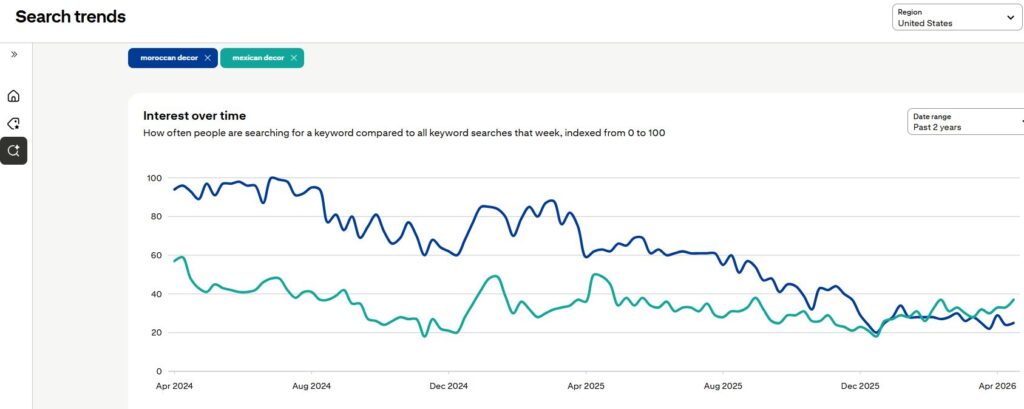
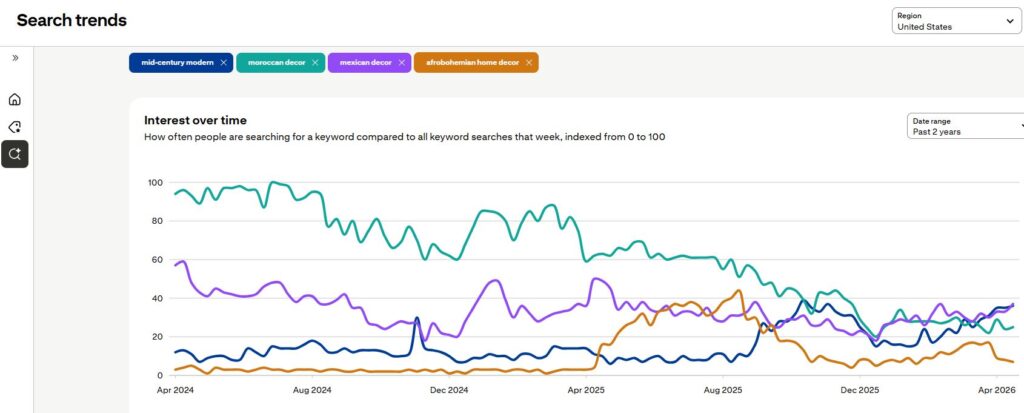
The chart above shows Pinterest US search interest for “moroccan decor” (in blue) compared to “mexican decor” (in teal) over the past two years. The pattern is unambiguous. Moroccan decor began the period scoring nearly 95 out of 100 on Pinterest’s interest index. By spring 2026 it had fallen to roughly 25 — a decline of more than 70% in measured search interest. The drop is gradual but persistent. There is no anomaly, no single cause; it is the look of a trend slowly losing the cultural moment.
This matters because most decor advice currently being published online still treats Moroccan as a current trend rather than a fading one. Bloggers are still recommending Moroccan-inspired bathrooms, Moroccan-style living rooms, Moroccan tile backsplashes — without noting that the audience for that content is shrinking.
We are not saying Moroccan decor is bad, or that no one should style it. Beautiful design does not become ugly because Pinterest cools on it. What we are saying is more practical: if you are choosing where to invest your time, your money, or your styling effort right now, you should know that the Moroccan-decor train has already left the station of peak attention. Other things are arriving.
The rising thread: Mexican wall art has come back
While Moroccan has been falling, a different cultural decor category has been quietly climbing.
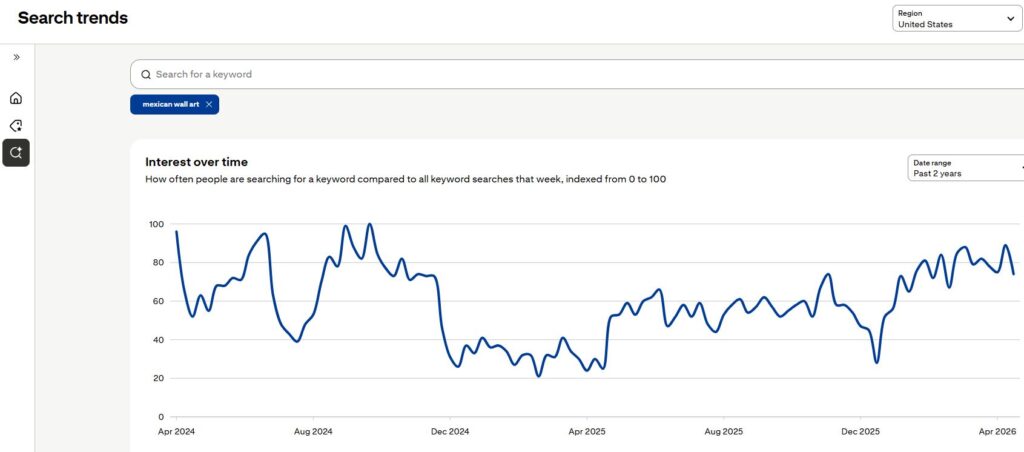
“Mexican wall art” started high (around 95) in April 2024, dipped substantially in late 2024, and has now climbed back to near-peak interest as of spring 2026 — currently sitting in the 75-85 range and trending upward.
This is a different shape than the Moroccan decline. Mexican wall art shows volatility, but the recent eighteen months have been characterised by a clear recovery. The audience for terracotta-walled interiors, talavera-tile inspired pieces, papel picado-influenced art, and Otomí-style embroidered prints is rebuilding.
We will not pretend to know exactly why. Some plausible factors:
- The general move away from cool minimalism (which we will return to below) has reopened the door to warm, saturated, hand-crafted aesthetics. Mexican decor delivers that vocabulary natively.
- Pinterest’s algorithm has been rewarding visually rich, color-saturated content over the past year, and Mexican folk art photographs beautifully on a feed.
- Cultural specificity is back in fashion. Generic “boho” content is fading. Specific, named cultural traditions are rising. Mexican is one of those traditions.
What is interesting — and worth noting carefully — is that “Mexican home decor” as a broader search term is essentially flat in the data. It is “mexican wall art” specifically that is rising. The audience is searching for wall pieces, not whole-room aesthetics. That tells us something about how the trend is being adopted: as accent rather than as full lifestyle commitment.
The brief moment: Afrobohemian peaked, then cooled
This part of the data is its own kind of cautionary tale.
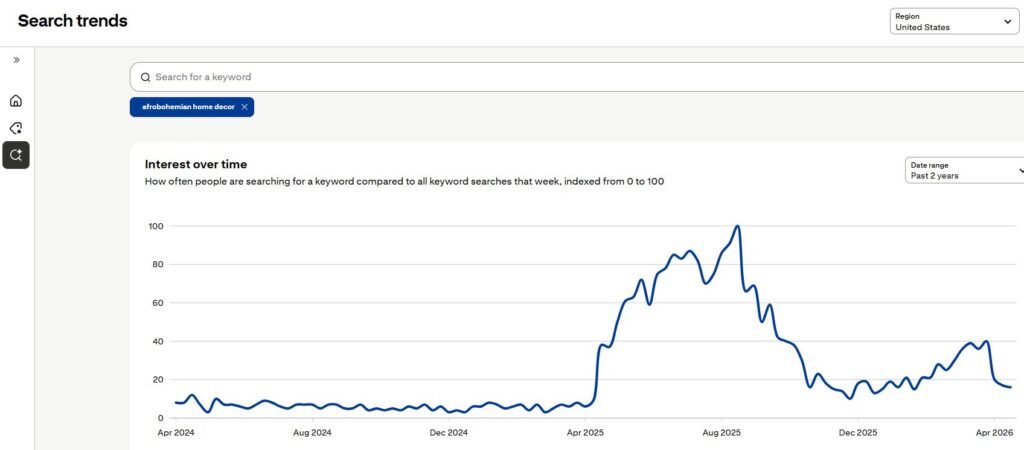
“Afrobohemian home decor” did not exist as a measurable Pinterest search term for most of 2024. It hovered near zero throughout that year. Then, beginning in April 2025, it suddenly took off — climbing to a peak of roughly 45 by late summer 2025.
And then it came back down. Hard. By spring 2026, the term has cooled to roughly 10 — barely above where it started.
This is the shape of a fast-cycle trend. Something — a viral pin, a notable account, a single design publication — likely catalysed Afrobohemian as a search term. People investigated. The term spread. Then it cooled.
This does not mean Afrobohemian style is over. The aesthetic — warm earth tones, layered textiles, Afrocentric wall art, plant-rich interiors — is still very much being practiced and loved. What is over is the specific search term being used to find it.
For anyone styling a home: the underlying aesthetic is alive. The label is fading.
The bigger story underneath: mid-century modern is roaring back
The most striking finding in our data set is also the one we did not initially expect to feature in this article. We will keep it brief because it is not the focus, but it changes the frame on everything else.
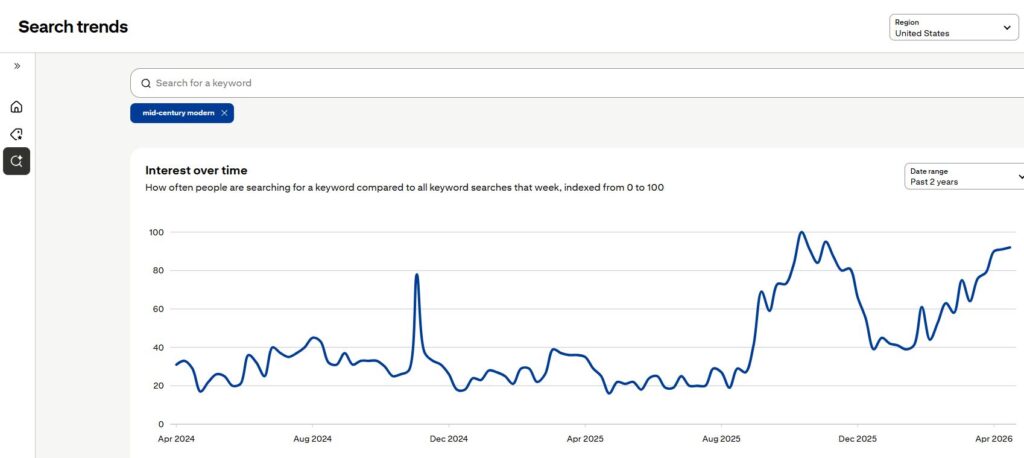
Search interest in “mid century modern” has been climbing aggressively for the past eighteen months. The trend dwarfs both Mexican wall art and Afrobohemian in absolute volume of attention.
This matters for two reasons.
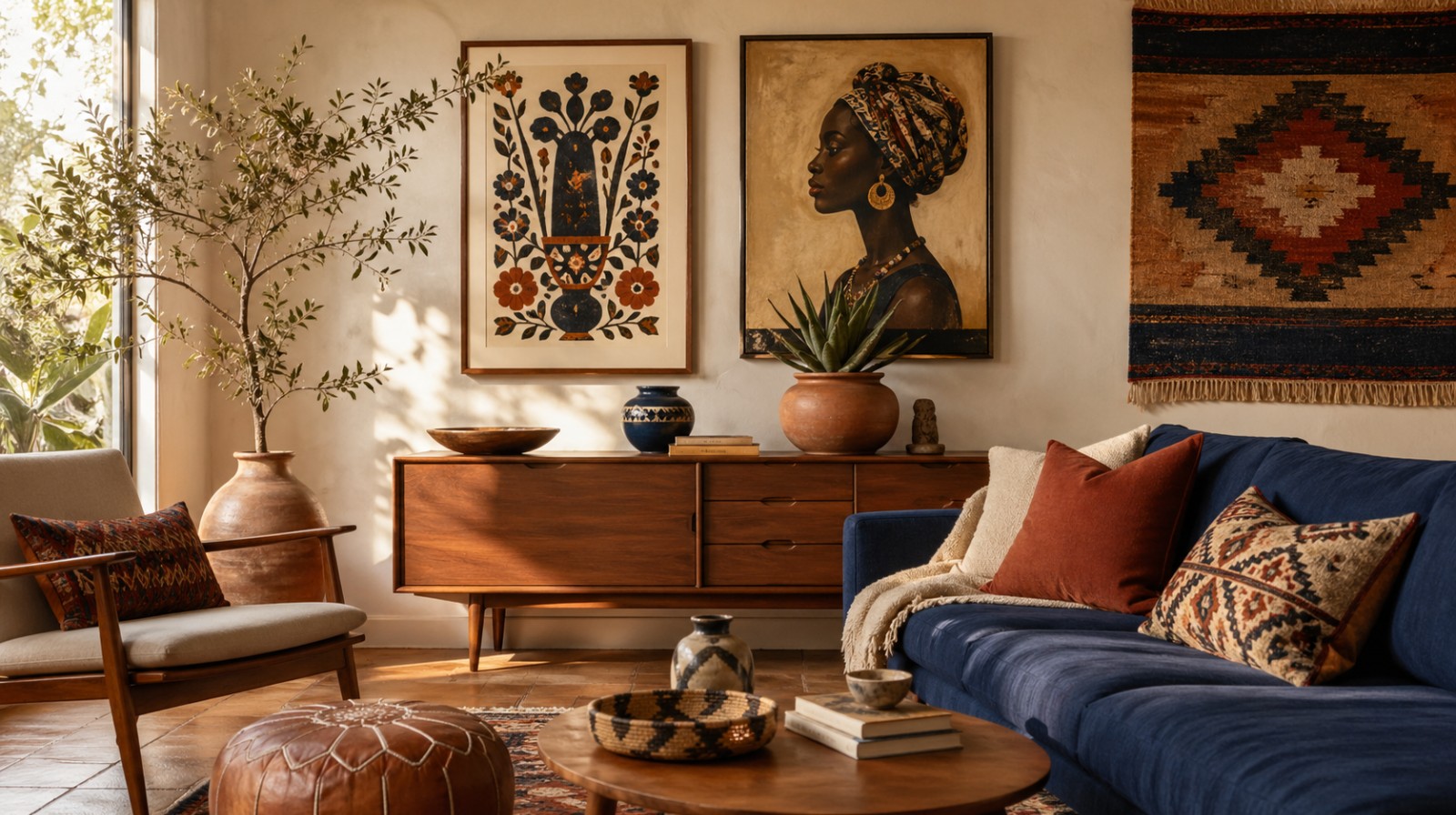
First, it tells us what people are actually putting in their living rooms. The container is mid-century modern — clean lines, walnut wood, warm leather, Knoll-style sofas. Inside that container, people are increasingly placing global, culturally-rooted accent pieces.
Second, it explains why the Mexican / Afrocentric / Afrobohemian palette is rising while Moroccan is falling. Moroccan style requires the room to be Moroccan. Tile backsplashes, lantern pendants, carved screens — these elements transform an entire space into a single aesthetic. Mexican wall art, Afrocentric portraits, woven baskets, indigo prints — these are pieces that layer into a mid-century modern room without taking it over.
The trend is not toward whole-room cultural lifestyle. The trend is toward warm, specific, layered cultural accents in a structurally modernist container.
That is a more nuanced — and more durable — story than “earthy global is in.” It explains the rise of certain pieces and the fall of others. It tells you, practically, what is going to age well over the next five years.
So is there a unified trend, or not?
Here is the honest answer: yes and no.
There is not a single unified earthy global decor movement, in the sense that all warm cultural aesthetics are rising together. The data clearly shows that Moroccan is falling while Mexican is rising, that Afrobohemian peaked and cooled, and that Afrocentric (which we will get to) sits in a steadier position.
But there is a unifying movement underneath the individual searches: the broader move away from cool grey minimalism and toward warmer, more layered, more culturally-specific interiors. That movement is real. It is durable. It is showing up in mid-century modern’s resurgence, in Mexican wall art’s recovery, in Afrocentric’s quiet steadiness, and even — paradoxically — in the rapid rise-and-fall of Afrobohemian as a search term. People are looking. They are trying labels. Some labels stick. Most do not.
What stays the same underneath the labels is the desire. Warmer rooms. Pieces with cultural depth. Materials that feel made by hand. Color palettes that hold ochre, terracotta, indigo, charcoal, cream, and warm wood.
That, more than any single search term, is the trend.
What the data quietly says about Afrocentric decor
We have to be transparent here, because Afrocentric wall art is what we make and the rest of this article is about other people’s traditions.
Afrocentric wall art and Afrocentric decor have not seen the dramatic spikes that Mexican wall art saw in 2025, or the sharp peaks that Afrobohemian briefly experienced. They also have not seen the steady decline that Moroccan has experienced. The pattern is quieter: a steady, durable presence in the data, slowly building rather than spiking.
In trend terms, this is actually the most desirable shape. Spike-and-crash trends are difficult for businesses, content creators, and homeowners alike. By the time you have invested in a fast-rising aesthetic, the audience is already moving on. Steady rises are more useful: they let you build, learn, refine, and grow with the audience rather than chasing it.
We mention this not to argue that Afrocentric is “winning” — that framing misses the point — but to note that durable trends are quieter than viral ones. Mexican wall art is having a moment now. Whether that moment proves durable or whether it follows the Afrobohemian shape (sharp peak, fast cool-down) is something only the next twelve months of data will tell us.
If you are a home decorator betting on what to invest in: durability matters more than peak interest.
What this means for choosing wall art in 2026
We will keep this section practical. Five takeaways from reading this data carefully.
1. If you are committing to a single cultural-aesthetic direction, choose one with steady momentum rather than a spike. Mexican wall art is rising — that is real. But its volatility over the past two years is meaningful. Afrocentric is quieter and more durable. Moroccan is past its moment. Choose accordingly.
2. Layer cultural accents into a modernist container, not the other way around. The data on mid-century modern’s surge is a hint here. A clean structural room with one or two thoughtful cultural accent pieces — a Mexican textile, an Afrocentric portrait, a Moroccan lantern even — works better than a single-aesthetic-themed room.
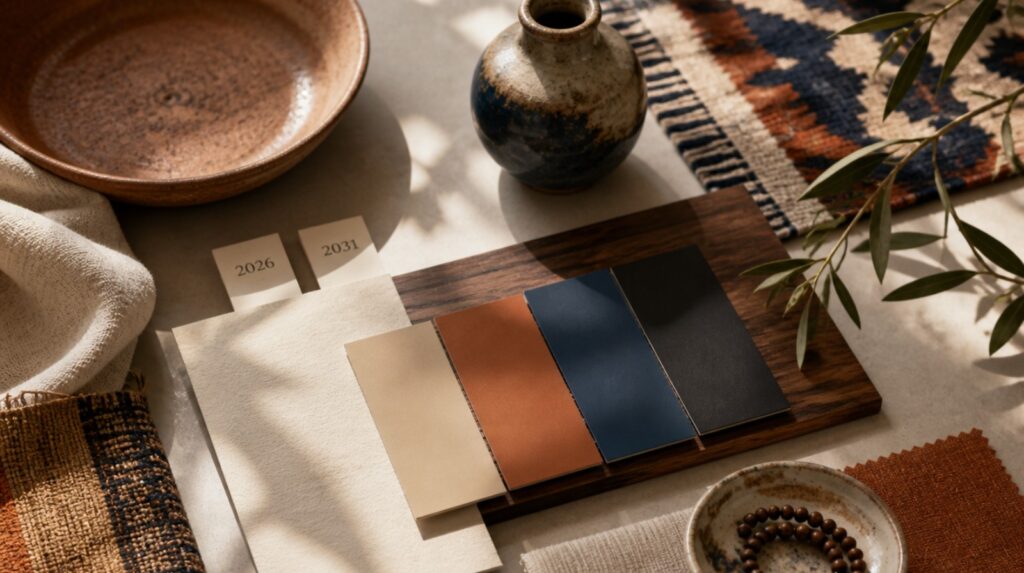
3. Invest in the palette, not the trend label. Trend labels move fast. Palettes age slowly. The terracotta, ochre, indigo, charcoal, cream, warm wood family will look right in 2026 and in 2031, regardless of which specific cultural reference is most fashionable that year.
4. Buy from sources that respect the tradition. This applies to all of these aesthetics. Mass-produced “Mexican-inspired” wall art from a print-on-demand factory is not the same as a piece from an artist who knows the cultural history. Same for Afrocentric. Same for Moroccan. Origin matters; not just for ethics, but for the piece holding up over time.
5. Trust the steady aesthetic over the viral one. Afrobohemian’s sharp rise and equally sharp fall is the lesson of this entire data set. Things that rise on a viral wave usually fall on the same wave’s recession. Things that build slowly tend to last.
What we are watching for next
Three questions we will be tracking through 2026 and into 2027:
- Does Mexican wall art’s rise prove durable, or does it follow the Afrobohemian shape? The next six months will tell us. If the trend holds at 70-85 through summer 2026, it is real. If it dips below 40 by autumn, it was a peak.
- Does mid-century modern’s surge fully replace the Scandinavian minimalist aesthetic that dominated 2018-2024? Right now, mid-century modern is rising fast — but Scandinavian minimalism still has dedicated audiences. The interplay matters.
- Does the broader move toward cultural specificity continue, or does generic “boho” reassert itself? Pinterest occasionally cycles back to less-specific terms. We are watching for whether “boho” or “globally-inspired” makes a comeback — which would be a step backwards in our view, but it is worth tracking.
We will revisit this analysis in autumn 2026 with fresh data. The point of writing this piece is not to make permanent predictions; it is to read the moment carefully so we can all make better decisions about what to do with our walls.
FAQ
Is Moroccan decor really declining, or is the data misleading?
The decline is real and consistent across multiple related search terms. “Moroccan decor,” “moroccan interior design,” “moroccan tiles,” and “moroccan living room” all show similar downward trajectories on Pinterest US over the past 18 months. This is not a one-search anomaly. That said, regional variations exist; Moroccan decor remains stronger in European Pinterest data and in luxury hospitality contexts. The trend is most clearly fading in the US residential market, which is the audience this article addresses.
Why is Mexican wall art rising specifically, and not Mexican home decor more broadly?
Wall art is a low-commitment way to incorporate a cultural aesthetic into an existing room. You can hang a Mexican-inspired piece without redoing tiles or repainting walls. The fact that “mexican home decor” stays flat while “mexican wall art” rises tells us that adoption is happening at the accent level, not at the lifestyle commitment level. This is consistent with what we see across all the cultural aesthetics in the data: people are layering, not reorienting whole rooms.
Should I avoid Moroccan-style pieces I already own because the trend is fading?
Absolutely not. A piece does not become beautiful or ugly based on Pinterest search volume. The question for existing decor is whether you love it, whether it has cultural and material integrity, and whether it works in the room. Trend data is most useful for new purchasing decisions and content creation choices, not for editing what you already have. Many of the most beautiful homes deliberately ignore prevailing trends.
Where does Afrocentric wall art fit into the current landscape?
Afrocentric wall art occupies a quieter, more durable position in the data. It does not show the sharp rises and falls that other categories do. This is consistent with the broader “warm cultural depth” movement that is replacing cool minimalism. Afrocentric pieces — particularly portraits, abstract continent art, and indigo-toned editorial work — sit naturally within mid-century modern interiors and within layered earthy palettes, which gives them placement flexibility across multiple aesthetic directions.
What palette should I invest in if I want my decor to look intentional in five years?
Earth tones with depth: terracotta, ochre, indigo, charcoal, cream, walnut and warm oak. These colors have shown durability across multiple trend cycles because they reference natural materials (clay, dye plants, wood, raw cotton) rather than fashion seasons. Within that palette, mix two warm notes for every cool note, and let texture do as much work as color. A jute rug, a linen throw, a clay vessel, a wood frame — these read as intentional regardless of the current trending cultural reference.
Read more about Afro-Boho Color Palette 2026.
A closing note on reading trend data carefully
Pinterest search data is one signal, not the truth. It captures attention, not adoption. People search for things they are curious about; they buy and install only a fraction of what they search. The relationship between rising searches and actual decor adoption is real but loose.
What this kind of data is most useful for is what not to do. It can tell you when a trend has clearly cooled — as it has done with Moroccan decor and as it briefly did with Afrobohemian. That signal is more reliable than any rising signal, because trend rises are noisy and trend falls are quiet but persistent.
We wrote this article because we think most decor advice is too confident about the present and too confident about the future. The honest read is that 2026 is a transitional moment in global decor: the old dominant aesthetic (Moroccan) is fading, several new candidates are competing to fill the space (Mexican is the strongest), and the structural container most people are putting these pieces inside (mid-century modern) is itself shifting.
What lasts through transitional moments is taste rather than trend. The home you are building over the next decade should be built around pieces and palettes you genuinely love — informed by, but not enslaved to, the data. That is the only durable strategy we know.
“The eye sees only what the mind is prepared to comprehend.” — Henri Bergson
We would add: which is exactly why looking carefully at the data, before forming an opinion about what is trending, is the discipline that separates good decor advice from confident-sounding noise.
Data source: Pinterest Trends
Region: US
Time period: April 2024–April 2026
Search terms tested: “moroccan decor,” "mexican decor," “mexican wall art,” "afrobohemian home decor," "mid-century modern".
Note: Pinterest trend scores are relative interest indexes, not absolute search volume or sales data.
Link: Pinterest
Also read:
- Afrocentric Home Decor Beyond Wall Art: 9 Everyday Pieces That Carry the Same Design
- 15 Mudcloth Pillows for Modern Homes: A Curated Buying Guide
- Modern Cozy Living Room: Warm Afro-Neutral Wall Art That Grounds the Space
- Black Thanksgiving Decor: An Ancestral Harvest Table and Wall

- Dining Room Decoration Ideas: An Afrocentric Gallery Wall Above the Sideboard
- Fall Bedroom Decor Ideas: An Afro-Boho Gallery Wall Above Your Bed
- AI Prompts for Afrocentric Room Mockups: 30 Paste-Ready Prompts
- Sankofa Symbol Meaning: The Akan Proverb Behind the Bird