12 Adinkra Symbols & Their Meanings: The Symbolism in African Art — Ghana
This article contains affiliate links. If you buy through our links, we may earn a small commission at no extra cost to you. We only recommend pieces we’d style in our own homes.
Some symbols decorate. Others speak.
The Adinkra symbols of Ghana belong firmly to the second kind. For more than three hundred years, the Akan people of Ghana — and across the border into Côte d’Ivoire — have stamped these dense, geometric forms onto cloth, carved them into stools, pressed them into pottery, and worked them into the architecture of their homes. Each one carries a proverb. Each one was meant to be read, not merely worn.
In the West, Adinkra often arrive flattened — a pretty shape on a t-shirt, a tattoo whose meaning is half-remembered, an image stripped from its proverb and printed on a tote bag. That isn’t what they are. They are a written philosophy, in a visual language that predates written Akan, designed to teach in a glance what a sentence cannot.
This guide is the first in our series on the symbolism of African art, country by country. We begin in Ghana because Ghana gave the world Adinkra — and because no other symbolic system shows so clearly how meaning, memory, and design can live in the same line.
If you are already drawn to Afrocentric wall art, this is the layer beneath the layer. Twelve symbols. Twelve proverbs. Twelve quiet ways a wall can hold a story.
Table of Contents
A short history, before the symbols
The word Adinkra comes from the Akan Twi language and is most often translated as “farewell” or “goodbye.” Originally, Adinkra cloth was funerary — stamped, never woven, and worn at burial rites to bid the dead farewell and to remind the living of the proverbs they had left behind.
The earliest surviving piece of Adinkra cloth dates to 1817 and lives today in the British Museum. Oral tradition tells of King Kwadwo Adinkra of the Gyaman kingdom, whose stamped cloth was taken by the Asante after the Gyaman-Asante war of 1818–19 — though scholars now know the cloth predates that conflict by some years. What is certain is that by the early nineteenth century, Adinkra had become an Akan inheritance, with its present centre of production in Ntonso, twenty kilometres northwest of Kumasi.
The making is slow. The dark Adinkra dye, adinkra aduru, is made by soaking and boiling the inner bark of the badie tree until the liquor thickens. The stamps are carved from the bottom of a calabash, each measuring five to eight centimetres square, with a small wooden handle on the back. The stamp is curved so the dye rolls on with a rocking motion. Every print is hand-pressed. Every cloth is unique.
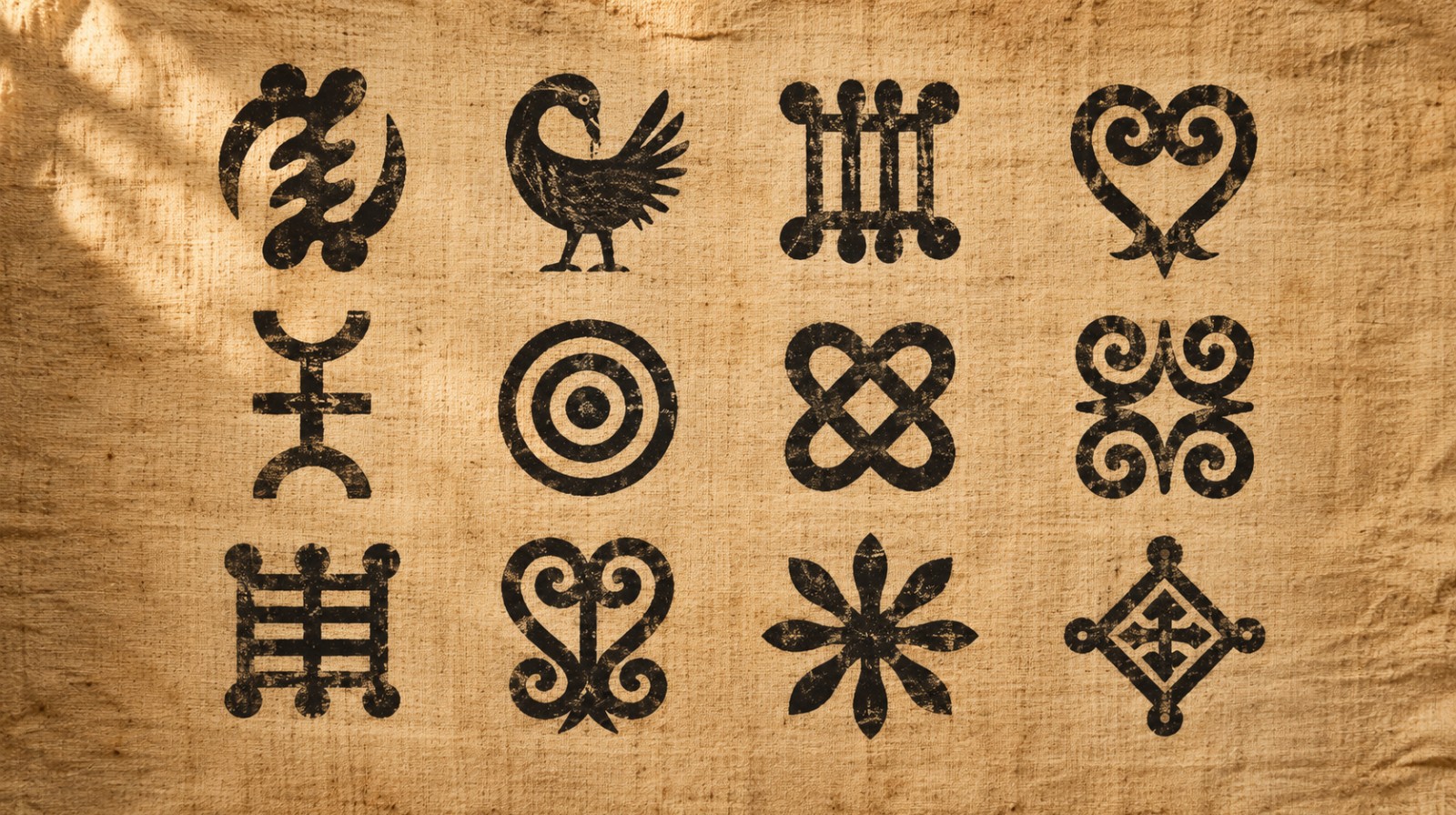
Today there are over a hundred recognised Adinkra symbols — some sources count 122, others 129, and new ones are still being created to reflect contemporary ideas. We have chosen twelve. Not the easiest twelve, and not the most decorative. The twelve we believe will mean the most when you live with them.
How to read this list
Each symbol below is given in its Twi name, with a phonetic guide for those new to the language. Every entry includes the literal translation, the proverb that gave the symbol its meaning, and a short note on how the symbol speaks in a modern home.
Adinkra are not interchangeable with one another. A wall that holds Sankofa speaks of memory; a wall that holds Eban speaks of family. We have grouped the twelve into four quiet themes — the divine, the self, the bond, the journey — because that is how the Akan themselves have long understood the world.
I. The Divine
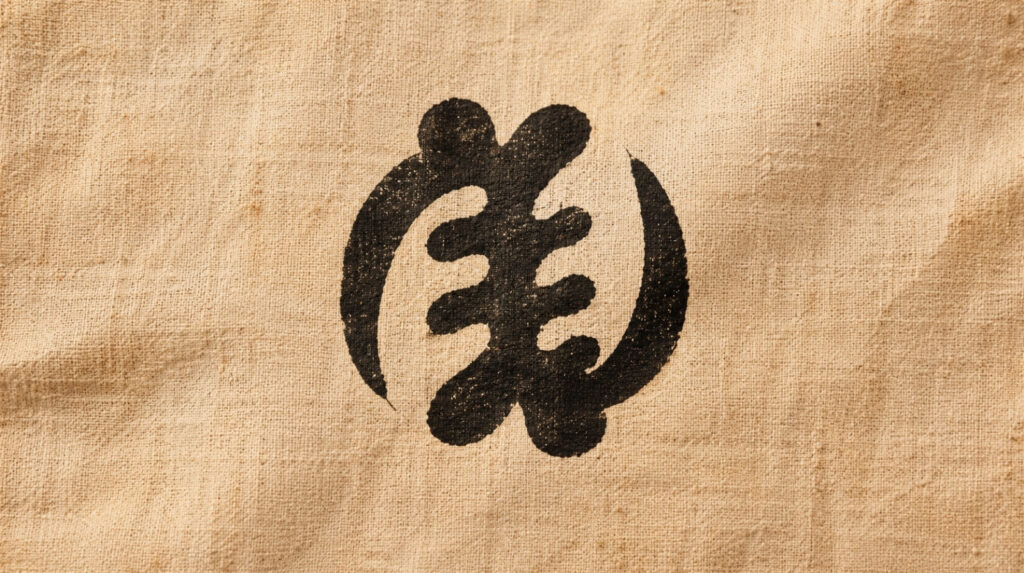
1. Gye Nyame — Except for God
Pronunciation: “jeh N-yah-mee” Literal meaning: Except for God Proverb: Abode santann yi firi tete; obi nte ase a onim n’ahyease, na obi ntena ase nkosi n’awie, gye Nyame. — “This great panorama of creation dates back to time immemorial; no one lives who saw its beginning, and no one will live to see its end, except God.”
Gye Nyame is the most recognisable Adinkra symbol in the world. It appears on Ghana’s two-hundred-cedi banknote, on the inauguration robes of presidents, on the stoops of homes, and on jewellery worn by Ghanaians abroad as a quiet declaration of faith. Its message is the supremacy of the divine — and, with that, the humility of the human.
To live with Gye Nyame is to keep one room in your home oriented toward something larger than yourself. In Afrocentric interiors, it is often the symbol that sits above the entry door — the first thing a visitor passes beneath, and the last thing the household sees before leaving.
2. Nyame Dua — Tree of God
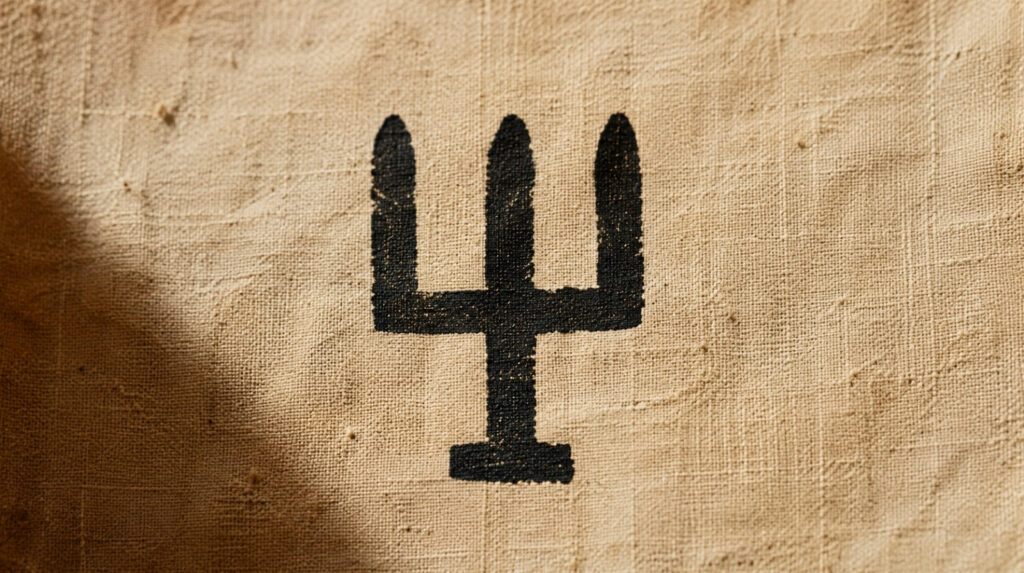
Pronunciation: “n-yah-mee doo-ah” Literal meaning: God’s tree, God’s altar Cultural note: A Nyame Dua was traditionally a sacred forked tree-stump that stood at the centre of an Akan compound, used as an altar for prayer and purification.
If Gye Nyame is the declaration, Nyame Dua is the ritual. The symbol depicts the three-pronged altar that stood at the centre of Akan villages — a place where libations were poured, blessings asked, and difficult news brought.
Hung in a quiet room, Nyame Dua reads as a small, deliberate signal: this is a space for prayer, or for the kind of stillness that resembles prayer. We see it most often in reading corners and bedside walls.
3. Nsoromma — Child of the Heavens
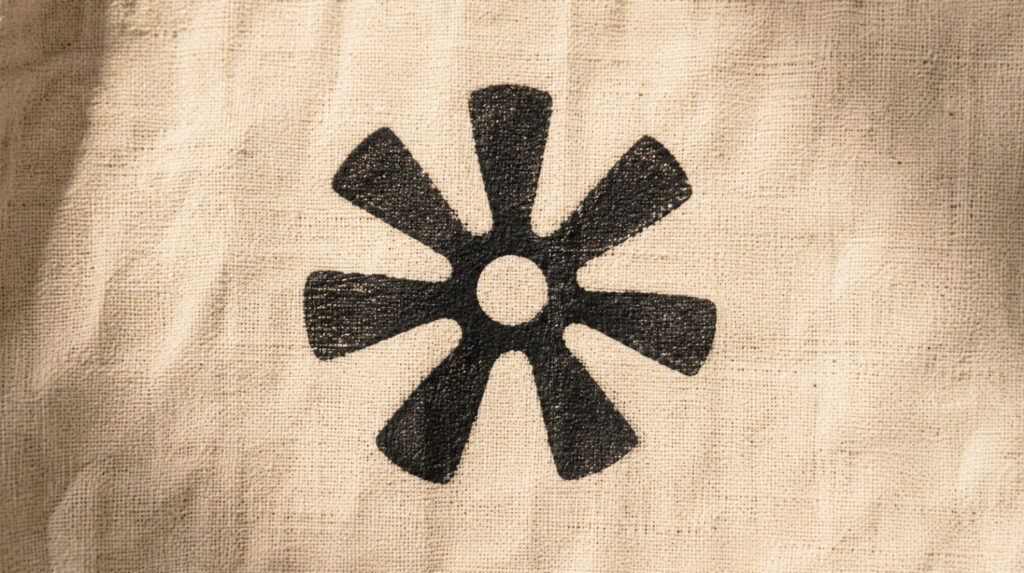
Pronunciation: “n-soh-rom-mah” Literal meaning: Star, child of the heavens Proverb: Oba nyansafo yenkyere no nsoromma. — “A wise child does not need to be shown the stars; he sees them himself.”
Nsoromma is rendered as a single five-pointed star — an emblem of guardianship, faithfulness, and the constant presence of the divine. The Akan saw the stars not as decoration of the sky but as evidence: God is watching; one is never truly alone.
It is one of the most quietly beautiful Adinkra to live with. A single Nsoromma above a child’s bed, or in the room of someone who has lost a parent, performs an act of accompaniment that asks nothing in return.
II. The Self
4. Sankofa — Go Back and Get It
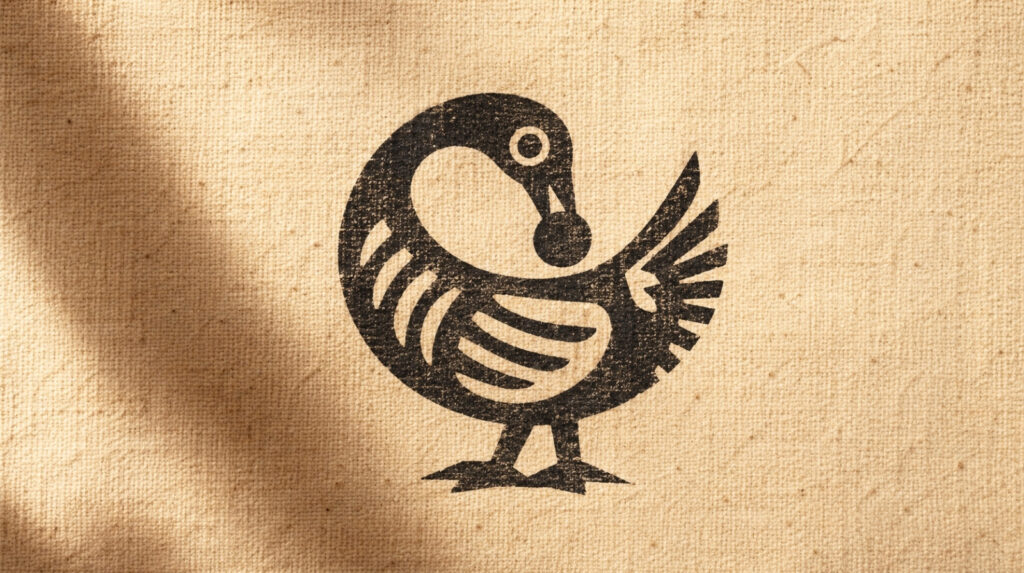
Pronunciation: “san-koh-fah” Literal meaning: Return and get it Proverb: Se wo were fi na wosan kofa a, yenkyiri. — “It is not taboo to go back and fetch what you forgot.”
If Gye Nyame is the most-worn Adinkra in the world, Sankofa is the most quoted. It exists in two forms: a stylised heart, and a mythical bird whose body faces forward while its head turns back — sometimes shown lifting an egg from its own back into its beak. The egg is the past. The bird is the present. The act is wisdom.
Sankofa does not romanticise the past. It instructs you to use it. In Akan philosophy, knowing your roots is not nostalgia — it is navigation. For anyone whose ancestry was disrupted by displacement, by silence, by the long erasures of colonialism and the diaspora, Sankofa has become more than a symbol. It is a permission slip. Reach back. The thing you forgot is allowed to be retrieved.
In a home, Sankofa belongs in the room where memory lives — above a desk, beside old photographs, on the wall where the family gathers.
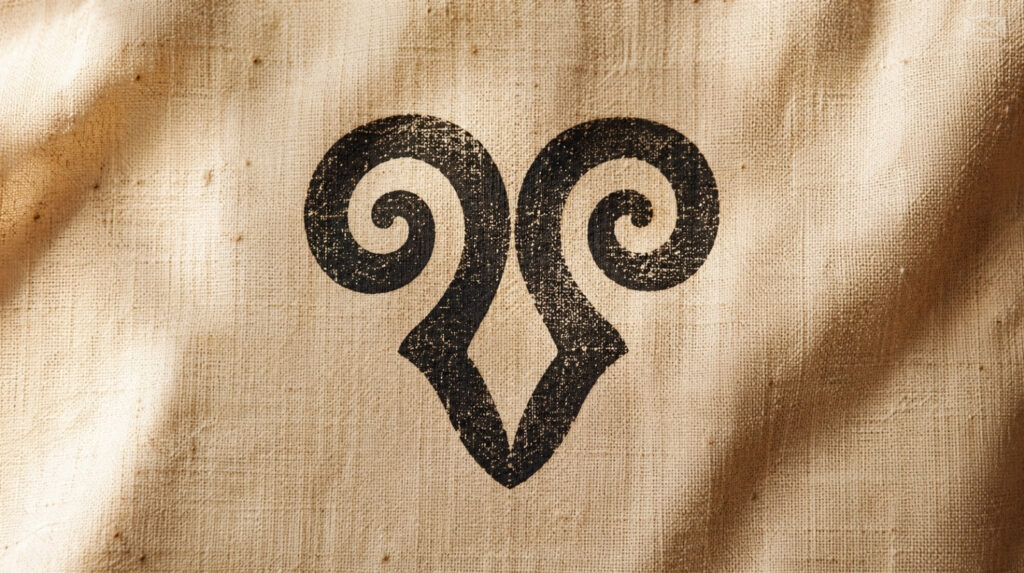
5. Dwennimmen — Ram’s Horns
Pronunciation: “djwin-knee-mmen” Literal meaning: The horns of the ram Proverb: Dwennimmen mu ne akoma; akokorom ye o, na yenfa noso — “It is the heart, not the horns, that leads a ram to bully.”
Dwennimmen is the symbol of strength married to humility — and of the two, humility is the harder. The intertwined horns represent the ram, an animal capable of considerable force, but the proverb makes the teaching clear: power without character is empty. The ram lowers its head before striking. That posture is the instruction.
Dwennimmen is one of the most beloved Adinkra in academic and leadership settings. The University of Ghana incorporates it into its crest. It is a perfect symbol for a study, an office wall at home, or above a workbench — anywhere a person makes decisions that affect others.
6. Nyansapo — Wisdom Knot
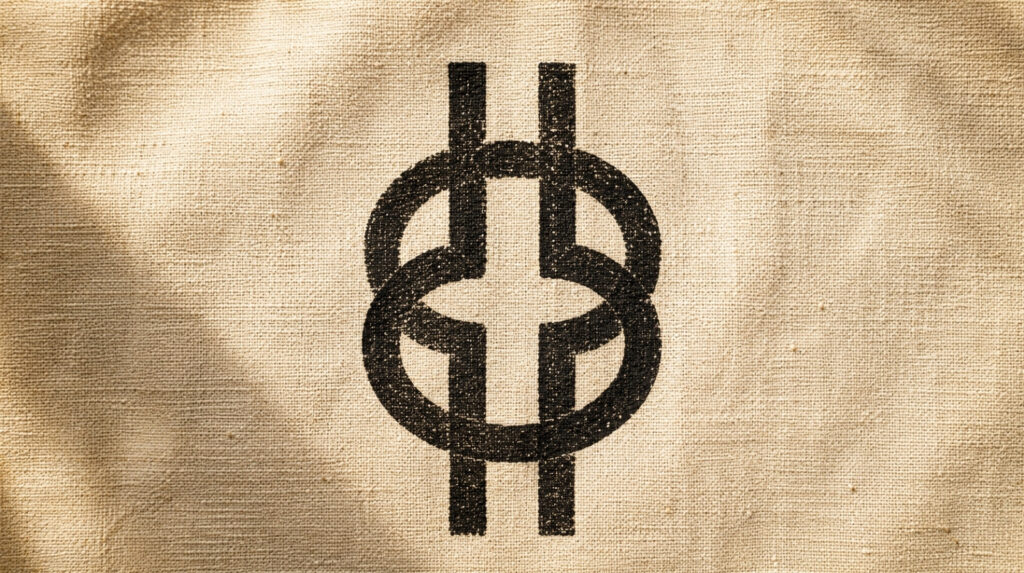
Pronunciation: “nyan-sah-poh” Literal meaning: Knot of wisdom Proverb: Nyansapo wosane no badwemma. — “Only a wise person can untie the knot of wisdom.”
The wisdom knot is exactly what its name suggests — an intricately interlaced loop with no obvious beginning or end. The proverb teaches that wisdom is never linear. A wise person sees the connections others miss; they untie the knot not by force, but by patience and the right sequence of moves.
Nyansapo is the Adinkra of strategy, ingenuity, and quiet intelligence. It belongs in a study, near a desk, or in any room where decisions are made slowly and well.
7. Akoma — The Heart
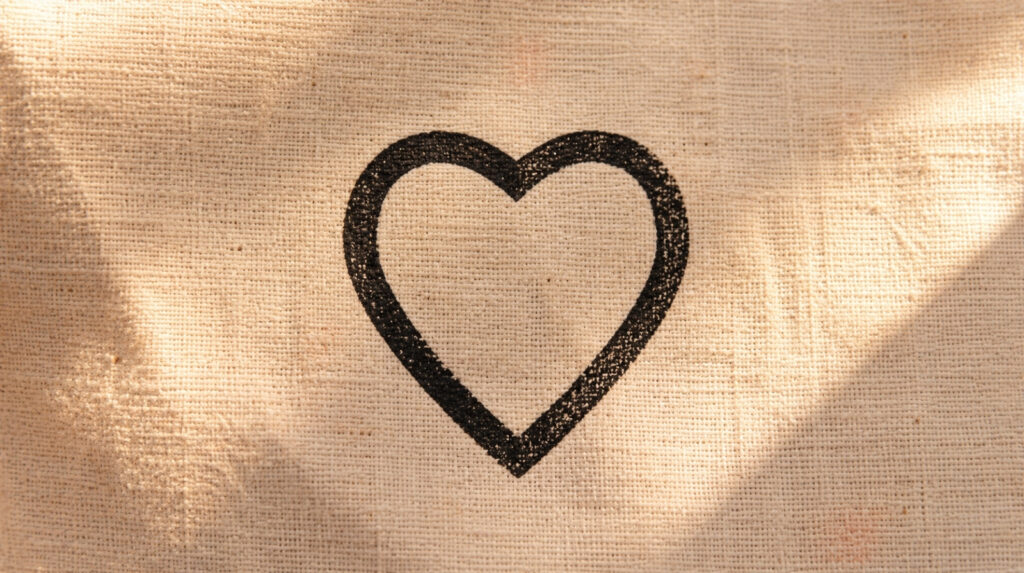
Pronunciation: “ah-koh-mah” Literal meaning: The heart Proverb: Nya akoma. — “Take heart. Be patient.”
Akoma is one of the simplest Adinkra to draw — a heart shape, almost — and one of the most easily misunderstood by those new to the tradition. In Akan philosophy, the heart is not the seat of romance. It is the seat of patience. To “have heart” is to endure with grace; to keep one’s footing in difficulty; to refuse to be made small by what is small.
Akoma is the symbol of forbearance, of love that lasts, of the kind of steadiness that keeps a household together through long years. It is one of the most gifted Adinkra at weddings and anniversaries — and one of the most quietly powerful pieces of art to keep above a kitchen table or in the room a couple shares.
III. The Bond
8. Eban — Fence
Pronunciation: “eh-bahn” Literal meaning: Fence Cultural note: The fence around an Akan home was considered a physical expression of the family’s love and protection — a boundary that held love in, rather than a wall that kept the world out.
Eban is depicted as an enclosed square — a tidy, generous boundary. It is the Adinkra of love, security, and the safety of the family. The Akan understanding is precise and worth preserving: a fence is built not against the outside world, but for the inside one. It marks the perimeter of a place where people are known and held.
In a modern home, Eban is the perfect symbol for the entry hall, the family room, or above a bed shared with a partner. It says: what is inside this house is precious, and we have built a place for it to be safe.
9. Funtunfunefu Denkyemfunefu — Siamese Crocodiles
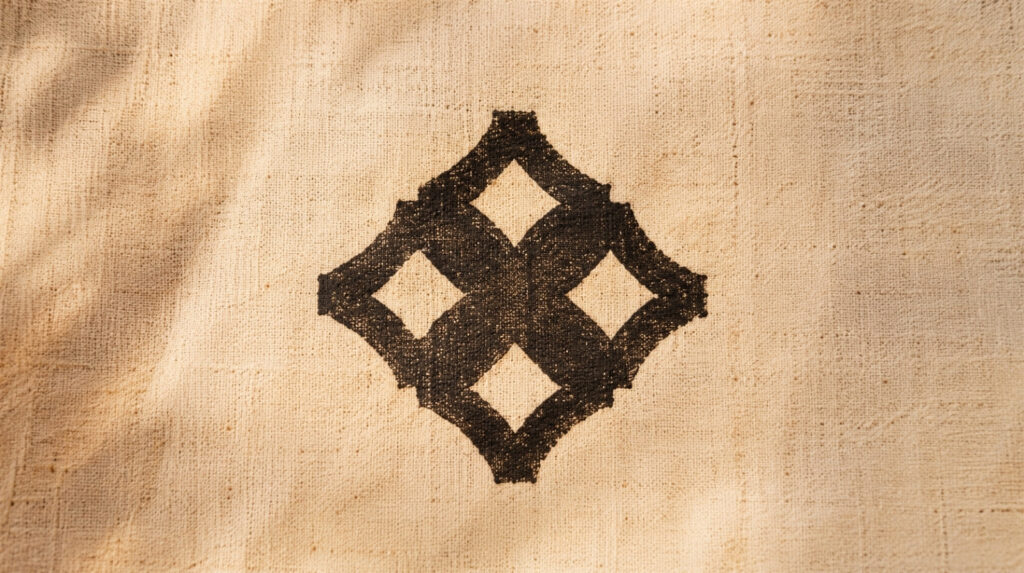
Pronunciation: “foon-toon-foo-nef-foo den-chem-foo-nef-foo” Literal meaning: Two crocodiles sharing one stomach Proverb: Funtumfrafu, denkyemfrafu, won afuru bom, nso woredidi a, na woreko, efiri se aduane no de fa won mene mu. — “They share the same stomach, yet they fight over food, because each tastes it as it goes down their own throat.”
This is the symbol of democracy, unity, and the difficulty of getting along when the cost of conflict is shared. Two crocodiles, fused at the stomach, fighting each other for food that ends up in the same belly — an image so blunt it leaves no room for misunderstanding.
In the home, Funtunfunefu speaks well in a dining room or family room — anywhere people negotiate, share, and sometimes disagree. It is a reminder, in beautiful form, that what wounds the family wounds everyone in it.
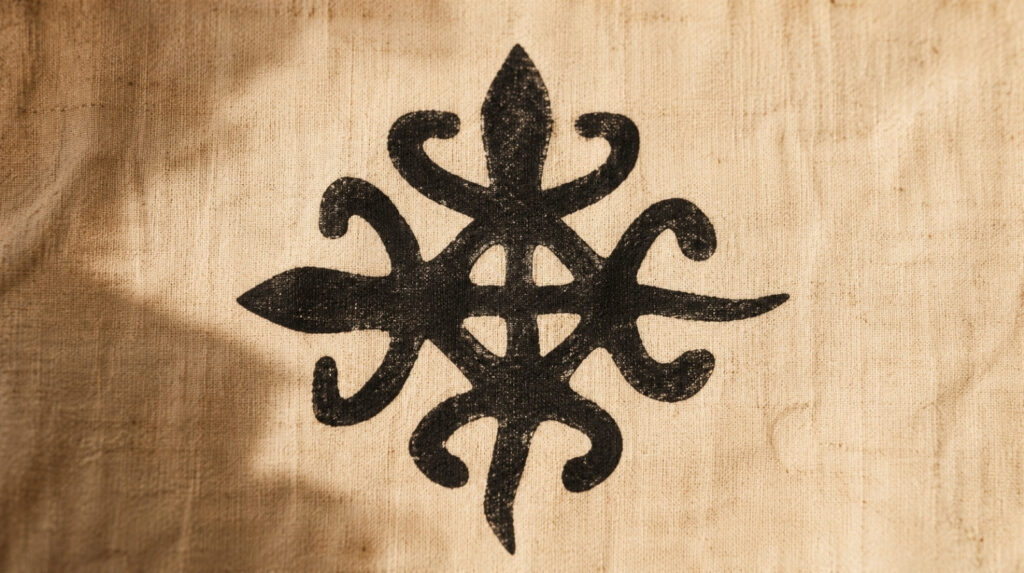
10. Mpatapo — Pacification Knot
Pronunciation: “m-pah-tah-poh” Literal meaning: Knot of reconciliation Cultural note: Mpatapo is a knot without a beginning or end — the form deliberately suggests that peace, once made, has no edges to come undone from.
If Funtunfunefu is the warning, Mpatapo is the resolution. The symbol depicts a closed knot with no starting point and no end — peace that cannot be pulled apart. It is the Adinkra of reconciliation, of forgiveness, of the active decision to bind together what conflict has torn.
The Akan teaching here is subtle: peace is not the absence of conflict. Peace is what is made after conflict, deliberately, by both parties. Mpatapo lives well in a hallway, in a meditation corner, or in any home where the people inside have done the slow work of returning to each other.
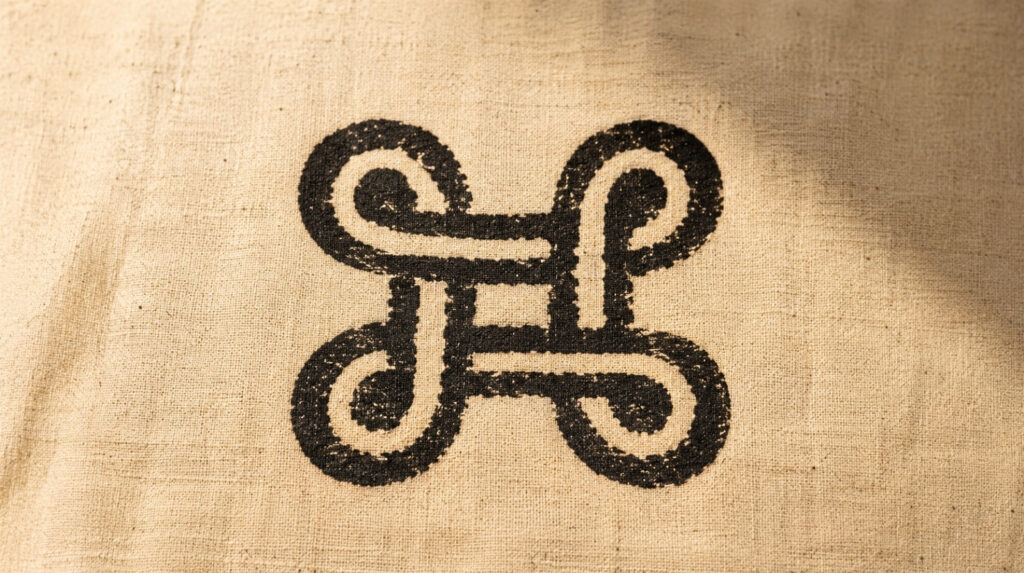
IV. The Journey
11. Adinkrahene — Chief of the Adinkra Symbols
Pronunciation: “ah-dink-rah-heh-nee” Literal meaning: King of the Adinkra symbols Cultural note: Adinkrahene is said to have inspired the design of many of the other symbols — the visual seed from which the Adinkra tradition grew.
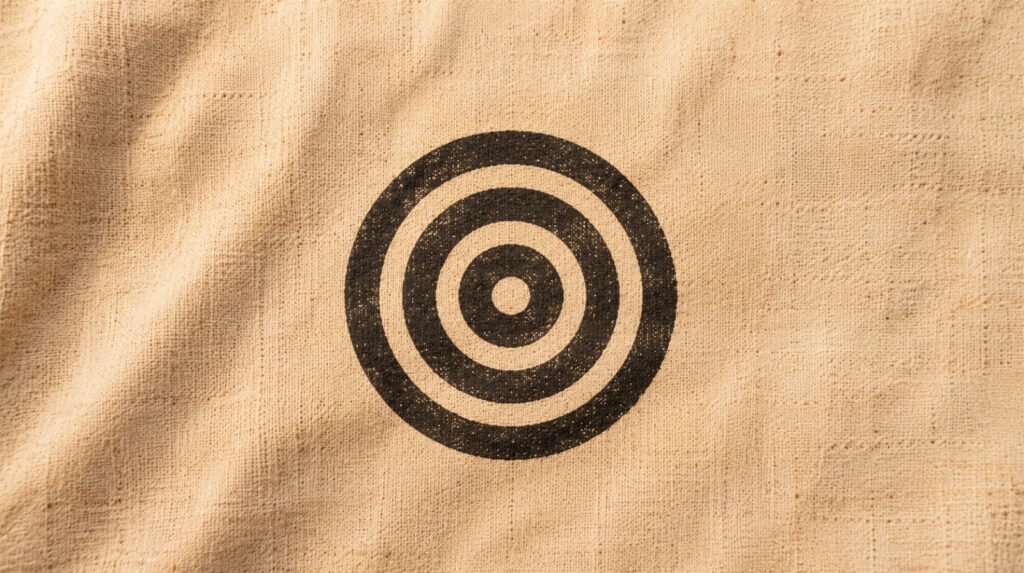
Three concentric circles. Nothing more. Adinkrahene is the most reduced of all Adinkra symbols, and it is also the one called king. Its meaning is leadership, charisma, and the kind of authority that comes not from force but from character. The form itself — circles within circles — suggests influence radiating outward, the way a stone dropped in water sends rings to every shore.
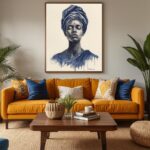
Adinkrahene is striking in scale. A single large Adinkrahene above a sofa, or as the centrepiece of a gallery wall, anchors the room with a still authority. We have used it more than once in homes where the owner wanted one image to hold the wall — and Adinkrahene was the only one that felt large enough.
12. Nkyinkyim — The Twisting Path
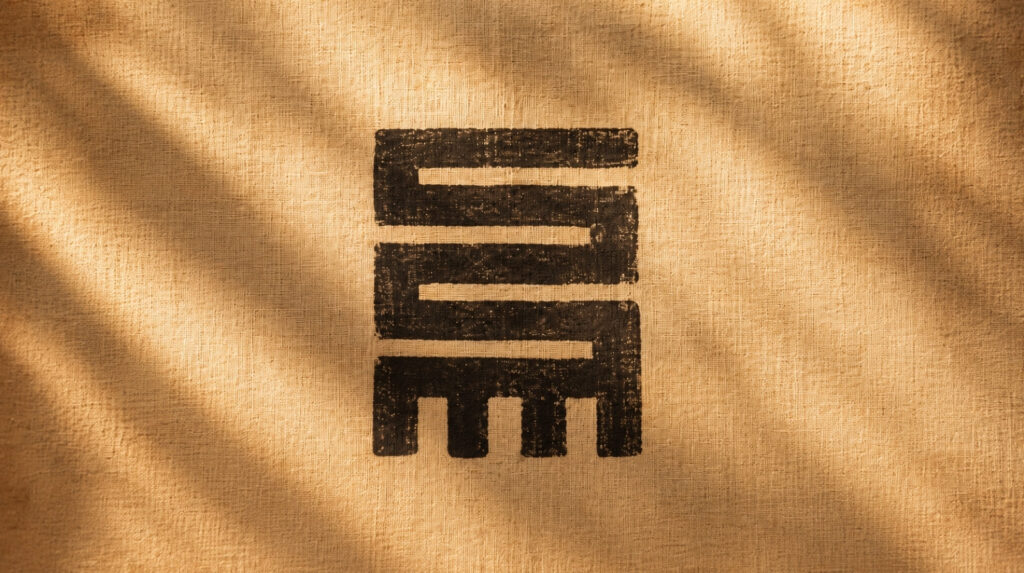
Pronunciation: “n-chin-chim” Literal meaning: Twisting, the zigzag Proverb: Obra kwan ye nkyinkyim. — “Life’s journey is twisted.”
We end with Nkyinkyim because it is honest. The symbol is a single zigzag line — life as it actually is, not as we draw it on a planning page. Nkyinkyim is the Adinkra of initiative, dynamism, and the resourcefulness required when the road bends without warning.
In Akan philosophy, the twisted path is not a failure of the journey. It is the journey. To accept Nkyinkyim is to accept that wisdom comes from learning to walk a road that does not run straight — and that the people who do this best are not those with the simplest lives, but those who have learned to bend without breaking.
It is, perhaps, the most modern Adinkra. It belongs in any room where a person is doing the difficult work of building something — a creative studio, a writing desk, the wall of a young person setting out on a life of their own.
How to live with these symbols
A few quiet rules we keep when working with Adinkra in interiors:
Read before you hang. Every Adinkra carries a proverb. Knowing the proverb changes the way the symbol holds the wall. A Sankofa hung by someone who has read its words is a different object from a Sankofa hung because the shape was pretty. The room can feel the difference.
Choose for the room, not the trend. Not every Adinkra suits every space. Gye Nyame above a child’s bed is too heavy; Akoma is the right one. Adinkrahene in a meditation corner is too commanding; Nyame Dua belongs there. The symbols are not interchangeable.
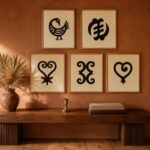
Restraint reads as respect. A wall holding twelve Adinkra at once is a poster, not a meditation. We almost always work in ones, twos, or threes — sometimes a single symbol allowed to hold a wall on its own, sometimes a curated trio that tells a small story. Eban, Akoma, Funtunfunefu — a family wall. Sankofa, Adinkrahene, Nkyinkyim — a study wall.
Pair with warm, restrained palettes. Adinkra were stamped in dark vegetable dye on natural-fibre cloth — the original palette is cream, charcoal, deep brown, and the warm reds and blacks of dyed cotton. Modern interiors that hold Adinkra well tend toward terracotta, ochre, walnut, and the soft creams of unbleached linen. Avoid cool greys and stark whites; they flatten the warmth the symbols were made to live in.
Frequently asked questions
What are Adinkra symbols and where do they come from?
Adinkra are visual symbols originating with the Akan people of Ghana and Côte d’Ivoire, dating to the eighteenth century or earlier. They are stamped — never woven — onto cloth, and each one represents a proverb, an aphorism, or a philosophical concept. The earliest surviving Adinkra cloth dates to 1817 and lives in the British Museum. Today the centre of traditional Adinkra production is Ntonso, twenty kilometres northwest of Kumasi in the Ashanti Region of Ghana.
How many Adinkra symbols are there in total?
Sources count between 122 and 129 traditional Adinkra symbols, and new ones are still being created to reflect contemporary ideas and values. The twelve we have featured here are among the most culturally significant and the most meaningful to live with at home — but the larger Adinkra dictionary covers ideas as varied as democracy, justice, ingenuity, the moon and stars, the family compound, and the seed of the wawa tree.
What is the most popular Adinkra symbol?
Gye Nyame — meaning “except for God” — is widely considered the most popular and recognisable Adinkra symbol both within Ghana and internationally. It appears on Ghana’s two-hundred-cedi banknote, on the inauguration robes of Ghanaian presidents, and on architecture, jewellery, and cloth across the Akan world and the African diaspora.
What is the difference between Adinkra and Kente?
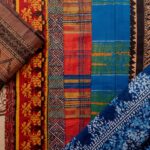
Both come from Ghana, but they are entirely different traditions. Adinkra are stamped symbols, traditionally pressed onto cotton cloth in dark vegetable dye, with each symbol carrying a proverb. Kente is a woven cloth, made on narrow strip looms in vibrant colours, with patterns named after historical events, queen mothers, and proverbs. Adinkra is read as text; Kente is read as textile. The two are sometimes combined on a single ceremonial garment, where the cloth speaks twice.
Is it disrespectful to use Adinkra symbols if you are not Ghanaian?
Adinkra are a generously shared part of Akan and broader African heritage, and they have been adopted across the African diaspora, in academia, and in design worldwide. The line between appreciation and appropriation is drawn at understanding. Using an Adinkra symbol because you have learned its proverb and want to live with its meaning is appreciation. Using one because the shape is pretty, or because it has been emptied of its proverb on a fast-fashion product, flattens a tradition that took centuries to build. If you are unsure, the simple test is this: can you say what the symbol means and why it speaks to you? If yes, you are honouring it.
Which Adinkra symbol is best for a bedroom?
For a primary bedroom, Akoma (the heart, meaning patience and enduring love) and Eban (the fence, meaning love and family security) are the most quietly powerful choices. For a child’s room, Nsoromma (child of the heavens, meaning guardianship) is gentle and protective. We tend to avoid the larger declarative symbols — Gye Nyame, Adinkrahene — in bedrooms; they are designed to make a public statement and can feel heavy in private space.
Which Adinkra symbol means strength?
Dwennimmen — the ram’s horns — is the Adinkra symbol most associated with strength, but the proverb behind it is essential to its meaning: “It is the heart, not the horns, that leads a ram to bully.” In Akan philosophy, strength is meaningful only when paired with humility. Dwennimmen is therefore the symbol of strength and gentleness, together. For pure resilience without that nuance, the Aya fern symbol — representing endurance through difficulty — is sometimes chosen instead.
How do I display Adinkra symbols at home without flattening them?
A few simple principles. First, choose one or two symbols rather than a dozen — a wall holding many Adinkra at once becomes a poster, not a meditation. Second, hang them in rooms whose function matches their meaning: Akoma in the kitchen, Sankofa near the family photographs, Adinkrahene above the sofa. Third, pair them with warm, restrained palettes — terracotta, ochre, cream, walnut — rather than cool greys, which flatten the warmth the symbols were made to live in. Fourth, frame them well; cheap frames signal the print is disposable, and Adinkra are not. Our free Afrocentric Gallery Wall Guide (linked just below) covers framing and spacing in more detail.
A small invitation
If you are building a home that holds meaning — not just style — you may like our free Afrocentric Gallery Wall Guide. It is the companion piece to this article: a curatorial reference for laying out walls that include symbols like the ones above, with three layout patterns, framing notes, and the spacing principles we keep coming back to in our own homes.
The guide is sent in one quiet email. No drip sequence, no pressure — just the PDF, and a note from us.
What’s next in this series
This is the first article in our country-by-country guide to the symbolism of African art. The next entries we are working through:
- The Symbolism in African Art: 12 Motifs & Their Meanings — Tanzania (Maasai shields, Tinga Tinga, Kanga proverbs)
- The Symbolism in African Art: 12 Motifs & Their Meanings — Senegal (Wolof gold, sous-verre painting, sacred geometry)
- The Symbolism in African Art: 12 Motifs & Their Meanings — Kongo (Cosmogram, nkisi, the four moments of the sun)
- The Symbolism in African Art: 12 Motifs & Their Meanings — South Africa (Ndebele geometry, Zulu beadwork, San rock art)
Each one will follow the same pattern: twelve symbols, the proverbs behind them, and notes on how to live with them at home. Slow design. Warm rooms. Real meaning.
Continue reading:
A Respectful Guide to African Textiles and What They Mean (The patterns tell you where they came from — if you listen…)
This article is part of the Wall Art Guides series at Essence of the Road Art — a home decor journal for soulful, Afrocentric and Afro-bohemian interiors.
- Teranga at Home: The Senegalese Way of Welcome as a Design Philosophy

- Afro-Boho Dining Room: Soulful Gathering Spaces with Warm Earth Tones

- 12 Tanzanian Symbols & Their Meanings: A Decor Lover’s Guide

- DIY Mudcloth Pillow Covers: A Beginner’s Sewing Tutorial
- Adinkra 5-Piece Gallery Wall: How to Build One at Home in 2026