The Difference Between a Symbol and a Motif (And Why Most Decor Blogs Get It Wrong)
By Essence of the Road Art · Published July 2026
This article contains affiliate links. If you buy through them, we may earn a small commission at no extra cost to you. We only feature pieces we would live with ourselves.
Type “African symbols” into any search bar and you will get a wall of results that use the words symbol, motif, sign, pattern and icon as if they were five spellings of the same word. They are not. And the sloppiness is not harmless — it is precisely how a mark that a specific community uses to say a specific thing ends up printed on a doormat.
We write about this for a living and we have made the mistake ourselves. So this piece is the correction we wish someone had handed us three years ago: where the border actually runs, how to test which side of it you are standing on, how to use old marks in a new room without embarrassing yourself, and where to find the real thing instead of the fourteenth-generation Pinterest copy.
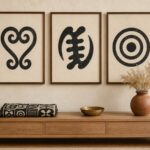
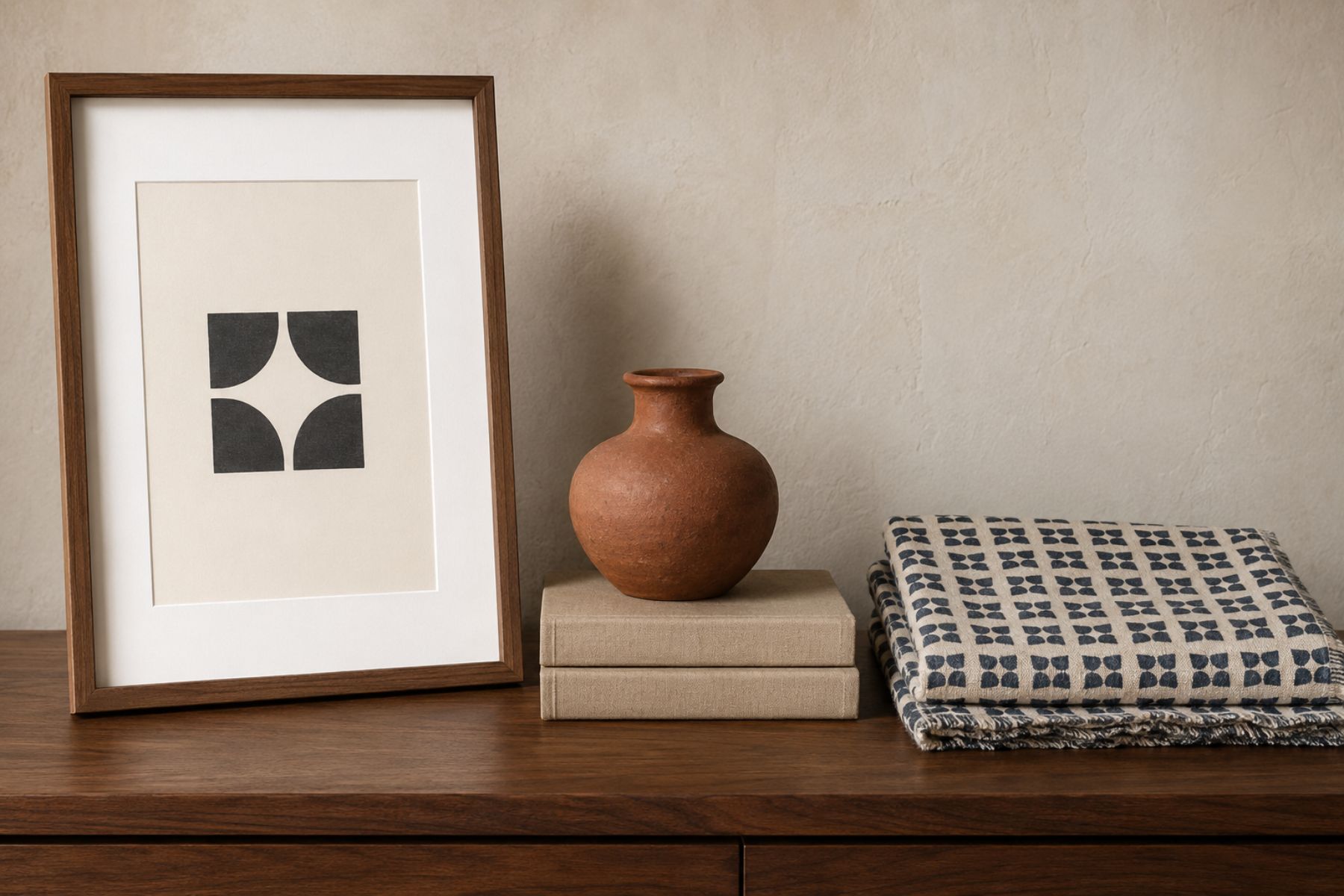
Quick answer. The difference between a symbol and a motif is function, not shape. A symbol stands in for an idea outside itself — it carries meaning that a community has agreed on, and it works alone. A motif is a recurring visual element that structures a surface — it works by repeating, and its job is rhythm. The same shape can be both, in the same afternoon: an Adinkra mark stamped once on a funeral cloth is a symbol; the same mark stamped four hundred times across a bolt of cloth is a motif. This is why our Adinkra Symbol Wall Art Set of 5 isolates one mark per sheet rather than tiling them — the framing decides which of the two you are actually hanging.
Table of Contents
The border exists. It is just not where people look for it.
Almost everyone looks for the border in the shape. They assume symbols look like symbols — solemn, geometric, ancient — and motifs look like motifs — pretty, floral, decorative. This is wrong, and it is wrong in a way that makes people confident.
The border runs through use.
Ask what the mark is doing on the object:
- If it is saying something — naming a proverb, claiming a lineage, warding something off, marking a rank, standing for a god — it is functioning as a symbol.
- If it is organising a surface — creating rhythm, filling a field, giving the eye somewhere to travel — it is functioning as a motif.
Nothing about the drawing tells you which. The context does.
Take Sankofa, the Akan bird turning its head backward. Printed once, large, in the centre of a page, it is unmistakably a symbol: it means go back and get it, retrieve what was left behind. Printed at two centimetres, ninety times, across a length of cloth, the meaning has not been deleted — but it has gone quiet. The eye stops reading it and starts feeling it. That is the moment it becomes a motif.
The honest version of this article is therefore not “symbols mean things and motifs are decoration.” It is: the same mark moves between the two categories depending on scale, isolation and repetition — and you, the person hanging it, are the one moving it.
Four words that are not synonyms
Here is the vocabulary, cleanly separated. Learn these four and you will immediately read decor listings differently.
| Word | What it actually is | Test question | Example |
| Sign | A mark that points to something by convention, with no depth beyond the pointing | Does it just indicate? | An arrow. A maker’s stamp. |
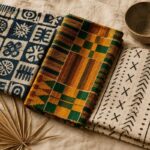
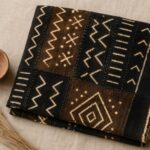
| Motif | A recurring visual element that structures a surface | Does it repeat? Would removing one break the rhythm? | The zigzag band running down a length of mudcloth |
| Symbol | A mark that stands in for an idea a community has agreed on | Does a group of people recognise it and could they name it? | Gye Nyame. The dikenga cosmogram. The khamsa. |
| Pattern | The overall system that motifs are arranged into | Is there a repeat unit and a rule for repeating it? | A half-drop repeat, a strip weave, a tessellation |
Philosophers of language draw a related line that is genuinely useful here. Charles Sanders Peirce split marks into three: the icon, which resembles what it refers to (a drawing of a fish); the index, which is physically caused by it (smoke for fire); and the symbol, which relates to it only because a community decided so (the word “fish”). Symbols are the ones that require an agreement. That is why symbols can be misread and motifs mostly cannot. There is nothing to get wrong about a zigzag. There is a great deal to get wrong about a mark that a community agreed means something.
The harsh part: a lot of published “symbol meanings” are invented
This is the section that makes people uncomfortable, and it is the reason we wrote the piece.
A very large share of the symbol meanings circulating in the decor and print-on-demand world have no source at all. They were written by someone paraphrasing someone paraphrasing a caption, and each pass smoothed a contested, region-specific, sometimes contradictory meaning into something that fits a product description. Once a wrong meaning is attached to a nice-looking shape, it travels faster than the correct one, because the wrong one was written to be shareable.
Three specific traps:
1. “Ancient” is usually a marketing word. Tingatinga painting — the flat, bright East African wildlife style that reads as timeless — was invented in Dar es Salaam in 1968. The red plaid Maasai shuka most people believe is centuries old was widely adopted in roughly the 1960s, through trade cloth; before that the Maasai wore ochre-dyed leather. Both are magnificent. Neither is ancient. We go into this in the Tanzanian symbols guide.
2. Meanings are tendencies, not rules. Ethnographers record what people in a particular village, in a particular decade, told a particular researcher. Another village forty kilometres away reads the same motif differently. A source that gives you one clean sentence per symbol, with no variation and no hedging, has flattened something. Ours hedge on purpose.
3. A symbol without a people is a red flag. If a listing says “African symbol of strength” and cannot tell you which people, which language the name is in, and what object it was traditionally applied to, there is a decent chance it was drawn by someone who had never seen the original.
The four-question test. Before you believe a meaning — or write one — ask:
- Which specific people or region uses this mark?
- What is its name in their language?
- What object or context was it used on — cloth, wall, body, pottery, architecture?
- Where did this meaning come from, and does that source name a real recorder or institution?
If you cannot answer three of the four, you are looking at a motif with a story bolted on.
How to use ancient symbols in a modern home without becoming a tourist in it
We are going to be direct, because vague respectfulness helps nobody.
Rule of one. Symbols do not stack. One symbol per room, given room to breathe. Motifs are the opposite — they want repetition and they get better with it. If you want density, use a motif. If you want meaning, use one symbol and let it be alone. This single rule fixes about eighty percent of the “why does my gallery wall feel like a gift shop” problem.
Scale is a translation. Blowing a symbol up to a metre wide does not make it more meaningful; it makes it louder. Marks that were designed at the scale of a hand — stamps, brands, beadwork units — usually read best small and isolated. Marks that were designed at architectural scale (Amazigh doorway geometry, tilework) survive being big.
Never live with something you cannot name out loud. Our actual working test: if a guest asked “what’s that?”, could you answer in two sentences without reaching for your phone, and would you be comfortable saying that answer to someone from the culture it came from? If yes, hang it. If no, either learn it or choose something else. This is a lower bar than it sounds and it eliminates almost every genuinely bad decision.
Some objects are not decor. Initiation masks, ritual figures, shrine objects and funerary pieces were made to be worn, fed, danced or buried — not looked at. A wall strips them of most of what they were. We are not saying never; we are saying know what you are doing, prefer contemporary work openly made for sale by a named maker, and ask how an older piece left its country before you buy it.
Prefer interpretation over extraction. A print inspired by a visual tradition, made in dialogue with it, credited honestly, is a fundamentally different object from a scan of someone’s sacred cloth sold as a digital download. Both exist on Etsy. They are not the same business.
The legal bit nobody in the decor world mentions: Ghana licenses Adinkra and Kente
This one genuinely surprises people, including sellers who have been printing these designs for years.
Under Ghana’s Copyright Act, 2005 (Act 690), works of folklore — explicitly including Kente and Adinkra designs — are protected, and the rights are vested in the President on behalf of and in trust for the people of Ghana. The Act establishes a National Folklore Board, and under Section 64, anyone intending to commercially exploit Ghanaian folklore is required to obtain authorisation from the Board and pay the prescribed fee. The Board has publicly reminded users to seek authorisation before using Adinkra symbols for branding, promotional and commercial purposes.
Two honest caveats, because we are not going to pretend this is simple:
- The law is contested. Ghanaian and international scholars have argued in outlets including The Conversation that the folklore provisions are overbroad and actually hamper Ghanaian creative practice — in the original drafting, even Ghanaians using their own heritage commercially fell under the licensing requirement. Enforcement against small overseas sellers is, in practice, rare.
- It is jurisdictional. A Ghanaian statute does not automatically bind a seller in Hungary or Ohio, and no court has made this a settled global obligation.
But “rarely enforced” is not the same as “does not exist,” and for anyone building a business on these designs, the existence of a national body whose literal job is to license them is a fact worth knowing. At minimum it should end the assumption that traditional designs are free-for-all public domain. They are somebody’s, and at least one country has said so in statute.
If you want the design vocabulary itself, our Adinkra symbols guide and Kente cloth patterns guide cover the marks and the colour grammar properly.
Where to find original inspiration (Pinterest is tier five)
Here is the sourcing hierarchy we use. Work down it, not up.
- The object itself — a real cloth, a real carved panel, in your hands or in a case
- A museum catalogue record — with culture, date, material, accession number, provenance
- Scholarly text — an ethnography, a monograph, a museum publication
- A museum’s own blog or interpretation page
- Everything else — decor blogs, Pinterest, AI-generated “symbol charts”, print-on-demand listings
Almost all of the bad information lives in tier five, and almost nobody in decor ever visits tiers one to three. That gap is the entire opportunity.
How to read a museum record. Four fields matter. Culture tells you the people (not “African” — “Asante,” “Kongo,” “Amazigh”). Date tells you whether “ancient” is honest. Materials and techniques tells you how the mark was actually made, which usually explains its shape better than any symbolism. Provenance tells you how the object got to a museum in Europe — and that field is frequently the most revealing one on the page.
Ten online museum collections worth your evening (verified July 2026)
Free to browse, all of them. The image-reuse column is the one that matters if you sell prints — and it is the one most people never check.
| Collection | Best for | Can you reuse the images commercially? |
| Smithsonian Open Access | 5.1 million 2D and 3D items across 21 museums, downloadable without asking | Yes — CC0 on flagged items |
| Smithsonian National Museum of African Art | ~9,000 African works plus 300,000 photographs; the single best starting point for this niche | Many items CC0 via Open Access; check per object |
| Digital Benin | 5,304 Benin Kingdom objects from 139 institutions in 21 countries, catalogued in Edo | No — images are © the holding institutions. Read, don’t reuse |
| The Met Open Access | Over 492,000 public-domain images, superb textile and ornament holdings | Yes — CC0 |
| Cleveland Museum of Art Open Access | 64,000+ records, 37,000+ images, clean API and full CSV download | Yes — CC0, explicitly commercial-use permitted |
| British Museum Collection | Enormous comparative range across cultures | No — CC BY-NC-SA 4.0, non-commercial only. Commercial licensing is separate |
| Rijksmuseum Rijksstudio | Pattern, ornament and print collections; excellent download quality | Yes for public-domain works |
| AfricaMuseum, Tervuren | ~120,000 Central African objects and 500,000 photographs — unmatched for Kongo material | No blanket reuse licence; read the terms per item |
| Brooklyn Museum — Arts of Africa | 6,000+ West and Central African works, strong online records | Varies by object; check the record |
| V&A Explore the Collections | Over a million records, half a million images — the best textile and ornament database anywhere | Varies; check per object |
One bonus, with a warning. Owen Jones’s The Grammar of Ornament (1856) is fully public domain and scanned in high resolution on the Internet Archive. It is the most-copied motif source in the design world, and it is genuinely beautiful. It is also a Victorian British project that stripped ornament from dozens of cultures, redrew it in one house style, and arranged it into a hierarchy with European work at the top. Use it as a catalogue of shapes. Do not use it as a source of meanings. Jones’s captions tell you what a nineteenth-century Englishman thought a mark meant.
The uncomfortable footnote about museum archives
Digital Benin exists because in February 1897 British forces looted the Kingdom of Benin and scattered its royal art across 139 institutions in 21 countries. The AfricaMuseum’s 500,000 photographs are largely a colonial-era archive of the Congo. Sending you to European museums to research African symbols is therefore not a neutral act, and we are not going to pretend otherwise.
Two things follow. First, prefer the platforms that centre the originating community’s own language and knowledge — Digital Benin catalogues in Edo and carries oral histories, which is a different project from a European accession list. Second, read the provenance field. It is usually the most honest sentence on the page, and it will change how you think about the object above it.
Frequently asked questions
Is there really a difference between a symbol and a motif, or is it just semantics?
There is a real difference, and it is functional. The difference between a symbol and a motif is what the mark is doing: a symbol stands in for an agreed idea and works alone; a motif structures a surface and works by repeating. The reason it matters practically is that symbols can be misused — hung upside down, placed in an inappropriate room, sold without permission — and motifs largely cannot. Getting the category right tells you how much care an object needs.
Can a motif become a symbol?
Yes, and it happens constantly. A repeating decorative element acquires meaning when a community starts using it to say something — to mark status, membership, mourning, or protection. The Maasai check is a clear modern example: a trade-cloth pattern adopted in the mid-twentieth century that now functions almost as a flag of Maasai identity. It moved from motif to symbol inside sixty years. The reverse happens too, usually through commercialisation, when a symbol is repeated so widely that it stops being read.
How do I know if a symbol meaning I found online is accurate?
Run the four-question test: which specific people use it, what is its name in their language, what object was it used on, and what source records that meaning. Then check the claim against a museum catalogue record rather than another blog. If a page gives you thirty symbols with one tidy sentence each and no named people, no language, and no citation, treat it as decoration rather than information.
Is it cultural appropriation to hang African symbols in my home?
Living with art from a culture that is not yours is not automatically appropriation. The problems arise in three specific places: taking objects that were never meant to be looked at (ritual and funerary pieces), profiting from someone else’s designs without credit or payment, and asserting meanings you have not checked. Buy from makers connected to the tradition where you can, learn what you own well enough to explain it aloud, and be honest about what is interpretation versus what is reproduction. Our guide to mixing global motifs works through this in a styling context.
Which online museum should I start with if I only have one evening?
The Smithsonian National Museum of African Art, then Digital Benin. The first gives you breadth with clean records and largely reusable images; the second shows you what a collection looks like when it is built around the originating community’s own language and oral history rather than a colonial accession list. Between the two you will recalibrate what a reliable source actually looks like.
Related reading
- African Motifs Explained: Adinkra, Kente, and Mudcloth
- Adinkra Symbols and Their Meanings: The Ultimate Guide
- Kente Cloth Patterns and Meanings: How to Read Ghana’s Royal Weave
- Mudcloth Patterns and Meanings: Reading Mali’s Bogolanfini at Home
- How to Mix Global Motifs at Home Without Losing Yourself
Closing
If you take one habit from this piece, take the naming habit. Before a mark goes on your wall, be able to say which people it belongs to, what it is called, and what it was for. That single sentence is the whole difference between a home that has collected things and a home that has understood them — and it is a far more interesting thing to say to a guest than “I found it on Pinterest.”
And when you do hang a symbol, give it the isolation it was built for. That is why our Adinkra Symbol Wall Art Set of 5 puts one mark on each sheet with generous space around it, rather than tiling five across a single print. Framed and hung with a gap, each one stays a symbol. Crowded together, they would quietly become wallpaper — which is a perfectly good thing to be, but it is a different thing.
Shop the Essence of the Road Art collection
- Essence of the Road Art on Etsy — the full printable collection
- Adinkra Symbol Wall Art Set (5) — one symbol per sheet, built for isolation
- Baobab Tree of Life Print — earth-tone symbolism for a living room
- Africa Map Textured Collage Print — mixed-media, motif-led rather than symbol-led