12 Symbols & Their Meanings: The Symbolism in African Art — Senegal
By Essence of the Road Art · Published May 2026
Senegal has a visual vocabulary as rich as Ghana’s adinkra system, but it is far less catalogued in English-language design writing. The motifs travel less easily than adinkra symbols because the cultural framing is more diffuse — Senegalese symbolism lives in textiles, in calabashes, in jewellery, in masks, in fabric dyeing, and in the country’s particular practice of hospitality known as teranga, more than in a single named symbol set.
This article is our attempt at a careful, respectful introduction to twelve of those motifs and what they mean. It is a companion piece to our adinkra symbols guide for Ghana, written with the same caveats: these are introductions, not authorities, and the most meaningful use of any cultural symbol is built on continued learning rather than quick decorative adoption.
| Quick answer Senegalese symbols meanings are rooted in the visual traditions of the Wolof, Serer, Fula, and other peoples of Senegal. Twelve of the most recognisable motifs include the baobab tree (longevity and wisdom), the cowrie shell (prosperity), the calabash (fertility and abundance), indigo dye patterns (status and rite of passage), the talking drum (communication), teranga symbols (hospitality), the sand pendulum (geomancy), the lion of the Lion Throne (sovereignty), the kora harp (storytelling), the wax-resist textile motif (lineage), the Senegalese mask (ritual), and the tirailleur silhouette (memory). Each carries cultural weight that goes beyond decoration. |
Table of Contents
How to read this guide
Each entry below names a motif, summarises its cultural meaning, and notes how it appears in modern Senegalese design and how to honour it respectfully in a home decor context. The summaries are intentionally brief; serious engagement with any of these motifs benefits from books, museum collections, and the writing of Senegalese artists and scholars rather than a short blog entry.
If you choose to bring any of these motifs into your home, do it the way you would bring any object with provenance: source from sellers who name the artisan or community, learn enough to explain the piece if asked, and integrate it as part of a coherent room rather than as a single conspicuous accent.
1. The baobab tree — longevity, wisdom, and rootedness
The baobab is Senegal’s national tree and its most recognisable natural symbol. The tree itself can live over a thousand years, and in Senegalese tradition the baobab is associated with wisdom passed down through generations, with rootedness in a specific place, and with the gathering of community in the shade of its enormous canopy.
In modern Senegalese design, baobab silhouettes recur in jewellery, textile prints, and wall art. The motif works particularly well as a single graphic element on a print or as a hand-carved element in furniture — anywhere a piece is meant to signal continuity and rootedness.
2. The cowrie shell — prosperity, fertility, and currency
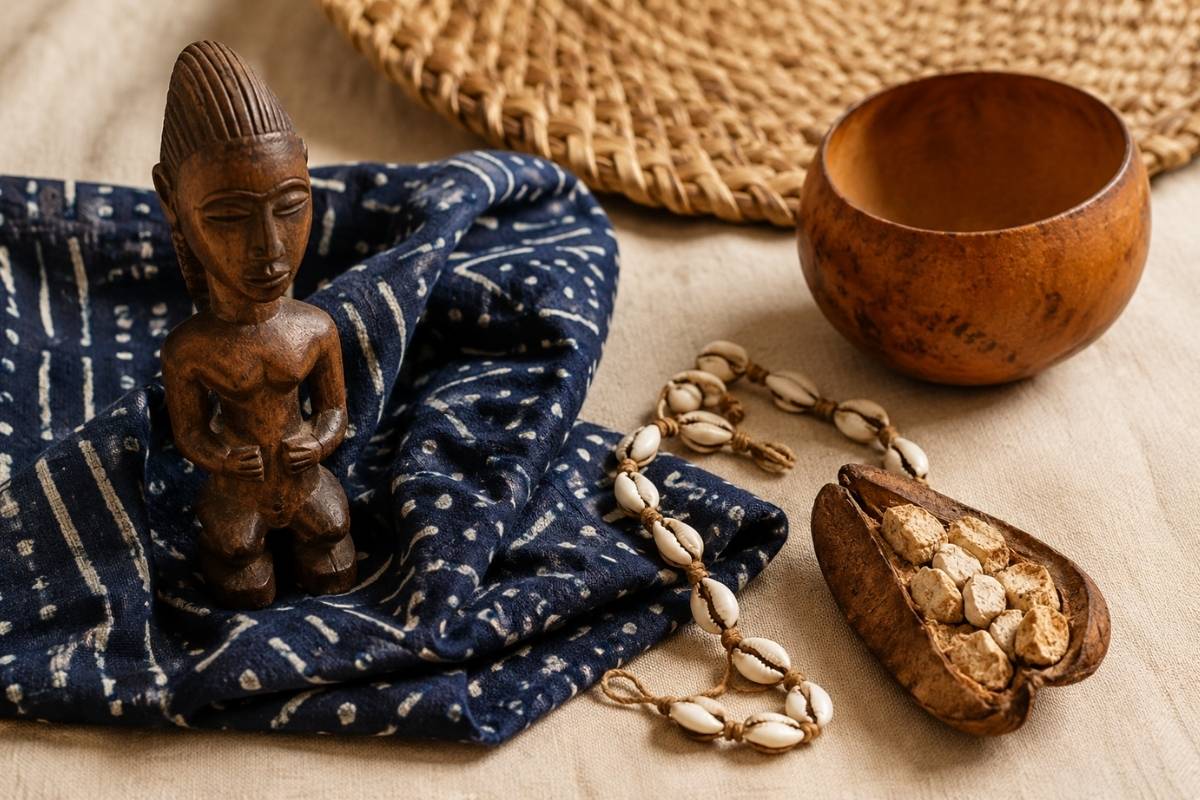
Cowrie shells were once a form of currency across West Africa, and they retain a strong symbolic association with prosperity, fertility, and protection. In Senegal, cowries appear sewn into traditional dress, set into jewellery, and arranged into divination patterns.
In contemporary decor, cowrie shells appear as accents on textiles, in macramé wall hangings, and as embroidery on cushions. The motif carries the most meaning when the shells are real rather than printed, and when the placement honours their historical use rather than reducing them to ornament.
3. The calabash — abundance, ritual, and craft
The calabash — a dried gourd hollowed and shaped into a bowl, instrument, or storage vessel — is one of the most widely used objects in Senegalese daily life and the most layered in symbolism. Calabashes carry water, food, and offerings; they are also musical instruments and ritual containers.
Decorated calabashes, often pyrographed with geometric patterns, appear in Senegalese homes and increasingly in international design retail. A genuine pyrographed calabash on a console or shelf brings both craft and cultural weight; a mass-produced lookalike does neither.
4. Indigo-dyed textiles — status, lineage, and craft tradition
Indigo dyeing in Senegal — particularly among Wolof and Manjak communities — is a tradition that traces lineage through pattern. Specific geometric motifs and dye techniques mark family origin, marriage status, and rite of passage. The deep saturated blue is the colour of considered occasion, not casual wear.
Indigo textiles are now widely available in international markets. The motif retains its weight when sourced from Senegalese artisans or fair-trade cooperatives, and when displayed as a textile in its own right — folded, framed, or upholstered — rather than cut down into accessories.
5. The talking drum — communication and call
The tama, or talking drum, is one of Senegal’s most distinctive instruments — a small hourglass-shaped drum held under the arm, its pitch changed in real time by squeezing the tension cords. Historically, the drum could imitate the rhythms and tones of speech, allowing it to carry messages across distances.
As a decorative object, the talking drum belongs in homes where instruments are honoured — displayed on a stand or wall mount rather than placed on a shelf alongside unrelated decor. As a decorative motif on textiles or wall art, the silhouette of the drum signals communication, call, and the carrying of message across generations.
6. Teranga symbols — hospitality as cultural principle
Teranga is the Wolof word for the Senegalese practice of hospitality — the offering of welcome, water, shade, food, and presence to anyone who arrives, whether stranger or family. It is one of the defining cultural principles of Senegal and the brand identity of the country itself.
There is no single iconographic symbol for teranga in the way that adinkra symbols have specific glyphs. The motif lives instead in the objects of welcome — the kettle and small glass of attaya tea, the calabash of water, the woven mat for sitting. A genuinely teranga-influenced home is recognisable not by a symbol on the wall but by the presence of these everyday objects of hosting.
7. The sand pendulum — geomancy and decision-making
Geomancy, or sand divination, has a long history in West Africa including in Senegal. Practitioners draw patterns in sand or trace them on a board, reading meaning from the configurations. The sand pendulum motif — a circular arrangement of dots or marks — appears in some traditional Senegalese textiles and in contemporary spiritual jewellery.
This is a motif to engage with carefully. Geomancy is a living practice for many people in West Africa; the motif is not a generic decorative flourish, and using it in a purely decorative context without acknowledging the practice is one of the easier ways to flatten cultural depth into ornament.
8. The lion of the Lion Throne — sovereignty and dignity
The lion of the Senegalese coat of arms references a deeper tradition: the historic Lion Throne of the Damel kings of Cayor, and the lion as a symbol of sovereignty across multiple Senegalese kingdoms. The motif appears in heraldry, in jewellery, and in commemorative textiles.
As a decor motif, the lion belongs in homes where heritage references are deliberate. A small framed lion-of-Cayor print or a single piece of jewellery carries the symbolism well; a mass-produced lion silhouette on a generic safari print does not engage with the tradition at all.
9. The kora harp — storytelling and lineage of music
The kora — a 21-stringed harp lute traditionally played by griots, the hereditary storytellers and historians of West Africa — is one of the most recognisable Senegalese instruments. The kora is associated with storytelling, oral history, and the transmission of family and community memory through music.
As a decorative object, a real kora belongs in homes where the instrument is honoured. As a motif on wall art or textiles, the kora silhouette references the broader griot tradition of storytelling and remembrance.
10. Wax-resist textile motifs — lineage, fabric language, and pattern grammar
Senegal shares with much of West Africa the tradition of wax-resist (batik) and indigo-resist textiles, in which patterns are drawn in wax or paste before dyeing so the protected areas remain undyed. The specific motifs vary by community and by occasion, with certain patterns reserved for particular ceremonies or family lineages.
This is one of the richest visual vocabularies in West African textile tradition, and one of the easiest to engage with respectfully — by buying directly from Senegalese textile artisans, by learning the meaning of a specific pattern before incorporating it into a home, and by treating the textile as a textile rather than as cut-up accessory material.
11. The Senegalese mask — ritual, ancestry, and presence
Mask traditions vary widely across Senegal, with the most documented coming from the Senufo, Bassari, and Diola peoples in different regions of the country and across borders. Masks are typically created for specific ritual contexts — initiation, harvest, funeral — and they carry weight that does not always translate to a decorative wall display.
If you choose to display a Senegalese mask in your home, source from a reputable dealer who can document the piece, understand the ritual context of the specific style, and treat the mask as a piece of cultural significance rather than as visual accent. Mass-market ‘tribal masks’ in big-box decor stores are not Senegalese masks; they are decorative objects that borrow the silhouette.
12. The tirailleur silhouette — memory and the long colonial reckoning
The tirailleur sénégalais — the West African colonial-era soldiers who served in the French army from the mid-19th century through both World Wars — occupy a complicated and powerful place in Senegalese memory. The silhouette of the tirailleur appears in contemporary Senegalese art, in commemorative posters, and in works engaging with the unfinished reckoning around colonial conscription, the Thiaroye massacre of 1944, and the long history of debt and pension France owes.
This motif is rarely decorative and almost always political. If it appears in a home, it appears as the work of contemporary Senegalese artists engaging with that history, not as a stylised silhouette in a generic gift print. Engage with it the way you would engage with any politically weighted art — by knowing what it references and why.
How to honour Senegalese symbols meanings in a contemporary home
Four principles that have guided our own approach to bringing Senegalese motifs into decor without flattening them.
- Buy from named makers. Sellers who name the artisan, the community, or the region the piece comes from are signalling that the piece has provenance. Generic listings rarely do.
- Learn the specific meaning before placing the piece. A symbol is not the same as a pattern. Knowing which is which changes both how you display it and what you say about it.
- One symbol per room, not five. A single meaningful piece reads as honoured. Multiple symbols in the same room reads as collected.
- Pair with the broader visual vocabulary. A piece sits more naturally when the surrounding palette, materials, and other objects share its origin — warm earth tones, hand-made ceramics, considered textiles. Isolation makes the piece read as ornament.
Where to learn more about Senegalese art and symbolism
A short list of starting points for anyone wanting to go deeper than this article.
- The Musée Théodore Monod / IFAN in Dakar. The most substantial museum collection of Senegalese and West African material culture, with extensive online resources.
- Contemporary Senegalese photographers and artists. The work of Omar Victor Diop, Aïda Muluneh (Ethiopian but widely shown in Dakar), and the Dakar Biennale archive offer entry points to current visual conversation.
- Books on West African textile tradition. Field guides to wax-resist and indigo textile traditions give the depth that any short article cannot.
- Senegalese musicians who carry the kora and griot traditions. Listening is part of learning. The instruments and the visual vocabulary are part of the same cultural conversation.
Frequently asked questions
What is the most recognisable Senegalese symbol?
The baobab tree is the most internationally recognisable single Senegalese symbol — it is the national tree, it appears widely in jewellery and textile design, and it carries strong cultural associations with longevity, wisdom, and rootedness. The cowrie shell is a close second, particularly in jewellery and adornment.
Are senegalese symbols meanings the same as adinkra symbols?
No. Adinkra is a specific Akan visual symbol system from Ghana, with named glyphs and codified meanings.
Senegalese symbolism is more diffuse — the motifs live in textiles, instruments, calabashes, and everyday objects rather than in a single named symbol set. Both traditions are rich, but they are distinct cultural and visual systems.
Can I use Senegalese motifs in my home if I am not Senegalese?
Yes, the same standards apply that apply to any heritage decor. Source pieces from named artisans, learn enough about the meaning to honour it rather than borrow the surface, and integrate the piece into a coherent room rather than as a single visual accent. Mass-market generic “African” decor is not Senegalese decor, and it does not honour the tradition.
What is teranga and why does it matter for Senegalese decor?
Teranga is the Wolof concept of hospitality, and it is one of the defining cultural principles of Senegal. In a decor context, teranga shows up not as a specific iconographic symbol but as the presence of objects that support welcoming guests — the attaya tea set, the calabash of water, the seating that invites lingering. A teranga-influenced home is recognisable by these objects more than by any single motif.
Where can I buy authentic Senegalese textiles and decor?
Etsy hosts a number of Senegalese textile artisans and resellers who name the source of the pieces. Fair-trade marketplaces and specialty African design retailers also stock indigo cloths, calabashes, and jewellery. The best signal that a piece is authentic is documentation: the artisan named, the region named, and the cultural context briefly explained.
Related reading
- 12 Adinkra Symbols & Their Meanings: The Symbolism in African Art — Ghana
- Senegal Interior Design Style Ideas for Soulful, Stylish Apartments
- A Respectful Guide to African Textiles and What They Mean
- 12 Moroccan Symbols & Their Meanings: A Decor Lover’s Guide
Closing
Senegalese symbols meanings are not a fixed catalogue the way adinkra symbols are. They are a living visual vocabulary — distributed across textiles, instruments, calabashes, jewellery, and the daily objects of teranga — and the best way to engage with them is through continued learning, careful sourcing, and the practice of treating cultural pieces as cultural rather than purely decorative.
If you are styling a home around Senegalese references, our shop carries wall art designed in palettes — warm clay, indigo, cream — that pair naturally with Senegalese textiles, calabashes, and ceramics, allowing the cultural objects to read as part of a coherent room rather than as isolated accents.
Shop the Essence of the Road Art collection
Essence of the Road Art on Etsy — full collection
Afrocentric Wall Art Set — Black Woman trio