Afrofuturism vs Afrocentric vs Afro-Bohemian: A Quiet Field Guide for Your Walls
By Essence of the Road Art · Published May 2026
This article contains affiliate links. If you buy through our links, we may earn a small commission at no extra cost to you. We only recommend pieces we would style in our own homes.
Why we wrote this
These three terms get used interchangeably across Pinterest, Etsy, and most home decor blogs, and the conflation is doing nobody any favors. A reader looking for Afrofuturist wall art ends up with a soft Afro-bohemian print and wonders why it does not feel right. An Etsy listing tagged “Afrocentric Afro-bohemian Afrofuturist boho cultural wall art” reads as a search-engine carpet bomb, not as a description.
We wrote this guide because the distinctions (Afrofuturism vs Afrocentric vs Afro-Bohemian) actually matter — for what you buy, for the room you put it in, and for the cultural traditions the words point to. None of them is the “best.” They just mean different things, and once you can tell them apart, your choices get noticeably better.
📌 Quick Answer
Afrocentric art centers African and African-diasporic identity, heritage, and beauty — it is the broad category. Afro-Bohemian decor is a interior style that blends African-inspired textiles and natural materials with bohemian layering, warm earthy palettes, and a soft homey feel. Afrofuturist art is a specific subset that combines Black identity with technology, science fiction, myth, and future-world building. All Afrofuturist art is Afrocentric. Afro-Bohemian is a decor style, not an art movement. You can have all three in one home, but they should not be confused for each other when you are choosing pieces.
Table of Contents
The clean definitions
If you want the entire article in three sentences, here it is. Afrocentric is an art and design framework that centers African and African-diasporic identity — it is the umbrella. Afro-Bohemian is a specific interior decor style that combines African-inspired pattern and texture with bohemian layering, earthy palettes, and a relaxed, lived-in feel. Afrofuturist is an art and cultural movement that uses Black identity plus technology, science fiction, and myth to imagine Black futures — it is one branch of the Afrocentric umbrella, not a synonym for it.
Afrofuturism vs Afrocentric vs Afro-Bohemian? Now the longer version, because the differences live in the details.
Afrocentric: the broad category
Afrocentric art centers African and African-diasporic culture, identity, and beauty. It is the widest of the three terms. An Afrocentric piece can be a Yoruba-inspired bronze sculpture, a contemporary Black portrait in oil, a Kente-pattern abstract, a Pan-African flag tribute, a digital painting of Maasai dancers, or a minimalist drawing of an Adinkra symbol. The unifying thread is not a style — it is a centering.
Visually, Afrocentric work can be:
- Figurative or abstract.
- Traditional, contemporary, or modernist.
- Pattern-based or portrait-based.
- Bright and saturated, or muted and editorial.
- Made by African or African-diaspora artists, or by allied artists working in the tradition.
What it always has is a deliberate cultural anchor. A landscape painting of the Serengeti by a Western tourist artist is not Afrocentric; it is a landscape painting. A digital print of a Black woman in an Ankara headwrap by a Nigerian illustrator is Afrocentric, because the cultural framing is the work’s point, not its setting.
Common palettes: terracotta, ochre, indigo, deep cream, charcoal, gold, mustard, deep green.
We cover Afrocentric work as a category in our Find Your Afrocentric Home Style post and our 15 Afrocentric Wall Art Ideas for a Modern Living Room post.
Afro-Bohemian: the decor style
Afro-Bohemian (sometimes called Afrobohemian or Afro-Boho) is not an art movement. It is a interior decor style — specifically, a way of arranging a home. It combines African-inspired pattern and natural materials (mudcloth, Kuba cloth, sisal, jute, rattan) with bohemian layering principles (multiple textures, plants, low seating, mixed cultural references, a relaxed informality).
A piece of wall art is rarely “Afro-Bohemian” on its own. The art might be Afrocentric, or might be a soft botanical print, or might be a tribal-pattern textile hung as art. What makes the room Afro-Bohemian is the styling around it: the rattan chair, the macramé, the layered rugs, the trailing plants, the mudcloth pillows.
Visually, an Afro-Bohemian room reads as:
- Warm and grounded — earth tones, never cool greys.
- Layered and textured — multiple rugs, multiple cushions, mixed weaves.
- Plant-rich — trailing pothos, fiddle leaf figs, dried pampas grass.
- Lived-in — comfortable, slightly imperfect, never sleek or minimal.
- Globally referenced — African textiles alongside Moroccan rugs alongside Mexican pottery, generally without strict cultural separation.
We cover the Afro-Bohemian decor style in detail in our Afro Boho Living Room Ideas, Afro Boho Color Palette 2026, and Afrohemian Rental Living Room posts.
Afrofuturist: the speculative branch
Afrofuturist art, as we covered at length in our full guide, is a specific subset of Afrocentric work that combines Black identity with technology, science fiction, myth, and future-world building. Where Afrocentric work can be about the past, the present, or a stylized cultural heritage, Afrofuturist work is specifically oriented toward speculative imagination.
Visually, Afrofuturist pieces tend to include:
- Cosmic imagery — stars, planets, deep blacks.
- Metallic finishes — bronze, gold, chrome, iridescence.
- Technological motifs — circuits, data, robotics, cybernetic forms.
- Hybrid bodies — part human, part machine, part spirit.
- Mythic feminine portraits — goddesses, oracles, queens, healers.
- Speculative geographies — future African cities, underwater civilizations, spaceships.
Palettes vary widely. The cyberpunk end uses neon. The editorial end — the strand we tend toward — uses bronze, indigo, terracotta, charcoal, cream, and muted gold.
How they actually look side by side – Afrofuturism vs Afrocentric
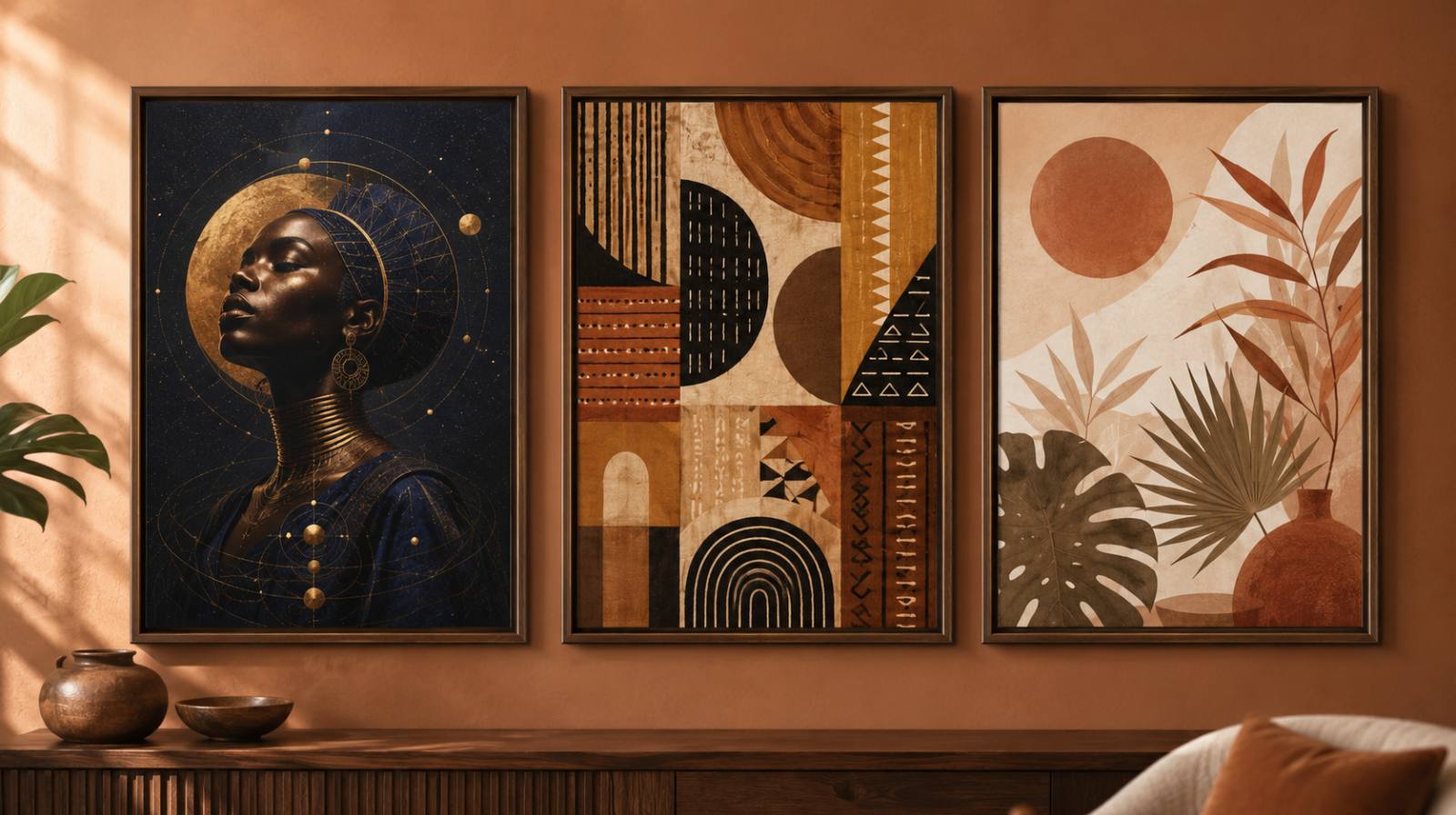
A small thought experiment. Imagine three pieces of wall art hanging next to each other on a clay-toned living room wall.
Piece A is a digital print of a Black woman in an indigo headwrap, painted in soft watercolor against a cream background, with subtle Ankara pattern in the wrap. This is Afrocentric. It centers Black identity, references African textile tradition, and uses a heritage-based color palette.
Piece B is a hand-painted abstract in mudcloth-inspired marks, framed in dark walnut, hung above a rattan armchair piled with cushions in mustard and terracotta. The piece is technically Afrocentric, but the room around it is Afro-Bohemian — the styling is the story, not the artwork.
Piece C is a digital portrait of a Black woman with a metallic bronze headdress against a deep black starfield, framed in wide bronze. This is Afrofuturist. It centers Black identity, but it adds speculative imagination — the cosmic backdrop, the technological adornment, the future-oriented framing.
All three can live in the same home, on the same wall, in the same week. They just mean different things, and if you tag all three identically on a Pinterest board, you make every one of them harder to find.
Where the lines blur (honestly)
These categories are not concrete walls. They overlap in real, useful ways.
- A modern Afrocentric portrait with metallic accents sits on the boundary between Afrocentric and editorial Afrofuturism.
- A soft Afro-Bohemian room with one cosmic Afrofuturist piece above the sofa is a real and increasingly common interior — the room is Afro-Bohemian, the focal artwork is Afrofuturist.
- A solarpunk Afrofuturist piece showing a future African city full of plants is genuinely Afro-Bohemian-friendly, because the warmth, the plant life, and the earth tones all align.
- An ancestral-technology Afrofuturist abstract in muted bronze and indigo is hard to tell from a contemporary Afrocentric abstract without context. Both are valid descriptions.
The lines blur most often when a piece is both about Black heritage and oriented toward future imagination. The cleanest rule we have is this: if the work is asking what does a Black future look like? it is Afrofuturist. If it is asking what does Black identity look like, right now or across time? it is Afrocentric. If you are asking how do I style my room around this aesthetic? you are in Afro-Bohemian territory.
How to mix them in one home
These three vocabularies can live together beautifully. We have built rooms doing exactly this. The rules we use:
- One Afrofuturist focal piece per room, maximum. It is a strong aesthetic. More than one and they start competing.
- Build the supporting cast with Afrocentric work. Soft portraits, textile-pattern abstracts, heritage-referenced pieces. They give the room cultural depth without escalating the visual intensity.
- Let Afro-Bohemian styling carry the rest. The rattan, the plants, the mudcloth cushions, the warm rugs. This is what makes the room feel like a home rather than a gallery.
- Unify the palette. All three traditions look excellent in bronze + indigo + terracotta + cream + charcoal. Picking a palette and holding it is the single best way to make a mixed room feel intentional.
FAQ
Is Afro-Bohemian the same as Afrocentric? No. Afrocentric is a broad art and design framework that centers African and African-diasporic identity. Afro-Bohemian is a specific interior decor style that combines African-inspired textiles with bohemian layering, plants, and earthy palettes. A room can be Afro-Bohemian and contain no Afrocentric art at all; conversely, Afrocentric art can be styled in many ways other than Afro-Bohemian.
Is Afrofuturism a kind of Afrocentric art? Yes. Afrofuturism is a specific branch of Afrocentric work that focuses on speculative imagination — Black futures, technology, myth, science fiction. All Afrofuturist art is Afrocentric. Not all Afrocentric art is Afrofuturist.
Which one is right for my home? You do not have to choose just one. A common setup is Afro-Bohemian styling overall, with Afrocentric wall art as the supporting cast, and one Afrofuturist focal piece per room. Pick the styling that fits how you actually live in the room.
Can a piece be both Afrocentric and Afrofuturist? Yes — by definition. All Afrofuturist art is Afrocentric. Many editorial Afrofuturist pieces sit comfortably under both labels and can be tagged with both on Pinterest.
Are these terms culturally specific? Yes. All three center African and African-diasporic culture. The terms were created within Black cultural conversations, and the strongest contemporary work in each tradition is being made by Black artists. As non-Black admirers, the healthiest engagement is to buy from Black artists, learn the histories, and use the terms accurately rather than interchangeably.
A closing note
Words matter, especially when they point to living cultural traditions. The distinction between Afrofuturism, Afrocentric, and Afro-Bohemian is not pedantic — it is the difference between buying the piece you actually wanted and buying something else with similar tags. Once the categories are clear, your choices get easier, your rooms get more coherent, and the artists you support get found by the readers who were genuinely looking for them.
If you want a starting place that sits cleanly inside the editorial-Afrofuturist tradition, the Indigo Archives collection is six volumes of three-piece gallery sets in indigo, cream, and charcoal. Repeat buyers can use code ARCHIVE15 for 15% off.
Related reading from us
- What Is Afrofuturist Art? A Calm, Honest Guide (the first post in this cluster)
- How to Style Afrofuturist Wall Art at Home Without It Looking Like a Cliché (the previous post in this cluster)
- Find Your Afrocentric Home Style
- Afro Boho Living Room Ideas
- How to Mix Global Motifs
- African Textiles Meaning Guide