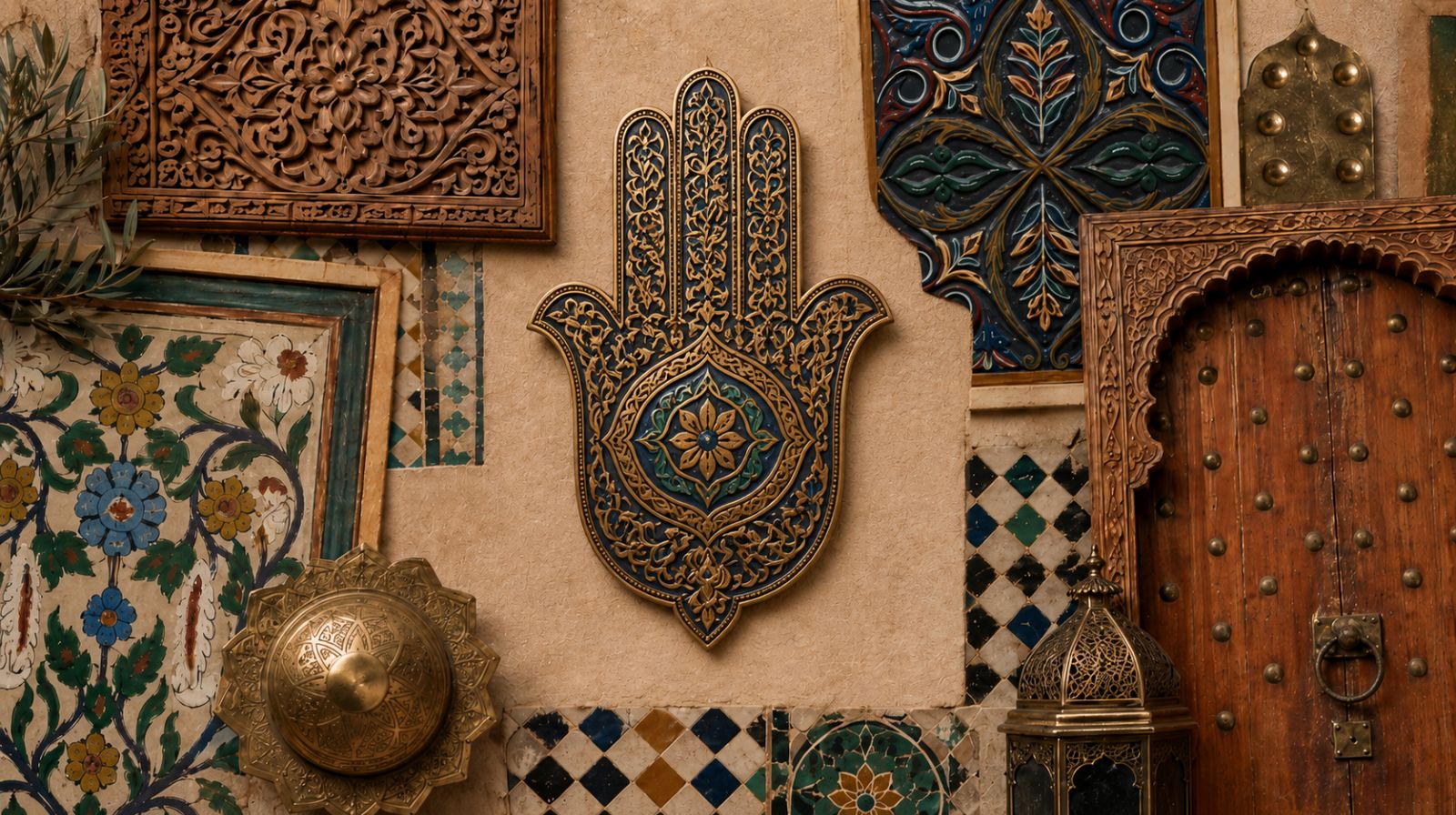
12 Moroccan Symbols & Their Meanings: A Decor Lover’s Guide
By Essence of the Road Art · Published May 2026
This article contains affiliate links. If you buy through our links, we may earn a small commission at no extra cost to you. We only recommend pieces we’d style in our own homes.
Why we wrote this
Most decor articles on Moroccan style stop at the surface — the terracotta walls, the lantern light, the patterned tile, the photogenic riad courtyard. They tell you what to buy. They almost never tell you what you are buying.
Stand for a moment in front of a Beni Ourain rug. The cream wool. The slow charcoal diamonds. The slight irregularity of the weave, the way no two diamonds are quite identical. Somewhere in the Middle Atlas, on a loom strung between two upright wooden posts, a woman wove that rug — probably from her own herd’s wool, probably with her daughter beside her, probably while a kettle was boiling somewhere out of sight. The diamonds she wove were not a fashion choice. They were a quiet wish: that no harm reach the bed this rug would lie beneath, that no envious eye find the body sleeping on it, that the household stay whole.
You can hang the rug without knowing any of that. It will still be beautiful. But the beauty changes once you know what you are looking at, the way a song in a language you suddenly understand changes.
We are not Moroccan. We make Afrocentric wall art, and the rest of this article is about a tradition that belongs to other people. We are writing it the way we would want someone writing about our own visual language to write — with care, with sources, and without flattening anything into shorthand. Where the meaning of a symbol is contested or layered, we have tried to say so plainly rather than picking the prettiest version.
This is the first piece in a small series we are building on the symbols behind culturally-rooted decor. Morocco is the natural place to begin because so many homes already include a Moroccan piece — and so few owners have ever been told what they are actually living with.
📌 Quick Answer
The twelve most recognisable Moroccan symbols are the diamond (lozenge), the zigzag, the triangle, the cross, the X, the eye, the eight-pointed star (Khatim), the Khamsa or Hand of Fatima, the Yaz glyph, animal motifs (snake, fish, camel), the chevron, and the horseshoe arch. Most come from one of two cultural streams: the Amazigh (Berber) tradition of the Atlas Mountains, which gave us the protective geometry of handwoven rugs, and the Arab-Islamic tradition that arrived from the 7th century onward, which gave us zellige tilework and the Khamsa. Their shared theme — the thread that runs through nearly every motif — is protection. Of the home. Of motherhood. Of the spirit against harm.
Table of Contents
A note on cultures, names, and care
Two cultural streams sit underneath almost every Moroccan symbol you will ever encounter, and they do not run quite parallel.
The first is Amazigh — also called Berber, though many Amazigh people prefer their own name, which means the free people. Once you have read that translation, the geometry on every Atlas rug starts to look different. Amazigh communities have lived across North Africa for thousands of years, long before Arab arrival, long before French colonisation, long before any of us were here to put their work on Pinterest. Their symbolic vocabulary is mostly geometric: diamonds, zigzags, triangles, crosses, woven into wool by women working in mountain houses where the wind comes through the door whether you like it or not. Almost everything carries the same underlying themes — protection of the home, fertility, motherhood, the survival of a body and a household through a hard climate.
The second stream is Arab-Islamic, which arrived from the 7th century onward and brought a different visual logic with it: tilework cut by hand from glazed clay, calligraphy, mathematical geometry that tessellates infinitely without a seam, motifs like the eight-pointed star and the Khamsa. Islamic art generally avoids depicting living beings, which is part of why Moroccan visual culture is so geometric — and why, paradoxically, it can feel so alive. The two streams have lived alongside each other for over a thousand years, often in the same room, often in the same household. A Beni Ourain rug under a zellige-tiled wall is not a clash. It is the way Morocco actually looks.
We mention this because lumping every Moroccan symbol together as one tradition flattens a real cultural distinction — and because the distinction is interesting once you can see it.
A second note. Meanings are not always fixed. Researchers who have studied Amazigh weaving carefully — including the curators behind Layers of Morocco’s recent archive work — make a point of saying so: symbol interpretations are ethnographic tendencies, not absolute rules. A diamond may mean protection in one valley and family continuity in the next. The fact that meanings vary is not a flaw in the tradition. It is how a living visual language works, the way any language with regional dialects works. We have given the most widely-cited meaning for each symbol below, with a note where the meaning is contested or layered.
The 12 Moroccan symbols, one by one
1. The diamond (lozenge) — protection and femininity
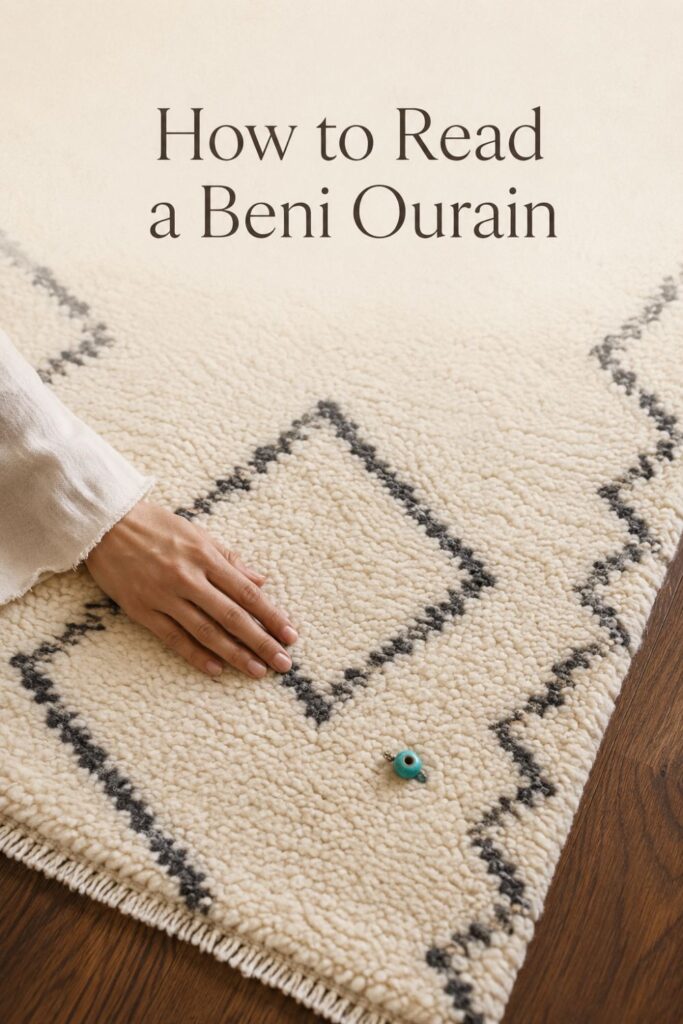
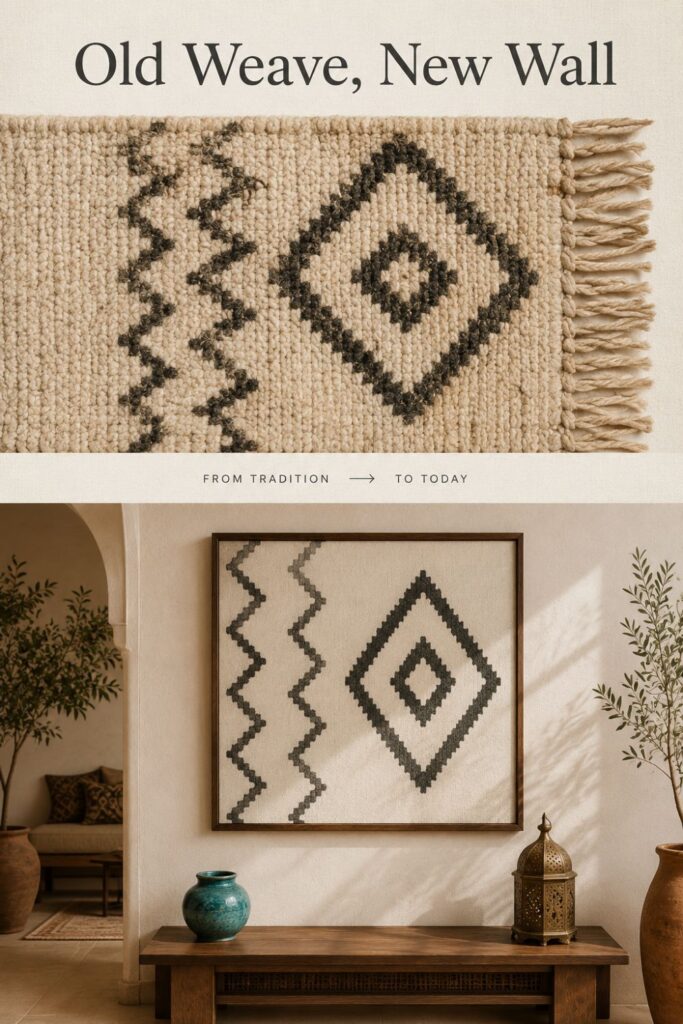
The diamond is the first motif most people notice on a Beni Ourain rug, and the last one they understand. Cream wool, charcoal lines, four corners pointing outward. It looks decorative. It is not.
The most widely-cited reading is protection against the evil eye — four corners as four guardian points, facing four directions, watching at every angle a threat could approach from. A second strong reading, just as old, is the female body, motherhood, fertility — the diamond as an abstracted woman, often woven into a piece meant for a marriage bed or a young mother. The two readings do not compete; they layer. A diamond is a body and a guard standing watch over the body, in a single shape.
In decor: the diamond works almost anywhere. Repeated in cream and charcoal, it built the entire Beni Ourain look that has dominated minimalist interiors for the past decade. Most owners of those rugs have no idea what they are sleeping on top of. We think they should.
2. The zigzag — water and the flow of life
Imagine the Middle Atlas in late summer. Dry stone, dry air, dry riverbeds where a year ago there was a river. In a region where water is the difference between life and not-life, a zigzag is not a decorative line. It is a wadi. A stream. A river finally arriving — and by extension, the flow of life itself, fertility, continuity through generations.
There is a second reading, less mentioned in decor blogs but well-attested in Amazigh ethnography: the zigzag as a serpent. Snakes appear in Amazigh folklore as figures of fertility and shamanic wisdom, and the zigzag echoes their movement so closely that it is hard to separate one reading from the other. Both are alive. Both keep things going.
In decor: zigzag-bordered rugs, kilim cushions, and zellige floor patterns all draw from this lineage. A zigzag-bordered runner in a hallway is not just pattern. It is a quiet wish for a household that flows.

3. The triangle — womanhood and fertility
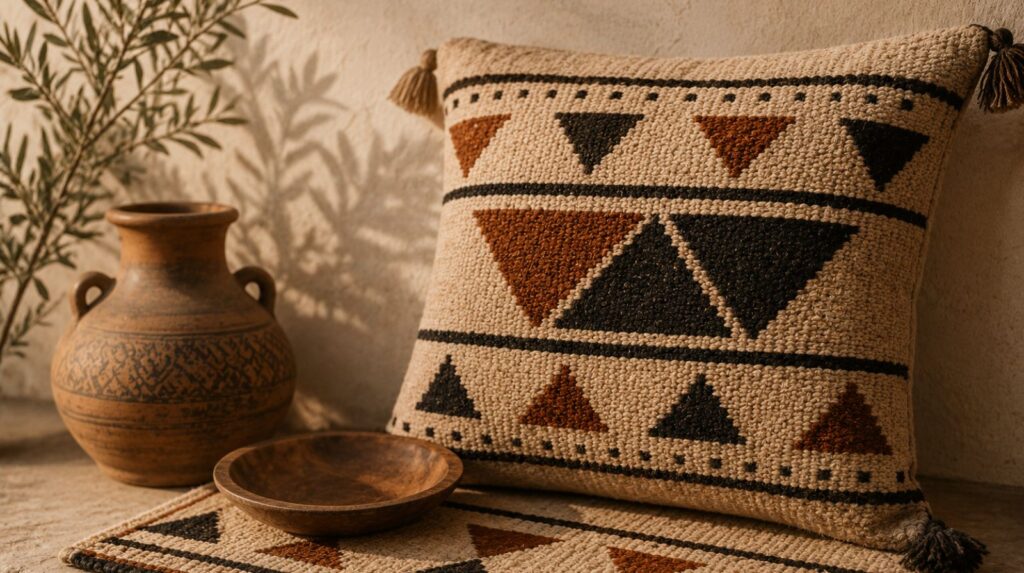
Where the diamond is settled — woman-as-protected-form — the triangle is more elemental. It signifies woman, fertility, and the protection of new life. A triangle pointing downward is sometimes specifically associated with motherhood; a triangle pointing upward, with strength and the masculine principle.
Two opposing triangles touching at the points become the diamond. This is part of why the diamond carries so much weight: it is two opposing forces meeting at a single still point, and in Amazigh symbology that meeting is what holds the world together.
In decor: triangle motifs work beautifully at small scale — pillows, table runners, framed weavings — where the rhythm and the geometry can be appreciated. Not every symbol needs to live on a rug.
4. The cross — balance between worlds
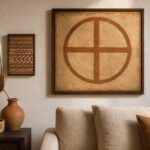
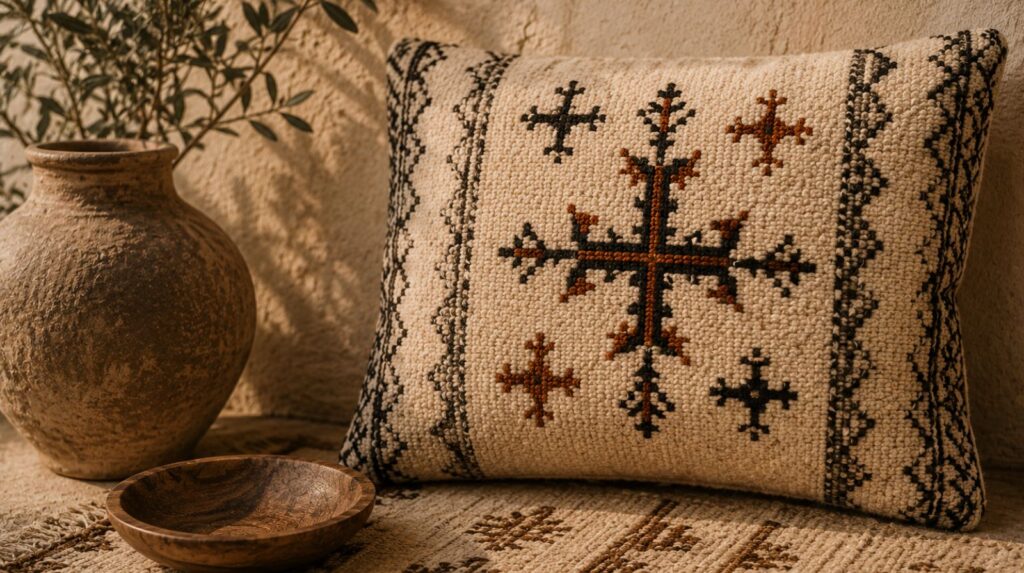
The Amazigh cross is not the Christian cross. It predates it in this region by thousands of years, and it carries a different load. It signifies balance — between the physical and the spiritual, between the four directions, between opposing forces held in equilibrium.
In some Atlas tribes the cross also marked tribal identity, woven into rugs and tattooed onto the faces of women as a quiet declaration of belonging. The tattoo tradition has largely faded; the woven cross has not.
In decor: less common in mass-market Moroccan decor than the diamond and the zigzag, which is exactly why an authentic cross-motif piece feels distinct. If you see one, look at it twice.
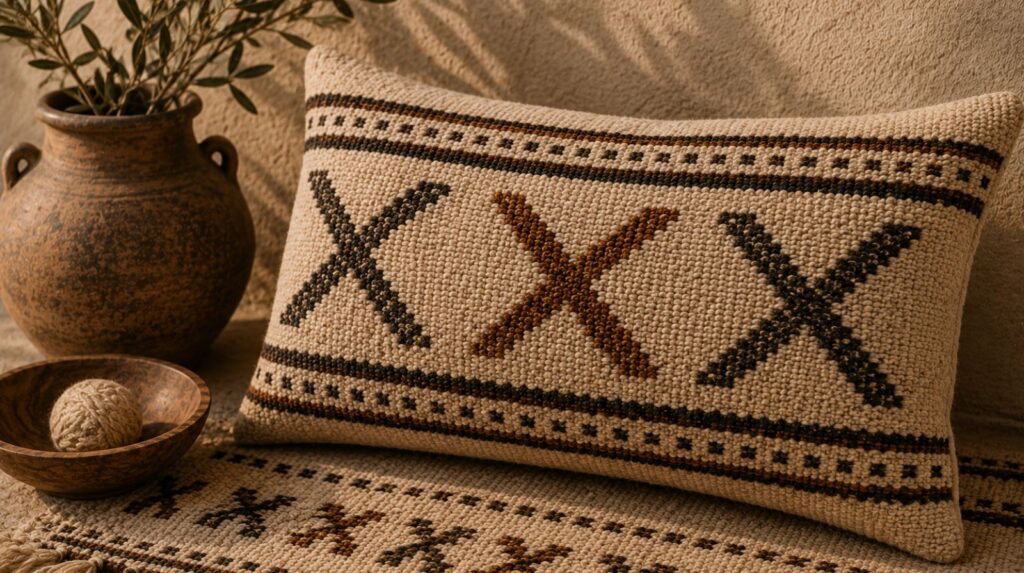
5. The X — motherhood and life-giving power
Closely related to the cross, the repeated X across many Berber rugs carries a more specifically maternal meaning: strength, motherhood, the life-giving power of the feminine. Some interpretations link it to the body itself, to the angles a body takes in childbirth, to the motion of arms reaching up.
In decor: rows of X motifs across a rug border or a kilim panel read as quiet rhythm rather than statement — which is exactly the point. Amazigh women rarely wove for spectacle. They wove for use, for warmth, for the people who would sleep under the work, and the symbols entered the cloth the way salt enters bread.
6. The eye — the gaze that protects against the evil eye
The evil eye — ain al-hasud in Arabic, the envious gaze — is one of the oldest beliefs in the Mediterranean. The countermeasure is a counter-gaze: an eye woven, painted, or carried that watches back.
You will find eye motifs woven into rug borders, set into the centre of Khamsa amulets, and painted in the famous Moroccan turquoise blue, a colour that is itself protective. The eye does not just decorate. It defends.
In decor: a small evil-eye amulet near an entryway, a Khamsa with a centred eye on a wall, or eye motifs subtly worked into a rug pattern. The piece does not need to announce itself to do its work.
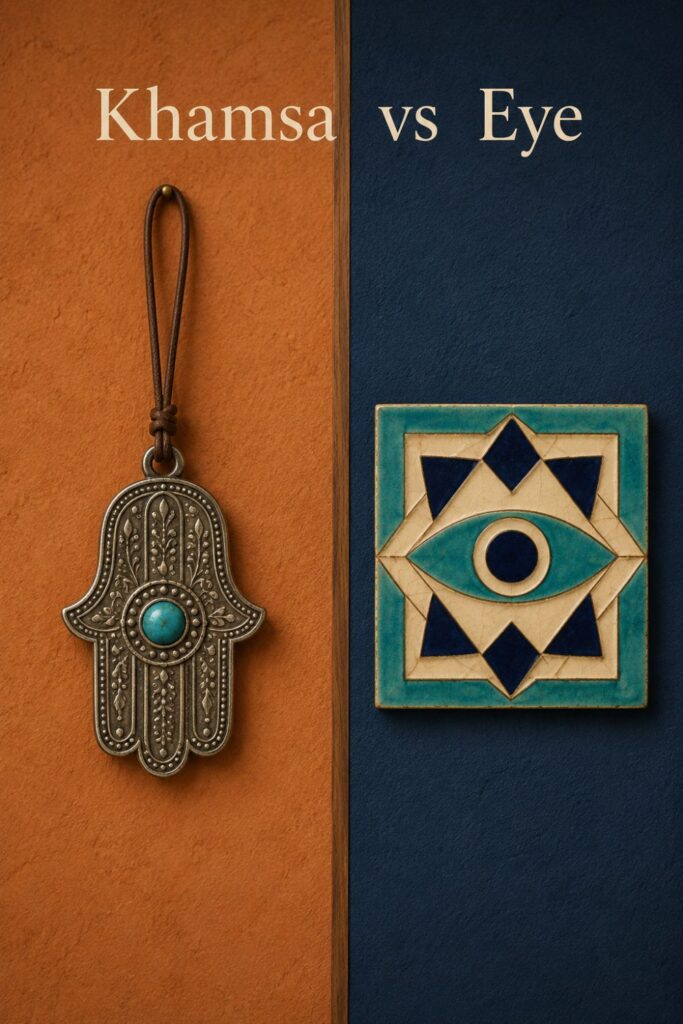
7. The eight-pointed star (Khatim) — cosmic order
This is the symbol you see when you walk into any Moroccan riad, mosque, or zellige-tiled courtyard, and look up. It is everywhere — and yet most decor articles describe it only as “geometric,” which is the kind of word people use when they have not understood what they are looking at.
The eight-pointed star is called Khatim or Khatim Sulayman — the Seal of Solomon, the Seal of the Prophets. It is constructed by overlaying two squares at a 45-degree angle. It signifies cosmic order, the balance between heaven and earth, divine harmony. In Islamic tradition it carries strong associations with prophetic authority and with the order underlying the universe.
It is also a profound piece of mathematics. Zellige patterns are built on the eight-pointed star because it tessellates infinitely without gaps — a single shape that, repeated, fills space without ever leaving a seam. The repetition is not just aesthetic. It is a visual argument that the universe holds together at every scale, and that the work of a craftsman in a Fez tile workshop is not separate from the work of the stars overhead. They are doing the same thing. Just at different sizes.
In decor: zellige tile splashbacks, tile-pattern wall art, framed zellige photography, decorative ceramic plates. The eight-pointed star elevates a room because it carries weight that no graphic motif on its own can carry.
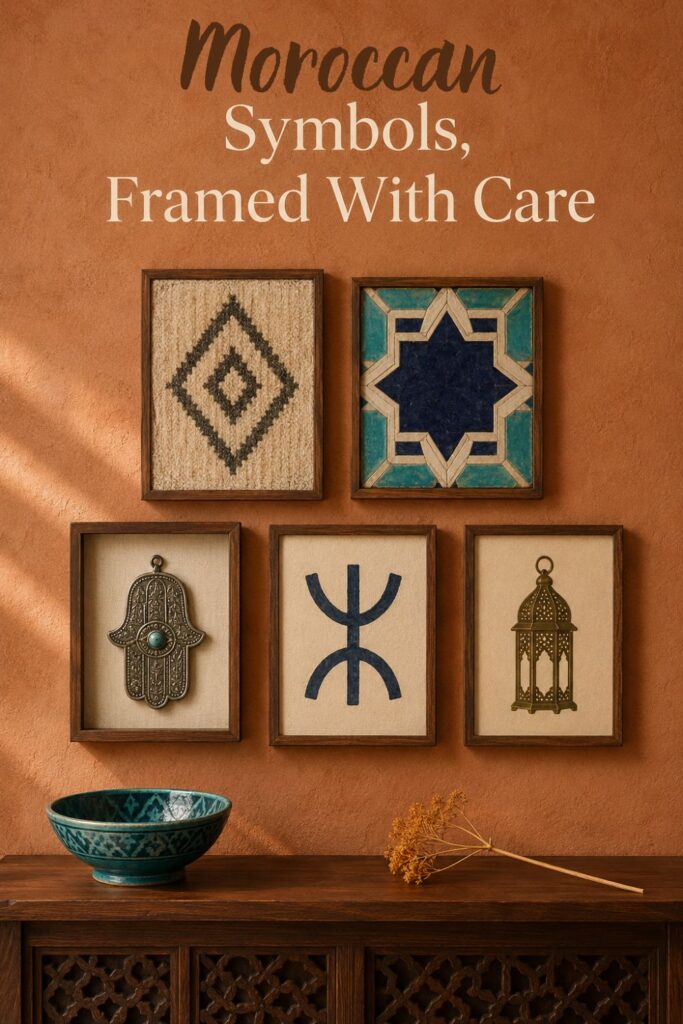
8. The Khamsa (Hand of Fatima) — five fingers of protection
The Khamsa is the most famous Moroccan symbol in the world. It is also the most misnamed.
The Arabic word khamsa simply means five — the five fingers of an open palm. The amulet itself is much older than Islam: Phoenician, possibly Punic, traceable back through the goddess Tanit to the city of Carthage on what is now the Tunisian coast. It is a protective sign against the evil eye, used across Jewish, Muslim, and Christian communities throughout the region. Sephardi Jews call it the Hand of Miriam. Levantine Christians call it the Hand of Mary. Muslims call it the Hand of Fatima, after the Prophet Muhammad’s daughter — though scholars note this name is comparatively recent and was popularised in part through colonial-era French use, where European soldiers in North Africa took to calling local women Fatima and the amulet name stuck. (Once you know that, the name lands a little differently.)
The five fingers carry layered meaning, depending on who is wearing the amulet: the five pillars of Islam in Sunni tradition, the five members of the Prophet’s family in Shia tradition, the five letters of the name Allah, the five senses, the five daily prayers. It is a single symbol that holds many readings at once and does not insist on one.
The Khamsa often contains a small eye in the centre of the palm — a doubled protection, hand and gaze working together. The traditional colour of that eye is turquoise. It is no accident.
In decor: a Khamsa near a doorway is the traditional placement, the way a mezuzah sits at the doorframe in a Jewish home — a protector at the threshold. As wall art, it works particularly well rendered in indigo or turquoise on a warm cream or terracotta ground.
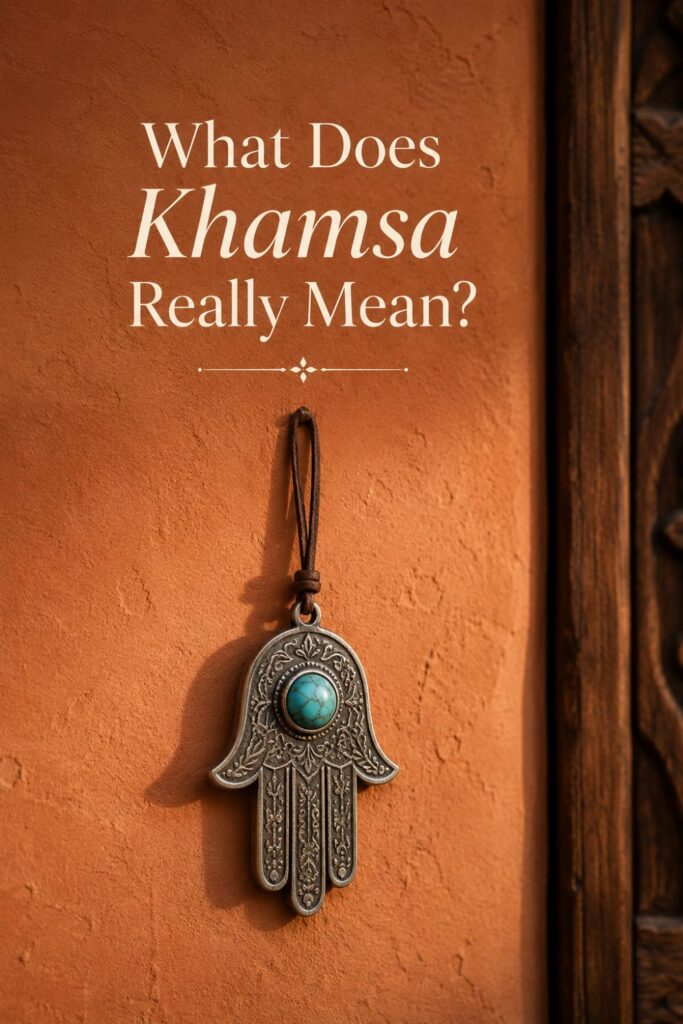
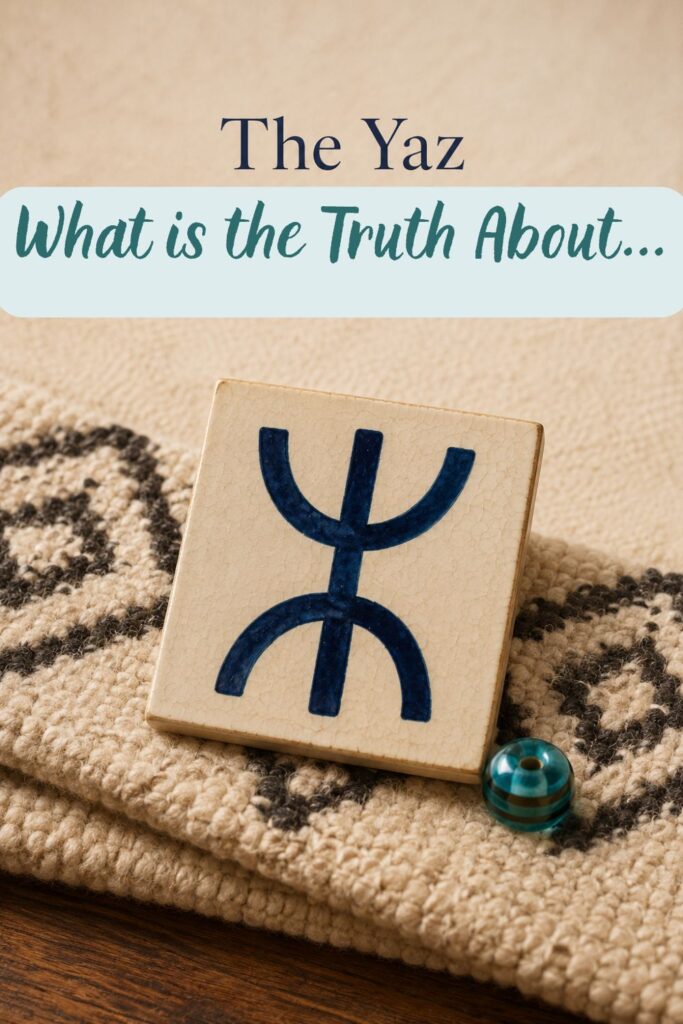
9. The Yaz glyph — the free spirit
The Yaz (ⵣ) is the boldest letter in Tifinagh, the ancient Amazigh writing system. A vertical line with two arms raised. Look at it long enough and you see a standing figure, head up, arms wide. It signifies the free man or free woman — the unbroken spirit at the heart of Amazigh identity. The word Amazigh itself translates as free people, and the Yaz is the visual form of that word.
You will see the Yaz on the modern Amazigh flag, in contemporary Amazigh activist art, in heritage-conscious wall art and silver jewellery. It is one of the few Moroccan symbols that is openly political — a quiet declaration of cultural identity in a country whose dominant official language is Arabic.
In decor: a Yaz-motif piece is a strong, specific choice. We would not blend it into a busy gallery wall. It works best where it can stand alone and mean what it means.
10. Animal motifs — snake, fish, camel
Three animals show up again and again in Moroccan symbolism, each carrying a different weight.
- The snake (or zigzag-as-snake) — fertility, transformation, shamanic wisdom. In pre-Islamic Amazigh folklore snakes were associated with healing rituals and feminine spiritual power. Some of the oldest woven zigzags in the Atlas tradition are read first as serpents and only second as water.
- The fish — fertility and protection against the evil eye, especially in coastal and southern Moroccan traditions. Fish charms are still hung over the cradles of newborn babies in some southern communities, the way a Khamsa is hung in others.
- The camel — endurance, patience, the long journey. The camel motif appears in textiles from desert and pre-desert communities, and it sometimes stands for the journey of a life rather than a literal trip across sand.
In decor: animal motifs in Moroccan textiles tend to be highly stylised — abstracted into geometric forms rather than rendered realistically. To most eyes, a snake-zigzag rug and a camel-motif kilim read simply as pattern. To a weaver, they are different prayers.

11. The chevron — rhythm and continuity
The chevron — a repeated V — is closely related to the zigzag, and shares some of its meanings: fertility, the cyclical nature of life, the constant rhythm of birth and death and birth again. Some readings interpret the V as the legs of a bird mid-step, a common motif in Amazigh weaving where birds carry their own associations with freedom and message-bearing.
In decor: chevron borders are one of the most adaptable Moroccan textile elements we know of. They sit comfortably in a contemporary mid-century modern room. They sit comfortably in a layered earthy-bohemian one. They almost never fight a piece.

12. The horseshoe arch — threshold and welcome
The horseshoe arch is the signature element of Moorish and Moroccan architecture — visible in mosques, riads, palaces, and the carved wooden screens of family homes. It travelled with Islamic architecture through Andalusia, and the Alhambra in Granada is one of its most famous expressions; for centuries before the Reconquista, this shape was the visual language of southern Spain as much as of North Africa.
The arch is a threshold. A passage from one space, and one state, into another. Architecturally, it carries the weight of the wall above. Symbolically, it marks where the public ends and the private begins, where the secular ends and the sacred begins, where the outside ends and the home begins. Walk through one and your shoulders drop; that is what a threshold is for.
In decor: arch-shaped mirrors, arched wall panels, and arched framing in wall art are the contemporary descendants of this tradition. An arched mirror in a hallway is one of the most elegant ways we know to nod to Moroccan architecture without committing to a full Moroccan room.

How to live with Moroccan symbols at home
A short, practical section, because intention matters and lists help.
Use one or two pieces, not ten. A single Khamsa, well placed, says more than a wall full of mixed motifs. Symbols accumulate meaning by being given space, not by being crowded. A room that announces its theme is rarely a room that holds it.
Mix Amazigh and Islamic pieces consciously. A Beni Ourain rug under a zellige-pattern wall piece places two cultural traditions in dialogue. That is fine — Moroccan homes have done it for over a thousand years — but it is worth knowing that you are doing it, and that the dialogue is the room’s actual character.
Buy from sources that respect the tradition. A handwoven rug from an Amazigh cooperative, a hand-cut zellige tile from Fez, a Khamsa from an artisan who knows what she is making — these carry the tradition forward. Mass-produced print-on-demand Moroccan-themed wall art generally does not. The aesthetic survives the cheaper version. The meaning rarely does.
Honour the protective intent where it exists. A Khamsa is traditionally placed near a doorway. An eye amulet faces outward, not inward. These are not absolute rules — and Moroccan homes themselves break them constantly — but following them is one quiet way to honour the meaning of a piece you have chosen to live with.
What to look for when buying — and what to avoid
If you are choosing Moroccan-symbol decor for your home, four signals matter most.
1. Origin clarity. Where was it made, and by whom? An authentic Beni Ourain rug comes from the Beni Ourain confederation of tribes in the Middle Atlas. A piece sold as “Moroccan-style” with no origin information is usually a print-on-demand product with no actual cultural connection — a costume, not a tradition.
2. Material integrity. Real Amazigh rugs are wool, often undyed. Real zellige is fired clay, glazed, hand-cut into shapes that took an apprentice years to learn to cut. Real Khamsas in jewellery tradition are usually silver, sometimes with enamel. If a piece is marketed as Moroccan but made from synthetic fibre or printed plastic, the meaning rarely survives the substitution. Wool insulates a body in cold mountain air. Polyester does not, and was not woven with that body in mind.
3. Symbol accuracy. Some mass-market “Moroccan” wall art uses motifs that are not actually Moroccan — generic geometric patterns labelled as Berber, or Arabic-looking calligraphy that is actually nonsense letters arranged for the look. Read what you are buying. Ask the seller what the symbol means. If they cannot answer, that is its own answer.
4. Price honesty. A genuinely handwoven Beni Ourain rug takes weeks of work, sometimes months, and cannot be priced like a factory rug from a warehouse. If a piece is suspiciously cheap, it is almost certainly not what its label claims.
For wall art specifically, our own Indigo Archives — Quiet Afrocentric Luxury Collection is not Moroccan — it is Afrocentric, in indigo, cream, and charcoal — but it shares the same design philosophy: hand-drawn, culturally rooted, designed to live alongside Moroccan pieces rather than replace them. Use code ARCHIVE15 for repeat-buyer pricing.
If you are looking specifically for affordable, well-framed wall art that complements Moroccan symbol decor — an arched mirror, a simple linen-toned frame, a clay vessel for a console table — Amazon carries solid options in the under-$50 range. We will return to specific product picks in our upcoming guide on the best frames for culturally-rooted wall art.
FAQ
What is the most important Moroccan symbol?
There is no single answer, but the Khamsa (Hand of Fatima) is the most universally recognised, the diamond is the most widespread within Amazigh weaving, and the eight-pointed star is the most architecturally significant. Each carries weight in a different setting: the Khamsa as a personal and household protector, the diamond as a quiet woven blessing, the star as a statement of cosmic order. The right one for your home is the one whose meaning you actually want to live with.
What is the difference between Amazigh and Arab Moroccan symbols?
Amazigh (Berber) symbols are mostly geometric and woven — diamonds, zigzags, triangles, crosses — and come from a tradition that predates Arab arrival in Morocco by thousands of years. Their themes centre on protection, fertility, motherhood, and survival in a hard climate. Arab-Islamic symbols arrived from the 7th century onward and tend toward mathematical tilework and calligraphy — the eight-pointed star, the Khamsa, the horseshoe arch. Their themes centre on cosmic order, divine harmony, and the protection of the home and the threshold. Both traditions have lived alongside each other for over a thousand years, and most Moroccan homes today carry pieces from both.
Is it disrespectful to use Moroccan symbols in my home if I’m not Moroccan?
Generally, no — but intention and sourcing matter. The Khamsa is a symbol that has crossed cultural and religious boundaries for centuries; it is widely worn and hung by people of many backgrounds, including non-Muslims and non-Arabs. Amazigh weaving symbols are similar in their portability. What matters is buying from sources that respect the tradition (artisan cooperatives, fair-trade sellers, named artists) rather than mass-produced knock-offs, and being honest about not flattening the meaning. A Khamsa hung as wall art is a continuation of an old tradition. A Khamsa printed on a fast-fashion bag is something else. The difference is mostly about who gets paid, and whether the piece has any chance of carrying its meaning forward.
Why does the Khamsa often have an eye in the centre?
The eye in the palm is a doubled protection — the hand wards off harm physically, the eye sees harm before it arrives. This combination predates Islam and appears in pre-Islamic talismans across the Mediterranean world, from ancient Egypt to Phoenicia to Carthage. The colour matters, too: turquoise blue is the traditional protective shade, and Moroccan Khamsas are often painted in this colour even when the rest of the piece is in different tones. It is not stylistic. It is functional, in the same sense that a doorbell is functional.
What colours are traditionally used in Moroccan symbol decor, and what do they mean?
The five most meaningful colours are: blue (especially turquoise) for protection; green for paradise, peace, and nature; yellow for the sun and divine light; white or cream for purity and blessings; red or terracotta for life, vitality, and the earth itself. These meanings are not absolute, but they recur consistently enough across Moroccan textiles, tilework, and pottery that they function as a working colour vocabulary. If you are choosing a palette for a Moroccan-influenced room, this is a more durable starting point than any current trend.
Do Moroccan symbols work in mid-century modern interiors?
Yes — and the combination is one of the more interesting things happening in interior design right now. Mid-century modern’s clean structural lines turn out to be an excellent container for individual Moroccan symbol pieces: a single eight-pointed-star tile detail, a Khamsa wall piece, a chevron-bordered rug. The mid-century container provides discipline. The Moroccan accent provides depth. Neither has to dominate. We wrote about this dynamic at length in our piece on global decor trends in 2026.
A closing note
A diamond on a Beni Ourain rug carries the same meaning in 2026 that it carried in 1926, and likely in 1626 — a quiet wish for protection, woven by a woman whose mother taught her how, on a loom that is still being used somewhere in the Middle Atlas tonight. That kind of continuity is rare in a decor world built on next-season novelty. It is also the actual point of culturally-rooted decor, the part the trend articles miss.
If you take only one thing from this piece, let it be this: when you bring a Moroccan symbol into your home, you are not adding a decoration. You are joining a conversation that has been going on for centuries, one that your wall is now part of. The right response is not reverence — these symbols are also working, daily, lived-with things, and treating them like museum objects misses what they are for. The right response is attention. Look at what you have chosen. Know what it means. Place it where its quiet work can be done.
That, as far as we can tell, is the difference between styling a room and making a home.
“The hand has remained a powerful symbol ever since.” — from a 2016 Jerusalem Fund essay on the Hand of Fatima
We would add: which is exactly why a piece carrying these symbols feels different on the wall than a piece that merely looks like them. The hand at the threshold is still doing its old work. The wall just changed.
Also read:
- Afrocentric Home Decor Beyond Wall Art: 9 Everyday Pieces That Carry the Same Design
- 15 Mudcloth Pillows for Modern Homes: A Curated Buying Guide
- Modern Cozy Living Room: Warm Afro-Neutral Wall Art That Grounds the Space
- Black Thanksgiving Decor: An Ancestral Harvest Table and Wall

- Dining Room Decoration Ideas: An Afrocentric Gallery Wall Above the Sideboard
- Fall Bedroom Decor Ideas: An Afro-Boho Gallery Wall Above Your Bed