How to Style African Prints in a Modern Home
By Essence of the Road Art · Published April 2026
The line between “cultural” and “costume” is closer than you think
There is a specific kind of room we are trying to help you avoid. The one where mudcloth meets Kente meets carved masks meets three different types of basket — all in the same 12 square feet. It is well-intentioned, but it reads as a stage set, not a home. The textiles stop speaking because they are shouting at each other.
The goal with how to style African prints is the opposite: one voice at a time, layered with restraint. Your home should feel like someone lives there, loves these textiles, and understands them — not like a pop-up exhibition.
In this guide, we walk through the exact styling rules we use: where to start, how to mix patterns without chaos, how to use walls and floors strategically, and — our favorite section — how to DIY real cultural texture into a room for almost no money. If you have not read our companion guide to what these textiles actually mean, start there first. Styling comes after understanding.
“I come as one, but I stand as 10,000.” — Maya Angelou
📌 Quick Answer
To style African prints in modern decor without a theme-room effect, start with one patterned accent piece, keep surrounding furniture in solid warm neutrals, and follow the pattern-mixing rule of three: vary scale, share one color, mix styles. Use walls and rugs as your boldest surfaces, and balance every pattern with two calm materials (such as linen, jute, or raw wood). A DIY frame or reupholstered stool often looks more intentional than a store-bought set.
Table of Contents
The one rule that separates cultural from costume
Before you buy or make anything, internalize this:
One textile should be loud. Everything else should be quiet.
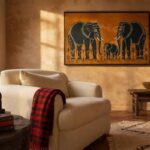
That is the whole rule. A room with one mudcloth pillow against a linen sofa feels grounded. A room with mudcloth pillows and Ankara curtains and a Kente throw and a carved mask wall feels like a gift shop. Cultural depth is not achieved through volume — it is achieved through restraint and specificity.
Once you know which textile is the voice of the room, every other choice becomes easier. Supporting pieces should be in solids, textures, or nearly-neutral patterns that make the anchor textile sing.

Start small — the accent-piece method
If you are new to styling bold prints, do not start with a sofa. Start with something small, changeable, and low-stakes.
Our recommended starter hierarchy:
- A throw pillow or two — easy to swap, big visual impact
- A single framed textile square — wall art you cannot spill on
- One small upholstered piece — a stool, ottoman, or bench
- A folded throw — draped over a sofa arm or the foot of a bed
- A table runner or placemats — dining room cultural layer
These are the pieces that let you test how a pattern feels in your actual light, your actual space, with your actual furniture. A mudcloth pillow in the store looks one way. A mudcloth pillow in your living room at 4 PM sunlight looks entirely different.
Amazon staples that work as starter accents:
| Piece | What to look for | Approx. price |
|---|---|---|
| Mudcloth-inspired pillow covers | 100% cotton, 18×18, cream on black | ~$15–20 each |
| Kuba-cloth-style throw blanket | Raffia texture or woven cotton, natural earth tones | ~$40–60 |
| Woven bench cushion in Kente palette | Gold, green, and black colorway | ~$35 |
| Table runner in indigo batik | Cotton, 14 × 72 inch | ~$25 |
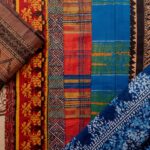
A note on language: almost every Amazon listing will say “African print.” Almost none will specify whether it is mudcloth, Kente, or Ankara-inspired. The tradition-respectful thing to do is research the pattern before you call it by a name. If you cannot confirm the origin, “inspired-by” is the honest label.
How to mix patterns without chaos
If you want more than one print in the room — and eventually you will — follow the pattern-mixing triangle: scale, color, style.
1. Scale. Pair one big pattern with one small one. A bold Ankara pillow sits beautifully next to a tight Shweshwe cushion because one dominates and the other breathes. Two big-scale prints next to each other cancel each other out.
2. Color. Every pattern in the room must share at least one color. If your mudcloth is black-and-cream and your Ankara throw is fuchsia-and-gold, the bridge color might be cream — both patterns share it, so the eye reads them as related even though they are completely different traditions.
3. Style. Counter-intuitively, mixing a geometric with an organic pattern usually looks better than mixing two geometrics. Mudcloth (geometric) against Ankara florals (organic) reads as collected. Mudcloth against a Greek key rug reads as confused.
A practical example, head to toe:
- Sofa: solid warm oatmeal linen (the rest area)
- Pillow 1: mudcloth-inspired cream and black, 20×20 (the anchor)
- Pillow 2: small Shweshwe-style pattern in indigo, 16×16 (the scale contrast)
- Throw: solid terracotta knit (the color bridge to the rug)
- Rug: jute with a faint terracotta stripe (the grounding)
Two patterns. Three solids. One shared color. Cohesive every time.
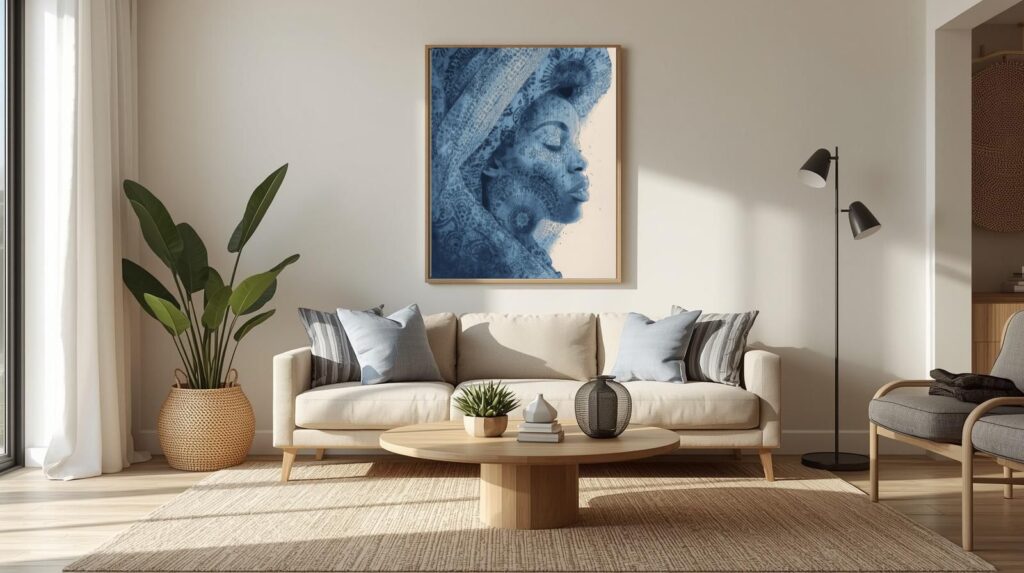
Statement walls and framed textile art
Walls are where we think African textiles are most underutilized in Western decor. A framed length of Kente, a stretched-canvas Kuba cloth, or a trio of Adire squares will do more for a living room than any amount of accessorizing.
Why walls work:
- Textiles look intentional when elevated. On the floor, a rug is traffic. On the wall, the same pattern is art.
- No wear, no spills. A wall textile outlasts every sofa cushion.
- Scale opportunity. A large framed textile can cover the two-thirds-sofa-width rule (around 48 inches for a 72-inch sofa) in a single piece.
For renters or for anyone who does not want to commit to a specific textile purchase yet, printable wall art bridges the gap. Our own Indigo Archives — Quiet Afrocentric Luxury Collection was designed as a visual conversation with Adire traditions (not a replacement for them) — six editorial sets in indigo, cream, and charcoal, sized for gallery-scale walls. Returning readers can use ARCHIVE15 as a collector’s code.
For affordable framing:
- Thin gallery frames in matte black, 16×20, sold as sets (~$40 for three)
- Floating picture ledge with removable strips (~$25 for three)
Rugs and curtains — when to go bold, when to go neutral
The floor and the windows are the two largest pattern surfaces in any room. Unless you want your space to feel like a maximalist gallery, pick one to be bold and let the other stay quiet.
Option A — Bold rug, quiet curtains. A Kuba-pattern or kilim-style rug grounds the room and handles most of the cultural visual weight. Pair with linen or cotton curtains in natural white, oatmeal, or sand.
Option B — Bold curtains, quiet rug. Ankara drapes turn the windows into the room’s showpiece. Pair with a plain jute or sisal rug underneath.
What not to do: bold rug + bold curtains + patterned sofa + gallery wall. Somebody loses, and it is usually the reader’s eye.
Affordable anchoring pieces:
- Jute rug, 5×7 (~$80) — use when textiles dominate elsewhere
- Neutral linen curtain panels, 84 inch (~$30 per panel) — your “quiet” option
DIY — 5 projects that look expensive and cost almost nothing
This is the section we actually think is the most fun — and the most original. Because the truth is, the most beautiful Afrocentric rooms we have seen are not the ones with the biggest budgets. They are the ones where someone sat on the floor with a staple gun and made the room their own.
Here are five projects that require almost no skill, almost no money, and deliver the highest emotional payoff of anything in this guide.
DIY 1 — Framed fabric scrap gallery wall
What you need: 3–5 fabric remnants (Ankara, Adire, mudcloth-inspired, or scraps from an old garment), matching thin gallery frames, scissors. Time: 30 minutes. Cost: Frames around $40 for a set, fabric often free from your own closet.
Cut each fabric scrap to the frame’s interior dimensions. Press flat. Place behind the frame’s glass. Hang in a tight grid of three, or a loose row of five. The result: a curated-looking wall of textile art that costs less than a single decent art print.
Pro tip: if you have an old Ankara dress or a grandmother’s fabric you no longer wear, this is the project that honors it. The memory enters the room.
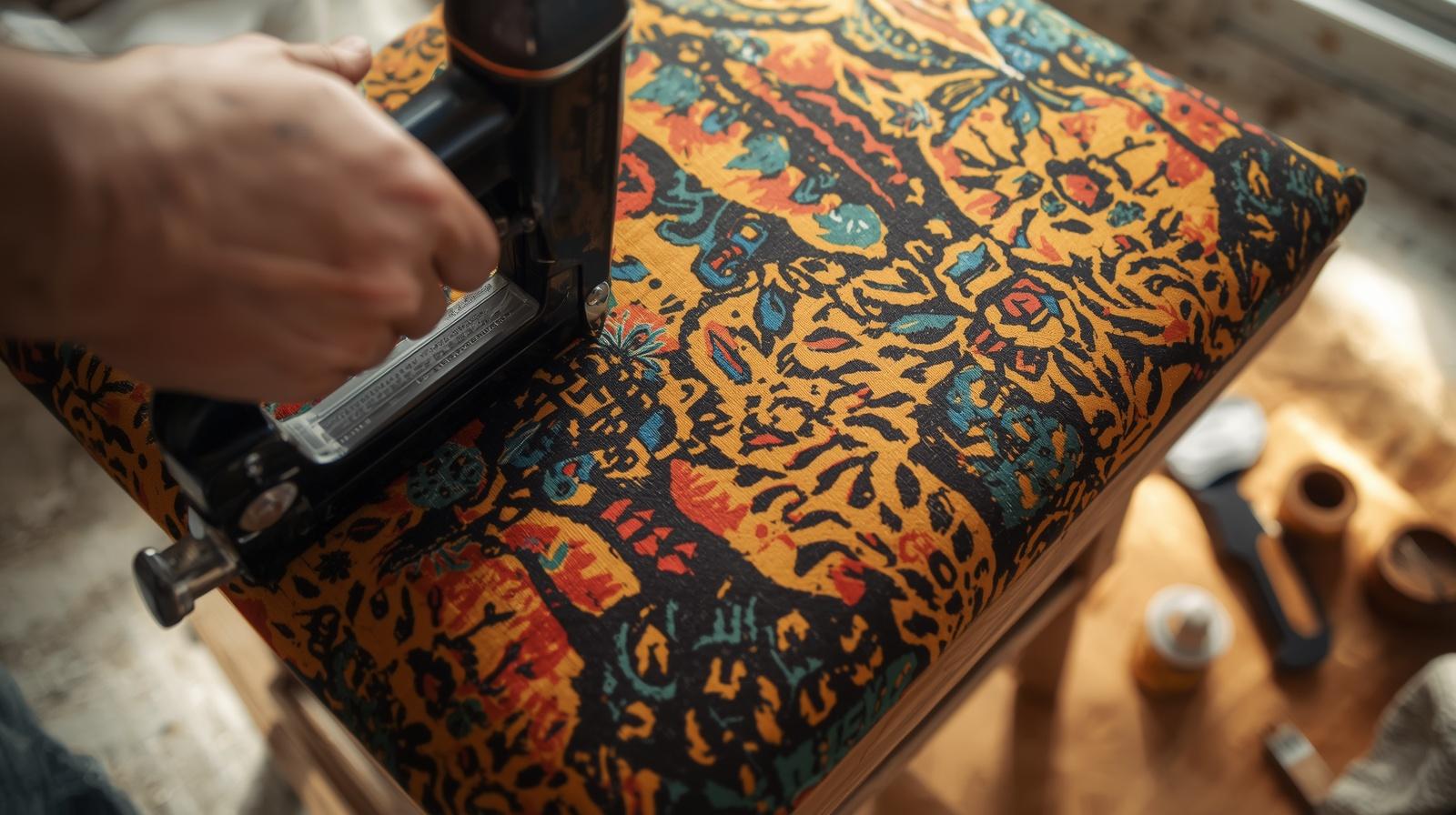
DIY 2 — Reupholstered thrift-store stool
What you need: A thrifted stool or dining chair with a removable seat, half a yard of fabric (mudcloth, Ankara, or any African print), a staple gun, scissors. Time: 20 minutes per seat. Cost: Stool under $15 at a thrift store, fabric ~$20–30 per yard online.
Unscrew the seat from underneath. Lay the fabric face-down, place the seat on top face-down, pull taut, staple the fabric to the underside of the seat board. Trim the excess. Screw the seat back on. You now have a one-of-a-kind accent piece that looks like it came from a boutique.
We cannot overstate how consistently this move transforms a room. It is the single highest-impact DIY in the Afrocentric decor world.
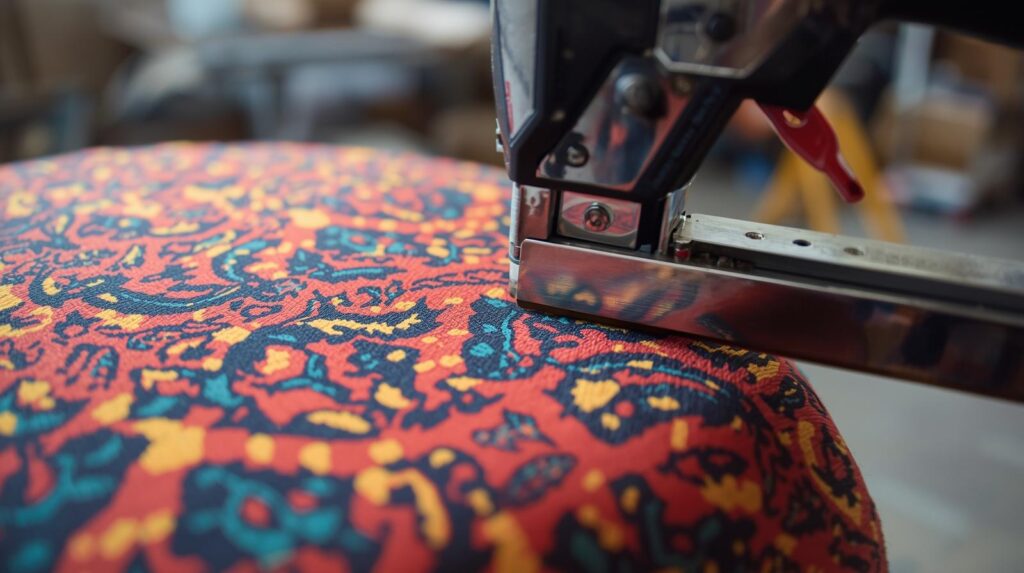
DIY 3 — Stretched-canvas textile art
What you need: A plain canvas (any size, around $15), a length of African fabric large enough to wrap it, a staple gun. Time: 15 minutes. Cost: Around $25 total.
Lay the fabric face-down on the table. Place the canvas face-down on the fabric. Pull each side of the fabric over the canvas frame and staple to the back — like wrapping a gift, pulling taut as you go. Fold corners neatly. Flip and hang.
The result reads as a $200 piece of textile art. Works especially well with Adire indigo or Kuba-style fabric where the pattern is the whole story.
DIY 4 — No-sew pillow cover from a fabric square
What you need: A square of fabric (roughly 20×40 inches), a pillow insert, safety pins or fabric glue. Time: 10 minutes. Cost: Around $10 for the fabric, $8 for the insert.
Fold the fabric in half with the right side facing inward to form a square pocket. Pin or glue the two open sides (not the folded side). Turn right-side-out. Insert pillow. Tuck the open end under, or pin discreetly. Done.
No sewing machine. No tailor. A pillow that looks entirely custom.
DIY 5 — Fabric-trimmed plain curtains
What you need: Plain white or linen curtains (store-bought), a strip of African fabric cut to curtain width × 4 inches tall, fabric glue or iron-on hem tape. Time: 20 minutes per curtain. Cost: Plain curtains around $30 a panel, fabric strip ~$10.
Iron-on (or glue) a horizontal strip of Ankara or mudcloth along the bottom hem of plain curtains. The effect is immediately expensive — tailored, deliberate, and grounded. And the commitment is tiny: you still have plain curtains under the trim if you ever want to remove it.
Why we love this one: it solves the “bold curtains or neutral curtains?” dilemma entirely. You get the best of both.
The Afro-Boho global mix, done respectfully
Afro-Boho — the blending of African textiles with Moroccan, Indian, Japanese, and other global elements — is one of the most beautiful directions in modern decor. The risk is treating every non-Western object as interchangeable. The fix is specificity.
Three rules we follow:
- Name things correctly. A Moroccan pouf is Moroccan. A mudcloth pillow is Malian. Do not call a collection of both “tribal.”
- Use one color story to unify. Earthy tones — ochre, indigo, terracotta, cream — are the natural bridge because many of these traditions share them.
- Give each piece room. If you love a Moroccan rug and a Kuba wall textile, do not also add Indian block-print curtains and Japanese ceramics in the same room. Edit ruthlessly.
The goal of Afro-Boho is not more cultures. It is more specificity within fewer cultures.
FAQ
How do I mix African prints without it looking like a theme room? Keep one textile loud and everything else quiet. Follow the pattern-mixing rule of three: vary scale, share one common color across all patterns, and mix geometric with organic styles. Balance every bold piece with two solid or neutrally textured surfaces like linen, jute, or raw wood.
What is the easiest DIY for adding African print to a room? A framed fabric scrap wall is the fastest entry point. Cut fabric remnants to fit thin gallery frames, hang as a grid or row, and you have custom textile art in under 30 minutes for under $50 total. No sewing required.
Can I mix African prints with Moroccan, Indian, or other global textiles? Yes — this is the heart of Afro-Boho style. The key is naming each piece correctly rather than grouping them as generic “tribal” decor, unifying the palette through a shared earthy color story, and editing ruthlessly so each piece has visual room.
Where should I use African prints as the boldest element — walls, floors, or furniture? Walls and furniture usually outperform floors for emotional impact. A framed textile or a reupholstered stool reads as intentional; a bold rug can work but needs quieter surroundings to shine. Pick one surface to be the focal point and keep the other two calm.
Final takeaway
A room with one meaningful African textile, thoughtfully placed, is more beautiful than a room with five. The pattern-mixing rules are there to help you restrain yourself, not to encourage more. The DIY projects are there to make the room yours in a way no purchase ever can.
Start with one piece. Make one thing by hand. Name it correctly when someone asks. That is the whole practice.