Afro-Boho Bedroom: A Layered, Earthy Sanctuary Guide for 2026
By Essence of the Road Art · Published July 2026
The afro-boho bedroom in 2026 has matured past its rattan-jungle phase. The version that works now is layered but restrained: one anchor textile, one anchor art piece, one anchor light, the right plant, and a palette that stays warm from floor to ceiling. Nothing competes; everything agrees.
A note on where this guide sits: we have written about bedrooms before — the Afrocentric bedroom ideas guide covers the cleaner, more editorial afrocentric approach, and the Afrocentric wall art for bedrooms guide goes deep on the single question of what hangs above the bed. This article is the third door: the bohemian branch of the family — woven texture, layered textile, collected-over-time warmth. If you are not sure which branch is yours, the two-minute Afrocentric home style quiz settles it.
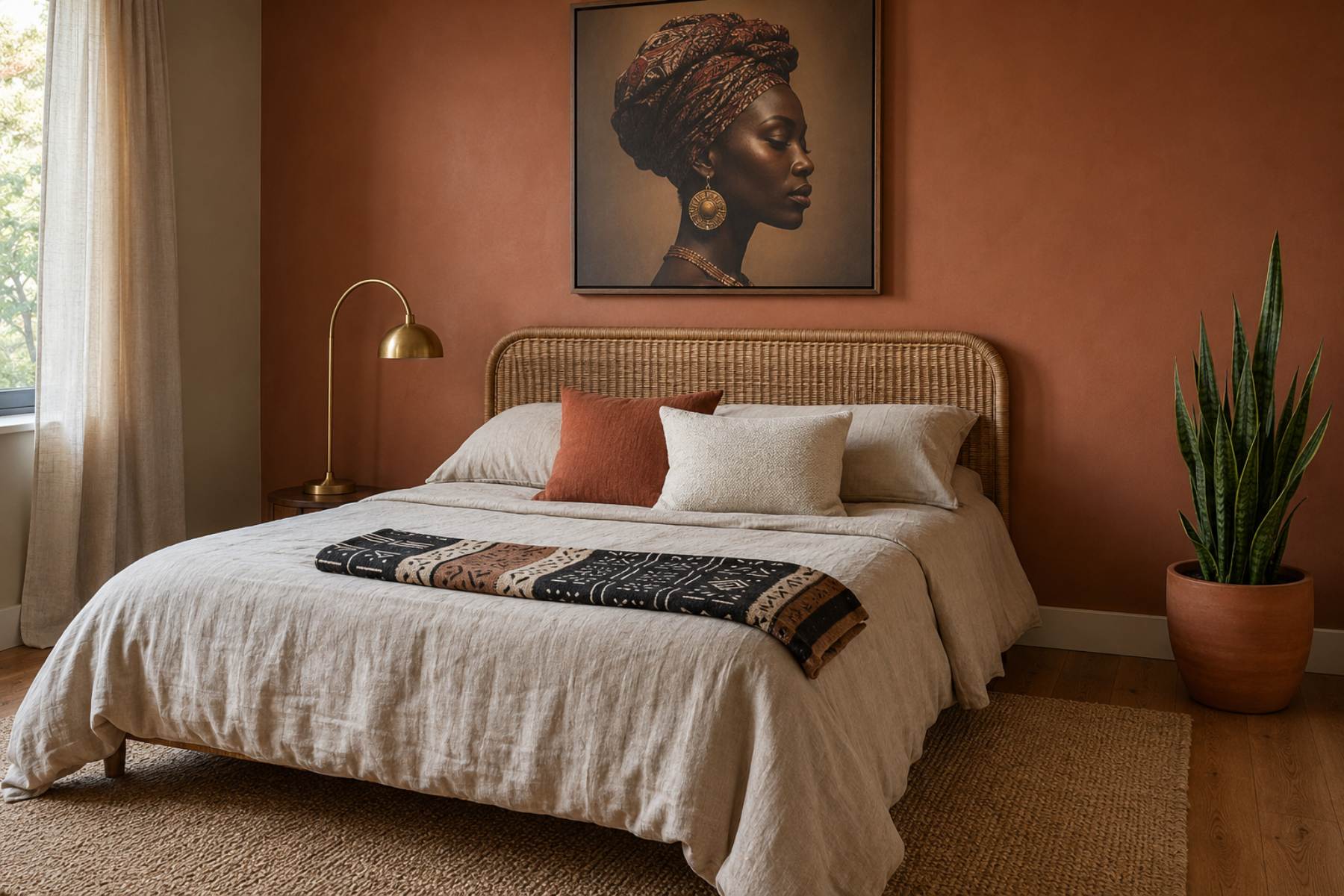
Quick answer: An afro-boho bedroom is built from five anchors: a rattan or cane headboard; layered linen and mudcloth bedding in cream and earth tones; a single dignified afrocentric portrait above the bed; brass lighting at 2700K; and one tall plant in a terracotta pot. The palette stays warm — terracotta, ochre, cream, walnut, brass — and never bright white or cool grey. Layered restraint beats maximalism every time.
Table of Contents
The afro-boho bedroom palette
Base: warm cream on walls, ceiling and bedding base — the most forgiving neutral in the warm spectrum, and the one that makes every texture read clearly.
The accent wall: warm terracotta or soft clay, behind the bed only. One painted wall gives the room a heart; four make it a cave. (Renters: a large flat-woven textile hung behind the headboard does the same job and moves out with you.)
Textile pattern: mudcloth — cream-and-black or ochre-and-cream. One mudcloth statement per bed, folded at the foot; the pattern is strong enough that two pieces argue.
Wood: walnut, oak, rattan. Metal: brass, always matte. The banned list — chrome, cool grey wood, glossy black — is short and absolute, because one cold material breaks the spell the other twenty warm ones cast.
This is the bedroom application of the full palette system in our Afro-Boho color palette guide; if you want hex codes for paint-matching, they live there.
The headboard decision
A rattan or cane headboard is the single fastest way to move a bedroom from generic to afro-boho — the woven texture does work no upholstery can. Rattan headboards run $200–450 new depending on size; Facebook Marketplace, searched under “wicker” and “cane,” reliably produces vintage ones at a third of that.
Alternatives that keep the language: a tall hand-carved wood headboard, an arched oat-linen upholstered piece, or — the zero-dollar version — no headboard at all, with the art above the bed scaled up to carry the wall alone (more on that scale trick below).
Skip: black tufted velvet, chrome four-posters, mirrored panels. Each one fights every other element on this page.
Bedding that holds the room
Build the bed in four layers, warmest last. Duvet: oat linen or warm cream cotton — linen duvet covers in this register run $60–130 and improve with every wash. Sheets: same family, one shade lighter. Pillows: two oversized euros at the back, two standard sleepers, one lumbar in mudcloth or hand-stitched detail — five total, which is enough (the twelve-pillow bed is the old maximalism this style outgrew). The throw: one folded mudcloth, kente or warm wool piece at the foot. One. The throw is the bed’s signature, and signatures are singular.
Real mudcloth versus inspired-by matters more here than anywhere else in the house, because you touch bedding daily — our African textiles guide covers how bogolanfini is actually made and how to verify a listing before paying real-cloth prices.
The art above the bed
The rule: one large piece, roughly two-thirds the width of the bed, hung 8–10 inches above the headboard. That proportion reads as deliberate from every angle in the room, including lying down.
The strongest match for this style is a dignified portrait in warm tones — the Indigo Black Woman and Bird set was designed for exactly this placement (hang the three in a row above a queen bed, or the central piece alone above a full), and the modern minimalist Black woman trio is its quieter sibling. For a wider, horizontal wall, an abstract Africa map scaled to 18×24 or 24×36 carries the space.
The anti-pattern is universal: a small lonely 8×10 floating above a king bed. If budget forces small art, hang it as a tight pair or trio — grouped small pieces read as one medium piece. The deeper dive into choosing bedroom art — subject, mood, what you want to see last thing at night — is the whole point of our wall art for bedrooms guide.
Lighting layers
Three layers, all warm. Ambient: one overhead pendant in rattan, woven fibre or brass-and-frosted-glass — never a bare boob-light, which is the first thing to replace in any rental that allows it. Task: a brass swing-arm or arc reading lamp on the heavy-reading side of the bed; a small ceramic table lamp on the other. Accent: one candle or a tiny lamp on the dresser, for the hour before sleep.
Every bulb 2700K warm white — a $12 four-pack — because terracotta under cool light turns to dried mud, and no amount of shopping fixes a color temperature problem.
The plant that finishes the room
One tall Sansevieria (snake plant) in a terracotta pot is the default for a reason: sculptural, vertical, tolerant of bedroom light levels, and one of the few plants that releases oxygen at night. A fiddle-leaf fig works in brighter rooms; a trailing pothos on the dresser works in darker ones. The pot matters as much as the plant — terracotta or a woven basket planter, never glossy white ceramic or plastic.
One is a statement; four is a greenhouse. If plants die in your care, a large dried arrangement — palm fronds, pampas, dried grasses in a floor vase — delivers the same organic vertical with zero maintenance.
The floor and the window
Underfoot: a jute or sisal rug, two-thirds under the bed so bare feet land on texture, with an optional soft washable layer on top at the bedside. The natural fibre grounds the palette the same way it does in the living room.
At the window: oat or cream linen curtains, hung high and wide — the instant-height trick that makes eight-foot ceilings feel nine. Sheer enough for daylight, doubled with a blackout layer behind if sleep demands it. Skip venetian blinds as the visible layer; the horizontal plastic lines belong to a different room in a different decade.
The weekend build order
If you are converting an existing bedroom rather than starting empty, this is the sequence that avoids re-doing work: bulbs first (five minutes, changes how every next decision looks), then the bed layers, then the art hung to the two-thirds rule, then the rug shoved under the bed (easier with a helper and furniture sliders), then lamp, plant, curtains as the finishing weekend. Budget version: the same room assembles for around $300 using the printable-art-and-thrift method in our afro-boho on a budget plan — the bedroom build is literally listed there.
Four mistakes that unmake the sanctuary
Bright white everything. Bright white bedding under cool bulbs is a hotel, not a sanctuary. Oat, cream, undyed — warmth is the whole thesis.
Pattern wars. Mudcloth throw plus kente pillows plus patterned duvet plus gallery wall equals noise. One pattern leads; everything else is texture.
The floating small print. Covered above, repeated here because it is the most common miss in reader photos: scale the art to the bed, not to the frame that was on sale.
Skipping the fifth layer. Rooms styled in one afternoon photograph well and feel thin. Leave one surface intentionally unfinished and let it collect — the shell from a trip, the thrifted brass bird, the small frame that migrates in later. Sanctuaries accrete.
The nightstand and the sixth surface
Nightstands in this style hold three things and refuse the rest: the lamp, one object with meaning (a small clay dish for jewelry, a cowrie shell or two, a candle), and whatever book is actually being read. The alarm-clock-charger-tissue-box clutter moves into the drawer — afro-boho surfaces are calm on top and honest inside.
The dresser is the room’s second stage. Style it like the console recipe: one taller element at the back corner (dried arrangement or framed small print leaning on the wall), one low bowl, one candle, a third of the surface left empty. If the mirror above it is framed in chrome, either swap the frame or lean a warm wood-framed mirror in front of the old one — mirrors are palette citizens too.
And every bedroom has a sixth surface nobody plans: the chair. The one that collects clothes. Make peace with it by choosing a beautiful one — a thrifted cane or spindle chair in warm wood — so that even mid-week, draped in a cardigan, it looks like styling instead of surrender.
The non-visual layer
Sanctuary is only two-thirds visual. The remaining third: scent — one warm note, amber, shea, sandalwood or cedar, from a single candle or diffuser, lit during the wind-down hour rather than all day; sound — a fan, a white-noise machine or simply a door that closes well; and hand-feel — the reason linen and washed cotton beat polyester blends at any thread count. When readers tell us a room finally “feels finished,” the last change was almost never visible in the photos they send. It was usually the light bulb and the candle.
A worked example: the 12×12 room
To make the formula concrete, here is the whole system in a standard 12×12-foot bedroom with one window. Queen bed centered on the wall opposite the door; rattan headboard against a clay-painted accent wall. Above it, the three-piece portrait set hung as a row, outer edges stopping at the pillows’ width. Jute rug perpendicular under the bed’s lower two-thirds. Reading lamp on the window side, ceramic lamp on the door side. Sansevieria in the corner the door swings away from, where it greets you on entry. Linen curtains hung six inches below the ceiling, wide enough to clear the glass entirely when open. Mudcloth throw folded on the lower third of the bed; cardigan chair in the remaining corner. Total pieces: eleven. Total pattern count: one. That ratio — eleven to one — is the entire style in a fraction.
Seasonal switches that cost almost nothing
The five-anchor system takes seasons gracefully because only the lightest layers rotate. Summer: the mudcloth throw retires to the chair, the duvet drops to a washed-cotton coverlet, the dried arrangement swaps for cut greenery, and one pillow cover goes paler. Winter: wool joins the foot of the bed over the mudcloth, the amber candle graduates to daily service, and the reading light gets one warmer bulb still — 2200K, candle-adjacent — for the darkest weeks.
The art can rotate too, which is printable culture’s quiet gift: a second set of prints for the same frames costs less than a single pillow, changes the room’s whole register, and stores flat in an envelope between years. Frames are furniture; the paper inside them is wardrobe.
The same sanctuary, after dark: the moody afro-boho bedroom
Everything above builds the warm daytime room. But the fastest-rising bedroom searches of 2026 are darker — the dark feminine bedroom, the romantic moody bedroom, the burgundy room aesthetic, and the brand-new black nouveau bedroom — and the afro-boho palette goes there better than most, because it was never actually about beige. It was about warmth. Deepen the warmth instead of cooling it, and the same five anchors read as a night room without losing their soul.
The rule that keeps a moody afro-boho bedroom warm-dark rather than cold-dark is the banned list you already have: no grey, no chrome, no black gloss. You go deep on the tones that already live in the palette instead. The walls move from cream to a saturated clay, aubergine, or true burgundy on the accent wall behind the bed; the black-and-cream mudcloth suddenly reads as the light in the room rather than the pattern; and brass stops being a detail and becomes the glow the whole room is lit by.
Burgundy earns its place here for more than the trend line. Deep reds are among the oldest adornment colors on the continent — camwood (osun) rubbed into skin and cloth, kola, red ochre — so a wine-dark afro-boho wall is not a departure from the heritage, it is a return to one of its richest registers. It sits beside terracotta the way dusk sits beside afternoon.
The dark-feminine version leans on softness inside the drama: a single dignified portrait lit low, linen draped from a ceiling hook into a loose canopy, an arched mirror, candlelight doing the work three lamps did in the daytime room. Romance here is restraint in a deeper key — one pattern still leads, the bed is still built in warm layers, only the light is pulled down and the palette pulled inward.
Black nouveau — the newest of the four and rising almost vertically — is Art Nouveau’s ornamental line reimagined dark and Black-centred, and it dovetails with African line-art and adinkra motifs more naturally than any trend this year. The early-mover angle is a framed line-art print in brass and near-black, one ornamental arch echoed in a headboard or mirror, and nothing else competing. Three weeks of trend data is thin, though, so treat it as a small bet placed early, not the whole room.
Practically, the moody room changes only three things from the daytime build: the accent wall goes deep, the bulbs drop to 2200–2700K and the overhead goes off in favour of two lamps and a candle, and one more textile layer joins the bed for weight. Everything else — rattan, brass, the portrait, the single plant, the eleven-to-one restraint — stays exactly where it was. That is the whole trick: it is not a different room, it is this room at night.
What it costs
The five anchors price out honestly: headboard $200–450 new (or a Marketplace fraction of that), bedding layers $120–220 built over two paychecks, the art $15–40 framed via the printable route, lighting $60–150 across all three layers, plant and pot $25–45. Call it $420–900 for the complete room — or $300 using the budget redistributions in the $300 plan, which trades the new headboard for a thrifted or no-headboard version and lets the art wall carry the difference.
Frequently asked questions
What’s the difference between an afro-boho and an afrocentric bedroom?
Family resemblance, different temperament. The afrocentric bedroom (see our dedicated guide) is cleaner and more editorial — fewer textures, art-forward, quiet luxury adjacent. The afro-boho version layers woven and textile texture over the same warm palette and cultural grounding. Neither outranks the other; they are two dialects of the same language.
Can I do an afro-boho bedroom in a small room?
Yes — restraint scales down beautifully. Keep the cream base everywhere, shrink the art to a tight pair above the bed, swap the floor plant for a dresser plant, and let the mudcloth throw be the single statement. Small rooms actually enforce the editing this style rewards. One extra small-room trick: mount the reading light on the wall instead of the nightstand — the freed surface is worth more than the lamp was, and the brass swing-arm looks better anyway.
What wall color goes behind a rattan headboard?
Warm terracotta or soft clay if you want the accent wall; warm cream if the rattan itself should star. Avoid cool greige — it drains rattan to beige plastic. Test under your actual evening bulbs before committing.
Is mudcloth bedding washable?
Authentic bogolanfini should be spot-cleaned and aired, not machine-washed — which is why it belongs at the foot of the bed, not as the duvet. Machine-washable mudcloth-patterned cotton is the practical compromise for anything that touches skin nightly.
Where do I start if I can only buy one thing?
The bulbs, honestly — but the first visible purchase should be the art. It sets the palette every later purchase answers to, and with printables the entry cost is a free download plus a thrifted frame.
Can an afro-boho bedroom be dark or moody?
Yes — and it is one of 2026’s fastest-rising directions (dark feminine, romantic moody and burgundy bedrooms are all climbing). The afro-boho way to do it is warm-dark, not cold-dark: deepen the palette to clay, aubergine or burgundy and let brass and candlelight carry the glow, but keep the same banned list — no grey, no chrome, no black gloss. The ‘after dark’ section above walks the full switch.
Related reading
- Afrocentric Bedroom Ideas: Warm, Calm Sanctuary Styling
- Afrocentric Wall Art for Bedrooms: A Quiet Luxury Guide
- Afro-Boho Color Palette 2026
- Afro-Boho Decor on a Budget: A $300 Soulful Room Plan
- Understanding African Textiles Meaning for Home Decor
Closing
A sanctuary is not a look; it is an agreement the room makes with you at the end of the day. The afro-boho version of that agreement is written in warm cream and terracotta, signed in woven rattan and mudcloth, and lit at 2700K. Build the five anchors, resist the sixth through tenth purchase, and let the room finish itself slowly — the best bedrooms are the ones that look like they happened to you.