Mudcloth Patterns and Meanings: Reading Mali’s Bogolanfini at Home
By Essence of the Road Art · Published July 2026
This article contains affiliate links. If you buy through them, we may earn a small commission at no extra cost to you. We only feature pieces we would live with ourselves.
Mudcloth has quietly become one of the most borrowed textiles in modern interiors — the graphic black-and-cream geometry turns up on cushions, throws, wallpaper and rugs from Lagos to Los Angeles. Yet most of what circulates is pattern without provenance: the look of mudcloth, detached from the country, the process and the meanings that made it. This guide puts those back. Mudcloth is Mali’s *bogolanfini*, and once you understand how it is made and what its marks mean, you decorate with it differently — with more restraint, more accuracy and, it turns out, more style.
Below you will find how bogolanfini is actually produced (which explains why its designs look the way they do), what the recurring symbols mean, the real difference between authentic Malian cloth and the mass-market print that imitates it, and a practical, room-by-room approach to using mudcloth patterns and meanings in a contemporary home. It sits alongside our hands-on DIY mudcloth pillow covers tutorial — that piece shows you how to sew; this one shows you how to read — and our broader African textiles meaning guide.
Quick answer: Mudcloth patterns and meanings come from Mali’s bogolanfini tradition, where Bamana artisans weave narrow cotton strips, dye them with fermented mud, and paint geometric symbols whose arrangements once carried proverbs, protection and social status — zigzags for a difficult life path, small stars and diamonds for the world’s balance, fishbone and sickle motifs for survival and successful farming. Because the cloth is earthy and graphic, it anchors a room beautifully; our Neutral Terracotta Botanical trio hangs the same earth-tone language above a mudcloth-styled sofa.
Table of Contents
How mudcloth is actually made — and why the patterns look this way
The single fact that transforms how you see mudcloth is this: the pale symbols are not painted on. They are what is left behind. Understanding the process makes the whole aesthetic legible.
It begins with cotton, hand-woven on a narrow loom into strips roughly five inches wide and stitched into a larger cloth — the same strip-weave logic as Ghana’s kente, which we cover in our kente cloth patterns and meanings guide. The plain cloth is then soaked in a tea made from the leaves of the *n’gallama* tree, which stains the whole cloth a yellowish tan and, crucially, loads it with tannin. Next, an artisan paints the *background* — not the motifs — with iron-rich mud that has been fermented for up to a year in clay pots. Where the mud meets the tannin-soaked cloth, a chemical reaction fixes a deep, permanent brown-black. Finally, the remaining yellow areas — the motifs themselves — are treated with a bleaching solution that returns them to cream white.
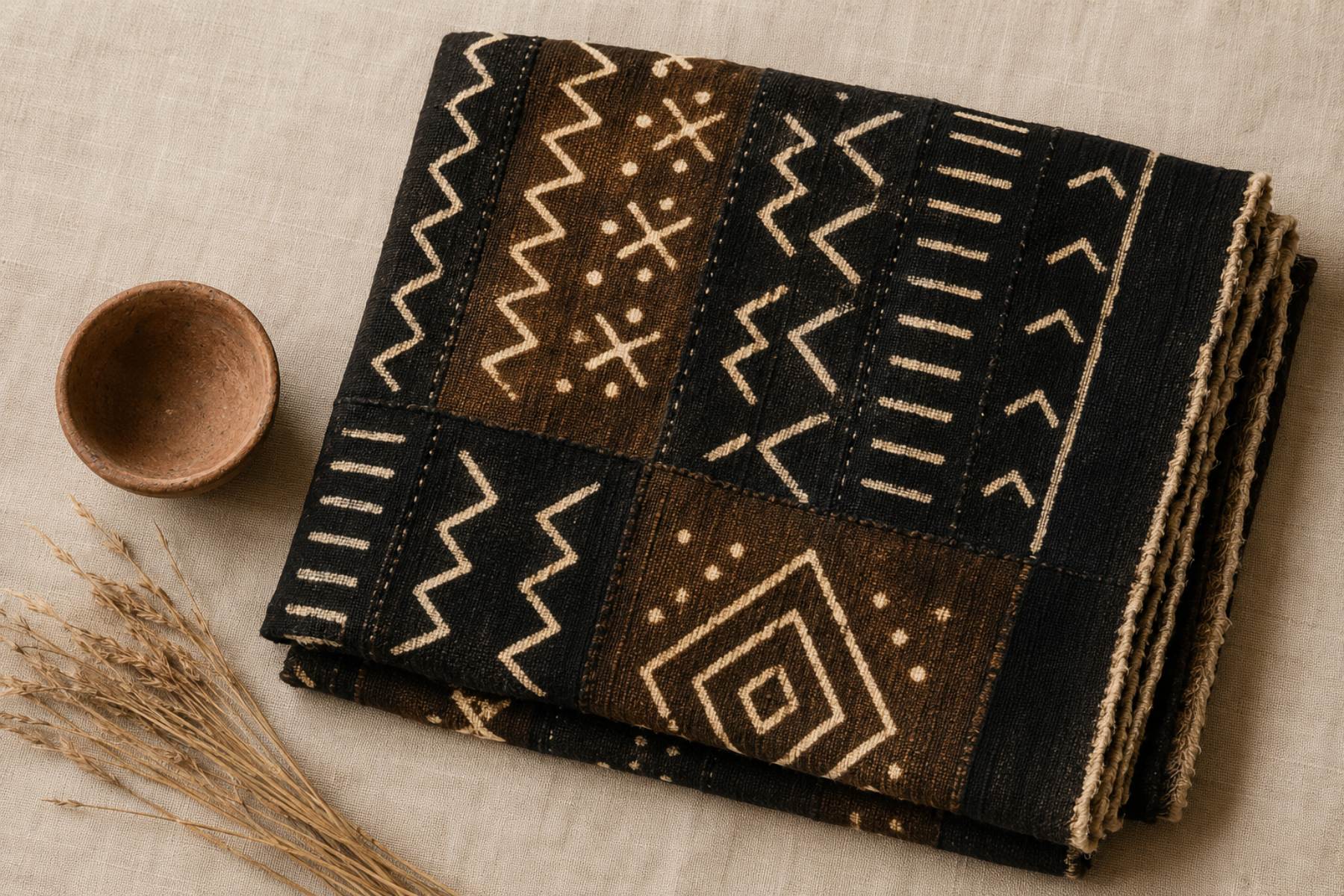
So a finished bogolanfini is a negative-space design: the artisan defines the pattern by darkening everything around it. This is why authentic mudcloth motifs have that slightly irregular, hand-drawn edge and why the palette is so narrow and earthy — it is literally the colour of mud, leaf and undyed cotton. It also explains the labour involved: a single cloth can take weeks and many cycles of mud and sun. In Bamana tradition the weaving is typically done by men and the dyeing and symbolic painting by women, with the knowledge passed down through families, and specific cloths made for specific purposes — a hunter’s protective shirt, a young woman’s initiation cloth, a wrap that marked a life passage. For the wider family of African cloth and how it developed, our African motifs explained overview places bogolanfini beside adinkra and kente.
What the mudcloth symbols mean
Bogolanfini is a language of arrangement. Individual motifs carry meanings, but the meaning of a whole cloth comes from how they are combined and sequenced — much as words combine into sentences. Traditional readings are held within families and initiation societies and were never fully standardised for outsiders, so the meanings below are offered as widely documented interpretations rather than a fixed dictionary. Read them as orientation, not as a decoder ring.
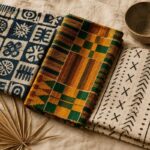
Zigzag lines commonly evoke the path or journey of life, and by extension its difficulties and reversals — the road is rarely straight. Small repeated stars and dots speak to the vastness and order of the world, the many things held in balance. Concentric diamonds and circles are frequently linked to the cycles of life and to protection, a boundary drawn around what matters. Fishbone and spine motifs point to sustenance and survival, the food that keeps a community alive, while the sickle or blade references successful farming and the harvest. Cowrie-shell shapes carry the old West African association with wealth and value, since cowries once served as currency. Motifs read as an “iguana’s paw” or “iguana’s elbow” are associated with fertility and protective power, and crossroads or ladder patterns mark meeting points, choices and passage between states.
The essential idea is that a mudcloth once *did* something — it protected a hunter, announced a woman’s readiness, recorded an event, or wished a household well. When you hang or drape one today, you are displaying a text, even if its precise sentence is not yours to read. That awareness is the difference between decoration and homage, and it is the same principle behind our understanding African textiles approach.
Authentic bogolanfini versus mass-market “mudcloth print”
Here is the distinction that will make you a more confident buyer. There are, broadly, three things sold under the word “mudcloth,” and they are not equal.
The first is authentic Malian bogolanfini: hand-woven cotton, real fermented-mud dye, hand-painted symbols, made in Mali by Bamana artisans. It has visible strip seams, an irregular hand-drawn line, a soft earthy hand-feel, and often a faint smell of earth when new. It is a significant object and priced accordingly, and it is best bought from sellers who name the region and, ideally, the makers.
The second is contemporary African-made bogolan that uses the traditional mud process but on commercially woven cloth, or with modern colour added — still a legitimate, living evolution of the craft, and a good, more affordable way to own genuinely mud-dyed cloth.
The third is mudcloth-*print*: the black-and-cream geometry screen-printed or digitally printed onto ordinary fabric, made anywhere. This is by far the most common thing in mainstream homeware, and there is nothing wrong with buying it — provided it is described honestly as mudcloth-inspired print rather than sold as the real Malian cloth. The problem is only ever misrepresentation and, occasionally, the flattening of a meaningful textile into “trendy pattern” with no acknowledgement of where it comes from.
For most homes, the elegant answer mirrors the one we give for kente: use inspired-by prints and cushions to carry the look across a room affordably, and invest in one genuine piece — a real bogolanfini throw or panel — as the anchor that gives the whole scheme integrity. If you sew, our DIY mudcloth pillow covers tutorial walks through making your own from mud-inspired fabric, and crafters can build authentic-looking mudcloth motifs from the geometric pattern libraries at Creative Fabrica. To display a genuine cloth panel, a set of natural wood clip hangers lets it hang like the textile it is.
From village cloth to global icon: a short modern history
Mudcloth did not arrive in your Pinterest feed by accident, and the story of how it travelled explains why it feels both ancient and contemporary. For most of its life bogolanfini was a rural craft of central Mali — particularly the Beledougou region north of Bamako — made for use rather than display, tied to hunting, initiation and ritual. Its leap onto the world stage came through a generation of Malian artists and designers who reframed it as fine art and high fashion.
The most celebrated master artisan of the traditional form, Nakunte Diarra, kept the deep symbolic vocabulary of Beledougou alive and taught it to a wider audience, insisting the marks be understood, not just admired. In the 1980s the Malian couturier Chris Seydou made the pivotal move of cutting bogolan into modern tailored garments, bringing it onto international runways and proving the cloth could speak in a contemporary idiom without losing itself. Around the same time, the artist collective Groupe Bogolan Kasobané pushed bogolan into gallery painting, expanding its palette and subjects while grounding the work in Malian identity.
That double life — sacred village cloth and celebrated modern medium — is exactly why mudcloth sits so easily in a present-day home. When you style it, you are joining a conversation Malian artists themselves opened: how to carry a meaningful tradition forward into new rooms without hollowing it out. The answer they modelled is the one this guide keeps returning to — know the cloth, credit its makers, and let it keep its voice.
How to decorate with mudcloth, room by room
Mudcloth’s superpower in a modern interior is that it is graphic and neutral at the same time — bold enough to be a focal point, earthy enough to sit with almost anything. The trap is overuse: because it is so easy to love, people buy it in every form until a room reads like a catalogue. Restraint is the whole game.
In the living room, one substantial gesture beats five small ones. A single large mudcloth throw over the arm of a cream or oatmeal sofa, or two mud-toned cushions against plain linen, delivers the pattern’s full impact while leaving the eye somewhere to rest. Hang earthy wall art above rather than more pattern; our Neutral Terracotta Botanical trio shares the exact clay-and-cream family and lets the textile be the texture while the art carries the colour. Our Afro-Boho living-room approach shows the wider layering.
In the bedroom, mudcloth reads best as a folded throw at the foot of the bed or a single lumbar cushion, kept to one or two pieces so the room stays restful. The negative-space geometry pairs naturally with undyed linen, rattan and warm wood. In an entryway or hallway, a framed strip of real bogolanfini becomes a piece of art in its own right — treat it as you would a painting, with a simple frame and a picture light. And as a rug or floor cushion, the sturdier mud-dyed cloths bring the pattern down low, grounding a seating area without competing with wall art above.
Across every room, three pairings keep mudcloth looking intentional rather than themed: pair it with plenty of plain, undecorated surface; pair it with natural materials — jute, rattan, clay, oak — rather than shine; and pair its cool black-and-cream with one warm note, a terracotta or ochre, to keep it from going stark. That warm note is exactly the logic of our Earthroot terracotta palette, and if you are mixing mudcloth with textiles from other cultures, our guide to mixing global motifs keeps the collection coherent.
Caring for real mudcloth
Because authentic bogolanfini is naturally dyed, it asks for gentler care than a printed imitation, and knowing this protects an investment. Spot-clean rather than machine-wash where possible; when washing is necessary, use cold water and a mild, pH-neutral soap by hand, and never wring the cloth. Dry it flat and out of direct, prolonged sun, which can fade the mud tones over years. A little softening and colour movement with age is normal and, many owners feel, part of the cloth’s character — it is a living textile, not a printed one, and it wears the way natural things do.
Frequently asked questions
What do mudcloth patterns and meanings represent?
They represent a language of arrangement from Mali’s Bamana people, in which geometric motifs — zigzags for life’s path, stars and diamonds for the balance of the world, fishbone and sickle for survival and harvest, cowrie shapes for wealth — are combined to carry proverbs, protection and social meaning. A whole cloth means more than its individual symbols, because meaning comes from how the motifs are sequenced. Traditional readings are held within families, so the interpretations shared publicly are widely documented approximations rather than a fixed code.
What is bogolanfini?
Bogolanfini, often shortened to bogolan, is the Bamana name for mudcloth, literally “mud cloth.” It refers to the traditional Malian textile made by weaving cotton into strips, soaking them in tannin-rich n’gallama leaf tea, and painting the background with fermented iron-rich mud that reacts to fix a permanent dark ground — leaving the pale motifs as negative space. The word describes both the cloth and the mud-dyeing technique behind it.
How can I tell if mudcloth is real?
Authentic Malian mudcloth is hand-woven cotton with visible strip seams, an irregular hand-painted line, an earthy matte hand-feel and often a faint smell of earth when new. Machine-made mudcloth print is perfectly even, printed on one continuous piece of fabric with no strip seams, and usually far cheaper. Neither is wrong to own, but only the first is genuine bogolanfini, and honest sellers will tell you which one you are buying.
Is it cultural appropriation to decorate with mudcloth?
Using mudcloth respectfully is widely welcomed, and the guardrails are practical: learn what the cloth is and roughly what its motifs mean, credit its Malian origin rather than calling it generic “tribal” pattern, and buy honestly — inspired-by print described as such, and authentic cloth from sellers who support Malian artisans. Appropriation becomes the risk when the textile is stripped of its origin and sold or displayed as meaningless trend.
What colours and materials go with mudcloth?
Mudcloth’s black-and-cream earth palette pairs most naturally with undyed linen, jute, rattan, clay and warm woods, and it comes alive when you add a single warm accent — terracotta, ochre or rust — to soften its coolness. Keep surrounding surfaces plain so the geometry can be the focal point, and avoid high-shine metals and glossy finishes, which fight the cloth’s matte, handmade character. Our Afro-Boho colour palette gives ready hex codes for the surrounding scheme.
Related reading
- DIY Mudcloth Pillow Covers: A Beginner’s Sewing Tutorial
- Understanding African Textiles: Meaning for Home Decor
- African Motifs Explained: Adinkra, Kente and Mudcloth
- Kente Cloth Patterns and Meanings: How to Read Ghana’s Royal Weave
- Earthroot: A Warm Sister Palette to Indigo (Terracotta Edition)
Closing
Mudcloth is proof that the more you know about a textile, the better you style it. Once you understand that the cream symbols are revealed rather than painted, that a zigzag is a life’s path and a cowrie a measure of worth, and that a real bogolanfini is a weeks-long act of craft rather than a print run, you stop scattering the pattern everywhere and start giving one good piece the room it deserves. Build the look in earthy layers — one strong mudcloth gesture, plenty of plain natural surface, a single warm accent, and earth-tone art above — and let the cloth be the story. Our Neutral Terracotta Botanical trio is the wall half of that story, ready to hang this week.