
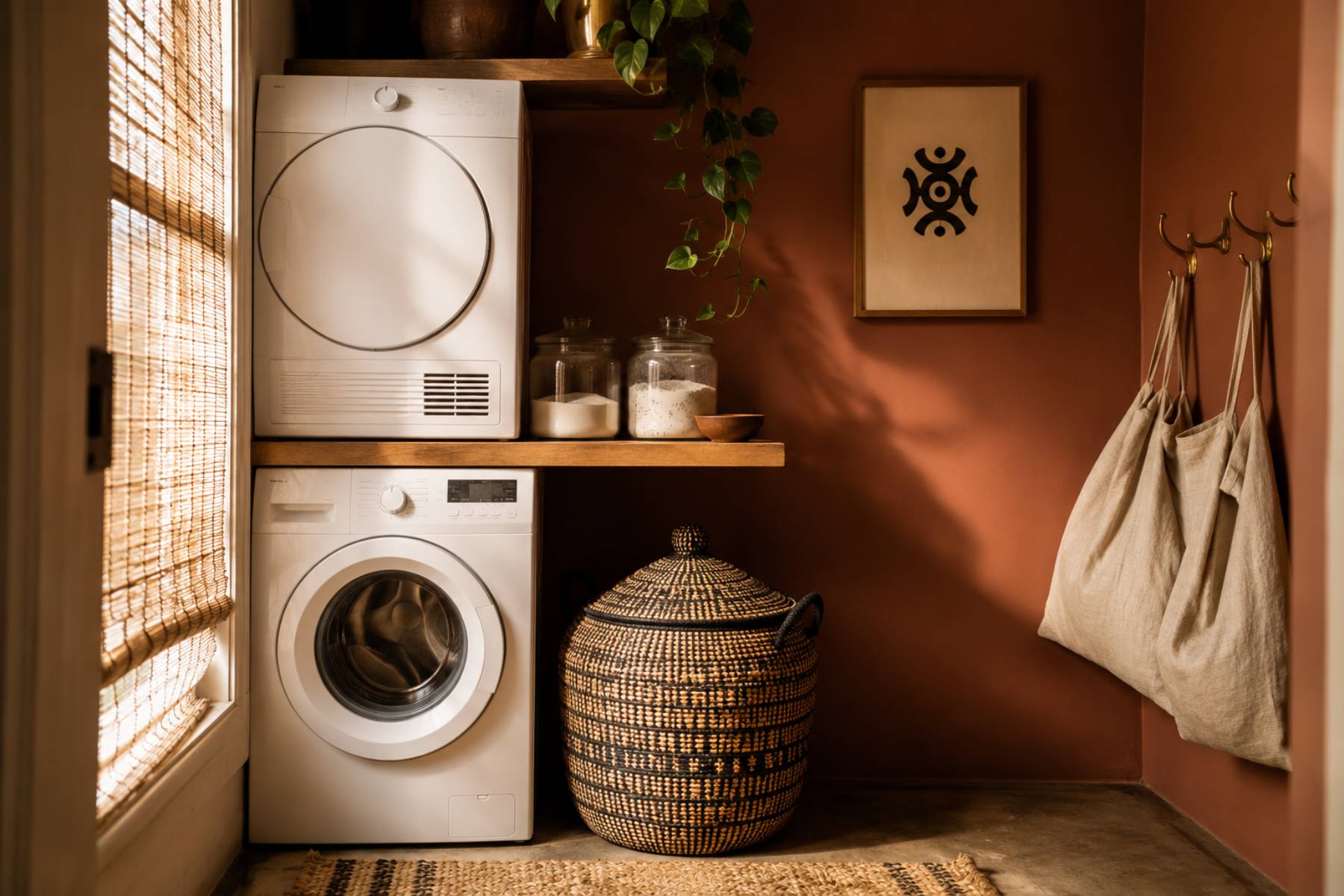
Afrocentric Laundry Room Ideas: 12 Warm Upgrades for the Most Ignored Room
By Essence of the Road Art · Published July 2026
Here is a quiet statistic about your home: the laundry room — or closet, or corner — is the space you visit more often than the guest room, the dining room and possibly the bathtub, and it is almost certainly the only room nobody ever decorated. Builder-white walls, a fluorescent tube, plastic baskets, the smell of detergent. We style the rooms guests see and abandon the room that takes care of everyone’s clothes.
Pinterest has noticed: laundry room designs are the platform’s fastest-rising home decor trend right now, up thirty-five-fold month over month in Pin saves. But almost none of that inspiration speaks the warm, rooted language this site is about. So this guide does: twelve afrocentric laundry room ideas — woven baskets instead of plastic, earth tones instead of builder-white, one meaningful print instead of a blank wall — nearly all of them renter-safe, most under $40, in a room small enough that every change registers.
Quick answer: Afrocentric laundry room ideas work by treating the smallest utility room as a real room: warm the light (2700K bulb), replace every plastic container with woven baskets, glass jars and clay dishes, add one framed afrocentric print behind glass (small rooms need only one), paint or hang warmth on a single wall, and let brass hooks and linen bags handle the hanging clutter. Total transformation cost for a typical laundry closet: $100–200.
Table of Contents
Why the laundry room deserves this
There is also a deeper reason this room suits an afrocentric treatment, and it is worth saying plainly. Across West African cultures — and across the diaspora — washing was never invisible labor. It was communal, outdoor, social: riverbank mornings, courtyard lines, songs that kept rhythm with the work, grandmothers who could read a family’s week in its wash. Laundry was care made visible. The modern laundry room privatized the work and then, oddly, made it ugly — as if care should be done in the least cared-for room of the house.
Styling this room is not decoration for its own sake. It is restoring a little dignity to the most caring work a home does. That is about as afrocentric as a design idea gets.
The laundry palette
Small utility rooms have one palette job: fight the cold. Machines are white or grey, floors are usually tile or vinyl, and the default light is the coldest in the house — so every added element must pull warm. Base: warm cream or soft sand on the walls. One deep accent: terracotta, clay or ochre — a single wall, or even just the back of a shelf niche. Texture layer: woven seagrass and jute, raw wood, linen. Metal: brass or matte black, never more chrome than the machines already supply. And glass jars wherever plastic used to be — detergent looks like pantry goods the moment it lives in glass.
If you want the palette by the numbers, the terracotta-and-cream schemes in our African color palette guide transfer to this room at one-wall scale.
Afrocentric laundry room ideas: the 12 upgrades
1. Swap every plastic basket for woven. The single defining move. Two or three large woven seagrass or water hyacinth baskets ($25–45 each) replace the plastic fleet — sorting stays, ugliness leaves. A genuine handwoven African market basket as the star of the group adds provenance for a few dollars more on Etsy.
2. One framed print, behind glass. Small rooms need exactly one piece of art, and laundry humidity writes the framing rule: always behind glass, never unframed paper or open canvas. An 8×10 or 11×14 print — an abstract Africa map or one symbol from the Adinkra set — hung above the machines or on the back wall turns the room from utility to room. The zero-budget version: the free Sankofa print at 8×10, whose meaning (“go back and fetch it”) is, among other things, an extremely good joke about odd socks.

3. Warm the bulb. The fluorescent tube or 5000K LED over the machines is half the problem with the whole room. One 2700K warm-white bulb — or a plug-in brass sconce if the ceiling fixture is beyond saving — changes everything the other eleven ideas do. Do this first; it costs $6.
4. Glass jars for detergent and pods. Decant powder, pods and clothespins into large glass apothecary jars with wooden lids ($20–35 for a set). The plastic jugs hide in the cabinet; the shelf becomes a still life. (Households with small children: keep pods locked away instead — the jars can hold powder and pins.)
5. Brass hooks and linen bags. A row of small brass wall hooks carries linen delicates bags, the lint brush and yesterday’s air-drying shirt — the hanging clutter that otherwise drapes over the machines. Hooks are the laundry room’s jewelry; plastic adhesive ones are the reason the room looked sad.
6. A wooden counter or shelf over front-loaders. If your machines are front-loading and side by side, a single oiled wood plank across the top ($30–60 cut to size, or an IKEA-style butcher block) creates the folding surface and the styling stage in one move. Renters: it rests on the machines; nothing is drilled.
7. The terracotta moment. Paint one wall — or, in a rental, hang a large mudcloth-patterned textile or a flat-woven runner vertically from a wooden dowel. The room is small enough that one warm plane recolors everything, including the chore.
8. A washable runner underfoot. A flat-woven washable runner in terracotta or striped earth tones ($40–70) warms the tile, saves your feet during folding sessions, and — being washable — lives in the one room perfectly equipped to care for it.
9. The drying rack goes wood. Replace the sagging plastic-coated rack with a wooden wall-mounted accordion rack or a simple wooden ladder leaned against the wall. Air-drying is how most of the world’s textiles — mudcloth included — were always meant to be treated; the tool may as well honor that.
10. One plant that loves the humidity. The laundry room is accidentally a greenhouse: warm, humid, bright when the light is on. A pothos trailing from the top shelf or a fern in a clay pot thrives on wash-day steam and softens every machine edge in the room.
11. The scent shelf. Laundry already owns a scent; upgrade it. A small clay dish of dried lavender or a shea-based candle on the shelf, plus wool dryer balls with a drop of essential oil instead of chemical sheets — the room starts smelling like care instead of chemicals, which is the olfactory version of this whole article.
12. A little language on the wall. Alongside (or instead of) the art, one small framed piece with words earns its place in the room where chores happen — our You Are Enough motivational poster reads differently, and better, above a washing machine at 7 a.m. than anywhere else in the house.
The laundry closet version
Most apartments get a closet, not a room — two machine faces behind bifold doors. The list compresses beautifully: warm bulb (3), glass jars and one basket on the shelf above (4, 1), brass hooks inside the door frame (5), one 8×10 framed print on the wall the closet faces (2), and — the closet’s secret weapon — replace the bifold doors with a linen curtain on a wooden rod in a mudcloth-adjacent pattern. Total cost under $100, fully reversible, and the “laundry closet” becomes an alcove with a textile story. This is the same lease-friendly logic as our Afrohemian rental living room guide: the constraint is the design brief.
What survives a laundry room (art edition)
A practical note the inspiration boards skip: this room runs humid and occasionally splashy, and not all decor survives it. Safe: prints framed behind glass with a sealed back, glazed ceramics, glass, wood that gets an occasional oiling, woven fibre (it lived outdoors first), metal in brass or powder-coat. Risky: unframed paper (curls in a month), open-face canvas (absorbs moisture and detergent haze), raw MDF frames (swell at the seams). This is, incidentally, why printables are the ideal art format for utility rooms — if a decade of steam ever dulls the print, the file reprints for pocket change, a promise framed-canvas decor cannot make. Print-and-frame mechanics live in our DIY printable wall art guide.
What it costs
The whole twelve-idea room: roughly $180–320 at the generous end. The high-impact core — bulb, two baskets, jars, hooks, one framed print — lands at $90–140. The closet version: under $100. And the free tier is real: the Sankofa download, a thrifted frame, and moving the prettiest jar you already own into the room costs six dollars of bulb and an afternoon. In a room this small, restraint isn’t a sacrifice — there is literally nowhere to put excess.
The Saturday build order
The room converts in one morning if you sequence it. First the bulb (five minutes, and every later decision gets judged under the light it will live in). Then purge and decant: plastic jugs into the cabinet, powder into jars, the plastic basket fleet to the curb. Then the wall layer — print hung, hooks mounted, textile or paint if you’re going that far. Baskets and runner last, once the floor is clear. Stop for coffee halfway and notice the room already reads differently with just light and glass — that early payoff is what carries you through hanging the hooks straight.
One scheduling tip from experience: do this the morning after laundry day, when the machines are quiet and the baskets are empty. Styling around a full hamper is how the project gets postponed to next weekend, twice.
Making it yours
Twelve ideas are a system, not a uniform — the room has space for exactly one personal move, so choose it deliberately. A shelf of your grandmother’s clothespins in a glass jar. A framed photo of a riverbank washing day, if your family has one. A tiny woven basket your child made that holds precisely nothing. The palette holds the room together; the one personal object is what makes the most functional room in the house quietly yours. And if you are unsure which direction your whole home leans before committing even to a laundry palette, the two-minute Afrocentric home style quiz sorts it out — this room is honestly the lowest-stakes place in the house to test your result.
Borrowed from the courtyard: three traditions worth keeping
Since the room’s ancestry is communal wash days, three practices translate directly and improve the modern version. Sort in the open. Courtyard washing sorted by hand, in daylight, socially — the modern echo is baskets you can see into, in a room pleasant enough that sorting isn’t exile. Dry what you can on air. Line- and rack-drying is gentler on textiles (your mudcloth and linen insist on it), cheaper than the dryer, and the wooden rack (idea 9) makes it look intentional rather than improvised. Fold where you styled. The counter (idea 6) exists so folding happens in the warm room you made, not hunched over a bed two rooms away. Households that fold in the laundry room report the strangest side effect of this whole project: the chore shrinks. Partly logistics — everything in one place — and partly the honest psychology that nobody rushes out of a room that feels good to stand in.
Frequently asked questions
Is it worth decorating a laundry room nobody sees?
You see it — four to eight times a week, usually while doing something tiring. Rooms used often and seen only by the household are arguably the most worth styling; the audience is the person doing the work. That reframe is the entire article.
What art works above a washer and dryer?
One framed print behind glass, hung high enough to clear the machine lids and any counter — 8×10 to 11×14 is the right scale for most laundry walls. Symbols and abstract pieces outperform busy scenes in small rooms; one strong graphic reads instantly on every trip in.
How do I make a rental laundry closet look better without renovating?
Warm bulb, glass jars, woven basket, brass hooks inside the frame, one small framed print, and a curtain replacing the bifold doors. Every item leaves with you; the transformation is total anyway.
What colors work in a windowless laundry room?
Warm cream base with one terracotta or ochre accent plane, and the warmest bulb you can buy. Windowless rooms punish cool greys and bright whites — they read as basement. Warm light plus warm neutrals reads as pantry, which is the correct ancestor for this room.
Where does the hamper system fit?
Woven, always — one large basket per sorting category, lined with washable linen bags that travel to the machines. The baskets do double duty as the room’s texture story, which is a job plastic never applied for.
Do woven baskets actually hold up to laundry duty?
Seagrass and water hyacinth handle full loads for years if they stay dry between uses — the failure mode is wet towels left in overnight, which no basket material forgives gracefully. Line them with removable linen bags (idea 5’s bags do double duty) and the weave never touches damp cloth at all. A well-made market basket is a decade purchase; the plastic bin it replaced was already cracking.
What about the utility sink corner?
Same rules, smallest scale: a bar of black soap on a clay dish, one linen towel on a brass hook, and the cleaning bottles decanted or hidden in a lidded basket below. The sink corner is where utility rooms relapse into chaos — one basket with a lid is the entire cure.
Related reading
- 15 Afrocentric Home Office Ideas for a Soulful Workspace
- A Beginner’s Guide to Afrocentric Decor in 2026
- African Color Palette Guide 2026
- Afrocentric Bathroom Ideas: A Warm Spa Sanctuary Guide
- DIY Printable African Wall Art: Free Templates Guide
Closing
The laundry room is where a home takes care of itself, and it spent decades being punished for it with fluorescent light and plastic bins. Twelve small choices — woven over plastic, glass over jugs, brass over adhesive, one print with meaning over a blank wall — and the hardest-working room in the house finally looks like it belongs to the same home as the rest of your rooms. Style the room that does the caring. It has been waiting the longest.