
Gallery Wall Layout Ideas With Sizes: 7 Plans That Work
By Essence of the Road Art · Published October 2026
This article contains affiliate links. If you buy through them, we may earn a small commission at no extra cost to you. We only feature pieces we would live with ourselves.
Most gallery walls go wrong before the first nail. The prints are beautiful, the frames are lovely, and then the group ends up floating too high, crowding the sofa, or spreading across the wall with gaps that never quite match. The problem is almost never taste. It is arithmetic.
This guide gives you seven gallery wall layouts with real frame sizes, real spacing and the finished width of each group, so you can match a plan to your wall before you buy a single frame. Every number below is a starting point you can measure, tape up and adjust.
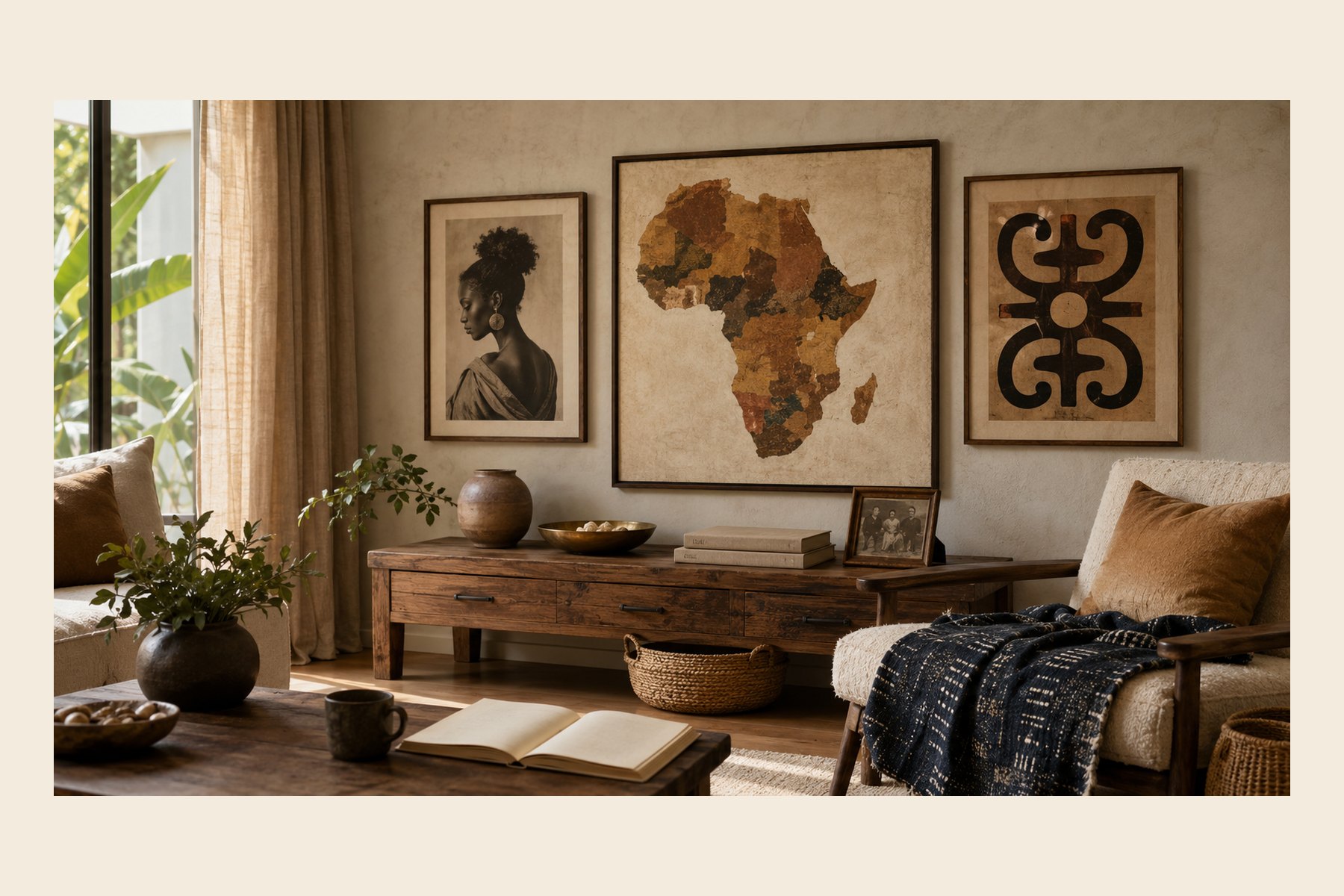
Quick answer: The most reliable gallery wall layout ideas with sizes start from the outer rectangle, not the individual frames: make the whole group about two-thirds of the furniture width below it, hang its center at 57–60 inches from the floor (or 8–10 inches above the sofa back), and keep 2–3 inches between frames. A three-frame row of 18×24 frames with 2.5-inch gaps is 59 inches wide, which suits an 84-inch sofa. If you want a ready-made grouping that already shares one palette, our Afrocentric Gallery Wall Set (6) is designed to hang as a 2×3 grid.
How to plan a gallery wall layout before you hang anything
Start with three measurements: the width of the furniture under the wall, the height of its top edge, and the free wall height up to the ceiling. Everything else is calculated from those.
- Group width: about two-thirds to three-quarters of the furniture width. Over an 84-inch sofa, that is 56–63 inches; over a 60-inch dresser, 40–45 inches.
- Center height: the visual center of the whole group sits at 57–60 inches from the floor. Blick’s gallery wall guide uses 57 inches, the same eye-level line many museums use.
- Clearance above furniture: 8–10 inches between the sofa back or headboard and the bottom frame. Crate & Barrel’s guide suggests roughly eight inches above a chair or couch. When furniture is involved, clearance wins over the 57-inch rule.
- Gaps: 2–3 inches between frames for most rooms, 1.5–2 inches for a tight, graphic look, 3–4 inches for a calmer, airy wall.
Draw the outer rectangle on paper first, then divide it. Our full process for printing, framing and lighting is in our print, frame, hang and light guide; this article stays with the layout itself.
Seven gallery wall layouts with exact frame sizes
The table gives each layout’s frame sizes, the gap we used and the finished size of the group, measured frame edge to frame edge. Use it to pick a plan that fits your wall, then read the notes for each one below.
| Layout | Frames | Gap | Finished size (W × H) | Best over |
|---|---|---|---|---|
| 1. Three-frame row | 3 × 18×24 in | 2.5 in | 59 × 24 in | 84–90 in sofa |
| 2. Four-frame grid (2×2) | 4 × 16×20 in | 2 in | 34 × 42 in | full bed, 50–60 in console |
| 3. Six-frame grid (2×3) | 6 × 11×14 in | 2 in | 37 × 30 in | 60 in sideboard, dining bench |
| 4. Five-frame anchor | 1 × 24×36 + 4 × 11×14 in | 2.5 in | 51 × 36 in | 72–84 in sofa |
| 5. Salon-style seven | 1 × 18×24, 2 × 11×14, 4 × 8×10 in | 2–3 in | about 56 × 40 in envelope | large sofa, open wall |
| 6. Hallway line | 5 × 11×14 in | 3 in | 67 × 14 in | corridor, landing |
| 7. Single statement | 1 × 30×40 in | — | 30 × 40 in | reading chair, narrow wall |
1. The three-frame row
Three 18×24 frames with 2.5-inch gaps make a 59-inch line: 70 percent of an 84-inch sofa. Hang all three on one shared centerline, with the bottom edges about 8–10 inches above the sofa back. This is the calmest gallery wall there is, and it suits a set of three that already shares one palette, such as our Earth Tone Terracotta + Africa Map Set (3).
2. The four-frame grid
Four 16×20 frames in a 2×2 grid with 2-inch gaps give you a 34 × 42-inch square-ish block. Over a 54-inch full bed, that is 63 percent of the width. Grids only work when all four frames are identical in size, color and mat width, so buy them together.
3. The six-frame grid
Six 11×14 frames, three across and two down, with 2-inch gaps, finish at 37 × 30 inches. That is about 62 percent of a 60-inch sideboard. A grid this tight rewards a consistent subject: six portraits, six symbols or six textiles, not a mix of all three.

4. The five-frame anchor
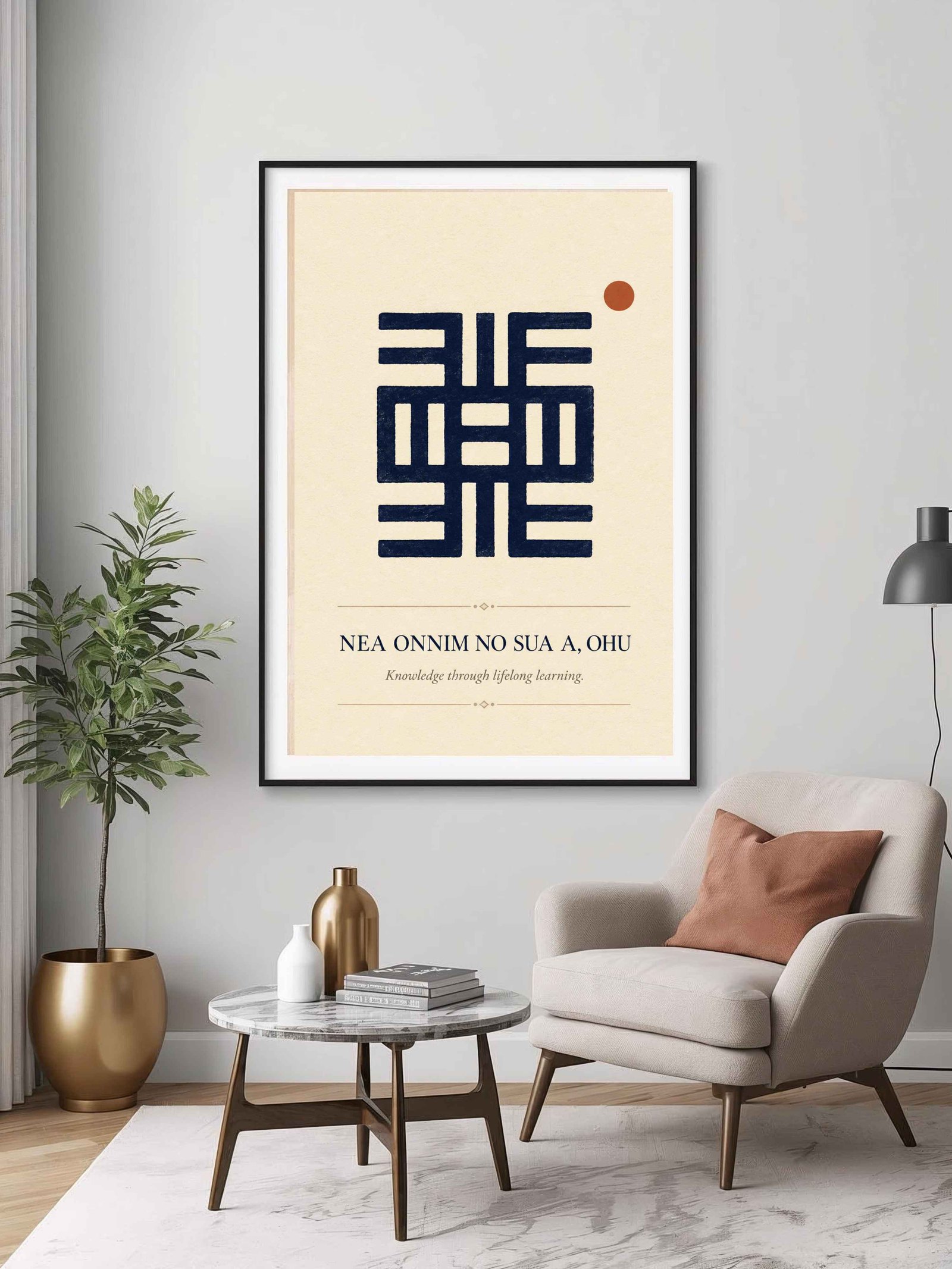
Put one 24×36 frame in the center and stack two 11×14 frames on each side. Each stack is 14 + 2.5 + 14 = 30.5 inches tall, so center the stacks on the large frame’s midline and they will sit about 2.75 inches inside its top and bottom edges. Total width: 11 + 2.5 + 24 + 2.5 + 11 = 51 inches, which fits a 72–84-inch sofa. A five-piece set like our Adinkra Symbol Wall Art Set (5) slots into this layout when one print is enlarged for the center.
5. The salon-style seven
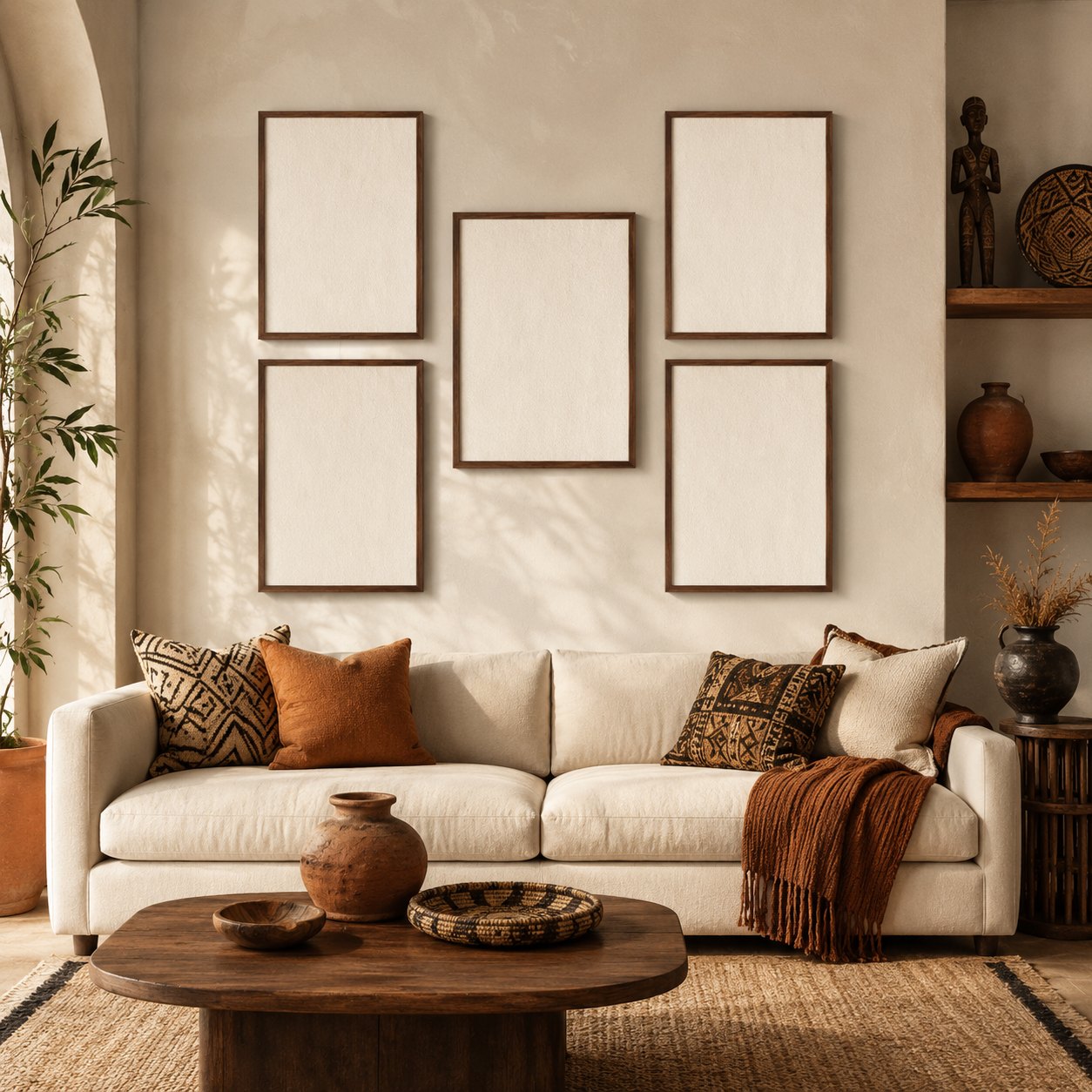
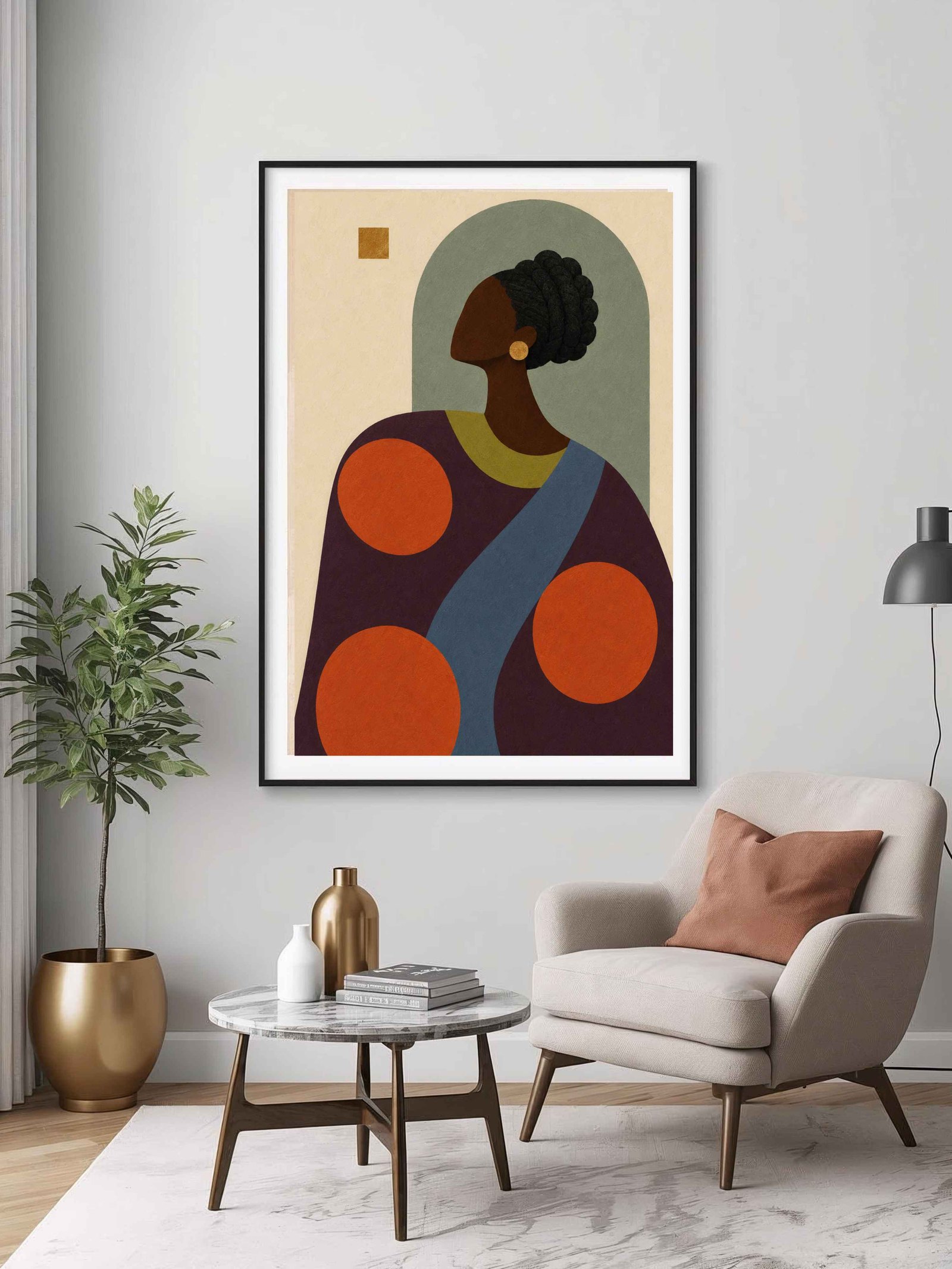
Salon style looks spontaneous, but the best versions are built inside an invisible rectangle. Draw a 56 × 40-inch envelope, place the 18×24 slightly off-center, then fit two 11×14 and four 8×10 frames around it, keeping every gap between 2 and 3 inches. Let the outer edges line up on all four sides even when the inside is irregular. This layout carries mixed subjects well, which is why a larger portrait collection like the Black Woman Set (15) gives you room to choose.
6. The hallway line
Corridors are viewed while walking, so a single horizontal line reads better than a cluster. Five 11×14 frames with 3-inch gaps run 67 inches. Keep the centerline at 57–60 inches the whole way; on a staircase, keep the same height above each step’s nose instead of the floor.
7. The single statement
Sometimes the best gallery wall layout is one frame. A 30×40 print over a reading chair or on a narrow wall between two doors does more than five small frames competing for 36 inches of plaster. The rule is the same: two-thirds of the furniture below it, center at 57–60 inches, or 8–10 inches above the chair back.
Print sizes and ratios: why your frames must match your files
Most layout trouble starts when a print’s ratio does not match the frame. An 8×10 frame needs a 4:5 file; an 18×24 frame needs a 3:4 file. Stretching a 2:3 image into a 4:5 frame either crops the artwork or leaves a white band. Check the ratio before you buy frames, not after.
| Ratio | Common print sizes (inches) | Pixels needed at 300 dpi (example) |
|---|---|---|
| 2:3 | 4×6, 8×12, 12×18, 16×24, 20×30, 24×36 | 12×18 = 3600 × 5400 px |
| 3:4 | 6×8, 9×12, 12×16, 18×24 | 18×24 = 5400 × 7200 px |
| 4:5 | 4×5, 8×10, 16×20 | 8×10 = 2400 × 3000 px |
| 11×14 | 11×14 (its own ratio) | 3300 × 4200 px |
| ISO (A-series) | A4 (8.3×11.7), A3 (11.7×16.5) | A3 = 3508 × 4961 px |
For one gallery wall, pick no more than two ratios. A three-frame row in 3:4 plus a few 4:5 accents is easy to balance; four different ratios on one wall almost always looks accidental. Our digital listings come as multi-ratio files, so you can print the same artwork at the size your layout needs; check each listing for the exact sizes included.
Frames, mats and paper that keep a gallery wall calm
A gallery wall reads as one piece when the frames agree with each other. Choose one frame finish, or two at most, taken from the artwork’s own palette: warm walnut or natural oak with terracotta and ochre prints, matte black with indigo and charcoal, brushed brass only as a small accent.
- Mats: a 2–3-inch mat gives small prints presence. A standard 11×14 frame matted for an 8×10 print, or a 16×20 frame matted for an 11×14, is the easiest way to make mixed print sizes share one frame size. Mat openings are cut slightly smaller than the print (for example, 7.5×9.5 inches for an 8×10) so the paper edge stays hidden.
- Mat width rhythm: in a grid, keep mat widths identical; in salon style, keep them proportional (wider mats on larger frames).
- Paper: matte, archival, acid-free paper of 230 gsm or heavier prints rich earth tones without glare and holds up in sunlit rooms.
Spacing, light and the line your eye follows
The eye reads a gallery wall along its strongest line. In a row, that is the shared centerline; in a grid, it is the gaps; in salon style, it is the outer edge. Pick which line matters and protect it with consistent spacing.
Light changes everything about how earth tones read. Warm-white bulbs of 2700–3000 K keep terracotta, ochre and skin tones true; cooler bulbs push them gray. If you add a picture light or an adjustable spot, aim it at roughly 30 degrees to the wall to limit glare on the glass.
Use a 60-30-10 split inside the group: about 60 percent of the frames carry your dominant tone, 30 percent a supporting tone, and 10 percent the accent. In a terracotta room, that might be six warm prints, three cream or sand prints and one deep indigo piece.
Paper templates and the nail-height formula
Cut a kraft-paper template for every frame, write its size on it, and tape the whole layout to the wall with painter’s tape. Live with it for a day. It costs nothing and catches the two most common mistakes: a group that sits too high and a gap that looks fine on the floor but wrong on the wall. If you want to test artwork on a digital room first, Creative Fabrica has room mockup templates you can drop your chosen prints into.
To find each nail, use this formula: nail height = center height + half the frame height − wire drop. The wire drop is the distance from the top of the frame to the taut wire. For an 18×24 frame centered at 58 inches with a 3-inch drop: 58 + 12 − 3 = 67 inches. Mark the nail on the template itself, hammer through the paper, then tear the paper away.
A buyer’s checklist before you order prints and frames
- Measure the furniture width and multiply by 0.66 and 0.75: your group width lives between those two numbers.
- Choose the layout, then the frame sizes, then the prints, in that order.
- Limit the wall to one or two print ratios and one or two frame finishes.
- Check pixel size: about 300 dpi for small prints you will see up close.
- Buy all grid frames at once from the same line, so colors and profiles match.
- Tape paper templates up for at least a day before drilling.
Typical mistakes are easy to spot once you know them: a group hung at 70 inches because the tallest person in the house hung it, gaps that drift from 2 to 5 inches, and one tiny 5×7 frame stranded beside large prints. Fix them with the numbers above, not with more frames.
Frequently asked questions
How far apart should frames be on a gallery wall?
Two to three inches works for most rooms. Go down to 1.5–2 inches for a tight grid of small frames, and up to 3–4 inches when frames are large or the wall is very wide. What matters most is that the gap stays the same throughout the group.
How high should a gallery wall be above a sofa?
Leave 8–10 inches between the top of the sofa back and the bottom of the lowest frame. If that puts the group’s center well above 60 inches, choose shorter frames rather than raising the whole wall.
What size gallery wall do I need for an 84-inch sofa?
Aim for a group roughly 56–63 inches wide. Three 18×24 frames with 2.5-inch gaps (59 inches) or the five-frame anchor layout (51 inches, plus a little breathing room) both fit well.
Can I mix frame sizes on one gallery wall?
Yes, in salon style or the five-frame anchor layout, as long as the outer edge forms a clean rectangle and the gaps stay consistent. In a grid, every frame should be the same size.
How many frames should a gallery wall have?
Odd numbers (three, five, seven) feel more relaxed; even numbers suit grids. Small walls rarely need more than three frames, and one large print is often the better choice under 40 inches of free width.
Related reading
- How to print, frame, hang and light your wall art
- An Adinkra five-piece gallery wall
- Dining room decoration ideas: an Afrocentric gallery wall above the sideboard
- Fall bedroom decor ideas: an Afro-boho gallery wall above your bed
- Modern cozy living room with warm Afro-neutral wall art
Closing
A gallery wall is a small piece of architecture. Once the outer rectangle, the centerline and the gaps are right, almost any artwork you love will look intentional on it. Measure first, tape it up, and let the art do the rest.
If you would rather start from a grouping that is already balanced in color and scale, our Afrocentric Gallery Wall Set (6) was made to hang as one wall.