African Motifs Explained: Adinkra, Kente, and Mudcloth
By Essence of the Road Art · Published June 2026
Adinkra, kente, and mudcloth are three of the most widely recognised African textile traditions in international design, and three of the most widely misunderstood. They are routinely treated as a single ‘African pattern’ aesthetic on mass-market home decor, when in fact they originate from different peoples, in different regions, with different ceremonial weight and different visual grammars.
This guide is a careful introduction to each. The aim is not to be encyclopaedic — the literature on each of these traditions runs to entire books — but to give a decor lover enough grounding to know which motif they are looking at, what it means, and how to use it in a home in a way that honours its origin rather than flattening it.
| Quick answer African motifs explained simply: adinkra is the Akan visual symbol system from Ghana, made of named geometric glyphs each carrying a specific meaning (e.g. Sankofa = return and learn). Kente is the Ashanti and Ewe ceremonial woven cloth from Ghana, made of narrow hand-woven strips in bold colour patterns. Mudcloth (bògòlanfini) is the Bamana hand-painted cotton textile from Mali, dyed with fermented mud in geometric earth-tone patterns. Each tradition has distinct ceremonial weight, and each is best honoured in decor by sourcing from named artisans and using one textile per room, not three. |
Table of Contents
Why these three African motifs get conflated — and why it matters that they shouldn’t be
In mass-market home decor, adinkra, kente, and mudcloth are routinely lumped together under the label ‘African inspired,’ as if Africa were a single design tradition. This is the same error as treating ‘European inspired’ as a coherent aesthetic — a flattening that erases the specificity of the actual traditions involved.
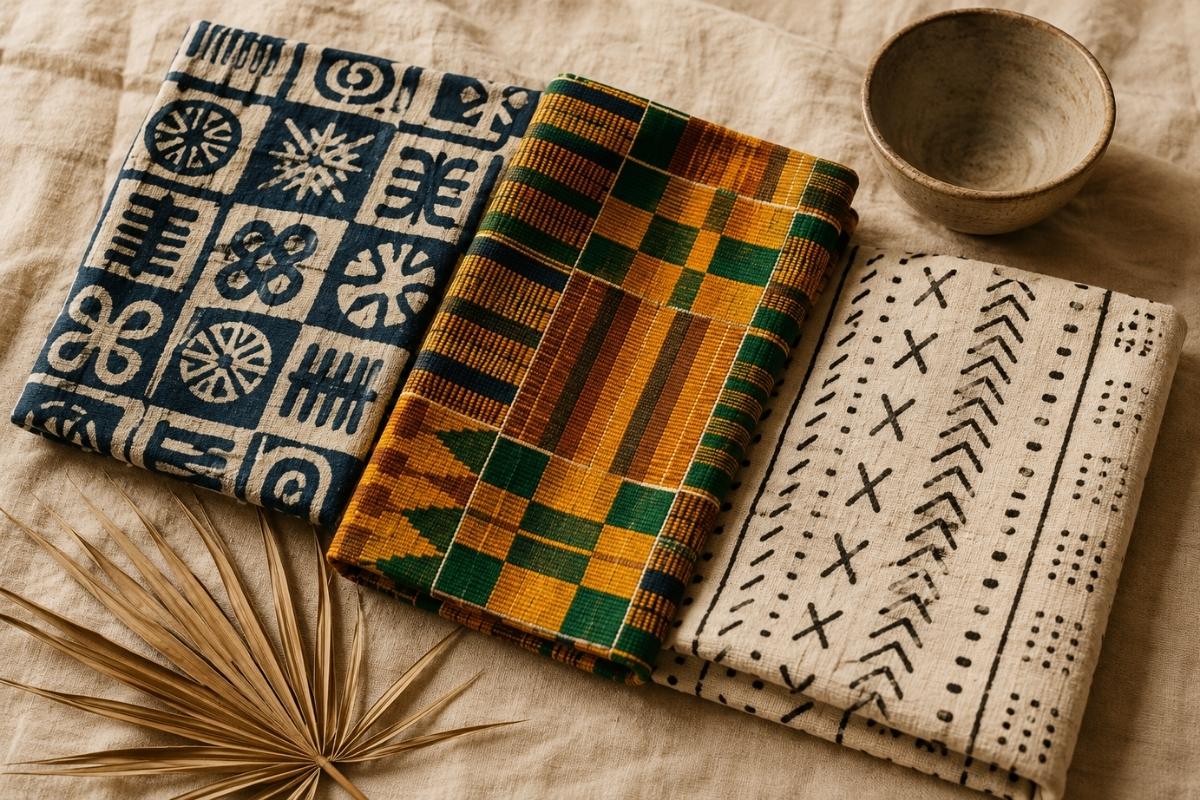
The three motifs come from different peoples, in different countries, with different histories and different ceremonial uses. They look different on close inspection. Adinkra is stamped, kente is woven, mudcloth is painted. They have different palettes, different cultural weights, and different appropriate uses in a home. Treating them interchangeably is the surest sign that a piece is decor rather than design.
Distinguishing them is not pedantry. It is the difference between a home that honours its references and a home that wears them.
Adinkra — the Akan symbol system from Ghana
Origin and tradition
Adinkra symbols originate with the Akan peoples of Ghana, particularly the Ashanti, and have a documented history stretching back at least to the early 19th century. The symbols were traditionally stamped onto cloth using calabash carved into glyph-shaped stamps and natural dye made from the bark of the badie tree.
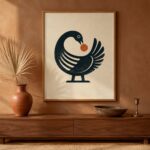
Historically, adinkra cloth was worn at funerals and significant ceremonial occasions. Each symbol carries a specific name, a specific meaning, and often a proverb attached. The most internationally recognised adinkra symbol is Sankofa — a bird with its head turned backward, meaning ‘return and learn from the past.’
Visual language
Adinkra is fundamentally a symbol system rather than a pattern system. The cloth shows individual named glyphs arranged in grids or panels, each one a complete unit of meaning. The visual rhythm of adinkra cloth is reading-like — you scan from symbol to symbol, each one a contained idea.
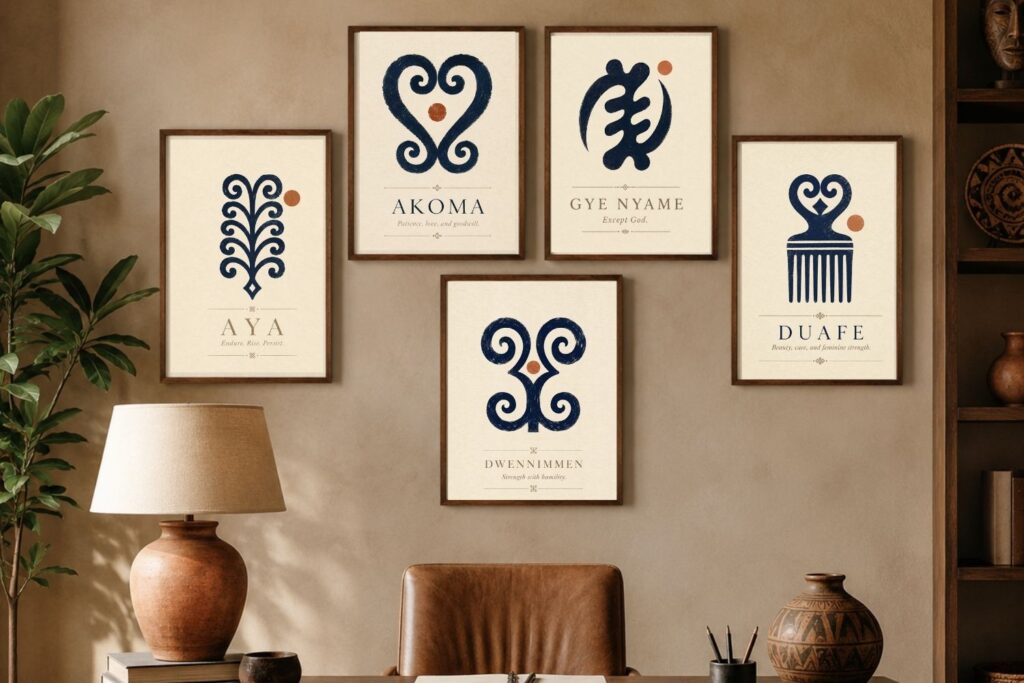
Common adinkra symbols include Sankofa (return), Gye Nyame (omnipresence), Dwennimmen (strength through humility), Adinkrahene (leadership), Aya (endurance), and Nkyinkyim (life’s twists and turns).
How to use adinkra respectfully in decor
Adinkra works in decor when individual symbols are used with knowledge of what they mean. A single Sankofa print on a wall, displayed because the meaning resonates personally, is a respectful use. A generic grid of unnamed adinkra-looking glyphs on a mass-market cushion is not. We have written a dedicated guide to 12 adinkra symbols and their meanings if you want to go deeper into the specific glyphs.
Kente — the Ashanti and Ewe ceremonial weaving from Ghana
Origin and tradition
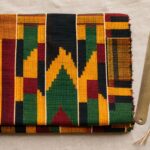
Kente is a woven textile originating with the Ashanti (Asante) and Ewe peoples of Ghana, with the Ashanti tradition traced to the village of Bonwire in the 17th century. The cloth is made on a narrow loom that produces strips roughly four inches wide; the strips are then sewn together to form the finished textile.
Kente was historically reserved for royalty and significant ceremonial occasions. Different patterns and colour combinations had specific meanings, names, and ceremonial uses. Even today, kente carries weight — it is worn at graduations, weddings, and major life events across the Ghanaian diaspora as a marker of cultural pride.
Visual language
Kente is fundamentally a pattern of woven strips. The cloth shows alternating colour blocks and geometric weaves arranged in tight, repeating sequences. Traditional kente palettes include gold, forest green, red, blue, black, and white, with each colour carrying symbolic meaning — gold for wealth and royalty, green for growth, red for spiritual and political moods, blue for love and harmony.
The named kente patterns include Adweneasa (the perfection of skill), Nyankonton (rainbow), Babadua (loyalty), and many others. Authentic kente is hand-woven; the strip-and-stitch construction is visible on close inspection.
How to use kente respectfully in decor
Kente carries enough ceremonial weight that it works best in decor as a deliberate accent rather than as a saturated theme. A folded kente runner on a dining table for a special occasion, a single kente cushion on a sofa, or a framed section of authentic kente cloth in a thin natural-wood frame all read as honoured.
What does not read as honoured: kente-print mass-market polyester upholstery, kente-pattern wallpaper, and kente-cut-up tote bags and accessories. The cloth was not made to be subdivided into novelty items.
Read more about: Understanding African Textiles Meaning for Home Decor
Mudcloth — Bamana bògòlanfini from Mali
Origin and tradition
Mudcloth — bògòlanfini in Bamanankan — originates with the Bamana people of Mali and has a documented history of at least several centuries. The cloth is hand-woven cotton, dyed with leaves to create a yellow base, then painted with fermented mud which reacts chemically with the leaf dye to produce the deep brown-black markings that characterise the textile.
Mudcloth was historically associated with hunters and with rituals of protection, transformation, and rite of passage. Specific patterns marked occasion and identity; the cloth was woven by men and painted by women, and the production process was, and is, slow.
Visual language
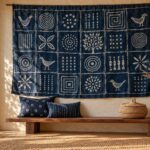
Mudcloth is fundamentally a hand-painted geometric pattern in a near-monochrome palette — cream or pale yellow base, deep brown-black markings. The patterns are bold, irregular, and read as drawn rather than printed; the small inconsistencies in line weight and spacing are what mark a real mudcloth from a printed lookalike.
Recurring mudcloth motifs include broken lines, arrow shapes, concentric squares, fish-bone patterns, and circles. The patterns are not as codified as adinkra symbols; they are closer to a visual grammar than a symbol set.
How to use mudcloth respectfully in decor
Mudcloth is the most decor-friendly of the three traditions because the textile is heavy, durable, and the palette pairs naturally with most warm earth-tone interiors. A mudcloth throw at the foot of a bed, mudcloth-upholstered cushions on a sofa, or a folded mudcloth panel on a low bench all integrate naturally into contemporary decor.
The respect line is whether the mudcloth is real. Hand-painted bògòlanfini from Mali carries the depth of the tradition. Polyester-printed mass-market ‘mudcloth pattern’ upholstery does not, and it is usually identifiable on close inspection by the perfect uniformity of the printed lines.
How to tell real adinkra, kente, and mudcloth from mass-market lookalikes
Three close-inspection checks that work across all three traditions.
- Look at the back of the textile. Real woven or hand-painted cloth shows the pattern on both sides — sometimes inverted, sometimes mirrored. Printed lookalikes are blank or solid on the reverse.
- Look at the edges. Real kente shows the strip construction at the edges where strips meet. Real mudcloth shows hand-painted line variation. Printed versions show clean machine-printed edges.
- Look at the listing description. Reputable sellers name the artisan, the cooperative, or the region the textile comes from. Vague descriptions that just say “African inspired” almost always indicate a printed lookalike.
Combining the three African motifs in one home — the one-room-each rule
It is possible to honour all three traditions in one home, but not in one room. The textiles are visually distinct enough that placing adinkra, kente, and mudcloth in the same space creates a competing visual conversation that flattens each one.
The rule we keep returning to: one tradition per room. Mudcloth in the living room. Kente in the dining room as a runner for special occasions. Adinkra in the entryway or study as framed art with named symbols. Each tradition gets its own moment, and the home as a whole reads as considered rather than collected.
Wall art helps with this kind of layered cultural styling — a piece in a related palette pulls the room together without adding another textile to compete. Our Africa Map abstract print and the Afrocentric Wall Art Set — Black Woman trio were both designed in palettes that work alongside any of the three traditions without competing for visual attention.
Where to source genuine adinkra, kente, and mudcloth
- Etsy artisan shops. A growing number of Ghanaian and Malian artisans and cooperatives sell directly through Etsy. Look for shops that name the maker and the village or region.
- Fair-trade marketplaces. Organisations like Ten Thousand Villages, Indego Africa, and Cultural Threads work directly with African artisan communities and document the provenance of each piece.
- Specialty African design retailers. Shops focused specifically on African textile import — both online and in-person in major cities — typically stock authentic pieces with documentation.
- Direct from artisan cooperatives. Several cooperatives ship internationally directly. These typically offer the strongest provenance and the most direct support of the makers.
Frequently asked questions
What is the difference between adinkra and kente?
Adinkra is a stamped cloth from Ghana made by pressing symbol-shaped stamps onto fabric using natural dye; each symbol is a named glyph carrying a specific meaning. Kente is a woven cloth from Ghana made by sewing together narrow hand-woven strips in bold colour patterns. They originate from related Ghanaian traditions but are made by completely different techniques and carry different ceremonial uses.
Is mudcloth from Africa as a whole or from a specific country?
Mudcloth (bògòlanfini) originates specifically from the Bamana people of Mali. The technique has spread regionally, but the cloth is traditionally Malian. The term “African mudcloth” is technically accurate but obscures the specific cultural origin — bògòlanfini is the more precise term and the one used by makers and scholars.
Can I use kente cloth in my home if I am not Ghanaian?
Yes, with care. Kente is widely used in decor by people from many backgrounds, and the textile is treated as a celebrated export of Ghanaian culture. The respect line is to source authentic hand-woven kente from Ghanaian artisans or fair-trade retailers, use it as a deliberate accent rather than as a saturated theme, and be willing to explain what it is and where it came from if asked.
Why is some mudcloth so much cheaper than others?
Authentic hand-painted bògòlanfini from Mali, made by named artisans, typically costs in the hundreds of dollars for a full panel because the production process is slow and labour-intensive. “Mudcloth pattern” textiles that sell for $30 to $60 are almost always machine-printed polyester or cotton lookalikes, not real bògòlanfini. The price gap reflects the difference between authentic and printed.
What is the most beginner-friendly way to bring african motifs explained into a home?
Start with one piece of authentic mudcloth — a throw, a cushion cover, or a panel. Mudcloth integrates more naturally into contemporary decor than the other two, the palette pairs with most existing rooms, and the textile is durable enough to live with daily. Add one piece of named adinkra wall art (with a symbol whose meaning resonates personally) once the mudcloth is settled. Skip kente until you have a specific occasion or formal room that suits it.
Related reading
- 12 Adinkra Symbols & Their Meanings: The Symbolism in African Art — Ghana
- A Respectful Guide to African Textiles and What They Mean
- How to Style African Prints in a Modern Home
- 12 Moroccan Symbols & Their Meanings: A Decor Lover’s Guide
Closing
African motifs explained, briefly: adinkra is stamped Ghanaian symbol cloth, kente is woven Ghanaian ceremonial cloth, mudcloth is Malian hand-painted Bamana cloth. They are distinct traditions, each carrying its own ceremonial weight, and they ask to be honoured one at a time rather than collected into a single ‘African’ visual theme.
If you are building a home around these references, our wall art was designed in palettes — warm clay, indigo, cream — that pair naturally with any of the three traditions, letting the textile carry the cultural moment while the wall art holds the room together.
Shop the Essence of the Road Art collection
Essence of the Road Art on Etsy — full collection
Afrocentric Wall Art Set — Black Woman trio