DIY Printable African Wall Art: Free Templates Guide
By Essence of the Road Art · Published May 2026
This article contains affiliate links. If you buy through our links, we may earn a small commission at no extra cost to you. We only recommend pieces we’d style in our own homes. As an Amazon Associate I earn from qualifying purchases.
Table of Contents
What is DIY printable African wall art — and why it works
Quick Answer: DIY printable African wall art means downloading a digital art file — a portrait, abstract design, botanical, or cultural pattern — and printing it yourself at home or through a local print shop, then framing it. It is one of the most affordable and flexible ways to bring Afrocentric, Afro-bohemian, or African-inspired art into your home. Files are available as instant downloads on platforms like Etsy, and the entire process from purchase to framed piece can take less than an hour.
There is a specific kind of satisfaction in looking at a wall you assembled yourself. Not because DIY is fashionable — it has always been fashionable — but because the curation was yours. You chose the palette. You chose which faces, shapes, and symbols would hold space in your home.
Printable wall art makes that process faster, cheaper, and more culturally specific than most alternatives. You are not limited to what the nearest home store carries. You are not paying for shipping, manufacturing, and retail markup. You are paying for the design itself — which is often the most thoughtful, irreplaceable part of the piece.
For Afrocentric and African-inspired decor specifically, printable art solves a real problem: beautiful culturally-rooted pieces are not always available locally, and quality art prints with depth and intention are easier to find through independent digital artists than through mass retail. The print-at-home format puts that work directly in your hands.
This guide walks through every step — from choosing a design direction to framing and styling — with practical detail rather than vague inspiration.
What you need to get started
The barrier here is genuinely low. Here is the practical list.
For home printing:
- A home printer capable of at least 300 DPI output (inkjet printers generally give warmer, richer results on art paper than laser printers)
- Matte or semi-gloss photo paper, or fine art paper such as smooth linen or watercolor texture
- Standard US frame sizes: 4×6, 5×7, 8×10, 11×14, 16×20 — always download your file in the size you plan to frame
For print shop printing:
- The digital file saved to a USB drive, Google Drive, or emailed to yourself
- Your chosen size and paper type noted in advance (most print shops offer matte, glossy, or lustre finish)
- Staples, FedEx Office, and Walgreens all offer art print services at reasonable cost
For framing:
- Frames in your chosen finish — black, natural wood, gold, or antique brass all work well with African-inspired palettes
- Matting (optional but recommended for 8×10 art in 11×14 frames — it elevates the look significantly)
- A level and removable adhesive strips if you are hanging on rental walls
No design skills required. Most printable art files come as ready-to-print JPEGs or PDFs. Canva templates require only minor text or color edits. Both approaches are covered below.
Step 1: Choose your design direction
African-inspired wall art is not a single aesthetic. Before downloading anything, spend five minutes deciding which direction fits your room.
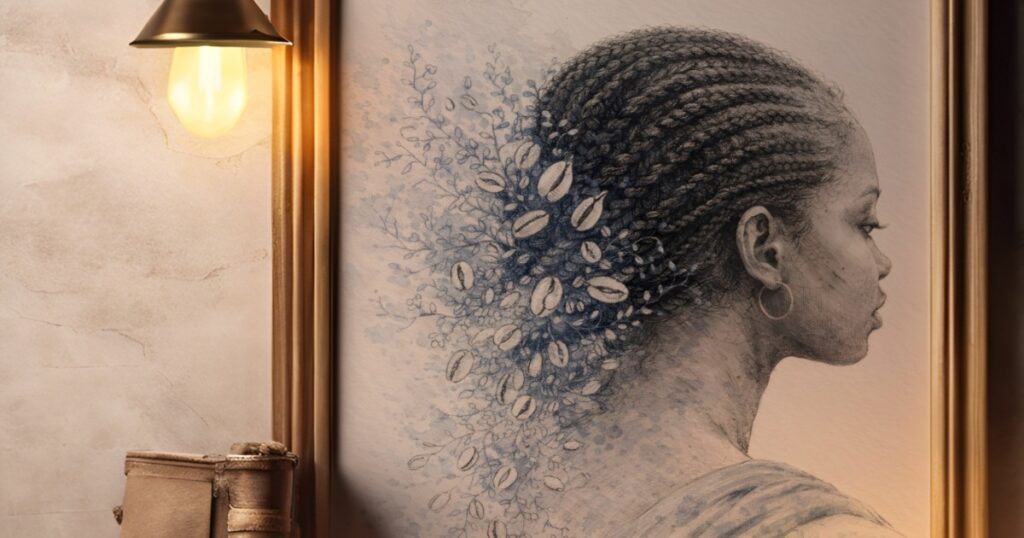
Afrocentric portraiture — stylized or editorial portraits of Black women, often with natural hair, bold earrings, or cultural adornments. Warm skin tones against deep indigo, terracotta, or ochre backgrounds. Best for: bedroom feature walls, living room gallery walls, quiet corner vignettes.
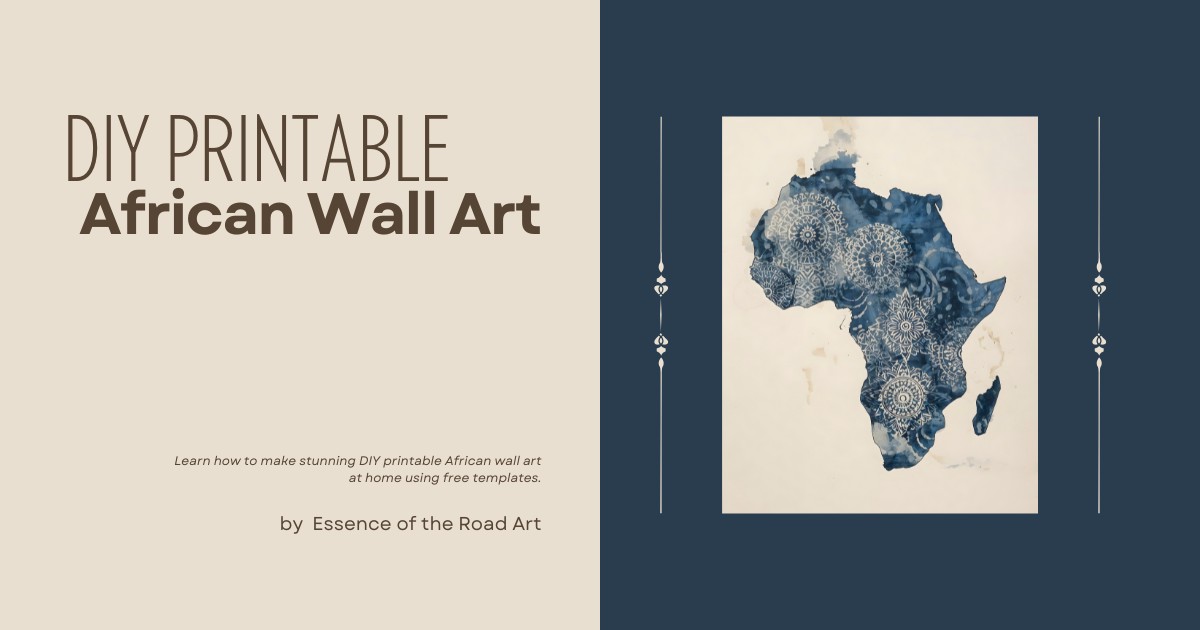
Abstract continent art — silhouettes, maps, or geometric interpretations of the African continent in earthy or jewel-tone palettes. These read as both culturally grounded and design-forward, which makes them versatile in modern and Afro-bohemian rooms alike.
Kente and textile-inspired pattern art — bold geometric patterns drawn from West African weaving traditions. Particularly striking in larger print sizes. Best used as a single statement piece rather than in multiples.
Botanical and nature-inspired — orchids, palm leaves, proteas, baobabs, and other flora associated with the African continent rendered in an editorial or painterly style. These layer beautifully into rooms that mix global decor with earthy neutrals.
Afro-bohemian collage style — layered compositions combining portraiture, pattern, botanical elements, and abstract shapes. This style has the widest appeal and works well in gallery wall groupings of three to five pieces.
Choose one direction as your anchor. You can mix in elements of others, but your dominant aesthetic should feel coherent rather than collected at random.
Step 2: Find or customize your templates
There are three main routes to your final file.
Ready-to-print digital downloads (fastest)
Etsy is the strongest source for culturally specific, independently designed Afrocentric and African-inspired printable art. Search terms that return quality results: Afrocentric wall art printable, African woman print digital download, African abstract wall art print, Afro boho printable art.
Filter by: instant download, file type (PDF or JPEG), and read the listing description to confirm the included sizes. Good listings offer multiple sizes in a single download — typically 4×6, 5×7, 8×10, 11×14, and 16×20.
From our own shop: We design Afrocentric printable art specifically for the kind of rooms this blog covers. Our Indigo Archives — Quiet Afrocentric Luxury Collection includes six volumes of editorial art in an indigo, cream, and charcoal palette — each volume a 3-piece set designed to hang together or separately. Use code ARCHIVE15 for 15% off any volume.

Canva templates (most customizable)
Canva’s free tier includes hundreds of printable poster templates. To adapt them for an Afrocentric aesthetic:
- Search “African wall art” or “Afrocentric poster” in Canva’s template library
- Swap any stock imagery for Afrocentric portrait illustrations (available via Canva’s element library or uploaded separately)
- Shift the color palette toward terracotta (
#C5603A), ochre (#D4A017), warm cream (#F5ECD7), charcoal (#2D2D2D), or deep indigo (#2E4057) - Use minimal, elegant typography if text is part of the design — Cormorant Garamond, Playfair Display, or DM Serif Display all align with the warm, editorial aesthetic
- Export as PDF Print (highest quality) or PNG at 300 DPI for home printing
AI-generated art (most original)
If you have access to Midjourney, Adobe Firefly, or a similar tool, you can generate completely original Afrocentric art in precise sizes and color palettes. This requires more iteration but produces work that is entirely unique to your home. Prompts that yield strong results: editorial portrait, Black woman, natural hair, terracotta and ochre palette, African-inspired background, flat art style, 8×10 print. Always generate at the highest resolution available and check the final file size before printing.
Step 3: Print at home or at a print shop
At home
Use the highest print quality setting on your printer. For inkjet printers, matte photo paper produces the most accurate color on warm, earthy Afrocentric palettes — glossy paper can shift warm tones toward yellow. Print a test copy on regular paper first to check crop and color before committing your art paper.
For 8×10 and larger prints, consider a dedicated art paper such as Red River Ultra Pro Satin or Epson Ultra Premium Presentation Paper Matte — both are available on Amazon and elevate the print quality noticeably over standard photo paper.
At a print shop
For anything 11×14 or larger, a print shop will typically give better results than a home printer. FedEx Office, Staples, and Walgreens Print can all handle standard sizes. Specify matte or lustre finish — avoid glossy for Afrocentric art with warm skin tones, as it tends to flatten and over-saturate.
For the highest quality, local fine art printers (often found through Yelp or Google Maps as “giclée printing” or “art printing services”) use archival-quality inks and fine art paper. The cost is higher — typically $15–$40 per print depending on size — but the result is indistinguishable from gallery-quality work.
Step 4: Choose your frames
The frame is doing more design work than it appears. A well-chosen frame elevates a modest print. A mismatched frame undermines even excellent art.
For Afrocentric and African-inspired art, these frame finishes work best:
Natural wood (light or dark) — walnut, maple, or bamboo frames ground African-inspired art in an organic, earthy context. They work in Afro-bohemian rooms, mid-century modern rooms, and minimalist spaces alike.
Matte black — a clean, modern choice that lets the art speak. Particularly effective for abstract or pattern-based pieces in bold palettes.
Antique brass or brushed gold — adds warmth and a quiet luxury feeling. Works best with editorial portraiture and botanical pieces. Avoid chrome or silver — it creates a visual temperature mismatch with warm Afrocentric palettes.
Avoid: heavily ornate white frames, heavy baroque styles, or anything with a distressed white or grey finish — these pull the aesthetic toward farmhouse rather than Afrocentric.
Frame sizing to know: If you want the matted gallery look, download an 8×10 file and place it in an 11×14 frame with a white or cream mat. The mat adds approximately 1.5 inches of visual breathing room around the print and makes a significant difference in perceived quality.
Amazon finds we recommend:
- Burnes of Boston 11×14 Black Gallery Frame (~$18) — clean, well-made, no visual noise
- Malden International Design Rustic Barn Wood Picture Frame (~$22) — warm natural wood, works beautifully with earthy palettes
- Americanflat Gold Gallery Wall Picture Frame Set (~$45 for a set of 4) — brushed gold finish in multiple sizes, ideal for a coordinated gallery wall
(All available on Amazon. As an Amazon Associate we earn from qualifying purchases.)
Step 5: Style your gallery wall
The most common mistake with gallery walls is arranging by symmetry rather than by visual weight. Symmetry produces stiffness. Visual weight produces elegance.
For a 3-piece horizontal arrangement:
Place your largest piece or most visually complex piece in the center. Flank it with two pieces that are slightly smaller or simpler in composition. Aim for a consistent bottom edge or a consistent center line, not necessarily a perfectly uniform top edge.
For a 5-piece gallery wall:
Start with your anchor piece — the piece you love most. Place it first, at eye level (approximately 57–60 inches from floor to center of the artwork). Build outward from there, spacing pieces 2–3 inches apart. Vary sizes to prevent the arrangement from looking like a grid.
Palette cohesion: Your pieces do not need to match exactly. They do need to share at least one or two colors. Terracotta, ochre, indigo, charcoal, and cream form a natural Afrocentric palette that ties together diverse pieces without making the wall feel matchy.
A simple rule that works every time: One large piece, two medium pieces, and (optionally) two smaller accent pieces — or small decorative objects like a woven wall hanging or a small ceramic plate — to break up the rectangular pattern.
Lay the arrangement on the floor first. Before a single nail goes into the wall, arrange your framed pieces on the floor in your intended layout. Photograph it. Live with the photograph for a day. Adjust. Then hang.
Find out more about Afro-Boho Color Palette 2026.
Our Indigo Archives collection: ready-to-print Afrocentric art
We designed the Indigo Archives collection specifically for the kind of rooms we write about — layered, warm, culturally rooted, and quietly luxurious without being overdone.
The collection is available in our Etsy shop EssenceOfTheRoadArt. Each volume contains three editorial art pieces in an indigo, cream, and charcoal palette — designed to hang as a triptych or work as individual pieces in a larger gallery wall.
There are six volumes in the collection, ranging from Black female portraiture to abstract geometric compositions to nature-inspired editorial pieces. Each download includes standard US print sizes from 4×6 through 16×20.
Use code ARCHIVE15 for 15% off any volume. The discount applies to any individual volume or multiple purchases in a single order.
If you are building a gallery wall and want pieces that work together from the start — rather than hunting for cohesion across different sellers — the Indigo Archives volumes are designed with that exact use case in mind.
Amazon finds that elevate your DIY gallery wall
A few well-chosen accessories transform a gallery wall from good to considered. These are the supporting pieces worth having.
Frames:
- Command Picture Hanging Strips (~$10 for 8 pairs) — essential for rental walls or if you want flexibility to rearrange without damage
- Golden State Art Pack of Storage Bags for print storage (~$12) — protect your downloaded prints before framing
Matting:
- Logan Compact Elite Matcutter (~$40) — if you plan to mat multiple prints yourself, a quality matcutter pays for itself quickly versus buying pre-cut mats individually
Wall styling accessories:
- Mkono Macrame Wall Hanging (~$18) — a woven textile element adds warmth and texture to break up the rectangular geometry of a multi-frame arrangement
- Bamjoy Bamboo Ladder Shelf (~$99) — lean a few framed prints against a shelf rather than hanging them, for a more relaxed, layered look
- Small terracotta planter or trailing pothos near the gallery wall adds organic life to the composition
(All available on Amazon. As an Amazon Associate we earn from qualifying purchases.)
FAQ
Can I use free printable African wall art I find online?
Yes, with important caveats. Free printables shared on Pinterest, design blogs, or platforms like Unsplash may be free for personal use but not for redistribution or commercial purposes. Always check the license terms before downloading. If a file states “personal use only,” that means you can print it for your own home but not sell prints of it or distribute it. For the best selection of culturally specific, independently designed Afrocentric art, Etsy digital downloads offer quality and licensing clarity that free Pinterest downloads often do not.
What size should I download for a gallery wall?
For most gallery walls, 8×10 is the most versatile size — large enough to read well from across a room, small enough to arrange in groups. For a single statement piece or anchor print, 11×14 or 16×20 creates more visual presence. Download the size that matches the frame you already have, or decide on your frame first and download to match.
Does home printing look as good as professionally printed art?
With the right paper and printer settings, home printing is genuinely excellent — particularly for art with warm, matte color palettes like Afrocentric pieces. The difference is most noticeable in very large sizes (16×20 and above), where a fine art print shop will typically outperform a home inkjet printer. For sizes 11×14 and below, a good home printer on quality paper produces results that are hard to distinguish from print shop work.
How many pieces do I need for a gallery wall?
Three pieces create a coherent grouping without requiring precise layout planning — it is the minimum for a gallery wall that feels intentional rather than accidental. Five pieces allow for more variety and visual interest. More than seven pieces in a single grouping tends to feel cluttered unless the space is large and the arrangement is very deliberately designed.
Can I mix African printable art with other styles in the same gallery wall?
Yes, and this is often where the most interesting gallery walls happen. Afrocentric portraiture, for example, mixes naturally with abstract geometric pieces, tropical botanical prints, and even neutral typographic art — as long as the color palette is coherent. The key is to anchor the wall with one or two strong Afrocentric pieces and let the other elements support rather than compete.
Final thoughts
The best gallery walls are built slowly. A print here, a frame found at an estate sale, a digital download from an artist whose work stayed with you. The DIY printable format makes it easier to start — and easier to evolve — because the investment is low enough to experiment freely.
What does not change is the intention behind the curation. African-inspired and Afrocentric art carries aesthetic weight, cultural depth, and historical significance that is worth approaching with care. Choosing pieces that were designed with that awareness — rather than mass-produced approximations — makes the difference between a wall that is styled and a wall that means something.
Start with one piece. Put it in a frame that does it justice. See how it changes the room.
Also read:
- 12 Ghanaian Symbols and Their Meanings: A Decor Lover’s Guide

- 12 Kongo Symbols and Their Meanings: A Decor Lover’s Guide
- 12 Moroccan Symbols & Their Meanings: A Decor Lover’s Guide
- 12 South African Symbols and Their Meanings: A Decor Lover’s Guide

- 12 Symbols & Their Meanings: The Symbolism in African Art — Senegal

- 12 Tanzanian Symbols & Their Meanings: A Decor Lover’s Guide