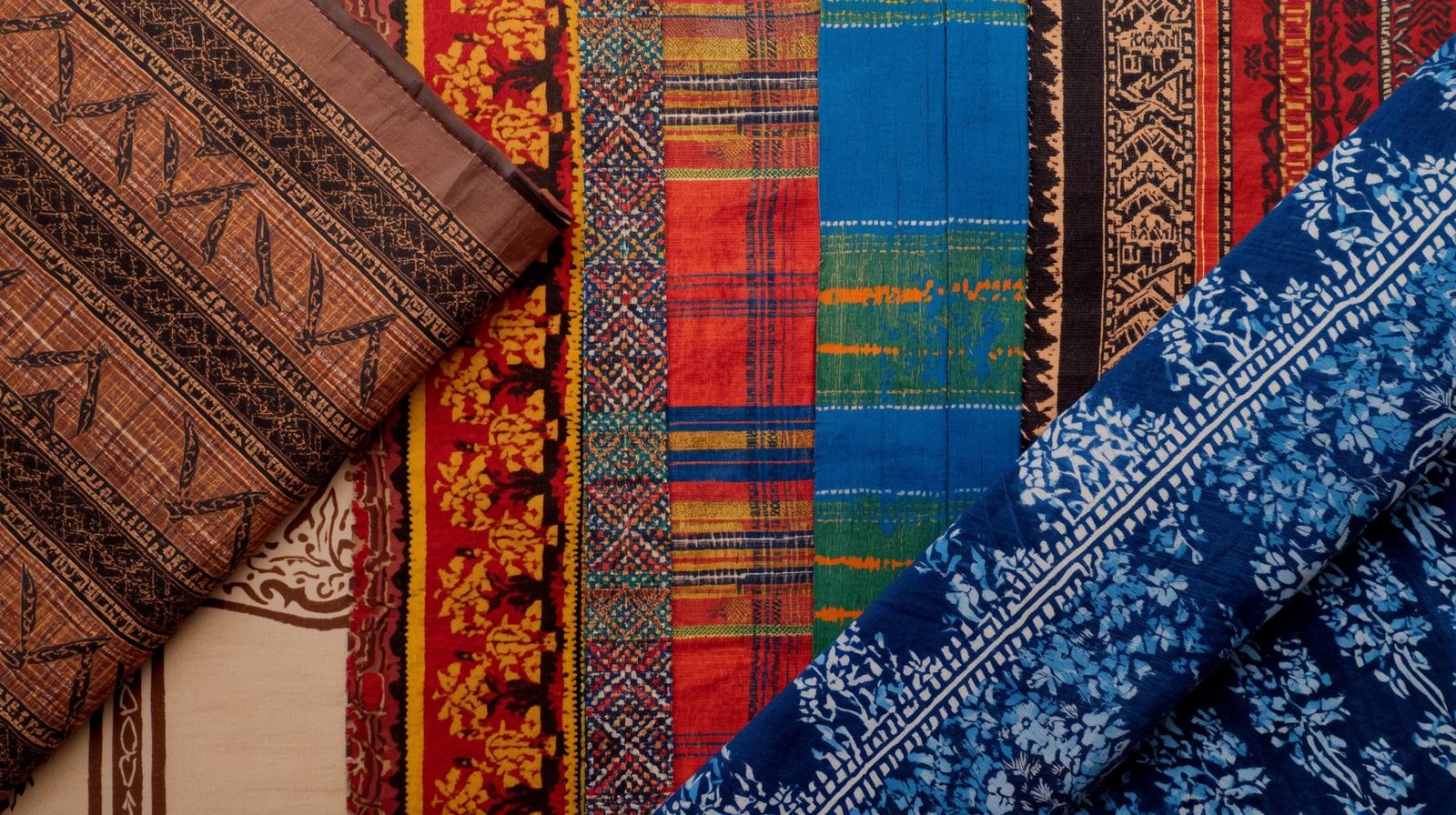
Understanding African Textiles Meaning for Home Decor
By Essence of the Road Art · Published April 2026
This article contains affiliate links. If you buy through our links, we may earn a small commission at no extra cost to you. We only recommend pieces we’d style in our own homes.
The patterns tell you where they came from — if you listen
Before we ever talk about mixing African textiles in a living room, we want to pause on what they actually are. Because the truth is, a mudcloth pillow is not just a pillow. A length of Kente is not just “bold stripes.” Adire is not navy tie-dye. Each of these textiles is a piece of language — shaped by a specific people, in a specific place, carrying specific meaning. Understanding African textiles meaning enriches our appreciation of these cultural artifacts.
We wrote this guide because too much of the decor internet treats African prints as interchangeable “tribal” patterns. They are not. And once you know the difference — even a little — your home stops referencing a culture and starts honoring one.
No styling advice in this post. No shopping lists. Just the stories. (When you are ready for the “how do I use this at home” answer, head to our [styling companion post].)
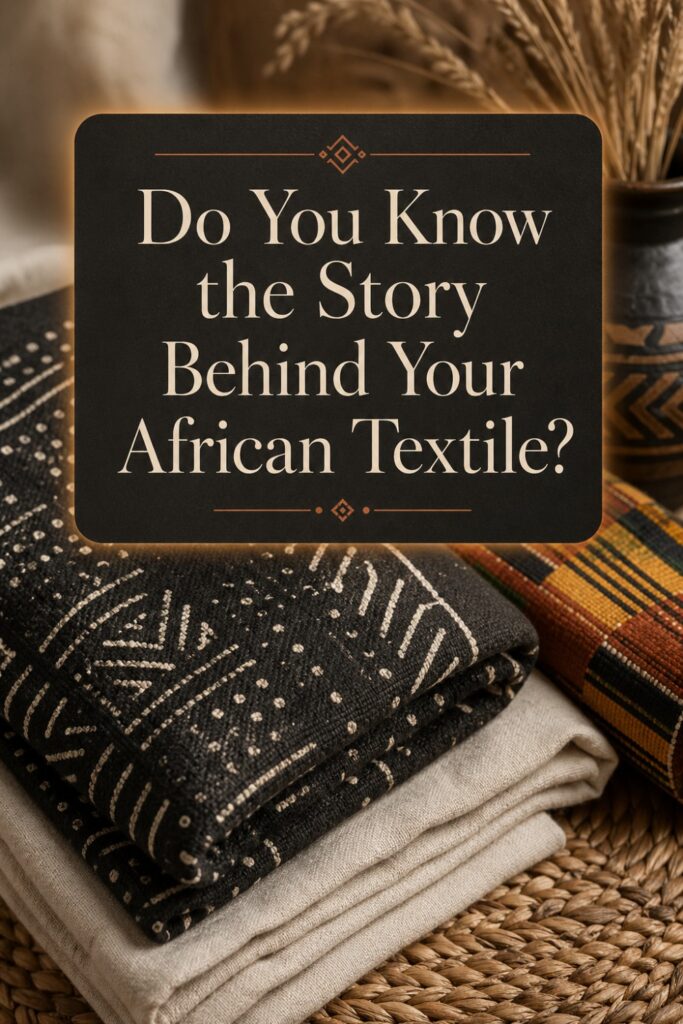
📌 Quick Answer
The six most widely used African textiles in modern decor are Mudcloth (Bogolanfini) from Mali, Kente from Ghana, Ankara (wax print) from West Africa, Adire from Nigeria, Shweshwe from Southern Africa, and Kuba cloth from the Democratic Republic of Congo. Each carries distinct symbolism — from protection and ancestry to royalty, status, and spiritual strength — and was traditionally hand-made by specific communities using techniques passed down through generations.
Table of Contents
Why these patterns carry meaning
In Afrocentric design, pattern is not decoration layered on top of the object. Pattern is the object. A textile’s motif names its maker, its region, and often its moment in history — a wedding, a funeral, a coronation, a harvest. Colors carry weight: gold for status, green for renewal, black for spiritual depth, indigo for wisdom and calm.
This is why a single framed textile square can hold a room together in a way that a generic print never will. There is a person — often a woman, often unnamed in Western museum labels — whose hands made this pattern on purpose. That intention is what we are really bringing into our homes.
Mudcloth (Bogolanfini) — Mali
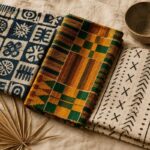
Made by: Bamana women, Mali Technique: Cotton fabric hand-painted with fermented mud and plant dyes, a process that can take weeks What the patterns mean: Protection, gender roles, historical events, community stories. Women traditionally painted these as visual narratives — a textile that could be read.
Visually, mudcloth is unmistakable: deep black, cream, and earthen tones, with bold geometric marks that feel almost calligraphic. In most Western decor stores, what you see labelled “mudcloth” is often a printed lookalike. Authentic Bogolanfini is a slow, ceremonial object — it carries weight because of the hands that made it.
A note we think matters: the patterns on traditional mudcloth are not generic geometry. They were created by specific women, often for specific purposes. If you buy authentic mudcloth from a fair-trade source or an African maker directly, you are supporting that continuity. If you buy a printed version, that is fine — just call it what it is: mudcloth-inspired, not mudcloth.
Kente Cloth — Ghana
Made by: Ashanti (Asante) and Ewe weavers, Ghana Technique: Narrow strips of vibrant silk or cotton woven on horizontal looms, then sewn together What the colors mean: – Gold = royalty, wealth, serenity – Green = growth, fertility, renewal – Black = spiritual strength, maturation – Red = political and spiritual mood, sacrifice – Blue = love, peacefulness, harmony
Kente was originally reserved for Ashanti royalty — worn only for ceremony, never for everyday life. The name of each specific pattern (and there are hundreds) tells a story: a proverb, a historical moment, a moral teaching. Kente is not a “bright striped fabric.” It is a woven archive.
Because of that, a little Kente goes a long way in a home. A folded length over a stool, a framed square on a wall, a single cushion — each is enough. More than that and the cloth stops speaking, because its volume drowns its meaning.
Ankara / African Wax Print — West Africa
Made by: Originally Dutch factories (inspired by Indonesian batik), then claimed and re-imagined by West African markets from the 19th century onward Technique: Wax-resist printing on cotton, high-saturation colors What the patterns mean: Less ancestral, more cultural-contemporary. Many individual patterns have nicknames and street meanings — “Happy Family,” “My Husband’s Capable,” “Eyes of My Rival” — that reflect the everyday wit, gossip, and pride of the women who wear them.
Ankara is the living, fashionable, street-side cousin of Kente and mudcloth. It is loud, it is joyous, it is worn to weddings and funerals and Sunday church. In decor, it translates beautifully into a statement armchair, a set of napkins, or curtains that dominate a room and leave everything else quiet.
The cultural story of Ankara is complicated — a Dutch-produced fabric that became deeply West African through adoption and redefinition. That complexity is part of its charm. It is not “authentic” in the anthropological sense. It is authentic in the lived one.
Adire — Nigeria
Made by: Yoruba women, Nigeria Technique: Indigo resist-dyeing — cassava paste painting, tying, or stitching before the dye bath What the patterns mean: Shells, leaves, animals, geometric grids — many carrying proverbs, histories, or blessings. The name itself means “tie and dye” in Yoruba.
Adire has the softest, most contemplative visual language of the six textiles in this guide. The deep indigo, the slightly irregular pattern, the way the dye settles unevenly — it looks like a textile that was made thoughtfully, because it was. For years Adire was nearly lost, the techniques held only by a few elder artisans. The current revival — driven by a new generation of Yoruba designers — is one of the most moving stories in modern African textile.
In a home, Adire reads almost like art. An indigo panel above a bed, a draped throw, a framed square — all of it feels quiet, grounded, and intentional. If you love indigo, this is the textile to learn.
This is also the textile that most directly inspired our own Indigo Archives collection — not as reproduction, but as visual conversation. Six editorial sets in indigo, cream, and charcoal, designed to sit alongside (never to replace) the traditional Yoruba originals. Returning readers can use ARCHIVE15 as a collector’s code.
Shweshwe — Southern Africa
Made by: Historically dyed in England, now predominantly produced in South Africa; worn by Basotho, Xhosa, and Tswana communities Technique: Small-scale intricate prints — dots, rosettes, geometric repeats — originally in deep indigo, now in many colors Cultural role: Central to Basotho and Xhosa traditional dress, often worn at weddings and coming-of-age ceremonies. Named for King Moshoeshoe I of Lesotho.
Shweshwe is sometimes called the tartan of South Africa — a fabric so woven into daily and ceremonial life that it has become national shorthand. Its patterns are tight, orderly, and read almost as texture from a distance. In decor, that makes Shweshwe surprisingly easy to work with: it layers next to bolder prints without competing.
A Shweshwe quilt, a set of stool cushions, a patchwork runner — all of these introduce real cultural specificity without overwhelming a room.
Kuba Cloth — DR Congo
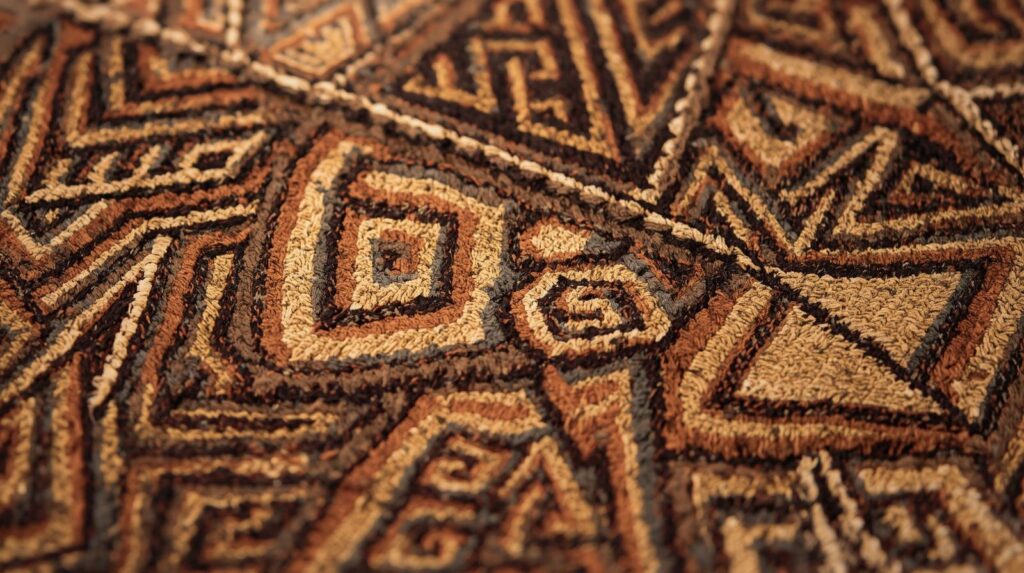
Made by: Kuba people, Democratic Republic of Congo Technique: Raffia palm fibers, hand-woven and embroidered — an exceptionally slow craft What the patterns mean: Status, spirituality, the maker’s patience. Geometric labyrinths of zigzags, triangles, and interlocking shapes in natural browns, blacks, and beiges.
Kuba cloth is the textile that most immediately looks like art to a Western eye, and for good reason — the scale and precision of the patterning is genuinely extraordinary. A single traditional piece can take a maker months to complete.
In a home, Kuba cloth works on a wall more than it works on a sofa. It is a slow, studied object, and it deserves to be displayed where it can be looked at closely.
How to honor these textiles in a home you did not grow up in
You do not have to be African, or Black, or from the specific region a textile comes from, to bring these pieces into your home. What we owe these objects — all of us, but especially those of us styling them into decor content — is something simpler: accuracy of naming, and effort in sourcing.
A short checklist we use ourselves:
- Call the textile by its real name. Mudcloth is Bogolanfini. Adire is Adire. “Tribal print” flattens six separate cultures into one word.
- If it is inspired-by, say so. A mudcloth-style cotton pillow from a big-box retailer is not mudcloth. That does not make it bad — it makes it honest.
- Buy from the makers when you can. Direct-from-Africa co-ops, Black-owned importers, and artisan platforms exist. A slightly higher price is a much more direct line to the hands that made it.
- Tell the story when guests ask. When someone points at your Kente square and says “I love that,” the correct answer is not “thanks.” It is “it is Kente, from Ghana, and the gold is for serenity.”
- Let one textile be enough. Cultural depth does not scale with volume.
FAQ
What is the difference between mudcloth and African wax print? Mudcloth (Bogolanfini) is a hand-painted cotton textile made by Bamana women in Mali using fermented mud and plant dyes — typically in earth tones with graphic symbolic motifs. African wax print (Ankara) is a factory-produced wax-resist cotton in bright, saturated colors, originally introduced via Dutch trade and later adopted and redefined by West African markets.
What do the colors in Kente cloth mean? Gold symbolizes royalty and serenity. Green represents growth and renewal. Black carries spiritual strength and maturation. Red signals political or sacrificial weight. Blue stands for love and harmony. Each color — and each specific woven pattern — is chosen deliberately.
Is it disrespectful to decorate with African textiles if I’m not African? No, when done with care. The line is not who you are — it is how you source and how you name what you have. Buying from makers or fair-trade sources, calling textiles by their real names, and being honest about “inspired-by” versus authentic pieces is what turns appreciation into respect.
What is the easiest African textile to start with? Adire (indigo) and Shweshwe are usually the gentlest entry points. Both have soft, pattern-as-texture visual rhythms that layer into almost any existing decor without demanding the room revolve around them.
A closing thought
We think the most beautiful homes are not the ones that match a trend — they are the ones that carry stories. Every textile in this guide represents hundreds of years of women and men making meaning with their hands. When we bring even one of these pieces home, we are quietly joining that lineage.
So start slowly. Learn one textile deeply before you buy three. Say its name correctly. And when you are ready for the styling side — the mixing, the scale, the how-not-to-make-it-a-theme-room question — our [companion styling guide] is where we get practical.
Akwaaba — welcome — to a way of decorating that means something.
What next?
How to Style an Afrohemian Rental Living Room (Damage-Free)
Afrocentric Bedroom Ideas: Warm, Calm Sanctuary Styling for 2026
-

Afrocentric Home Decor Beyond Wall Art: 9 Everyday Pieces That Carry the Same Design
By Essence of the Road Art · Published August 2026 This article contains affiliate links. If you buy through them, we may earn a small commission at no extra cost to you. We only feature pieces we would live with ourselves. Most people treat Afrocentric decor as a wall decision. You find a print you…
-

15 Mudcloth Pillows for Modern Homes: A Curated Buying Guide
By Essence of the Road Art · Published July 2026 This article contains affiliate links. If you buy through them, we may earn a small commission at no extra cost to you. As an Amazon Associate I earn from qualifying purchases. We only feature pieces we would live with ourselves. Mudcloth pillows are the single…
-
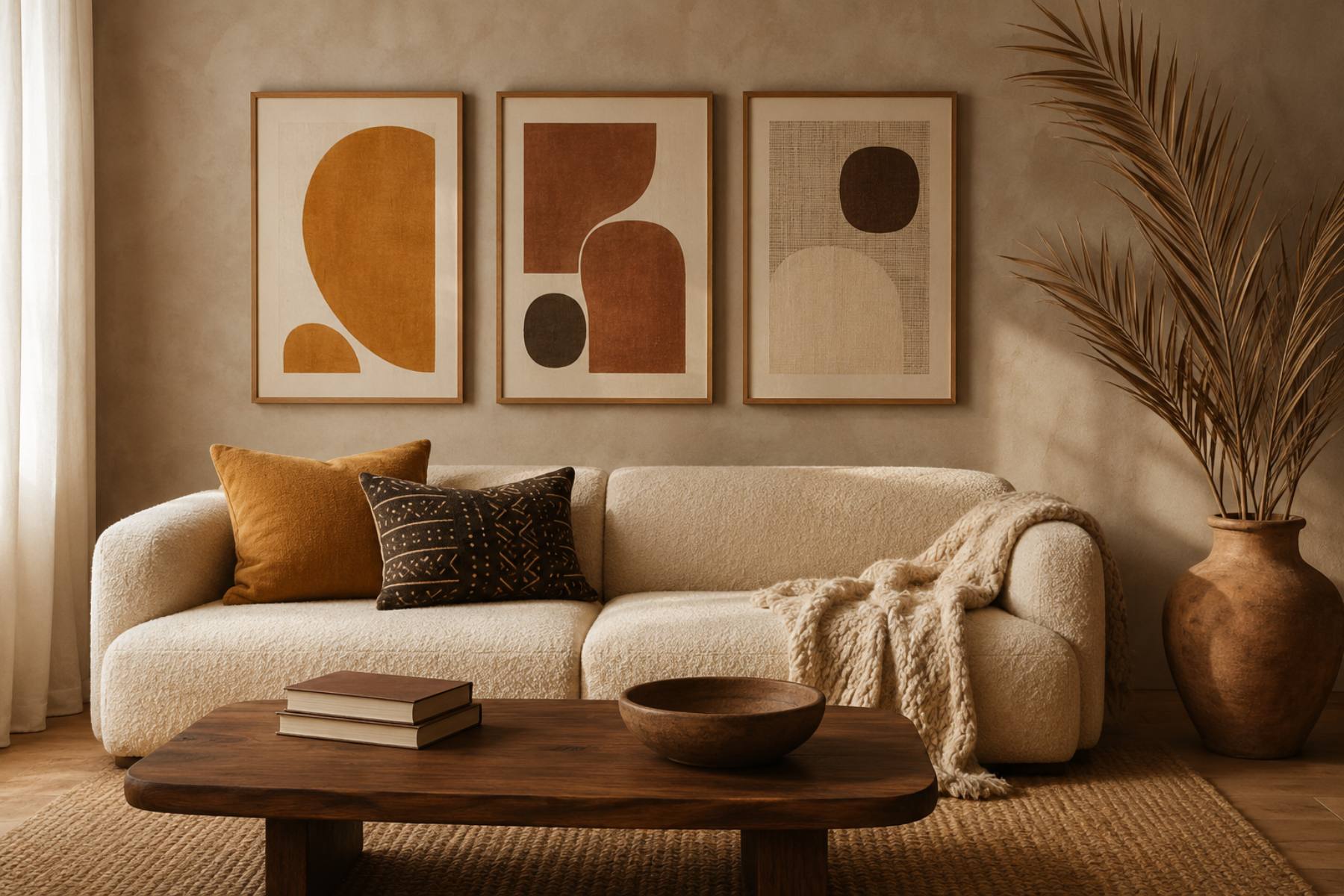
Modern Cozy Living Room: Warm Afro-Neutral Wall Art That Grounds the Space
By Essence of the Road Art · Published July 2026 This article contains affiliate links. If you buy through them, we may earn a small commission at no extra cost to you. As an Amazon Associate I earn from qualifying purchases. We only feature pieces we would live with ourselves. There is a specific frustration…