How to Style an Afrohemian Rental Living Room (Damage-Free)
By Essence of the Road Art · Published April 2026
This article contains affiliate links. If you buy through our links, we may earn a small commission at no extra cost to you. We only recommend pieces we’d style in our own homes. As an Amazon Associate I earn from qualifying purchases.
The problem with most rental living rooms
If your afrohemian rental living room still looks flat — even after three Amazon orders and a new throw pillow — the issue usually is not your taste. It is the sequence. Most small spaces fail because the decor arrives before the story does. You end up with six medium-sized objects that cancel each other out, and a wall that still feels bare.
In this guide, we walk through the exact method we use to style a warm, culturally grounded Afrohemian rental — without drilling, without overspending, and without turning the room into a theme. You will learn how to pick one art anchor, size it correctly above the sofa, layer renter-safe texture, and source pieces that feel personal rather than mass-produced.
📌 Quick Answer
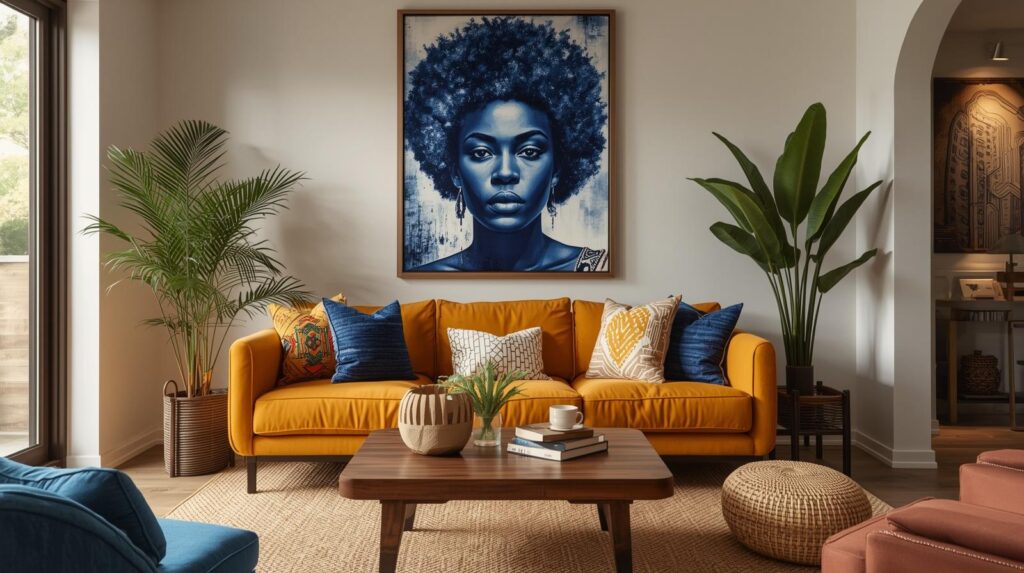
To style a small rental living room in Afrohemian decor without damaging the walls, start with one large art anchor — a portrait or textile that covers roughly two-thirds of your sofa width. Add two supporting materials (such as rattan and indigo), use removable hanging strips or a picture ledge, and limit the room to one statement plus three accents. Editing is what makes a small Afrohemian space feel elevated.
Table of Contents
Why small Afrohemian rooms fall flat
Most small-space problems look like decor problems but are actually editing problems. A rental living room feels cluttered when it tries to include mudcloth, adire-inspired print, raffia, carved wood, beading, and a full salon wall at once. On 600 square feet, that reads as visual noise, not warmth.
Afrohemian style — a soulful blend of Afrocentric art and bohemian layering — was never about more. It is about layered meaning. One strong cultural anchor. Two supporting materials. A color story pulled from warm neutrals: terracotta, ochre, indigo, clay, and deep cream. Everything else is restraint.
Start with one story, not ten pieces
Before buying anything, write one sentence that describes the room you want. Something like:
- “We want this room to feel warm, grounded, and art-led.”
- “We want a living room that looks collected over time, not trend-chased.”
- “We want cultural expression without turning our apartment into a theme.”
That sentence becomes the filter every purchase has to pass through.
Choose one art anchor first
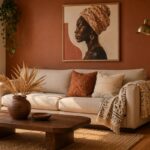
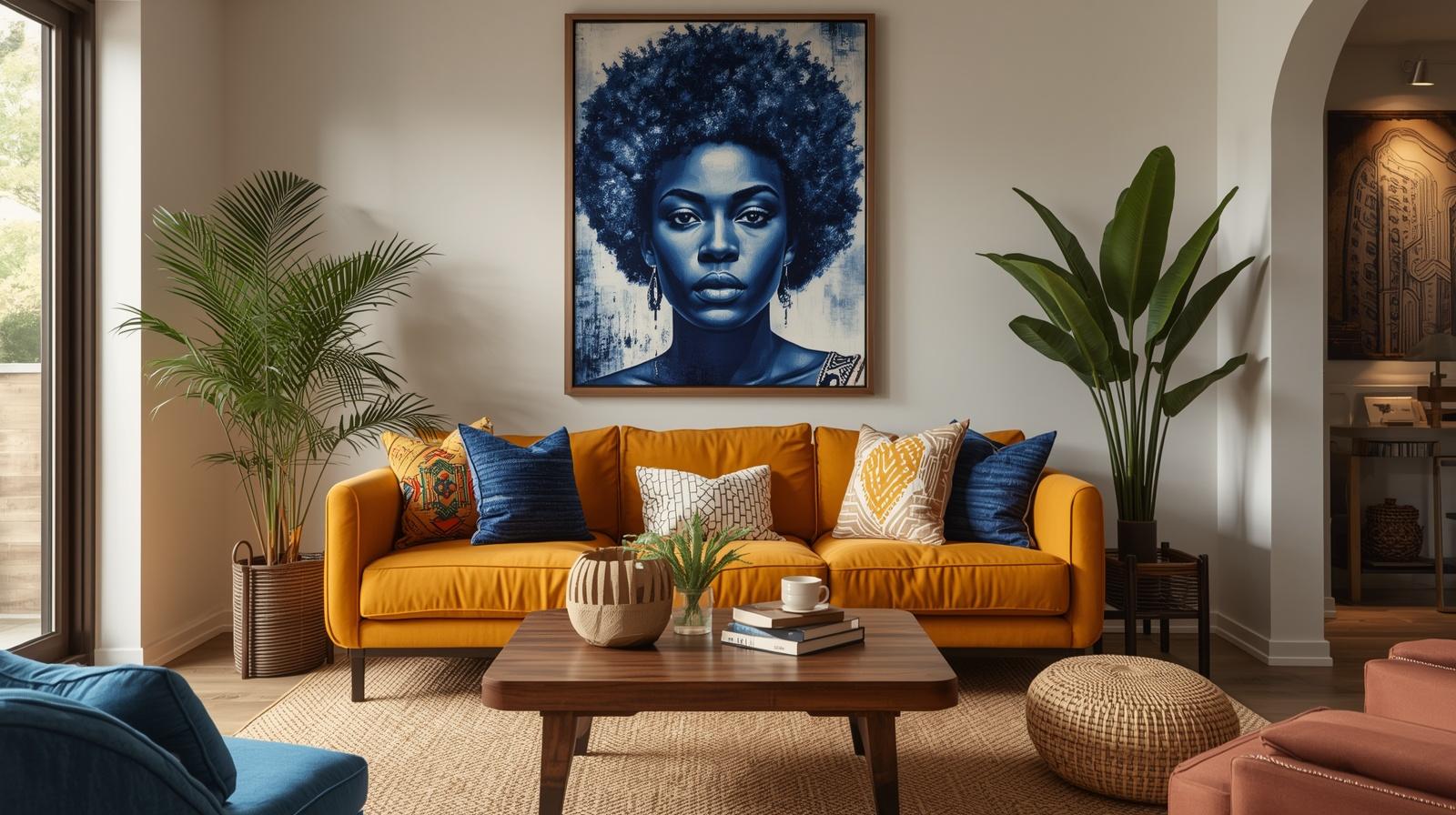
In a small room, one strong focal point beats six medium ones. The art anchor is the decision that makes every other decision easier. For an Afrohemian living room, strong anchor options include a Black portrait print, a modern Afrocentric silhouette, or a layered textile-style piece in indigo and clay tones.
This is where printable wall art quietly outperforms everything else for renters. You download, print locally, and frame — you get a gallery-scale piece for under $40, and you can swap the print whenever your taste shifts. Our Indigo Archives — Quiet Afrocentric Luxury Collection was designed exactly for this: six volumes of three-piece editorial sets in an indigo, cream, and charcoal palette, made to anchor a living room rather than decorate it. Returning readers can use code ARCHIVE15 for a collector’s discount.
Limit the room to two supporting materials
Once the anchor is chosen, pick only two supporting materials. Strong Afrohemian pairings:
- Handwoven basket + linen
- Rattan + indigo textile
- Black wood + warm brass
- Natural fiber rug + one patterned cloth
Three material groups is the ceiling. More than that and the room starts competing with itself.
Get the wall scale right before you shop
Most “my living room still feels empty” problems are scale problems, not quantity problems.
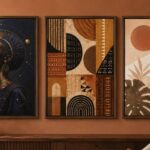
The two-thirds sofa rule: your art — or a grouped arrangement — should cover roughly two-thirds of the sofa width. If your sofa is 72 inches wide, your art grouping should be around 48 inches wide in total. That can be one large piece, a triptych, or a textile paired with a framed print. A three-piece set in 16×20 format (common for printable art) lined up with two inches between frames gives you about 52 inches of width — right in the pocket.
Small art on a big wall is almost always what makes a rental look unfinished. If you cannot drill, the fix is not to shrink the art — it is to mount it differently.
Renter-safe ways to hang correctly-sized art:
- Lean a large framed piece on a low console behind or beside the sofa
- Use a picture ledge with Command strips (~$25 for a set of three, enough for a gallery row)
- Hang lightweight prints with heavy-duty removable strips rated for up to 16 lb (~$12)
- Use a magnetic poster rail for textile or paper art
- Group three same-size frames in a clean row rather than a busy salon wall
Build a renter-friendly layering system
A well-styled Afrohemian room should feel layered, not stuffed. We use this four-layer sequence every time:
Layer 1 — Art on the wall. One meaningful focal point above the sofa.
Layer 2 — Texture at eye level. A pillow, throw, or basket that echoes the art’s palette. A woven seagrass basket (~$35) grounds the space and doubles as throw storage.
Layer 3 — Grounding the room. A rug, stool, or low basket in natural fibers. A jute area rug in warm sand (~$80) makes almost any sofa feel more intentional.
Layer 4 — One living element. A trailing plant, dried pampas branches, or a sculptural lamp — something that moves or glows, so the room does not read as a flat collage.
If you want to introduce pattern without commitment, use textile reversibly. Clip an authentic or inspired-by cloth to a wood hanger and let it read as textile art. Rotate seasonally.
A note on language: if the piece is not actually made in the adire, kente, or mudcloth tradition, do not label it as though it is. Say “adire-inspired” or “indigo batik” instead. Precision is part of respect.
Add cultural depth without turning the room into a theme
The fastest way to flatten Afrocentric design is to treat an entire continent like one pattern library. Depth comes from specificity, not accumulation.
- If a basket is from Senegal, name it.
- If a textile is Ethiopian-inspired, say that.
- If an art print was created by a Black artist, credit the maker.
A good small-room shopping formula:
- One statement art piece or textile (your anchor)
- One handmade storage or basket piece
- One soft good with cultural or material depth
- One book or object that signals point of view
That is enough to shift the room entirely.
Shop smarter with Amazon — supporting pieces under $60
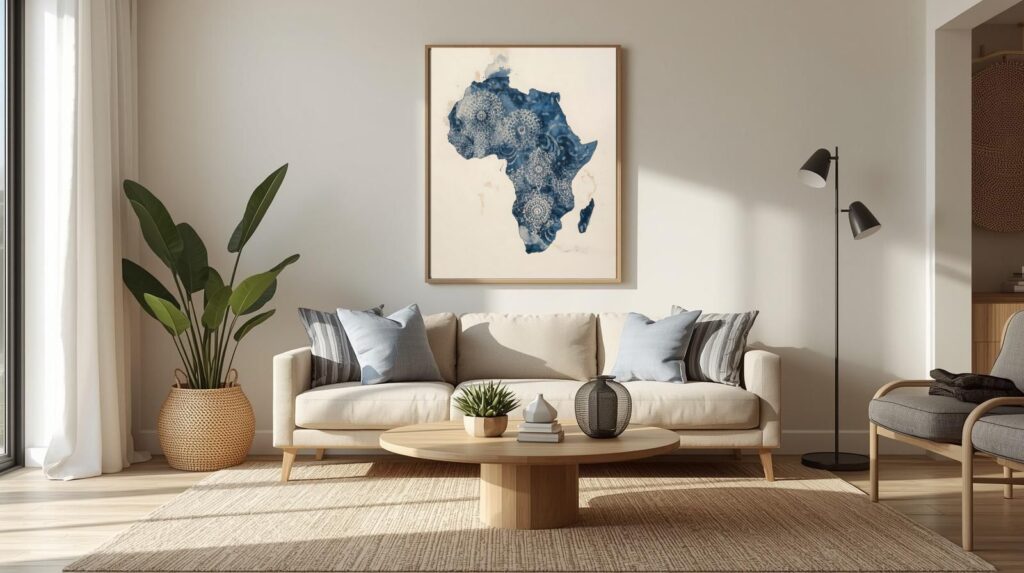
Amazon is not the place we shop for the art anchor. It is the place we shop for the layers that frame it. These four categories consistently deliver for Afrohemian styling without looking mass-produced:
| Piece | What to look for | Approx. price |
|---|---|---|
| Woven storage baskets | Seagrass or water hyacinth, natural weave, tall belly shape | ~$30–40 |
| Mudcloth-inspired throw pillow covers | Cotton, cream on black or indigo, 18×18 | ~$15–20 each |
| Jute or sisal area rug | Natural fiber, warm sand or ochre | ~$70–120 |
| Carved wood decor bowl | Dark mango wood, hand-carved texture | ~$25–35 |
Skip: five tiny “African-inspired” pieces at $10 each. One $60 anchor beats a cluster of vague trend objects every time.
A budget priority list for new renters
If you are starting from a nearly empty room, spend in this order:
- Wall art anchor (~$15–40 printable + $25 frame) — sets identity
- Jute rug (~$80) — grounds the whole room
- Two textured pillows (~$30–40) — adds color and softness
- One woven basket (~$35) — adds material depth and storage
- Small carved object or book stack (~$25) — signals point of view
Total starting investment: roughly $210–250 for a fully realized Afrohemian living room — less than many people spend on a single bad throw pillow decision.
FAQ
What is Afrohemian decor? Afrohemian (also spelled Afro-bohemian) is a warm, layered interior style that blends Afrocentric art, textiles, and cultural references with bohemian layering — natural fibers, mixed patterns, and lived-in texture. The result feels soulful, collected, and personal rather than theme-styled.
How do I make Afrohemian work in a rental without damaging the walls? Use removable Command strips rated for the frame weight, a leaning floor or console arrangement, or a picture ledge mounted with strips. A large art anchor centered above the sofa gives more visual impact than a cluttered gallery wall and requires fewer fixings.
What size wall art do I need above a standard sofa? Aim for art that covers about two-thirds of your sofa width. For a 72-inch sofa, that is around 48 inches of total art width. A triptych in 16×20 frames with two-inch spacing lands at about 52 inches — ideal.
Where can I buy authentic Afrocentric wall art online? For printable wall art in indigo, cream, and charcoal tones, we recommend our own Indigo Archives collection — six editorial sets designed for gallery-scale impact. For broader Black-owned sourcing of textiles and physical pieces, names like AphroChic, 54kibo, and Bolé Road Textiles are established starting points.
Final takeaway
A small rental does not need more stuff. It needs a better hierarchy. Choose one story. Scale your art correctly. Use renter-safe layers. And let cultural expression show up through clarity, not excess.
The room will feel more Afrohemian not because you added more references — but because you made each one matter.
Next read: How to Style Afrocentric Wall Art Without Making a Room Feel Busy (2026 Guide)